
30 Proven Payment Reminder Message Templates to Secure Your Payments
Stop chasing late payments. Unlock 30 expert payment reminder templates. Copy, paste, and get paid faster while improving cash flow.
14 min read

Most unpaid patient balances aren't refusals. The patient set the bill aside, wasn't sure what they actually owed, or assumed insurance had already covered it. That single fact should shape every reminder you send, because the fix for a confused patient is clarity, not pressure.
Knowing how to ask a patient for payment professionally comes down to a system — a few clear messages, sent on a schedule, each one easy to read and easy to act on. Get that system right and a large share of balances get paid before you ever send a firm word.
The habit that quietly costs practices the most is treating each overdue balance as a one-off. Someone at the front desk finds a spare ten minutes, hunts down the account, and improvises a message somewhere between apologetic and annoyed.
It goes out at the wrong moment, in the wrong tone, and often gets ignored. Multiply that across a month of balances and you have staff hours burned and money still uncollected.
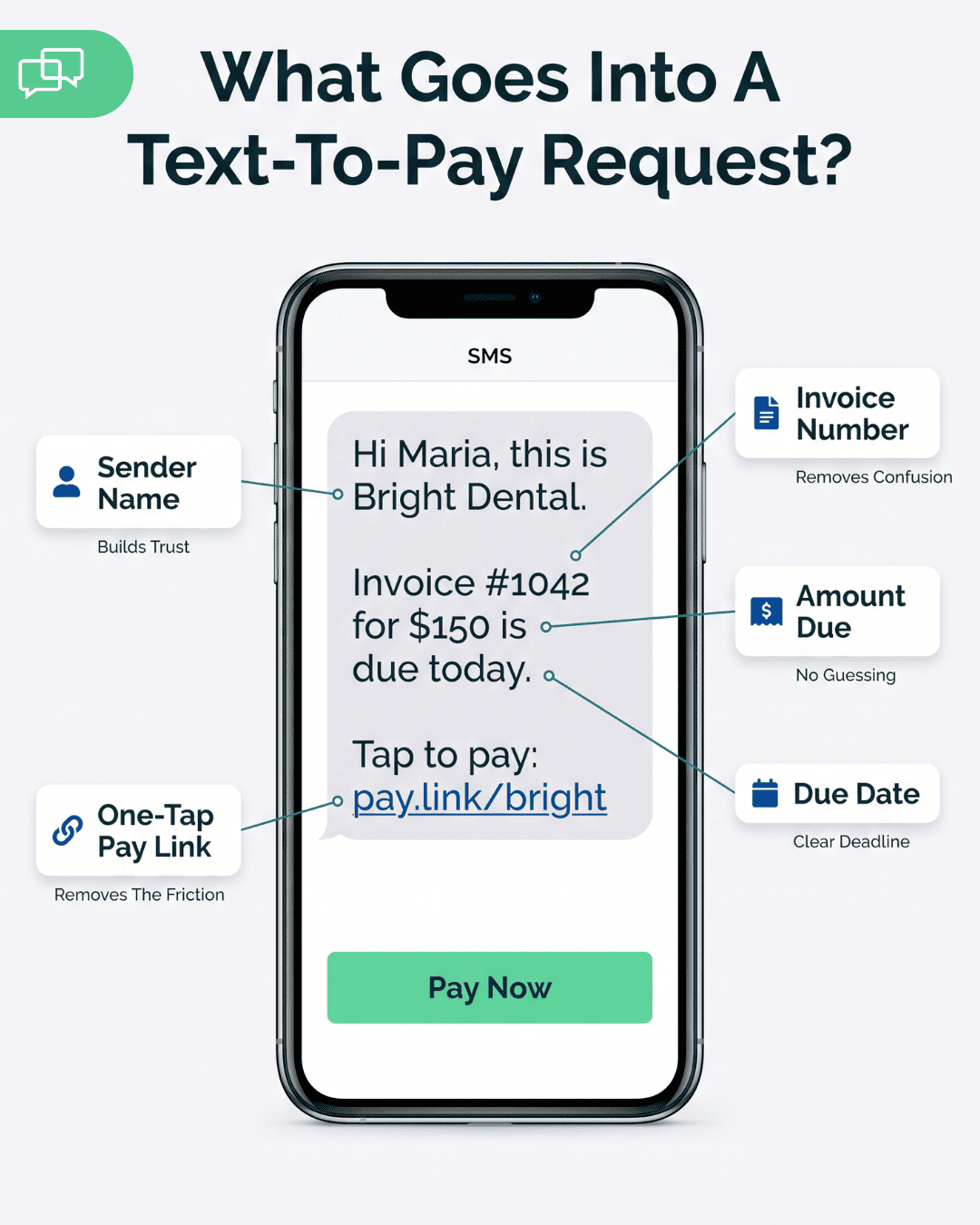
A planned cadence does the opposite. The patient hears what they'll owe at check-in, gets a reminder before the due date, a direct note on the day, and a polite overdue notice a week later — each one clear about the amount, the visit, and how to pay in one tap.
This guide walks through that whole sequence:
The four habits behind every good request
Ready-to-use email and text templates for each stage
HIPAA and TCPA rules that govern patient billing texts
What to do when a patient disputes a charge or can't pay
Every template is written to be copied, dropped into your workflow, and sent without a rewrite.
How you ask for money says as much about your practice as the work you did to earn it. A sloppy or pushy request can undo a good relationship in one message. A clear, respectful one does the opposite, even when the payment is weeks late.
Four things are at stake every time you hit send.
Client trust. People notice how you handle the awkward parts. Handle a late payment with courtesy and you show the patient you're organized and fair, which makes them want to keep working with you.
Your reputation. Every payment message is a sample of how you run things. Clear invoices and polite reminders signal a clinic that's reliable, and reliable businesses get referred.
Speed of payment. A confusing or accusatory message is easy to set aside. One that gives the patient everything they need — amount, due date, a link to pay — turns payment into a 30-second task instead of a to-do they keep pushing.
Steady cash flow. A repeatable reminder process means fewer invoices slip through the cracks. That predictability is what lets you cover your own costs and plan ahead instead of chasing money at month's end.
Email, text, or a portal message — the same four habits separate a request a patient acts on from one that sits unread. Here's each one, with what it looks like at your front desk.
Patients are juggling their own appointments, work, and the confusion of what insurance did or didn't cover.
So the reason for your message should land in the first line. "Checking in on your account" makes them guess;
"Your balance of $45 for your March 3 visit is due Friday" tells them the amount, the visit, and the deadline at once. One is easy to ignore, the other is easy to pay.
Assume the patient forgot or is unsure what they owe — not that they're avoiding you. Medical bills are confusing, and a balance often sits untouched because the patient doesn't understand it, not because they won't pay.
Words like "please," "thank you," and "friendly reminder" keep the message from feeling like a collections notice. You can be clear about the balance and still be kind about it.
Every question your message leaves open is another week the balance waits. A complete request removes the phone tag.
| Include | Why it earns its spot |
|---|---|
| Your practice name | Patient knows who's asking |
| Patient's name | Reads as personal, not a mass text |
| Date of service | They remember which visit |
| Amount due | No guessing after insurance |
| Due date | Sets a clear deadline |
| What the balance is for | Cuts the "I thought insurance paid this" call |
| A direct pay link | The single biggest driver of faster payment |
| Portal or statement copy | Everything in one place |
A set follow-up cadence isn't aggressive — it's just consistent. Most patients need one reminder, not repeated calls.
Deciding in advance when each message goes out (a few days before, on the due date, a week after) means your billing staff never has to improvise a firmer message on a busy afternoon.
The easiest balance to collect is the one that never goes overdue. Most of that work happens before the patient ever leaves the office.
Tell patients what they'll owe as early as you can — at scheduling, at check-in, or right after the visit is coded.
A patient who hears "your copay is $30, and any balance after insurance will be texted to you" isn't surprised by the bill later. Clear financial policy up front prevents the "I didn't know I owed anything" standoff weeks down the line.
A statement is a payment request, so make it plain. Your practice name and contact info, the date of service, what insurance paid, what the patient owes, and the due date up top where it's seen first.
A clean statement gets paid faster than a dense one because the patient never has to decode it.
Every method you don't offer is a reason to put the bill aside. What most practices give patients:
A tapped text link gets paid fastest; a mailed paper statement is slowest by days. Paper statements also collect at roughly 20% and can run $800 to $1,000 a month in printing and postage — both industry-typical estimates, not our internal figures.
A short note two or three days ahead reads as helpful, not pushy. It reaches the patient who genuinely forgot and shows your practice keeps close track of accounts. That single pre-due reminder heads off a real share of overdue balances before they start.
Subject: Reminder: Your balance of $[Amount] is due [Due Date]
Body:
Hi [Patient Name],
A quick reminder that your balance of $[Amount] for your [Date of Service] visit is due in [Number] days, on [Due Date].
You can review the details and pay online here: [Payment Link]
This is the amount left after your insurance was applied. If anything looks off, or you have a question about the charge, just reply and we'll help sort it out.
Pay online anytime: [Payment Link]
Thank you,
[Practice Name]
[Phone Number]
When the due date lands, the message gets more direct while staying warm. You're no longer pointing at a deadline ahead — you're telling the patient it's here today.
This is often the single reminder that collects the most, because it reaches people who meant to pay and needed the prompt.
The change is small but real. The pre-due note said "coming up"; today's says "due now."
Keep the assumption positive — this is a patient who's about to take care of it, not one who's dodging you. On the due date, a text usually outperforms an email, since it's read within minutes and the pay link is one tap away.
Subject: Your balance of $[Amount] is due today
Body:
Hi [Patient Name],
Your balance of $[Amount] for your [Date of Service] visit is due today. This is the amount left after your insurance was applied.
You can pay in a few seconds here: [Payment Link]
If you've already taken care of it, thank you — no need to do anything else. If you have a question about the charge, just reply and we'll help.
Pay now: [Payment Link]
Thank you,
[Practice Name]
[Phone Number]
A due-date text works when it's short and easy to act on. One balance, one link, no clutter.
Hi [Patient Name], this is [Practice Name]. Your balance of $[Amount] for your [Date of Service] visit is due today. Pay here: [Payment Link]. Questions? Just reply. Thank you!
A week past the due date, it's time for the first overdue notice. The tone firms up but stays polite — you're stating plainly that the balance is now late, without treating the patient like they're avoiding you.
Five to seven days after the due date is the right window. It gives the patient a fair grace period in case they missed your earlier message or planned to pay on the date itself.
Send it too soon and it reads as impatient; wait much longer and the balance starts slipping toward hard-to-collect.
Subject: Your balance of $[Amount] is past due
Body:
Hi [Patient Name],
Your balance of $[Amount] for your [Date of Service] visit was due on [Due Date], and we haven't received payment yet. This is the amount left after your insurance was applied.
We know life gets busy and this may have slipped by. You can take care of it in a few seconds here: [Payment Link]
If you've already paid, thank you — just let us know so we can update your account. And if something about the charge doesn't look right, reply and we'll help sort it out.
Pay now: [Payment Link]
Thank you,
[Practice Name]
[Phone Number]
Hi [Patient Name], this is [Practice Name]. Your balance of $[Amount] for your [Date of Service] visit is now past due. You can pay here: [Payment Link]. Already paid or have a question? Just reply. Thank you.
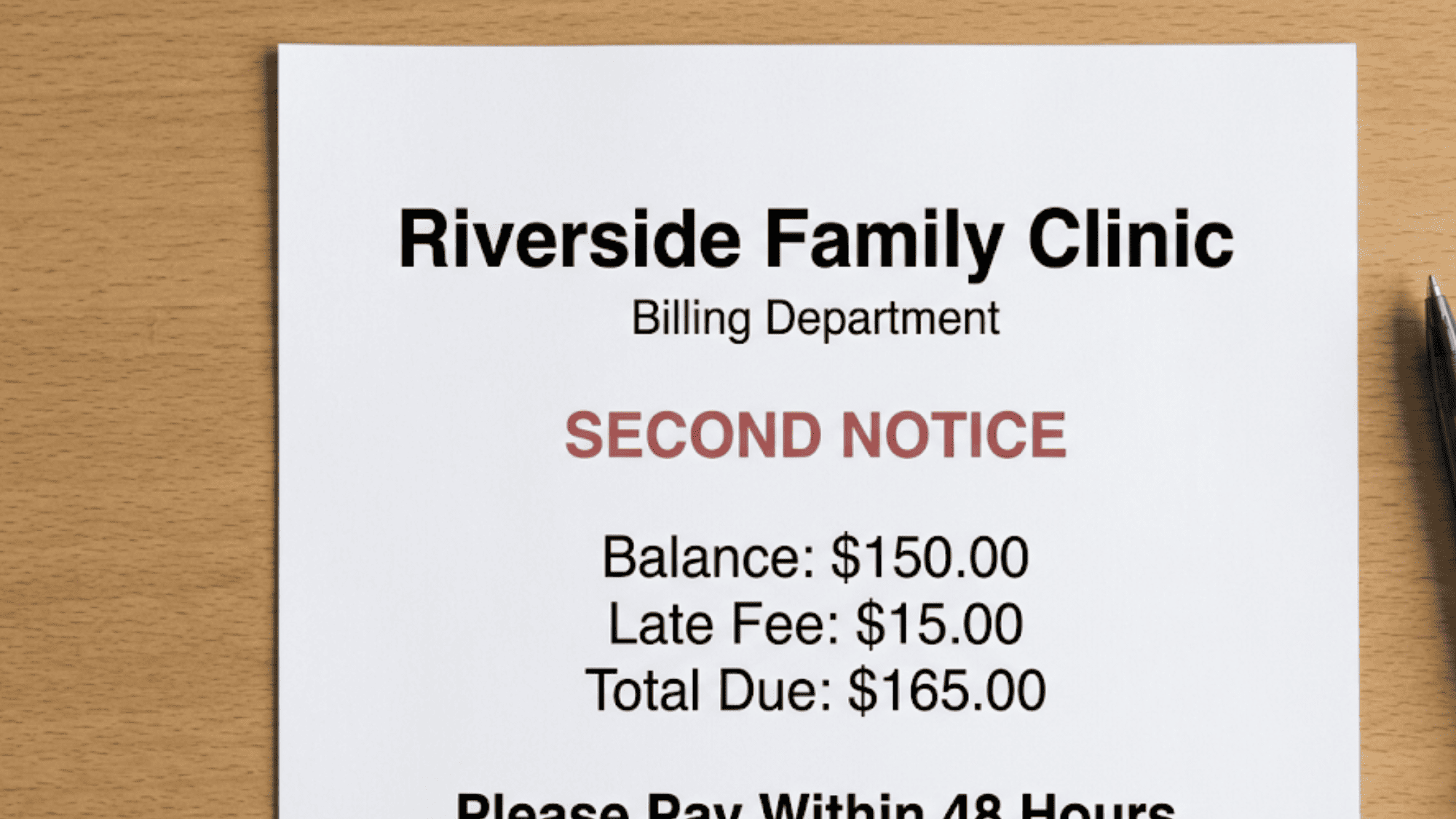
Two to three weeks past due, the message gets more serious while staying respectful. You're now referencing your earlier reminders and, if your practice's policy allows it, noting any late fee. The goal is a clear sense of urgency — not a threat.
At this point you name the earlier attempts so the patient sees this isn't the first notice. If your financial policy includes a late fee and your state and payer contracts permit one, this is where it applies.
Keep an off-ramp open: a patient this far behind may be confused about the charge or unable to pay in full, and a path to a plan collects more than a hard demand does.
Subject: Your balance of $[Amount] is now [Number] days past due
Body:
Hi [Patient Name],
This is our third reminder about your balance of $[Amount] for your [Date of Service] visit, which was due on [Due Date] and is now [Number] days past due. This is the amount left after your insurance was applied.
[If your policy applies one: Per our financial policy, a late fee of $[Late Fee] has been added, bringing your total to $[New Total].]
Please take care of this soon so your account stays in good standing. You can pay in full here: [Payment Link]
If paying the full amount is difficult right now, call us at [Phone Number] — we can set up a payment plan that works for you. And if something about the charge looks wrong, let us know and we'll review it.
Thank you,
[Practice Name]
Texts get read — most within minutes — which is why a payment link in an SMS collects faster than the same link buried in email.
But a patient billing text carries rules an email doesn't. Get the wording and timing right and the channel does a lot of quiet work; get it wrong and you risk a compliance problem, not just an ignored message.
| Do | Don't |
|---|---|
| Name your practice in the first line | Use slang, emojis, or a casual tone |
| Reference the visit by date of service only | Ever name the condition, provider, or reason for the visit |
| Include the balance and a tap-to-pay link | Send outside daytime hours (roughly 8am–8pm local) |
| Give a way to reply with questions | Text a patient who hasn't consented to messages |
| Keep it to one balance, one link | Send more than a couple of texts per balance |
Two rules are worth singling out:
Consent - Under the TCPA, you need the patient's agreement to text them before you send the first message — usually captured at intake.
Privacy - Keep every word HIPAA-safe by referencing the date of service, never the clinical reason.
Each of these maps to a moment covered earlier. Here they are side by side so your billing staff can copy the right one at a glance.
Pre-due (2–3 days before):
Hi [Patient Name], this is [Practice Name]. Your balance of $[Amount] for your [Date of Service] visit is due [Due Date]. Pay here: [Payment Link]. Questions? Just reply.
Due date:
Hi [Patient Name], this is [Practice Name]. Your balance of $[Amount] for your [Date of Service] visit is due today. Pay here: [Payment Link]. Already paid? Ignore this — thank you!
One week overdue:
Hi [Patient Name], this is [Practice Name]. Your balance of $[Amount] for your [Date of Service] visit is now past due. Pay here: [Payment Link]. Questions or already paid? Just reply.
Two to three weeks overdue:
Hi [Patient Name], this is [Practice Name]. Your balance of $[Amount] for your [Date of Service] visit is [Number] days past due. Please pay here: [Payment Link], or reply to set up a payment plan.
A little insight into how patients think makes your reminders land better. This isn't about pressure — it's about writing the message so paying feels easy and obvious.
Most unpaid balances aren't refusals. The patient set the bill aside, wasn't sure what they owed, or assumed insurance had it covered..
Write every reminder as if that's the case, because it usually is. A message that assumes good faith keeps the patient from feeling cornered, and a patient who doesn't feel cornered pays sooner.
Speed of payment tracks almost exactly with how little effort it takes. A tap-to-pay link that opens a pre-filled amount is the fastest path there is.
Every extra step — log into a portal, find an account number, dig up a statement — is another reason to close the message and deal with it later. Most patients never come back to "later."
| Path to pay | Effort for the patient | How fast it's paid |
|---|---|---|
| Tap-to-pay text link, amount pre-filled | One tap | Often within minutes |
| Emailed link to a login portal | Find password, sign in | Days |
| Mailed paper statement | Write a check, mail it | A week or more |
The single biggest thing stalling a patient balance is confusion about why they owe it. "I thought insurance covered this" keeps a bill sitting untouched for weeks.
One line — "this is the amount left after your insurance was applied" — answers that before it becomes a phone call, and a patient who understands the charge is far more likely to pay it.
Not every reply is a payment. Some are questions, some are pushback, and how your staff answers decides whether the balance gets paid or turns into a standoff. Three come up again and again.
Treat it as true, whether or not it is. Arguing about what you sent wastes the goodwill you need to collect. Resend it on the spot and make the next step effortless:
No problem at all — I've just resent your statement by text and email, with a link to pay right from it. Let me know if it doesn't come through.
Sending it by both text and email at once means the patient can't miss it a second time, and the tap-to-pay link removes the excuse before it forms again.
Some patients genuinely can't cover the balance at once — a large deductible, a rough month, a surprise bill. A payment plan collects far more than a demand does, and it keeps the patient coming back for care. Offer a clear, written split:
I understand money's tight right now. We can break your $[Amount] balance into three payments of $[Amount] on [Date], [Date], and [Date]. Would that help?
Put the dates and amounts in writing so both sides know the terms. A patient on a plan is a patient who's paying, which beats a balance sitting untouched for months.
The most common pushback on a medical bill is "I thought insurance covered this" or "this amount looks wrong." Don't defend the number — check it. Separate the question from the payment so the patient feels heard:
Happy to look into that. Let me review how your insurance was applied and confirm the balance is right. I'll follow up by [day], and we'll sort out anything that needs fixing.
If the charge is correct, you've explained it and can collect. If an adjustment is needed, you've caught it before it became a complaint or a bad review — which protects the reputation your practice depends on.
If 30 to 60 days of polite reminders bring silence, you have a few paths left. Each carries more cost and more risk to the patient relationship than the last, so weigh them against the size of the balance before acting.
Before handing a balance to anyone else, send one clear final notice — by mail, and by text or email too. It states the full amount, a firm last deadline, and what happens next if it isn't paid.
Keep the tone factual, not threatening. For many patients, a plainly worded "this is the last step before your account moves to collections" prompts the payment that months of softer reminders didn't.
A collections agency takes a cut of what it recovers, and it almost always ends the patient relationship. It can work for a patient who's gone completely silent, but medical debt has its own rules.
Any agency you use must follow the Fair Debt Collection Practices Act, and recent federal changes limit how and when unpaid medical bills can appear on a patient's credit report. Confirm your agency is compliant before you hand over a single account.
For a larger balance, small claims court is built to be used without a lawyer. It's rarely worth it for a routine copay, and suing patients can draw complaints and bad reviews that cost more than the balance recovers.
Weigh the amount against the fallout first. The U.S. Small Business Administration and your state courts publish plain guides on how the process works and the limits that apply.
Collecting a patient balance rarely comes down to one perfect message. It comes down to a system — a few reminders, sent on a schedule, each one clear about the amount and easy to act on.
Most of the work is prevention. Tell patients what they'll owe at check-in, send statements they can read, and give them a link they can tap. Do that, and a large share of balances get paid before a single reminder goes out.
When a balance does slip, the pattern holds at every stage. Assume the patient forgot. Say what's owed and for which visit. Answer the insurance question before they ask it. And keep one line open — a reply, a question, a payment plan — so a stuck balance has somewhere to go besides collections.
The tone matters as much as the timing. A patient who feels cornered digs in; a patient who feels respected pays and comes back. Firm and kind aren't at odds — the reminders that collect best manage both at once.
Pick the templates that fit your practice, set the cadence, and let the schedule do the chasing so your front desk doesn't have to.
Send one HIPAA-safe text and get paid — no portal login, no mailed check. Schedule your Curogram demo today and see it work with your patient list.
Stop chasing late payments. Unlock 30 expert payment reminder templates. Copy, paste, and get paid faster while improving cash flow.

See how SMS mobile payments work in a medical practice, what a payment provider charges, and which consent rules apply before your first text goes...
What is text-to-pay? The four-step flow, how tokenization keeps card data off your own network, what that does to your PCI scope, and the consent...