
1 min read
How SMS Mobile Payments Work: A Guide to Accepting Payments by Text
💡 SMS mobile payments let a practice collect a patient balance through a text message. The practice sends a secure link tied to one balance. The...
15 min read
Your practice sees the patients. Your team files the claims. The insurance side pays out. And then a balance sits there for 60 days, then 90, and nobody is quite sure who is supposed to chase it.
It sounds simple. It isn't.
Patient balances have grown into a real problem for medical practices. High-deductible insurance plans transfer more financial responsibility onto the patient, and individuals typically pay slower than insurers. The money is owed. It just never shows up.
Think about what that actually costs you. A practice carrying $40,000 in unpaid patient balances is not short $40,000 on paper. It is short that money in the bank, which is the only place it counts. Meanwhile your front desk spends its afternoons leaving voicemails that nobody returns.
The fix is not a louder phone call. It is a better message, sent at the right moment, with a link that lets the patient pay in under a minute. That is what a payment reminder message does when you build it properly.
This guide gives you 30 templates you can use today. It also walks you through the timing, the wording, and the structure that turn a reminder into a payment. By the end, you will have a system your staff can run without thinking about it.
Before we dive into the templates, it’s crucial to understand why a systematic approach to payment reminders is essential.
It's about more than just getting the money you're owed;
It's about establishing professional standards and maintaining financial health.
Every day a balance sits unpaid, your odds of collecting it drop. Collection rates decline substantially after 90 days, which means the balance you disregard in March frequently becomes the balance you eliminate in June. Speed matters more than pressure.
That decay is the whole reason timing matters more than tone.
There is a staffing cost too. If a biller spends 6 hours a week on collection calls, that is roughly 300 hours a year spent on work a text message could do.
300 hours a year. |
| That is nearly two full months of one employee's time, spent leaving voicemails that mostly go unreturned. |
In practice, that time is not just lost—it could instead be spent helping reduce no-shows, scheduling patients, and managing prior authorizations. It is time pulled away from scheduling, prior authorizations, and the patients standing at your front desk right now.
A patient who gets a clear, friendly nudge feels informed. A patient who receives an unexpected collections notification feels ambushed. The difference is not the balance. It is the communication that came before it.
Which raises the obvious question: What should that communication actually say?
Not all reminders are created equal. A vague or demanding message can be ignored or, worse, damage your client relationship. A truly effective payment reminder message—whether it’s an email or a text—is clear, concise, and contains all the necessary information for the client to act immediately.
Here are the essential elements every reminder should include:
Notice what is missing from that list. There is no explanation of the claim, no insurance breakdown, no policy language. Additional information is decoration, and decoration is where attention goes to die.
The last element matters more than it looks. A patient who calls with a question is a patient who is about to pay, and a message that shuts down conversation shuts down that call too.
Get the elements right and you still have one variable left: when the message lands.
The timing of your reminders is as important as the content. Sending a message too early can be annoying, while sending it too late can result in significant delays. The key is to create automated payment reminders or a semi-automated schedule that escalates in urgency over time.
Here is a proven timeline for sending your payment reminder message sequence:
Stage 1 — One week before the due date.
The first appointment reminder is a heads-up, not a demand. It reaches patients who budget in advance and identifies complications early, such as an incorrect address or a claim that processed incorrectly.
Stage 2 — On the due date.
The second is a simple due-date nudge. It treats the date as real, which trains patients to treat it that way too.
Stage 3 — 3 to 5 days overdue.
By the third message, you are naming the delay out loud. Keep it kind. Most people at this stage are not avoiding you. They are just busy.
Stage 4 — 7 to 14 days overdue.
The fourth message gets firmer and asks a direct question: is something wrong. This is where payment arrangements get offered and legitimate financial hardship surfaces.
Stage 5 — 30+ days overdue.
The fifth is the last stop before anything escalates. Be formal, be clear about what happens next, and give them one final easy way to pay.
Here is a look at how those five stages line up.
| Stage | Timing | Tone | Primary Goal |
|---|---|---|---|
| 1 | 7 days before due | Helpful, light | Prevent the delay |
| 2 | Due date | Direct, professional | Prompt on-time payment |
| 3 | 3–5 days late | Concerned, kind | Recover the oversight |
| 4 | 7–14 days late | Firm, still warm | Surface the real problem |
| 5 | 30+ days late | Formal, clear | Final resolution |
You do not need to send all five to everyone. Most balances clear in the first two or three. The subsequent stages exist for the small share that do not.
Here is a comprehensive list of templates you can adapt and use for your business. We have categorized them by timing and channel (Email and SMS) to make them easy to navigate.
Email gives you room to explain. Use it when the balance is larger, when the patient is older, or when the bill needs context. Attach the statement every time.
Template 1: The One-Week Heads-Up
Subject: Friendly Reminder: Invoice [Invoice Number] is due in 7 days.
Hi [Client Name],
Just a friendly reminder that invoice [Invoice Number] for [Amount] is due for payment next week, on [Due Date].
You can view the invoice and pay online here: [Payment Link]
We appreciate your business!
Best regards,
[Your Name] [Your Company]
Template 2: The Three-Day Proactive Reminder
Subject: Heads Up: Invoice [Invoice Number] from [Your Company Name] is due soon.
Hello [Client Name],
This is just a quick note to remind you that payment for invoice [Invoice Number] for the amount of [Amount] is due on [Due Date].
We've attached the invoice for your convenience. To make a payment, please use the following link: [Payment Link]
If you've already scheduled this payment, please disregard this message. Thank you!
Sincerely,
[Your Name]
Subject: Invoice [Invoice Number] from [Your Company Name] is due today.
Hi [Client Name],
This is a reminder that invoice [Invoice Number] for [Amount] is due for payment today, [Due Date].
The invoice is attached for your reference. You can make a payment easily via our online portal: [Payment Link]
Thank you for your prompt payment. We value your partnership.
Regards,
[Your Name]
Template 4: The Simple & Direct Due Date Message
Subject: Payment for Invoice [Invoice Number] is due today.
Hello [Client Name],
Following up on invoice [Invoice Number] for [Amount], which is due today. Please let us know if you have any questions.
You can settle the payment here: [Payment Link]
Thank you,
[Your Name] [Your Company]
Template 5: The Gentle "Past Due" Nudge (1-3 Days Overdue)
Subject: Friendly Follow-Up: Invoice [Invoice Number] is slightly overdue.
Hi [Client Name],
Hope you're having a great week.
Our records show that we haven't yet received payment for invoice [Invoice Number] for [Amount], which was due on [Due Date]. We've attached a copy for your convenience.
We understand things get busy, so if you've already sent the payment, please disregard this. If not, you can pay online here: [Payment Link]
Please let us know if you have any questions.
Best,
[Your Name]
Template 6: The "Just Checking In" Reminder (5 Days Overdue)
Subject: Checking In on Invoice [Invoice Number]
Hello [Client Name],
I'm writing to follow up on invoice [Invoice Number] for [Amount]. It is now 5 days past its due date.
Could you please let me know when we can expect to receive payment? If you're having any issues or have questions about the invoice, please don't hesitate to reach out.
The invoice is attached, and payment can be made here: [Payment Link]
Thank you,
[Your Name]
Template 7: The Firm but Polite Reminder (7 Days Overdue)
Subject: Action Required: Invoice [Invoice Number] is 7 days past due.
Hi [Client Name],
According to our records, your payment for invoice [Invoice Number] is now one week overdue. The amount of [Amount] was due on [Due Date].
Prompt payment would be greatly appreciated. You can access the invoice and pay securely through our portal: [Payment Link]
If payment has already been sent, please let us know. If there is an issue preventing payment, please contact us immediately so we can work together to find a solution.
Sincerely,
[Your Name]
Template 8: The Second Overdue Notice (14 Days Overdue)
Subject: URGENT: Invoice [Invoice Number] is 2 weeks overdue.
Hello [Client Name],
This is our second reminder regarding invoice [Invoice Number] for [Amount], which was due on [Due Date]. Your payment is now 14 days late.
We need to resolve this matter as soon as possible to ensure your account remains in good standing. Please process this payment immediately via this link: [Payment Link]
If you are facing difficulties, you must contact us within the next 48 hours to discuss the situation.
Regards, [Your Name] [Finance Department]
Template 9: The Pre-Suspension Warning (21 Days Overdue)
Subject: FINAL REMINDER: Invoice [Invoice Number] - Account at Risk of Suspension
Dear [Client Name],
Despite our previous reminders, invoice [Invoice Number] for [Amount] remains unpaid. It is now 21 days overdue.
Please be advised that if payment is not received within the next 5 business days, we will be forced to suspend your account and access to our services, as per our terms and conditions.
To avoid this, please remit payment immediately here: [Payment Link]
We urge you to treat this matter with the highest priority.
Sincerely, [Your Name]
Template 10: The Final Notice (30 Days Overdue)
Subject: FINAL NOTICE OF OVERDUE PAYMENT: Invoice [Invoice Number]
Dear [Client Name],
This is the final notice regarding invoice [Invoice Number] for [Amount], which is now 30 days past due.
Your failure to settle this outstanding balance has left your account in serious delinquency. We have attached the invoice and a summary of your account statement.
If the full payment of [Amount] is not received within the next 7 days, we will have no alternative but to [mention consequence, e.g., apply late fees of X%, forward your account to a collections agency].
To avoid further action, please settle your balance immediately: [Payment Link]
This is our last attempt to resolve this matter amicably.
Regards,
[Accounts Department] [Your Company]
Template 11: The "Payment Plan" Offer
Subject: Let's Talk About Your Overdue Invoice [Invoice Number]
Hi [Client Name],
I'm reaching out about invoice [Invoice Number] which is now overdue.
We understand that circumstances can sometimes make timely payments difficult. If you're experiencing issues, we are open to discussing a potential payment plan to help you get back on track.
Please reply to this email so we can find a solution that works for both of us.
Best,
[Your Name]
Template 12: After a Partial Payment
Subject: Thank You & Reminder for Invoice [Invoice Number] Balance
Hi [Client Name],
Thank you for your recent payment of [Partial Amount] towards invoice [Invoice Number].
This email is to confirm that we have received it and to remind you that a remaining balance of [Remaining Amount] is still due.
Please let us know when we can expect the final payment.
Thanks again,
[Your Name]
A payment reminder text message is perfect for quick, less formal reminders. They have high open rates and are ideal for reaching mobile-first patients. Keep messages short, clear, and include a direct payment link to make it easy for patients to take action.
For healthcare practices, payment reminders sent by text or email should also comply with HIPAA Privacy Rule requirements. Avoid including unnecessary protected health information (PHI) and share only the information needed to help patients identify and pay their balance.
Template 1:
[Your Company]: Hi [Client Name], a friendly reminder that invoice [Inv #] for [Amount] is due on [Due Date]. Pay here: [Short Link]
Template 2:
Hi [Client Name]! Just a heads-up from [Your Company] that your payment for invoice [Inv #] is due in 3 days. Thanks!
Template 3:
[Your Company]: Hi [Client Name], your payment of [Amount] for invoice [Inv #] is due today. Pay securely here: [Short Link]
Template 4:
Hello from [Your Company]. This is a reminder that invoice [Inv #] is due for payment today. Thank you for your business!
Template 5: The Gentle Reminder for Payment Message (1-3 Days Overdue):
[Your Company]: Hi [Client Name], our records show invoice [Inv #] is past due. It may have been an oversight. Please pay here: [Short Link]
Template 6: (5 Days Overdue):
Hi [Client Name], this is a follow-up from [Your Company] regarding your overdue invoice [Inv #] for [Amount]. Please let us know if you have questions. Pay now: [Short Link]
Template 7: (7 Days Overdue):
[Your Company]: Your payment for invoice [Inv #] is now 7 days late. Please process the payment of [Amount] today to avoid late fees. [Short Link]
Template 8: (14 Days Overdue):
URGENT: Your [Your Company] account is overdue by 14 days (Inv #). Immediate payment of [Amount] is required. Pay here: [Short Link]
Template 9: (21 Days Overdue):
FINAL REMINDER from [Your Company]. Invoice [Inv #] is 21 days past due. Service may be interrupted if payment is not made within 48 hours. [Short Link]
Template 10: (30 Days Overdue):
FINAL NOTICE: Your [Your Company] invoice [Inv #] is 30 days overdue. Your account will be sent to collections if not paid within 3 days. Contact us immediately.
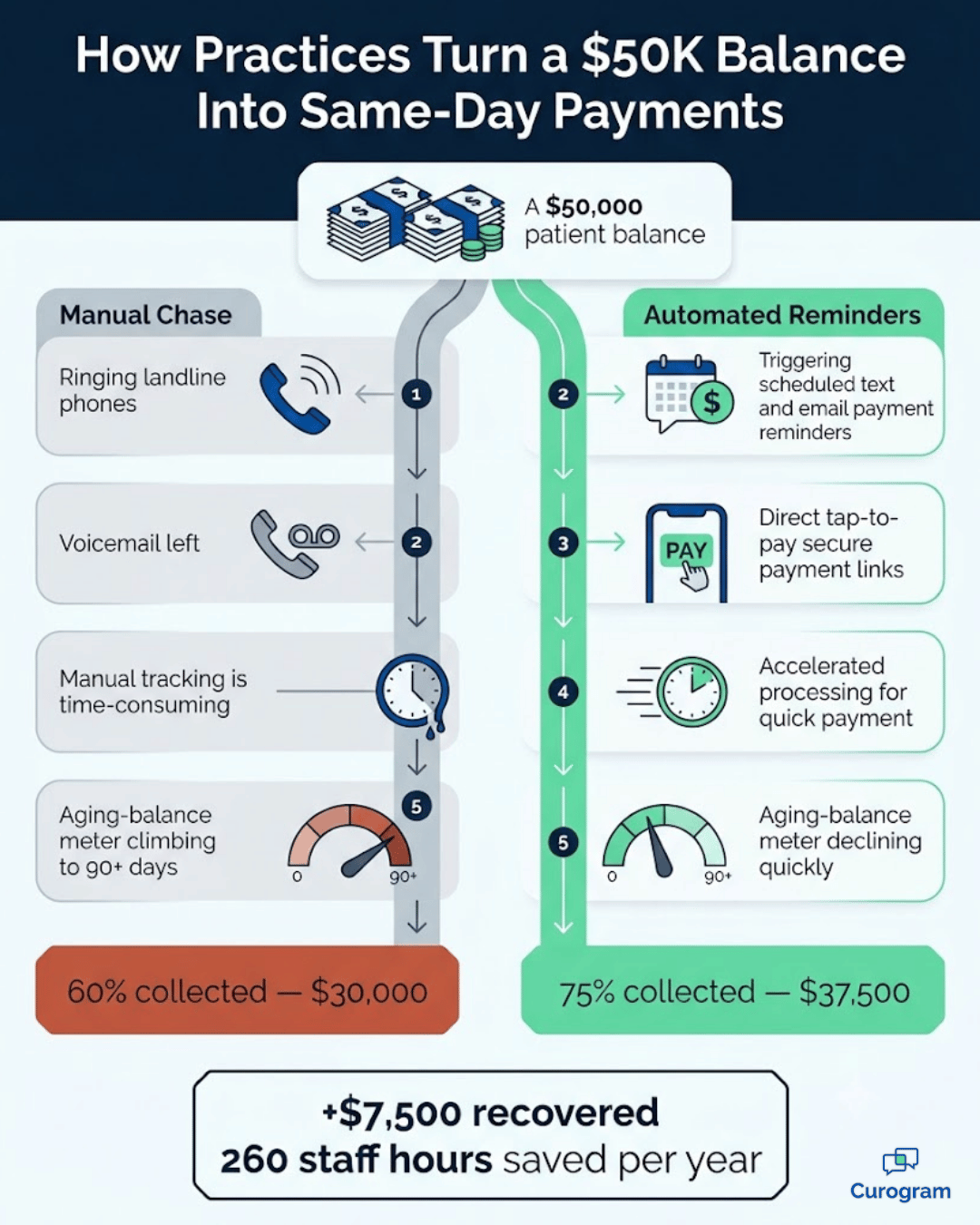
Sometimes a standard template feels too cold. These templates are designed to maintain a strong, positive relationship.
Template 1: The "How's Everything?" Approach (Email)
Subject: Checking In + A Quick Question
Hi [Client Name],
Hope you're doing well and that you were happy with the recent [Service/Product] we provided.
I'm just finalizing my accounts for the month and saw that invoice [Invoice Number] hasn't been settled yet. Would you mind looking into it when you have a moment? I've attached it for your convenience.
Let me know if you have any feedback on our work!
Best,
[Your Name]
Template 2: The "Did You Get It?" Inquiry (Email)
Subject: Quick Question about Invoice [Invoice Number]
Hi [Client Name],
Just wanted to quickly check if you received invoice [Invoice Number] that we sent over on [Date Sent]. It was due last week, and I want to make sure it didn't get lost in your spam folder.
Let me know! You can also view and pay it here: [Payment Link]
Thanks,
[Your Name]
Template 3: The Value-Add Reminder (Email)
Subject: Hope You're Enjoying [Product] + Reminder for Invoice [Invoice Number]
Hello [Client Name],
We hope you're getting great value from [Product/Service]. Here’s a helpful resource we thought you might enjoy: [Link to a helpful blog article about a related topic].
Also, a quick reminder that invoice [Invoice Number] for [Amount] is now a few days overdue. You can settle it easily at this link: [Payment Link]
Let us know if you need anything at all.
All the best, [Your Name]
Template 4: The Humorous SMS:
Hi [Client Name]! Your invoice [Inv #] is starting to feel a little lonely. Please give it some attention! Pay here: [Short Link]. Thanks from the [Your Company] team!
These are for when the polite approach hasn't worked.
Template 1: Statement of Account (Email)
Subject: Overdue: Statement of Account from [Your Company]
Dear [Client Name],
Attached you will find your current statement of account.
Your balance of [Total Amount] is now significantly overdue. This includes the following outstanding invoices:
Please remit full payment immediately to bring your account current.
Pay Online: [Payment Link]
Regards,
[Finance Department]
Template 2: Notice of Intent (Email)
Subject: Formal Notice of Intent Regarding Overdue Account: [Account Number]
Dear [Client Name],
This letter is a formal notice that your account is in serious breach of our payment terms. The amount of [Amount] on invoice [Invoice Number] remains unpaid despite numerous reminders.
If we do not receive payment in full within ten (10) business days from the date of this email, we will escalate this matter to a third-party collections agency. This action may impact your credit rating. For more information on business credit, you can consult resources like the Small Business Administration.
This is your final opportunity to resolve this debt directly with us.
Pay here to stop further action: [Payment Link]
Sincerely,
[Your Name/Legal Department]
Template 3: The "Call Us Now" SMS:
URGENT: Your account with [Your Company] is severely delinquent. To avoid collections, you must call us at [Phone Number] within 24 hours to arrange payment for invoice [Inv #].
Template 4: The Service Suspension Confirmed (Email)
Subject: Notice of Service Suspension for Account [Account Number]
Dear [Client Name],
This email is to inform you that, due to non-payment of invoice [Invoice Number] for [Amount], your account and all associated services have been suspended, effective immediately.
To reinstate your service, you must pay the full outstanding balance, including any applicable late fees.
Pay here to restore your account: [Payment Link]
Once payment is received, your service will be reactivated within 24 hours.
Regards,
[Billing Department]
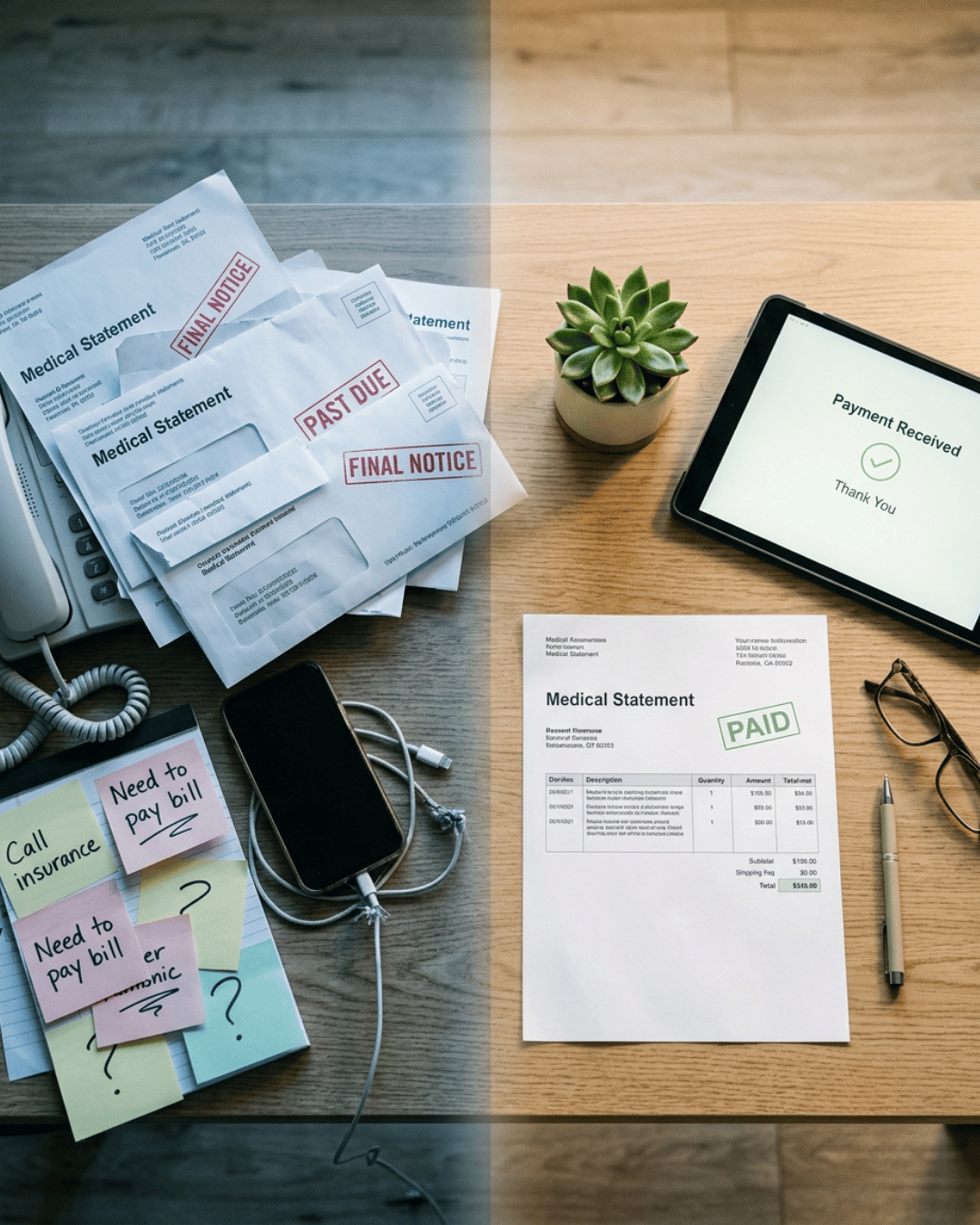
A template is only half the work. The system around it does the rest.
Manual reminders fail because employees become occupied. Automation never becomes occupied.
A busy Tuesday buries the follow-up list. A staff departure takes the reminder habit with it. The balances do not disappear during those weeks — they simply age, quietly, into the column you eventually write off.
Setting this up is a one-afternoon project, not a quarter-long rollout:
Once it runs, your team stops managing a list and starts managing conversations. That is a meaningfully different job, and a much shorter one.
Then measure what happens. Track how many balances clear after each message. If most of your money arrives after message two, you may not need message five at all.
The numbers usually make the case better than any pitch can.
Here is a simple way to see the payoff.
Say your practice carries $50,000 in patient balances at any given time and collects 60% of it. Lifting that to 75% through consistent reminders adds $7,500 back to your cash flow, without seeing a single extra patient.
Now add the staff time. Cutting collection calls from 6 hours a week to 1 gives you back 260 hours a year. That is time your team can dedicate to scheduling, prior authorizations, or simply departing on schedule.
None of this requires a bigger billing department. It requires a message that goes out on schedule and a link that makes paying easy.
Late payments are rarely about unwillingness. They typically involve friction. Every step between a patient and their balance is a chance for that balance to age another 30 days.
You now have the pieces to remove that friction. Thirty templates. A five-stage schedule. A clear structure for every message you send.
Start small. Pick three templates, set the timing, and watch what happens over the next 60 days. Most practices are surprised at how much of their aging balance was never a collections problem at all. It was a reminder problem.
The practices that get paid fastest are not the ones that push hardest. They are the ones that make paying effortless, then get out of the way.
Curogram brings that system into one place. Two-way texting, automated reminders, and text-to-pay links operate together so patients can resolve a balance from their mobile phone in seconds. Your staff stops chasing. Your cash flow stops waiting.
If you are ready to see what that looks like inside your practice, book a demo of Curogram and walk through it with our team.

1 min read
💡 SMS mobile payments let a practice collect a patient balance through a text message. The practice sends a secure link tied to one balance. The...

1 min read
💡 To ask a patient for payment professionally, lead with the specifics they need to act: the balance amount, the date of service, the due date,...
1 min read
 Aubreigh Lee Daculug : 1/18/26, 4:00 PM
💡 Patient portals promised to revolutionize healthcare communication and billing, but most clinics see adoption rates below 25%. Too many login...