Skip to the main content.

20 min read

Best Appointment Reminder Template Examples

Best Appointment Reminder Template Examples
💡An appointment reminder template is a reusable message you send before a booked visit. It carries six things: the client's name, your business name, the date, the time, the place, and one clear next step. Good templates work across text, email, and voice, though text tends to lead because open rates run high and replies come back fast.

The strongest appointment reminder message examples all ask for some small action, usually a reply of YES to confirm, and that tiny act is what actually locks in the visit. A full set covers the whole arc of a booking, from the first confirmation through to a follow-up appointment example that brings a lapsed client back. Based on our internal data, practices using automated reminders confirm over 75% of bookings and push no-show rates well below the industry norm.

A missed booking is never just a gap on a screen. It is paid staff time with nobody in the chair, overhead still ticking away, and a client on your waitlist who never got the call.

The fix is boring, cheap, and almost unfairly effective: send a good reminder. That is the whole thing. A short, timely, well-built message will do more to protect your day than almost any other tool you own.

This guide is meant to be a working library rather than an essay. Inside, you will find more than 55 appointment reminder message examples you can lift, edit, and send today, spanning text, email, and voice.

They cover the plain confirmation, the prep note, and the same-day nudge. They also cover the we missed you message, and the follow-up appointment example that quietly pulls a lapsed client back into your book.

But a pile of scripts is only half the job. Wording matters, timing matters, and the single verb you choose for your call to action can swing your confirmation rate more than you would expect.

So we will also unpack the why behind the templates. Why does asking someone to reply YES beat a passive note? Why does a map link earn its space in a 160 character message?

You will also find industry-specific builds, because a dental office and a plumbing crew both need reminders, but not the same reminder. One needs privacy and prep. The other needs an arrival window and proof of who is knocking.

Finally, we will show you how to test rather than guess. A simple split test reveals what your clients actually respond to, and that beats any best practice list, this one included.

Read it straight through, or jump to whichever section you need. Either way, you should leave with a system rather than a script.

Why Your Business Absolutely Needs an Appointment Reminder System

Before we get to the template library, it is worth settling the why. A reminder system is not a perk you bolt on once things get busy. It is the thing that stops the busy from quietly leaking out of your schedule.

Think of it as a small courtesy with an outsized payoff. It tells the client you value their time, and it quietly reinforces the promise they already made to show up.

The Real Cost of No-Shows

A no-show is not a scheduling hiccup. It is a block of time you have already paid for that gives you nothing back. Salaries keep running, overhead keeps running, and the slot simply dies.

Healthcare feels this hardest of all. Missed visits cost the US health system billions every year, and some clinics watch nearly a fifth of their book evaporate before anyone walks through the door.

Money Out the Door

Every empty slot is revenue you cannot bill and cannot get back. It is simply gone.

And the math compounds faster than most owners expect. Ten missed visits a week is not ten small losses. It is a standing hole in your yearly number, one you have to keep filling from somewhere else.

Based on our internal data, one clinic rolled out automated reminders and cut its no-show rate from 14.20% down to 4.91% in just three months. That lands roughly 3X better than the industry norm.

Across our client base, no-show rates run about 53% lower than the industry average. Practices report a 10% to 20% lift in revenue as recovered slots turn back into billable visits.

The Ripple Beyond Revenue

The damage does not stop at the invoice. A hole in the middle of the day breaks the rhythm of it, and rhythm is most of what makes a busy schedule survivable.

Staff are idle for twenty minutes, then scramble to catch up. The waitlisted client who wanted that exact slot never hears from you. Planning out next month turns into guesswork.

Over time, this warps how you staff. You either overstaff and burn wages, or you understaff and burn goodwill, and neither one is a trade you want to keep making.

Reminders Build Trust, Not Just Attendance

Money is the loud reason to send reminders. Trust is the quiet one, and it tends to outlast the money argument by years.

A well-timed note reads as care rather than admin. It hands the client every detail in one place and asks almost nothing hard of them in return.

Lowering Client Anxiety

New clients spend a surprising amount of energy guessing. They guess about parking, about paperwork, about what they are supposed to bring with them.

A good reminder answers all of it before they have to ask, which turns a small nagging worry into a non-event.

It also opens a door. If they genuinely need to move the visit, they can tell you so, rather than simply going quiet and not turning up.

Freeing Your Front Desk

Calling every client by hand is a relic of a slower era. It is tedious, it is error prone, and it quietly eats your best people alive.

Automation takes the whole task off their plate. Based on our internal data, one clinic now confirms more than 1,100 visits a month without a single manual call.

Your team stops dialing and starts helping the person actually standing in front of them, which is the only trade here worth making.

The Core Components of an Effective Appointment Reminder Template

A reminder either does its job or it gets swiped away, and the difference usually comes down to something you left out rather than something you got wrong.

Every message, on every channel, should carry the same load-bearing parts. Drop one of them, and you create friction, doubt, or a phone call to your front desk that nobody wanted to make.

The Non-Negotiable Details

Start with the facts, and put them where nobody has to hunt. If a client has to scroll or squint to find a single detail, you have already lost a slice of them.

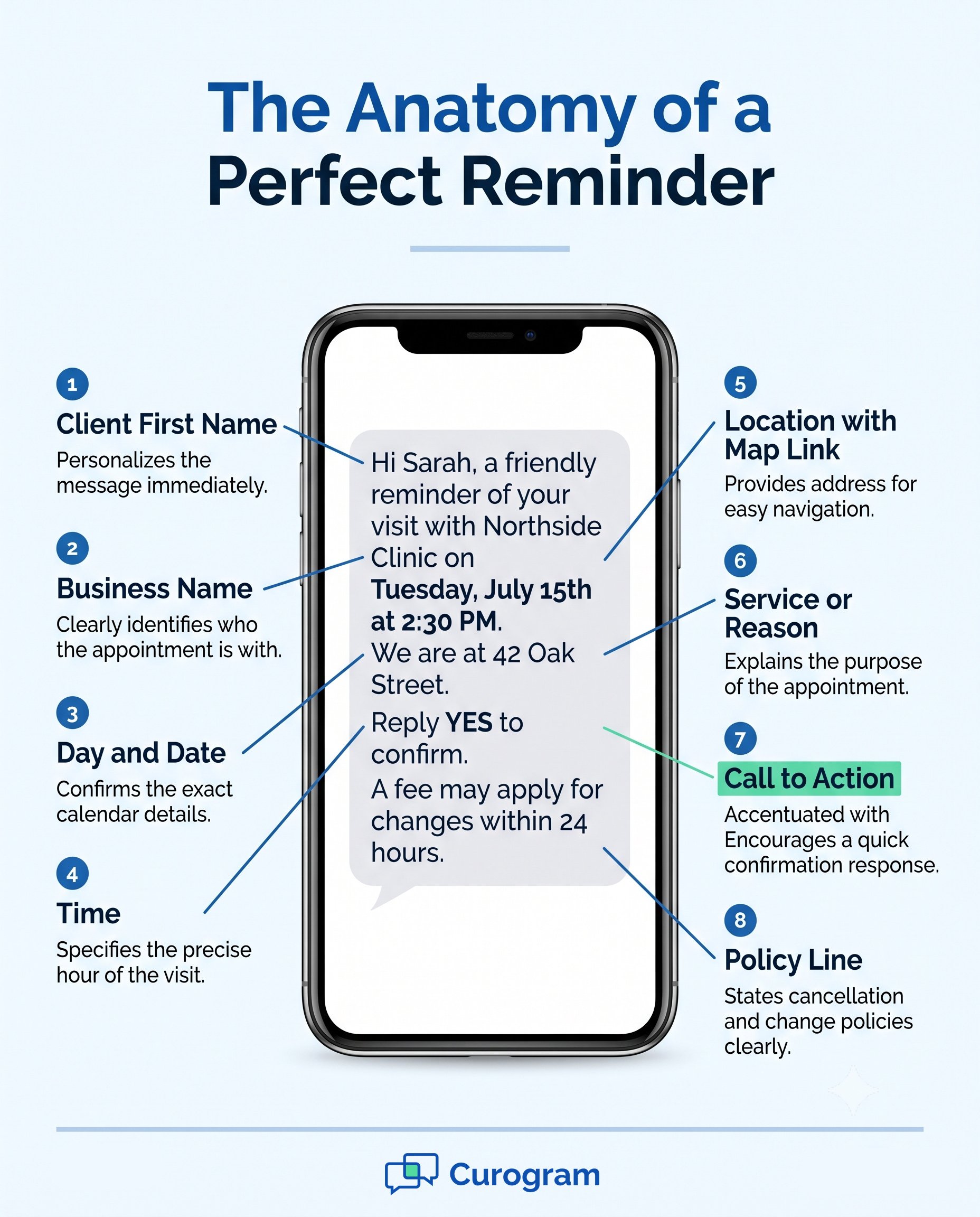
Lead with their first name, then say who you are, when the visit is, and where they need to be.

Who, When, and Where

  • Use the client's first name. It flips an obvious mass send into something that reads like it was written for one person.
  • State the day of the week alongside the date. Tuesday, July 15th at 2:30 PM is far harder to misread than a bare numeric date sitting on its own.
  • Name your business in full, every time. Nobody memorizes your number, and a text from a stranger gets ignored or reported.
  • Give the full street address plus a map link, even for regulars. For virtual visits, give the join link and whatever code they will need to get in.

The Reason for the Visit

  • Name the service, but keep it brief. Something like your 60 minute massage or your annual review does everything you need it to.
  • It jogs their memory and quietly confirms they booked the thing they actually meant to book.
  • In healthcare, keep this deliberately vague. Confirm that a visit exists, never what it is for.

The Parts That Drive Action

Facts inform, but only the ask converts, and this is precisely where most templates quietly fall apart.

Tell the client exactly what to do next, in plain words, and give them one obvious path rather than three competing ones.
A Call to Action That Cannot Be Missed

  • Weak asks sound like this: hope to see you then, or let us know. Both are perfectly polite, and both are trivially easy to ignore.
  • Strong asks sound like this: reply YES to confirm, or tap here to add it to your calendar. There is nothing to interpret.
  • Stick to one ask per message. Two competing asks split the reader attention and reliably lower your response rate.
  • Based on our internal data, clinics running this style of prompt see confirmation rates above 75%.

Contact Info and Your Policy

  • Always give a live phone number. Somebody will need it, and hiding it makes an otherwise friendly message feel evasive.
  • A single policy line can pull real weight. Something like a fee may apply for changes made within 24 hours, which sets the terms without nagging anyone.
  • Keep it to one sentence, though. A wall of rules reads as a threat, and threats have never built repeat business.

Anatomy of a perfect patient appointment reminder text template infographic

20 General Purpose Appointment Reminder Text Template Examples

Text is the workhorse of the whole system. It gets opened, and it gets opened within minutes rather than days.

A good SMS reminder is short, plain, and asks for exactly one thing. The 20 below cover the full life of a booking, running from that first confirmation all the way through to the note that wins a lapsed client back.

Confirmations and Prep Messages

Most of your volume lives right here. These are the unglamorous routine sends that quietly hold the schedule together.

Keep them under two lines wherever you can, because every extra clause you add is another chance to lose the reader halfway through.

Simple and Forced Confirmations

  • Standard: Hi [Client Name], a friendly reminder of your visit with [Business Name] on [Date] at [Time]. Reply YES to confirm.
  • Brief: Hi [Client Name]! Quick reminder about tomorrow at [Time] at [Business Name]. See you then!
  • Address Included: Reminder: your visit with [Business Name] is [Date] at [Time]. We are at [Address]. Reply C to confirm.
  • Minimalist: Your visit at [Business Name] is [Date] at [Time]. Call [Phone Number] to change it.
  • Forced Confirm: Hi [Client Name]. To hold your visit on [Date] at [Time], reply CONFIRM. Unconfirmed slots may be released.
  • Policy Note: Hi [Client Name]. Reminder for [Date] at [Time]. Reply YES to confirm. A fee may apply for changes within 24 hours.
  • Reschedule Path: Reminder of your visit on [Date] at [Time]. Need to move it? Reply RESCHEDULE and we will call you.
  • Calendar Link: Your visit is set for [Date] at [Time]. Add it here: [Calendar Link]. Reply YES to confirm.
  • Two Step: Hi [Client Name], reply 1 to confirm or 2 to reschedule your [Date] visit at [Time]. Thanks!
  • Waitlist Framing: Hi [Client Name], we have a waitlist for [Date]. Reply YES by tonight to keep your [Time] slot.

Prep and Same Day Nudges

  • Paperwork: Hi [Client Name], reminder for [Date] at [Time]. Please finish your online forms before you arrive. [Business Name].
  • Fasting Note: Reminder for [Client Name]: your visit is [Date] at [Time]. Please do not eat or drink for 2 hours before.
  • Virtual Link: Your video visit with [Business Name] is [Date] at [Time]. Join here: [Link]. Log in 5 minutes early.
  • Parking: Hi [Client Name], see you [Date] at [Time]. We are at [Address]. Free parking is behind the building.
  • 24 Hour: Hi [Client Name], this is your 24 hour reminder for tomorrow at [Time] with [Business Name].
  • Same Day: Hi [Client Name], quick reminder that your visit is today at [Time]. See you soon!
  • On My Way: Hi [Client Name], this is [Staff Name] from [Business Name]. I am en route and should arrive around [ETA].
  • Urgent: [Client Name], we still need to confirm your visit today at [Time]. Please call [Phone Number] to hold your spot.
  • Running Late Check: Hi [Client Name], your visit is in 30 minutes. Reply LATE if you are delayed and we will adjust.
  • Weather Note: Hi [Client Name], we are open today despite the weather. Your [Time] visit is still on. Reply YES to confirm.

Follow-Ups, Rebooking, and Recall

The booking does not end when the client walks out of the door. In a sense, the next one begins right there.

This is easily the most ignored group of templates, and also the most profitable. A follow-up appointment example done well fills tomorrow schedule with the clients you already have today.

After the Visit

  • Thank You: Hi [Client Name], thanks for visiting [Business Name] today. We hope your [Service] went well.
  • Review Ask: Hi [Client Name], thanks for choosing us! Would you share your experience? [Review Link]
  • Care Check: Hi [Client Name], just checking in after your [Service]. Reply if anything feels off and we will help.
  • Results Ready: Hi [Client Name], your results are ready. Call [Phone Number] and we will walk you through them.
  • Payment Nudge: Hi [Client Name], your balance from [Date] is ready to settle. Pay here: [Link].

Winning Clients Back

  • Follow-up Appointment: Hi [Client Name], you are due for your next [Service] at [Business Name]. Book here: [Booking Link] or call [Phone Number].
  • Recall: Hi [Client Name], our records show it has been [Timeframe] since your last visit. Reply BOOK and we will find you a time.
  • We Missed You: Hi [Client Name], sorry we missed you today. Things come up. Call [Phone Number] and we will find a new time.
  • Second Chance: Hi [Client Name], we held your spot as long as we could. Reply RESCHEDULE and we will get you back on the books.
  • Overdue Care: Hi [Client Name], you are overdue for [Service]. Staying on schedule matters. Reply YES and we will call you today. 

That last group is worth serious money. Based on our internal data, one multi-location practice sent SMS recalls to lapsed patients, and 35% of the people who received one booked an appointment within a month. That single campaign brought 1,240 patients back through the door.


Reminder Channels at a Glance

Channel

Best For

Length

Typical Ask

Text (SMS)

Routine confirms, same day nudges

1 to 2 lines

Reply YES or C

Email

New clients, prep steps, document lists

Short list format

Tap a confirm button

Voice call

High value visits, recalls, no answers

20 to 30 seconds

Verbal yes or reschedule

Voicemail

Clients who screen calls

15 to 20 seconds

Call back to confirm


20 Professional Appointment Reminder Email Templates

Email buys you room to breathe, so use it whenever a text would feel cramped or would have to leave something important out. It suits new clients, complicated prep instructions, document checklists, and anything involving a link the client needs to click now and find again later.

Confirmation and Prep Emails

The subject line carries most of the weight here, so say what the email is and when the visit happens. Nothing clever. Then lay the details out as a short list rather than a paragraph. Nobody reads prose when they are trying to find a time.

Standard Confirmations

  • Subject: Your visit on [Date] at [Time] with [Business Name].
    Body: Dear [Client Name], we have you booked for [Service] on [Day], [Date] at [Time], at [Address]. Map: [Link]. Please tap Confirm below. Need to change it? Call [Phone Number].
  • Subject: A friendly reminder of your upcoming visit.
    Body: Hello [Client Name], this is a reminder of your [Service] with [Provider Name] on [Date] at [Time]. We are at [Address]. Parking: [Details]. Reply to confirm.
  • Subject: You are confirmed for [Date].
    Body: Hi [Client Name], you are all set for [Time] on [Date]. Add it to your calendar: [Link]. Questions? Call [Phone Number].
  • Subject: Final confirmation for tomorrow.
    Body: Hello [Client Name], we still need your confirmation for [Time] tomorrow. Reply by end of day or we may release the slot.
  • Subject: Your booking with [Provider Name].
    Body: Dear [Client Name], your [Service] is set for [Date] at [Time]. Please arrive 10 minutes early. Reply to confirm.

Prep and Instruction Emails

  • Subject: Preparing for your visit on [Date]
    Body: Dear [Client Name], to make your [Service] smooth, please complete your forms here: [Link]. Bring photo ID and your insurance card. Arrive 15 minutes early.
  • Subject: Your video visit link and instructions
    Body: Hi [Client Name], your video visit is [Date] at [Time]. Join here: [Link]. Code: [Password]. Use a quiet room, a strong connection, and headphones. Log in 5 minutes early.
  • Subject: Documents to bring on [Date]
    Body: Dear [Client Name], your meeting with [Professional Name] is [Date] at [Time]. Please bring: [List]. This keeps our time together productive.
  • Subject: What to expect at your first visit
    Body: Hi [Client Name], welcome. Your first visit is [Date] at [Time] and runs about [Duration]. Here is what to bring: [List]. Here is where to park: [Details].
  • Subject: Reminder and prep for your [Service]
    Body: Hello [Client Name], your [Service] is [Date] at [Time]. Please avoid [Restriction] beforehand. Call [Phone Number] with any questions.

Policy, Follow-Up, and Industry Emails

Some emails carry a harder job than a simple confirmation. They have to set terms, or reopen a relationship that has gone quiet.

Both of those work best when the tone stays warm and the ask stays small. Firmness comes from clarity, not from volume.

Emails That State the Policy

  • Subject: Action required, please confirm [Date]
    Body: Hello [Client Name], please confirm your [Time] visit on [Date]. Our policy: we need [Number] hours notice for any change. A fee of [Amount] applies to late changes or missed visits. This lets us serve clients who are waiting.
  • Subject: Reminder and policy note for your visit
    Body: Dear [Client Name], your [Service] is [Date] at [Time]. Please reply to confirm. We ask for 24 hours notice on changes. Late changes may carry a fee of 50% of the service cost.
  • Subject: Holding your reserved time
    Body: Hi [Client Name], your [Time] slot on [Date] is reserved for you. Unconfirmed slots go to our waitlist at [Cutoff]. Tap Confirm to keep it.
  • Subject: Last chance to confirm
    Body: Hello [Client Name], we have not heard back about tomorrow at [Time]. Please confirm today or we may release the spot. Call [Phone Number].
  • Subject: Card on file and your upcoming visit
    Body: Dear [Client Name], your visit is [Date] at [Time]. A card is held on file for late changes per our policy. Reply to confirm.

Follow-Up and Sector-Specific Emails

  • Subject: Thank you, and one small request
    Body: Dear [Client Name], thank you for your [Service] on [Date]. Would you share your experience? [Review Link]. It helps others find us.
  • Subject: It is time to book your next visit
    Body: Hi [Client Name], you are due for your next [Service]. Staying on schedule protects [Benefit]. Book here: [Booking Link] or call [Phone Number].
  • Subject: We missed you
    Body: Hello [Client Name], we missed you at [Time] today. Things come up. Pick a new time here: [Booking Link] or call [Phone Number].
  • Subject: Your [Service] with [Stylist Name] tomorrow
    Body: Hi [Client Name]! You are booked with [Stylist Name] at [Time] tomorrow. Arrive a few minutes early to settle in. Note our 24 hour change policy.
  • Subject: Your vehicle service on [Date]
    Body: Hello [Client Name], your [Vehicle] is booked for [Service Type] on [Date] at [Time]. This is a drop-off visit. We will call when it is ready. 

The review ask deserves its own mention. Based on our internal data, one multi-location practice tied automated post-visit surveys to Google Reviews. It earned 1,064 new five-star reviews in three months, with 90% of responding patients leaving five stars.


15 Effective Voice and Voicemail Appointment Reminder Message Examples

A human voice still lands in a way that a notification simply does not. It cuts through a crowded inbox because it never went to the inbox in the first place.

Use it for high-value bookings, brand new clients, or anyone who reliably ignores a screen. Keep it short, warm, and unmistakably clear.

Live Call Scripts

A live call is a conversation, not a recital, so confirm the details and then actually stop talking and listen.

The goal is either a yes or an honest reschedule. Both of those beat a silent no-show by a wide margin.

Standard Check-In Calls

  • Friendly Check-In: Hi, may I speak with [Client Name]? This is [Your Name] from [Business Name]. I am calling about your visit on [Day], [Date] at [Time]. Does that still work?
  • Confirm And Inform: Hello, this is [Your Name] from [Business Name], calling for [Client Name]. I am confirming your [Service] on [Date] at [Time]. Please bring [Item]. Any questions before you come in?
  • Proactive Reschedule: Hi [Client Name], it is [Your Name] from [Business Name]. If [Date] still works, wonderful. If not, I can find you a new time right now while I have you.
  • New Client Welcome: Hi, is this [Client Name]? This is [Your Name] from [Business Name]. I am confirming your first visit on [Date] at [Time]. We are at [Address]. Anything you need before then?

High Value and Recall Calls

  • High Value Confirm: Hello [Client Name], this is [Your Name] from [Business Name]. I am personally confirming your [Service] on [Date] at [Time]. We have reserved real time for you, so I want to be sure the details are right.
  • Recall: Hi [Client Name], this is [Your Name] from [Business Name]. Our records show you are due for [Service]. Would you like me to find you a time now?
  • Waitlist Offer: Hi [Client Name], a slot just opened for [Service] on [Date] at [Time]. You are on our list. Would you like it?

Voicemail Scripts

Assume they will hear it once, half distracted, probably while walking somewhere. Build the message for that reality rather than an ideal one.

State the date, the time, and your name at the start and again at the end. That repetition is essentially the whole trick.

Clear and Instructional Voicemails

  • Clear And Simple: Hello, this is a message for [Client Name] from [Your Name] at [Business Name]. This is a reminder of your visit on [Date] at [Time]. Again, that is [Date] at [Time]. Call [Phone Number] with any questions.
  • Instructional: Hello [Client Name]. This is [Your Name] from [Business Name] about your visit on [Date] at [Time]. Please remember [Instruction]. To change it, call [Phone Number].
  • Formal: Good afternoon. This is a message for [Client Name] from [Your Name] at [Firm Name]. I am confirming your meeting on [Date] at [Time] at our office. Please call [Phone Number] to confirm.
  • Mobile Service: Hi [Client Name], this is [Staff Name] with [Business Name]. We are booked to be at [Address] on [Date] between [Time Window]. Please call [Phone Number] to confirm someone will be home.

Urgent and Warm Voicemails

  • Urgent Confirm: Hello, this is for [Client Name]. This is [Your Name] from [Business Name] about your visit tomorrow, [Date] at [Time]. We still need to hear from you. Please call [Phone Number]. Again, [Phone Number].
  • Warm and Friendly: Hey [Client Name]! This is [Your Name] from [Business Name]. Quick note about your visit on [Date] at [Time]. Looking forward to it. Our number is [Phone Number].
  • Post-reschedule: Hello [Client Name], this is [Your Name] from [Business Name]. Your new time is on the books for [New Date] at [New Time]. If that is wrong, call [Phone Number] right away.
  • Follow up After No Answer: Hello [Client Name], this is [Your Name] from [Business Name] again. I called earlier about your visit on [Date] at [Time]. Please call [Phone Number] when you get a moment.

Industry-Specific Deep Dive: Tailoring Your Appointment Reminder Template

A generic script will work. A tailored one will win, and usually by more than you would guess.

Your clients live inside a context, and matching the message to that context lifts your confirmation rate without you writing a single new word of persuasion.

Care and Personal Services

These fields share one defining trait: the client themselves is the thing being served, which means tone carries real weight.

One of them lives on privacy, the other on warmth. Both of them stand or fall on how the message feels to the person reading it.

Healthcare and Behavioral Health

  • Use a HIPAA-compliant platform, and be clear with yourself that a standard consumer SMS tool is not one.
  • Follow the minimum necessary rule without exception. Confirm that a visit exists, and never name the condition, the test, or the reason behind it.
  • Sample text: Hi [Patient Name]. Reminder from [Clinic Name] about your visit with Dr. [Last Name] on [Date] at [Time]. Reply YES to confirm. Call [Phone Number] to reschedule.
  • Do remind them what to bring, though. A photo ID, an insurance card, and a current medication list will cover the vast majority of visits.

Salons, Spas, and Fitness

  • Use the reminder to sell the visit a second time, and always name the stylist, therapist, or coach by name.
  • Sample text: Hi [Client Name]! It is almost time for your [Service] with [Stylist Name] at [Salon Name] on [Date] at [Time]. Reply C to confirm. Note our 24-hour change policy.
  • State the policy plainly and without apology. An empty stylist chair is a stylist who is not getting paid that hour.
  • Email gives you room for a gentle upsell. Offer the add-on treatment once, and leave it there.

Field, Professional, and Auto Services

In these fields, the client is not really the subject of the appointment. Their home is, or their case, or their car. So the message shifts accordingly. Access, preparation, and timing become the entire game.

Home Services and Contractors

  • Give a window rather than a fixed time. Something like between 1 PM and 3 PM is honest, and it survives traffic without making you a liar.
  • Always confirm that an adult will be home. A locked door does not waste one appointment; it wastes an entire crew for half a day.
  • Sample text: Reminder from [Company Name]: your service is tomorrow, [Date], between [Time Window]. Reply YES to confirm someone will be home.
  • Send an on-the-way text with a photo of the technician. It answers the safety question before the client has to work up the nerve to ask it.

Legal, Financial, and Automotive

  • Professional services need preparation far more than they need warmth, so lead with the documents your client has to bring.
  • Sample email line: To make the most of our time together, please bring [List of Documents].
  • Automotive work needs clarity about time above all else. Say plainly whether the client waits or drops off, and name the vehicle so there is no mix-up.
  • Sample text: Hi [Client Name], your [Vehicle] is booked at [Garage Name] tomorrow at [Time]. This is a drop-off. We will text you when it is ready.

The Psychology of Reminders: Why the Right Wording Matters

Two reminders can carry exactly the same facts and produce completely different results. Wording is the reason, and it is not a small one. A handful of old, well-tested ideas about how people behave explain most of that gap. You may as well use them deliberately.

Principles That Drive Confirmation

Two forces do most of the heavy lifting here. One makes people want to give something back, and the other makes them want to look consistent with what they said. Neither one announces itself. Both are considerably stronger than they look.

Reciprocity and Commitment

A courteous reminder functions as a small gift, and people who receive a small gift feel a quiet pull to give one back. The cheapest way for them to repay you happens to be the thing you wanted anyway: show up, or tell you early that they cannot.

Commitment is the bigger lever of the two. When a client acts in order to confirm, by replying YES or tapping a button, they have made themselves a small promise.

And people work surprisingly hard to stay consistent with promises they made themselves. That single reply is worth more than any clever wording you could possibly choose.

Loss Aversion

Losing something tends to hurt about twice as much as gaining the same thing feels good. That asymmetry is worth designing around.

Your client already owns something valuable, whether they think about it that way or not: a convenient slot, held open just for them. So frame the message around the loss. Confirm to hold your spot quietly outperforms please confirm, because it implies the spot could vanish.

A stated fee works the same way. It turns a vague policy into a concrete thing the client would rather not lose.

Removing Friction

The easier you make an action, the more people take it. That is genuinely the whole rule, and it explains more failed reminders than bad copy ever will. Every extra tap, scroll, or moment of required thought is another place where somebody quietly gives up.

One Tap, Not Three

Add a map link so that nobody has to retype your address into their phone.

Add a calendar link so that nobody has to build the event by hand at a red light. Let them reply with a single letter. Typing C is easier than placing a phone call, and in this business easier always wins.

Say Exactly What You Mean

Vague instructions produce silence. Clear ones produce replies. It really is that blunt.

So do not write let us know. Write reply YES by Friday instead. Also, do not write bring what you need. Write out the actual list, even if it feels obvious to you.

Guessing is work, and nobody is willing to do work on behalf of a text message.
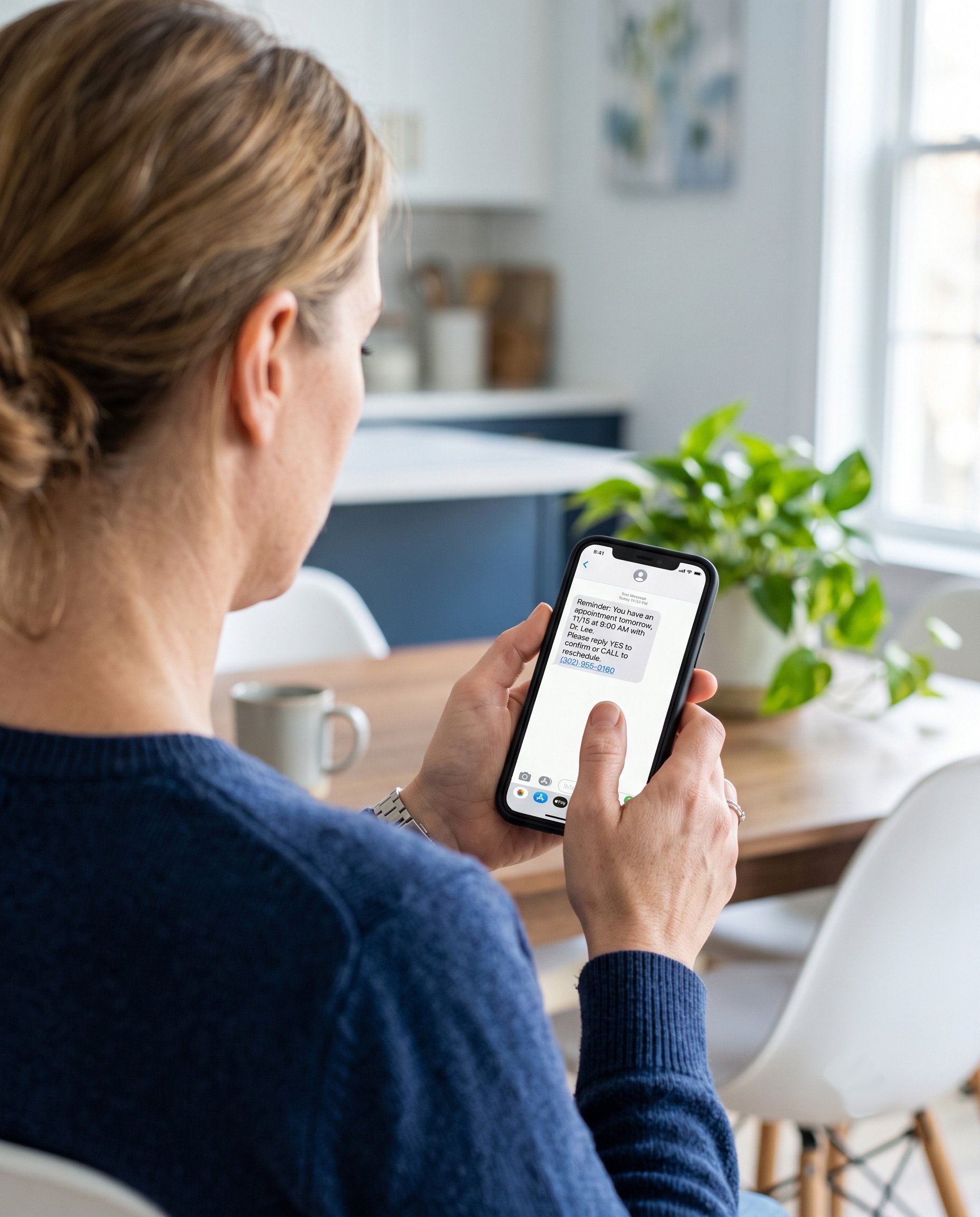
Patient reading a medical appointment reminder text message on a smartphone

A/B Testing Your Appointment Reminders for Maximum Effectiveness

Writing the template is step one. Proving that it works is step two, and it is the step almost everybody skips.

A split test compares two versions of a message and lets your actual clients pick the winner. No theory required, and no marketing degree either.

What to Test

Change one thing at a time, always. Change two, and you will never know which of them actually moved the number. Four levers give you most of the return for the least amount of effort.

Timing and Channel

Timing is the easiest thing to test and often turns out to be the biggest single win available to you. Try 48 hours out against 24 hours out. Then try running both sends together against just the one.

Channel matters just as much. Test SMS on its own, email on its own, and then an email at 48 hours, followed by an SMS at 24. Your clients have a preference here. They will never tell you what it is, but their behavior will say it clearly enough.

Wording and the Ask

Test the call to action head-to-head. Put reply YES up against tap here to confirm and see which one your clients actually use. Then test a passive version, something like no need to reply if you can make it. It occasionally wins, and knowing that is genuinely useful.

Save tone for last. Run a casual note against a formal one, keeping the facts identical in both.

How to Run the Test

You do not need a statistician for any of this. You need a little patience and a spreadsheet. The entire method fits comfortably on a napkin.

A Simple Framework

Pick a single variable, then build version A and version B of your message. Split the next month of bookings at random into two groups. Most reminder software will do this part for you automatically.

Send A to one group and B to the other, and change absolutely nothing else about how you operate. Run it until each group has roughly 100 bookings behind it. Any smaller than that and you are just reading noise.

What to Measure

Track three numbers and no more: your confirmation rate, your no-show rate, and your reschedule rate. The no-show rate is the scoreboard that matters. Whichever version produces the lower number wins, full stop.

Adopt the winner as your new house standard, then pick a fresh variable and start the whole thing over. This is slow and profoundly unglamorous work. It is also exactly how a decent template quietly becomes a great one.

Conclusion: Build the System, Not Just the Script

A missed booking is not bad luck. It is a gap in your system, and gaps in a system can be closed.

Everything in this guide points in one direction. Say who you are, say when and where, and ask for one small action. Then let software handle the sending, on time, every single time.

The templates are honestly the easy part. Copy them, fill in the blanks, and start today. The harder part is building the habit around them.

Send the reminder every time, not only when the schedule is looking thin. Follow up after the visit, not just before it. And keep testing, because the message that works this year may quietly stop working next year.

The payoff here is not abstract. Based on our internal data, practices that automate reminders confirm more than 75% of their bookings and push no-show rates well below the industry norm. Revenue climbs 10% to 20% as empty slots turn back into billable time.

That is not really a marketing claim. It is arithmetic. Fewer holes in the day means more people served and more revenue kept.

Start with one channel, get the wording right, and then add the next one.

Curious how automated reminders would fit into your current workflow? A short walkthrough is the fastest way to find out. Book a quick demo with Curogram, and we will show you what the numbers could realistically look like for your practice.

Frequently Asked Questions

How do you politely remind someone of an appointment?

Lead with their first name and frame the whole note as a courtesy rather than a demand. Give the business name, the date, and the time in plain words, with no filler wrapped around them. Then make the next step effortless, usually by asking them to reply YES to confirm. A warm tone paired with a small ask will beat a stern reminder every time.

Why do text reminders work better than phone calls for most clients?

Text reaches people where they already are, and it does not demand that they stop whatever they are doing to deal with you. A call insists on attention right now, while a text simply waits until they have a spare moment.

Replies also come back faster, because typing a single letter is far easier than holding a conversation. That said, calls still win for high-value visits and for clients who habitually ignore their screens.

How far in advance should you send an appointment reminder?

Most businesses settle on 24 hours before the visit, which gives a client enough room to rearrange things if they need to. Many add a second send at 48 or 72 hours out for bookings that were made weeks earlier and have had time to fade.

A same-day nudge helps for early morning visits or clients facing a long commute. Test the timing yourself, though, because the right answer really does depend on who your clients are.

Why does asking for a confirmation reply reduce no-shows?

When somebody takes an action to confirm, they make a small promise to themselves as much as to you. People tend to follow through on promises they have stated out loud, even quietly. A passive reminder asks for nothing, so nothing gets committed to. That one tap is the whole difference between a notice and a commitment.

How do you write a follow-up appointment example that clients actually respond to?

Say why the next visit matters, rather than simply announcing that it is due. Tie it to something the client already cares about, such as staying on track with their own care. Then give them one easy path to book, either a link or a single reply keyword. Keep it short, keep it warm, and keep the pressure out of it entirely.

The Science of Reminder Timing: How Data Closes Schedule Leaks

The Science of Reminder Timing: How Data Closes Schedule Leaks

💡 Most practices send appointment reminders at a fixed time before every visit. But this one-size-fits-all approach often misses the mark. When a...

Read More
How Appointment Heatmaps Reveal Your Practice's No-Show Patterns

How Appointment Heatmaps Reveal Your Practice's No-Show Patterns

💡 Appointment scheduling analytics using a heatmap gives medical practices a visual way to find no-show patterns. Standard EHR reports show one...

Read More
27+ Best Appointment Reminder Email Template Examples & Strategies

27+ Best Appointment Reminder Email Template Examples & Strategies

An appointment reminder email template is a pre-designed, reusable message that you can quickly customize and automatically send to your clients to...

Read More