
1 min read
27+ Best Appointment Reminder Email Template Examples & Strategies
💡 An appointment reminder email is a short, pre-written message a practice sends before a scheduled visit, confirming the date, time, provider,...
9 min read

Your 9:15 never walks in. Neither does the 9:45. By 10:30, the front desk has left six voicemails about tomorrow's schedule, and the phone hasn't stopped.
An appointment reminder service for doctors exists to close the gap between a booked slot and a filled one. It sends the message, captures the reply, and updates your schedule without anyone dialing. Below: how the software works, what it costs, which vendors keep showing up on shortlists, and how to launch it in the middle of a full clinic week.
One empty chair at 9:15 can feel like a break. Stack those chairs across a quarter and they show up in your production report, your overtime line, and the recall list nobody has worked in weeks.
The most direct impact of a no-show is lost revenue. If a patient doesn't show up for a scheduled visit, you lose the income from that consultation, procedure, or follow-up. Consider a conservative estimate: if a practice has just three no-shows per day at an average reimbursement rate of $150 per visit, the annual loss amounts to over $112,000.
That estimate tracks with published research. A large study in BMC Health Services Research found an average no-show rate of 19%, with each missed visit costing roughly $196. The Health Management Academy has put the national bill near $150 billion a year.
Specialty changes the picture. A dermatology slot and a 45-minute behavioral health intake carry very different replacement costs, and the second one is far harder to refill on two hours' notice.
Confirmation calls are the tax a practice pays for a manual process. Picture a two-person front desk working 60 appointments a day at 90 seconds a call: 90 minutes on the phone before lunch, most of it into voicemail. Treat that as illustrative math, not a benchmark, then run it against your own call log.
Those 90 minutes are the ones practice managers most want back. They're also the reason the post-visit review request keeps getting skipped, because three patients need rescheduling and the second line is ringing.
An empty slot is a clinical event too. A skipped A1c recheck means another three months on an unadjusted dose. A missed post-op wound check turns a small problem into an urgent care visit at twice the price.
Behavioral health absorbs the worst of it, with typical clinic no-show rates of 18% to 22%, roughly double primary care. No text message fixes transportation or childcare. Forgetting is the cause a reminder can actually address, and 81% of providers in that same survey named it first.
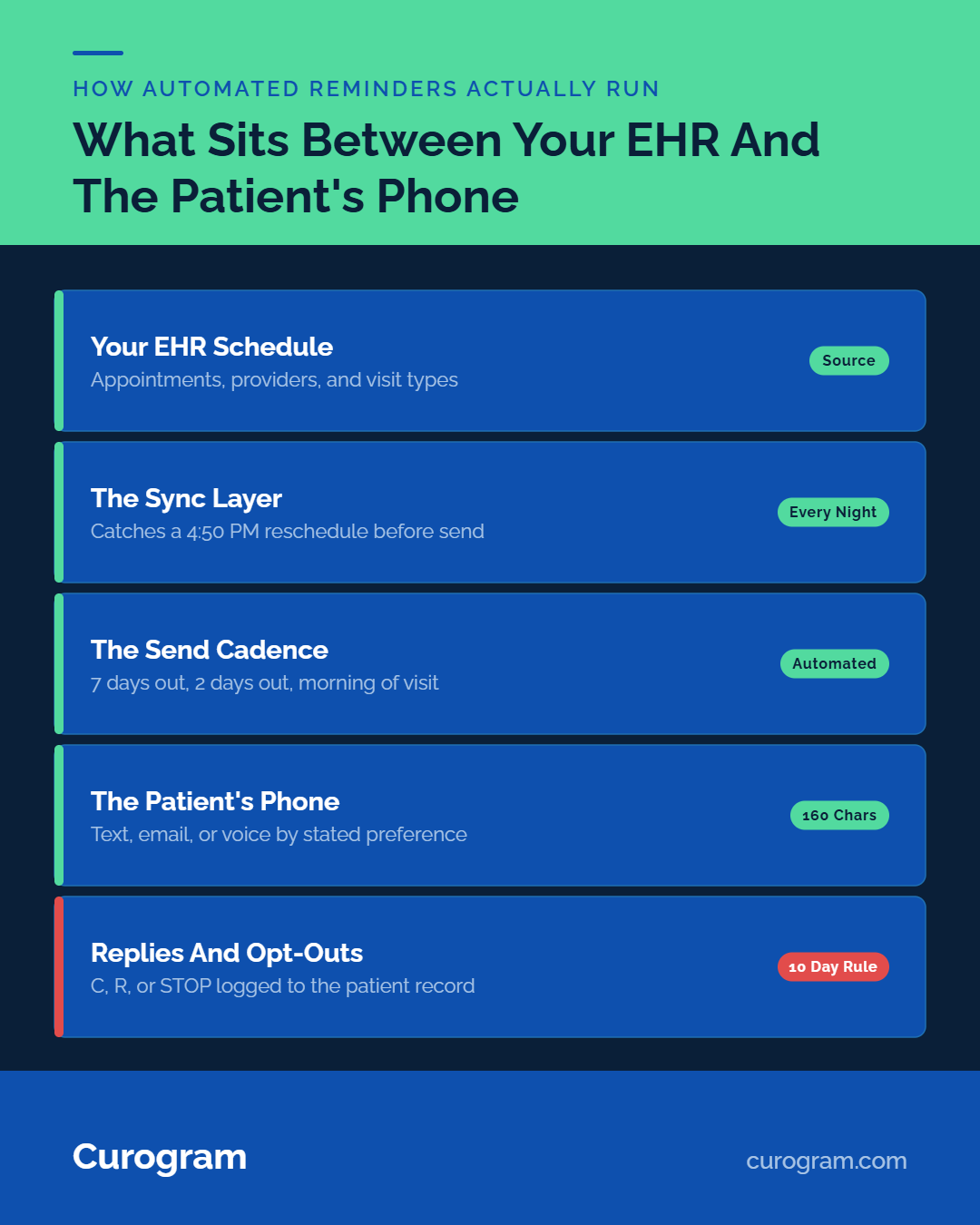
Strip the marketing, and these platforms do three things: read your schedule, send messages on a set cadence, and record what patients say back. Everything else is packaging around those three jobs.
It runs nightly. The platform pulls next week's and tomorrow's appointments from your EHR. A first reminder goes out about seven days ahead, a second two days before, and a short one the morning of the visit. Patients reply C to confirm or R to reschedule, replies land in a shared staff inbox, and confirmed visits get flagged on the schedule.
No one on your team touches that sequence until a patient asks a real question. Automated appointment reminders replace the call list, not the person at the desk.
Text carries most of the volume. Under the TCPA healthcare exemption, those messages stay short, generally under 160 characters, name the practice, and include a way to opt out.
Email handles what won't fit: intake forms, parking instructions, prep for a procedure. Automated voice calls still earn their place with landline-only patients and large elderly panels.
Set the preferred channel at registration and let the platform fall back. When a text fails to deliver because a number changed carriers, a voice call the night before catches it.
A reminder is only as accurate as the schedule behind it. Say a scheduler moves a 2:00 to 4:30 at ten minutes to five. A connected platform catches that on the next pull and sends the corrected time. A spreadsheet exported that morning doesn't, and your patient arrives at 2:00 to an empty room.
Curogram connects with a wide range of EHR and practice management systems and runs alongside the one your team already knows. Nothing gets replaced. Before you sign anything, ask the vendor to name two practices running your exact EHR and call them.
The first thing practices notice isn't the no-show number. It's the phone. Inbound confirmation calls drop within about two weeks, because patients who already replied by text have no reason to call.
Reminders do two jobs at once. They keep booked patients booked, and they surface cancellations early enough that a slot is still sellable. A patient who texts back on Tuesday that Thursday won't work gives your team 48 hours to fill the hour.
|
What we measured |
Result |
|---|---|
|
No-show rate, Atlas Medical Center |
14.20% down to 4.91% within three months |
|
Average confirmation rate across clients |
Above 75% of appointments confirmed |
|
Confirmations handled, Covina Arthritic Clinic |
More than 1,100 per month |
|
No-show rate against industry average |
53% lower across specialties |
|
Patient recall reconversion |
35% booked within a month; 1,240 patients seen |
Based on our internal data, drawn from the Curogram case studies.
Covina Arthritic Clinic used to confirm appointments by hand, one call at a time. Automating it moved more than 1,100 confirmations a month off the phones, based on our internal data. Nobody was replaced. The hours went back into check-in, eligibility, and the patients standing at the window.
Recall is the quieter half of this. One multi-location practice sent SMS recalls to patients overdue for follow-up, and 35% of them booked within a month, adding up to 1,240 patients seen from recall messages alone. That is revenue from people already in your chart, which costs far less to reach than a new patient does.
Acquisition is a different job. Reaching people who aren't patients yet belongs in a marketing tool like HubSpot CRM, where you're working with prospect contacts rather than chart data. Recall goes to patients you already treat, so those messages stay inside the platform that signed your BAA.
Demos look alike. The differences turn up in the compliance paperwork, the reply handling, and whether your office manager can read the report without a training session. Our side-by-side breakdown of medical appointment reminder software covers how specific vendors handle each one.
A vendor handling appointment data is a business associate, full stop. Ask for the Business Associate Agreement in writing before the pilot, not after. HIPAA-compliant appointment reminders also mean the message itself stays thin: patient name, practice, date, time, and nothing about the reason for the visit.
Curogram is SOC 2 Type II certified and HIPAA compliant, and signs a BAA with every practice. Ask any vendor on your shortlist for both documents on the same call.
Opt-Out Handling That Matches Current FCC Rules
This changed recently enough that older vendor documentation is wrong. Since April 11, 2025, patients can revoke consent by any reasonable means, and STOP, QUIT, END, CANCEL, and UNSUBSCRIBE all count. Practices then have 10 business days to honor the request.
The broader provision, where one opt-out stops every message type from your organization, has been delayed again and now takes effect January 31, 2027. Ask your vendor how their system logs a revocation today and what happens to it in 2027.
A one-way blast tells you nothing. Two-way texting turns each doctor appointment reminder into a small scheduling transaction: confirm, cancel, or ask for a different day. Watch a demo of the staff inbox specifically, because that screen is where your team will spend real time.
Ask what happens when a patient replies with a sentence instead of a letter. Plenty of platforms handle C and R, then drop "can we do Friday instead."
Three numbers matter: confirmation rate, no-show rate by provider, and reminder delivery failures. Delivery failures are the one most vendors bury, and they're how you find the 40 patients with dead phone numbers sitting in your chart.
Pull the report the same day each week. A no-show rate that moves from 14% to 5% and then drifts back up usually means the message timing slipped, not that patients changed.
Most implementation pain comes from doing all four of these at once. Spread them across three weeks, and the clinic barely notices.
Pull 90 days of scheduling data and calculate your no-show rate by provider and by visit type. Note who currently makes confirmation calls and roughly how long it takes them. Without that baseline, you'll have no way to prove the platform worked, and no way to catch it when it stops working.
Shortlist two, then make the EHR connection the first thing you test, not the last. Ask for a sandbox sync against your system and watch a schedule change flow through it. References from practices on your exact EHR are worth more than any feature comparison chart.
Keep them short and specific. Include patient first name, practice name, provider, date, time, location, and the reply instruction. Write separate versions for new patients, follow-ups, and procedures with prep requirements, since a colonoscopy reminder needs different content than a 15-minute recheck.
Run a single provider's schedule through the system for two weeks. Watch for wrong times, duplicate sends, and replies that fall through. Fix what breaks while it's small, train the rest of the front desk on the inbox, then turn on the full schedule.
Practices approve this line item faster when the math sits on one page. Three steps get you there.
Multiply missed visits per month by your average revenue per visit. Use collected revenue rather than billed charges, or the number will be optimistic enough that your CFO throws it out.
Vendor claims of an 80% drop don't survive a finance review. Model something you can point to. Atlas Medical Center went from 14.20% to 4.91% in three months, based on our internal data, and that pair of numbers is defensible in a budget meeting.
|
Line item |
Example practice |
|---|---|
|
Appointments per week |
250 |
|
No-show rate before reminders |
14% |
|
Missed visits per month |
152 |
|
Average collected revenue per visit |
$150 |
|
Revenue lost per month |
$22,800 |
|
No-show rate after reminders |
5% |
|
Missed visits per month |
54 |
|
Revenue recovered per month |
$14,700 |
Illustrative model. Rates follow the Atlas Medical Center result; volume and revenue are stand-in figures. Swap in your own.
Most platforms land between $50 and $200 per provider each month, or roughly $0.02 to $0.10 per message. Against $14,700 in recovered monthly revenue, the subscription stops being the interesting number. Reclaimed staff hours sit on top of that and rarely make it into the calculation at all.
Pull your 90-day no-show rate first. That single number tells you whether this is a $2,000 problem or a $100,000 one, and it decides how much attention the project deserves.
From there the work is small: two demos, one EHR connection test, four message templates, one pilot provider. A patient appointment reminder system won't fix a schedule that's overbooked or a phone tree nobody can get through. It will stop you from losing visits that were already on the books.
See how Curogram handles reminders, confirmations, and recalls inside your current EHR. Book a demo and bring your no-show numbers to the call.

1 min read
💡 An appointment reminder email is a short, pre-written message a practice sends before a scheduled visit, confirming the date, time, provider,...
-featured.png)
1 min read
💡 Knowing how to send a reminder text to someone is one of the fastest ways to cut no-shows. It also helps you build lasting trust with clients....
1 min read
💡 Missed appointments cost the U.S. healthcare system an estimated $150 billion a year, with each individual no-show costing a physician roughly...