
Text-to-Pay for Multi-Specialty Practices: Simplifying Billing
💡Managing billing for different specialties in one practice is tough. Each department has its own workflow, and traditional systems can't keep up....
9 min read
Aubreigh Lee Daculug
:
January 31, 2026
Sarah had been managing billing for Desert Valley Primary Care for eight years. Every month, her team sent hundreds of paper statements, made countless phone calls, and watched unpaid balances pile up. The manual process was draining her staff and frustrating patients who wanted easier ways to pay.
"We were spending more money trying to collect payments than some of the balances were worth," Sarah recalls. Her four-location practice across Arizona was stuck in an expensive cycle that ate into both time and revenue.
The numbers told a troubling story. Each payment cost the practice $6.75 to process when you added up postage, paper, staff time, and phone calls. Patients took an average of 45 days to pay, and 15% of balances never got collected at all. The billing team spent 15 minutes per transaction just tracking down payments.
Then Sarah discovered Curogram's Text-to-Pay system. She was skeptical at first, like many healthcare administrators who've heard automation claims before.
But the healthcare billing automation success story that unfolded over the next three months changed everything about how Desert Valley handled patient payments.
Within 90 days, the practice saw billing costs drop by 95%. Payment turnaround time fell from 45 days to just 3 days. Staff members who once dreaded billing duties were now handling twice the volume in half the time. Patients who used to ignore mailed statements were paying immediately from their phones.
This medical practice payment improvement wasn't just about numbers on a spreadsheet. It transformed how the entire team worked and how patients experienced healthcare. The results proved that even small practices could achieve enterprise-level efficiency with the right tools.
This is the story of how one primary care practice escaped billing chaos and discovered a better way forward.
Desert Valley Primary Care was drowning in administrative work that didn't involve patient care. The billing department operated like a call center, not a medical office. Staff members spent entire days making reminder calls that patients rarely answered.
The practice mailed physical statements twice a month. Each mailing cost $800 in postage and paper alone. Many statements never reached patients who had moved or changed addresses. Others sat unopened in piles of mail.
When patients did call back with billing questions, it created another time drain. Staff had to pull files, explain charges, and process payments over the phone. Each conversation took at least 15 minutes, and the phone lines were constantly busy. This left less time for scheduling appointments and answering medical questions.
The collection timeline stretched painfully long. From the date of service to actual payment, 45 days was the average wait time. Some balances took 90 days or longer to resolve.
The practice had to write off 15% of patient balances as uncollectable every year.
Patient feedback revealed another layer of the problem. Many patients wanted to pay but found the process inconvenient:
These barriers meant that willing patients still ended up with overdue balances. The system itself was preventing successful collections.
Staff burnout became a serious concern. Two billing coordinators quit in six months, citing stress and frustration. The remaining team members felt overwhelmed by the endless cycle of printing, mailing, calling, and following up. Sarah knew something had to change, but switching systems felt risky and expensive.
The clinic was caught in a trap where the billing process itself was preventing successful collections.

Sarah decided to test Curogram's Text-to-Pay system at one location first. The implementation took less than two weeks, and the practice experienced zero downtime during the switch. Curogram's team handled the EMR integration, connecting seamlessly with the practice's existing patient management software.
The new system worked through secure SMS payment links sent directly to patient phones. When a balance was due, patients received a text message with a HIPAA payment system ROI-compliant link.
They could click, review their balance, and collect payment in under a minute. No apps to download, no new accounts to create.
Automated follow-up reminders solved the problem of patients forgetting to pay. The system sent gentle reminders at intervals Sarah could customize. Patients who preferred email could receive links that way instead. The key was meeting patients where they already spent their time.
The EMR integration delivered immediate benefits that went beyond simple payment processing:
This eliminated the frustrating back-and-forth between billing software and patient records. Everything synchronized instantly, giving management complete visibility into collections.
Curogram's support team trained the entire billing staff in a single afternoon session. The interface was simple enough that even the least tech-savvy team members felt comfortable within the first week. Sarah appreciated that she didn't need to hire IT consultants or dedicate weeks to learning new software.
The practice started with co-pays and small balances, then expanded to all patient billing within a month.
The numbers transformed almost immediately. Billing cost per payment dropped from $6.75 to just $0.03, a 95% reduction that freed up thousands of dollars monthly.
The practice saved $800 every month just by eliminating postage and paper costs. Staff time per transaction fell from 15 minutes to 2 minutes, an 87% decrease that multiplied across hundreds of monthly transactions.
| Metric | Before Curogram | After Curogram | Improvement |
|---|---|---|---|
| Billing Cost per Payment | $6.75 | $0.03 | 95% decrease |
| Payment Turnaround Time | 45 days | 3 days | 93% faster |
| Staff Time per Transaction | 15 minutes | 2 minutes | 87% decrease |
| Patient Satisfaction Score | 78% | 96% | +18 points |
| Monthly Collections Rate | 85% | 100% | +15% |
The automate patient billing results exceeded Sarah's expectations. She could now process more payments with fewer staff members while improving the patient experience.
The reduce billing costs healthcare goal wasn't just met; it was shattered. Monthly collections increased by 40% simply because patients paid faster and more consistently.
Staff morale improved alongside the metrics. Billing coordinators spent their time on meaningful work instead of repetitive phone calls. They could focus on complex cases and patient questions that actually required human attention. The endless frustration of chasing down payments disappeared.
One team member described the change as "getting my job back." Instead of being a collections agency, the billing department could support patient care again. New hires stayed longer because the work felt more purposeful. The practice stopped losing trained staff to burnout.
Patients expressed their appreciation in surveys and at the front desk. Many mentioned how much easier Text-to-Pay made their healthcare experience.
Parents especially loved paying quickly between school pickup and dinner. Working professionals could handle balances during lunch breaks without making phone calls.

The text-to-pay results rippled through Desert Valley's entire operation. Curogram's platform included appointment reminders and patient surveys, which the practice began using alongside billing automation. These features worked together to create a complete communication system.
Appointment no-shows decreased because patients received timely text reminders they actually read. The practice could now send pre-visit instructions and post-visit care tips through the same system. This comprehensive approach meant fewer missed appointments and better patient outcomes.
Staff energy shifted from administrative tasks to patient relationships. Front desk personnel had more time for greeting patients and answering questions. Nurses could focus on clinical work instead of payment discussions. Physicians noticed the difference in office atmosphere.
Management gained visibility across all four locations through a single dashboard. Sarah could see payment patterns, response rates, and staff performance in real-time.
This data helped her make informed decisions about staffing, hours, and patient outreach. Previously, getting this information required pulling reports from multiple systems and manually combining them.
Cross-location coordination became easier when everyone used the same communication tools. Staff could cover for each other and access patient communication history from any office. This flexibility improved both patient service and employee satisfaction.
The practice reinvested the money saved from reduced billing costs into patient care improvements. They hired an additional nurse practitioner and extended hours at two locations.
These changes attracted new patients and increased revenue beyond the direct savings from automation.
The success inspired Desert Valley to explore other automation opportunities throughout their practice.
Desert Valley's transformation mirrors a larger movement in healthcare administration. Medical practices nationwide are discovering that automation doesn't require massive budgets or IT departments. The barrier to entry has dropped dramatically, making enterprise-level tools accessible to small and mid-sized practices.
Patient expectations have evolved faster than many healthcare systems. People now expect to manage their healthcare like they manage their banking, shopping, and other services.
Text messages, mobile payments, and instant confirmations are the standard everywhere except healthcare. Practices that ignore this shift lose patients to competitors who offer modern conveniences.
Curogram leads this trend by combining affordability, HIPAA compliance, and simplicity. Unlike legacy systems that require lengthy implementations and expensive consultants, Curogram works immediately with existing EMRs.
The platform was designed specifically for healthcare workflows, not adapted from other industries.
Similar results have occurred across multiple specialties using Curogram. Dermatology practices, orthopedic clinics, and multi-specialty groups have all seen comparable improvements in billing efficiency and patient satisfaction. The solution works regardless of practice size or medical focus because the core problem is universal.
The healthcare billing automation success story isn't about replacing human staff with machines. It's about freeing staff from repetitive work so they can focus on activities that require empathy, judgment, and expertise. Automation handles the routine tasks while humans handle the complex cases.
Regulatory compliance actually becomes easier with automated systems that build security and documentation into every transaction. Manual processes create more opportunities for errors and privacy breaches. Digital systems maintain audit trails and enforce protocols consistently.
The shift toward patient-centered automation will only accelerate as more practices share their success stories.
Automation doesn't require enterprise-level investment or months of preparation. Desert Valley proved that a mid-sized practice could implement Text-to-Pay in under two weeks with minimal disruption.
The key is choosing solutions built specifically for healthcare instead of trying to adapt generic business tools.
Compliance and simplicity can coexist when you work with vendors who understand healthcare regulations. HIPAA requirements shouldn't force practices to choose between security and usability. The right system protects patient data while making transactions effortless for everyone involved.
The ROI from billing automation is immediate and measurable, not theoretical or long-term. Desert Valley saw results in the first month, with improvements continuing to compound over time.
Practices don't need to wait years to justify the investment. The numbers speak for themselves within weeks.
Staff resistance to change decreases when the new system makes their jobs genuinely easier. Desert Valley's team embraced Text-to-Pay because it eliminated their biggest frustrations. Change management becomes simple when you're replacing pain with relief instead of asking people to work harder.
Patient adoption happens naturally when the solution aligns with their existing habits. Texting is already how patients communicate in every other area of life. Healthcare practices that meet patients on familiar ground see higher engagement and satisfaction.
Integration with existing EMRs is non-negotiable for successful automation. Standalone systems that don't connect to your practice management software create more work instead of less. Seamless data flow is what enables the dramatic time savings and accuracy improvements.
If your practice still mails payment statements, you're losing more than money. You're losing time, staff energy, patient satisfaction, and competitive advantage. The cost of not automating grows every month.
Desert Valley Primary Care's journey from billing chaos to streamlined efficiency took just three months. Your practice could achieve similar results in even less time. The difference between their before and after states came down to one decision: trying something new.
Text-to-pay case study healthcare examples like this one demonstrate what's possible when practices prioritize patient convenience alongside financial health.
The technology exists, the implementation is simple, and the results are proven. The only question is when you'll take action.
Curogram's Text-to-Pay system delivers faster collections, lower costs, and happier patients without the complexity of enterprise software.
The platform was built by healthcare professionals who understand your daily challenges. Every feature addresses real problems that real practices face.
Book a free demo today to see how Curogram's Text-to-Pay can deliver results like this for your clinic. You'll discover exactly how the system would work with your EMR, your workflows, and your patient population. No high-pressure sales tactics, just a clear demonstration of what's possible.
Talk to a specialist who can answer your specific questions about implementation, pricing, and expected ROI. They'll help you understand what results practices similar to yours have achieved.
You'll get honest information about whether Text-to-Pay is the right fit for your current situation.
The medical practice payment improvement Sarah achieved at Desert Valley isn't exceptional anymore. It's becoming the new standard for practices that embrace patient-centered automation. Your practice can join them, or you can continue fighting the same battles Sarah faced before making the switch.
The choice is yours, but the opportunity won't wait forever. Book a demo now.
Yes. Curogram integrates with multiple EMR platforms simultaneously. Each department keeps its existing system while connecting to the unified payment platform. Data flows automatically without manual intervention.
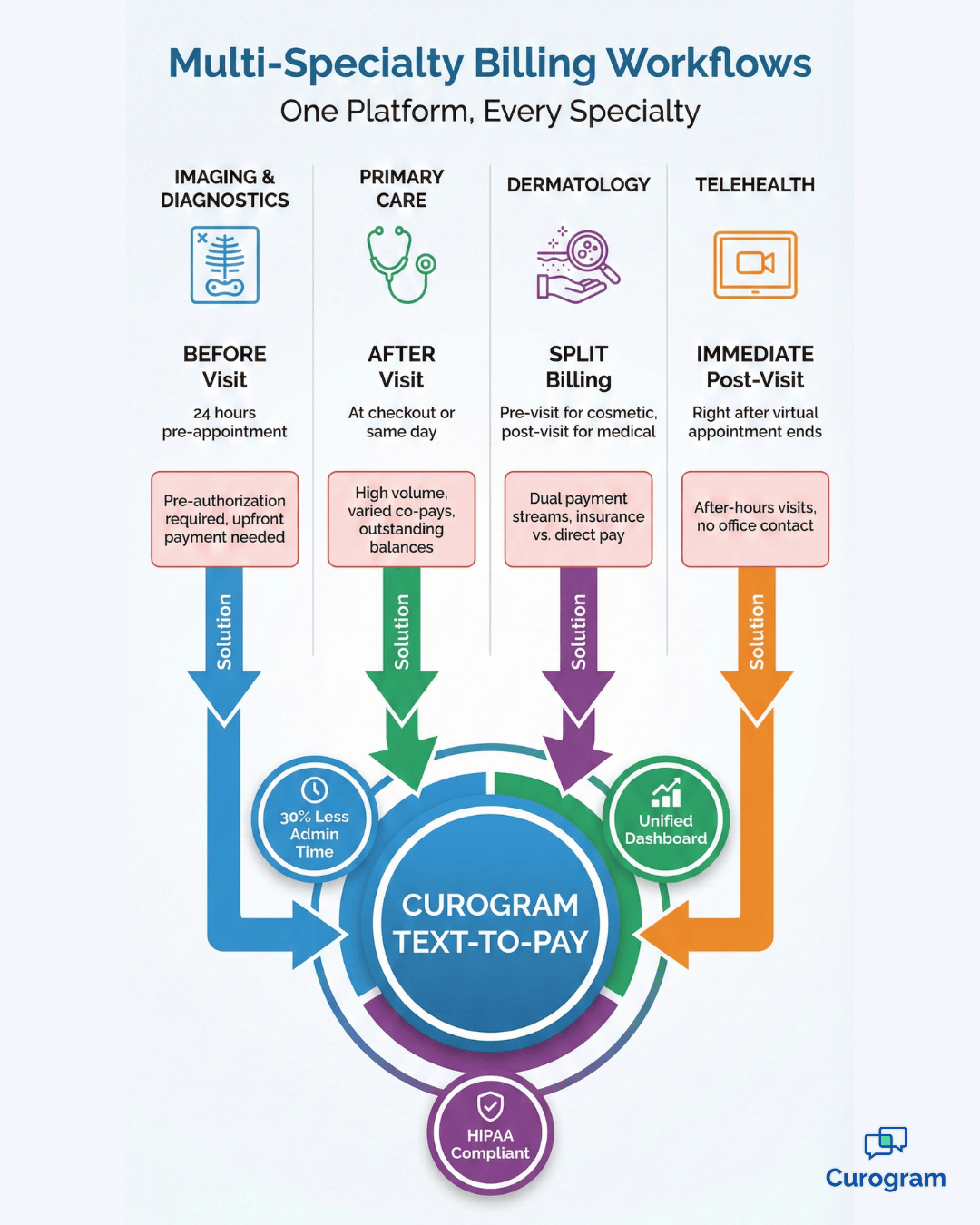
The platform uses flexible triggers that adapt to each specialty's needs. You configure when payment requests go out based on appointment type. Imaging sends pre-visit links. Primary care sends post-visit reminders. The system executes these rules automatically.
Patients can reply directly to payment text messages. These responses route to the appropriate department based on customizable rules. Staff see the question and can respond or call the patient as needed.
Initial training takes about 30 minutes per department. The interface is straightforward, and most staff pick it up quickly. Ongoing support is available whenever questions arise.
Most multi-specialty practices complete implementation in 2-4 weeks. This includes EMR integration, workflow configuration, and staff training across all departments.
💡Managing billing for different specialties in one practice is tough. Each department has its own workflow, and traditional systems can't keep up....

💡 A connected patient journey healthcare system brings all patient touchpoints into one platform.Curogram unifies reminders, online forms,...
💡Paper billing costs clinics around $7 per transaction once you account for printing, postage, and staff time. Text-to-pay reduces that cost to...