
Automate Your Front Desk: Patient Scheduling with Conversational AI
Explore how AI appointment booking improves healthcare workflow management for small clinics with real-world examples and tools.
10 min read

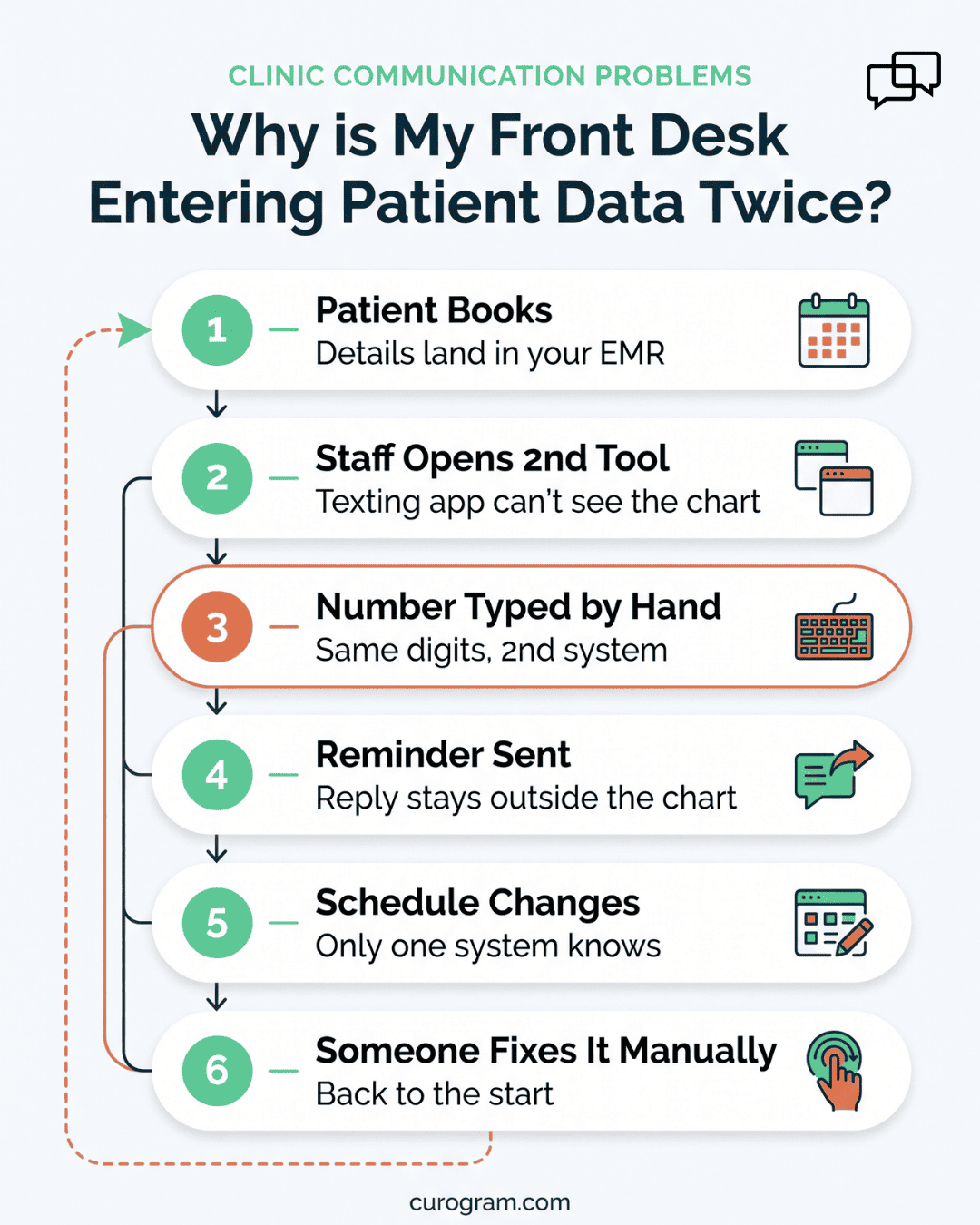
Your EMR knows the patient's phone number. Your texting tool needs it too. Somebody at the front desk opens both windows and types it across by hand, one patient at a time, between phone calls.
That copying step is the root of most healthcare communication problems, and it explains why buying another reminder service rarely moves your numbers. The four warning signs in this article all trace back to it.
The signs themselves are easy to miss because each looks like ordinary clinic life. Staff who seem busy are actually entering the same data twice.
Patients who call to ask what time their appointment is are answering a question your system should have answered first. A provider walking into an exam room without yesterday's intake form isn't disorganized. The form is sitting in a separate inbox that never wrote back to the chart.
No-shows are where the cost finally becomes visible. Atlas Medical Center sat at a 14.20% no-show rate before changing how it reached patients. Three months later it was 4.91%, based on our internal data.
Nothing about the practice changed except which system sent the reminder and whether the reply landed somewhere the schedule could see it.
The four sections ahead cover what each warning sign looks like from the front desk, what it costs across your schedule, payroll, compliance exposure, and patient retention.
Most clinics reading this already know which sign applies to them. The useful question is what it's been costing while it looked like normal operating friction.
Healthcare communication problems start when patient details, schedules, and care instructions stop moving cleanly between your staff, your systems, and your patients.
The causes are usually the same three: an EMR that doesn't connect with your messaging tool, workflows still built around the phone, and patient details living in two places.
Your front desk absorbs all of it — calling to confirm, calling again when nobody answers, then retyping a number out of the chart into a tool that can't read the chart. Every retyped field is a chance to get one digit wrong, and those hours come out of patient care time.
Clear communication sits at the core of safe care. The Joint Commission has identified communication failures as a leading cause of sentinel events in healthcare, the serious safety events that trigger a full review.
Clinic communication issues rarely surface that dramatically. They show up as patient communication issues first: the same question asked three times, prep instructions nobody received, a chart missing yesterday's intake form.
Patients expect texting now. Across our client practices, confirmation rates run above 75% once texting is in place, based on our internal data. Phone-only clinics rarely come close, and that gap is one of the clearest signs your clinic needs EMR integration.
Four patterns show up again and again in clinic communication issues. Each one is visible from the front desk before it ever reaches a report.
Your EMR holds the phone number. Your texting tool needs it too, and the two don't talk. So someone at the front desk opens both windows and types it across by hand, patient after patient, between calls. One transposed digit sends a reminder to a stranger.
That same copy-and-paste habit spreads. Intake answers get retyped into the chart. Appointment changes get entered twice, once in the schedule and once in the reminder list.
Staff spend their morning moving data instead of working with patients, and the check-in line gets longer while they do it. When your team is doing your software's job, that's one of the clearest signs your clinic needs EMR integration.
Count the calls that shouldn't need a person. What time is my appointment. Do I fast before this. Can I move to Thursday. Each one is a patient answering a question your system should have answered first.
Those calls stack. When a reminder never arrives, or arrives as a voicemail nobody plays, the patient picks up the phone instead — and your front desk fields the same three questions all morning. Patients read it as disorganization.
One practice using our reputation tools cut inbound calls by 24% over 22 months, based on our internal data, largely by moving routine questions off the phone.
Phone-only workflows keep clinic communication issues in a loop: fewer answered messages, more callbacks, less time for the patients standing at the desk.
The patient texted a schedule change on Tuesday. The chart still shows Thursday. Your provider walks in cold, and the patient has to explain it again.
Messages that live outside the chart don't reach the exam room. Intake forms filled out by text sit in a separate inbox. Follow-up confirmations land on a phone at the front desk.
Nothing wrong happened at any single step, yet the record your provider reads is a day or two behind the patient's actual situation.
That lag costs real time. A test gets reordered because the outside result never made it in. A prep instruction gets repeated because nobody can tell whether the first one landed.
Patients notice fast when they're asked the same question at every visit, and they read it as carelessness. A chart that can't see your own messages is one of the plainest signs your clinic needs EMR integration.
No-shows are where healthcare communication problems show up on the schedule. Without automated reminders or a simple way for patients to confirm, the rate climbs.
Atlas Medical Center sat at 14.20% before adding texting, based on our internal data. That's roughly one empty slot in every seven.
Run the math on a small practice. At 20 missed visits a month and $200 each, that's $48,000 a year in unfilled time — illustrative figures, but the shape holds at any size.
The cost isn't only money. A no-show at 10 a.m. means someone on your waitlist waits another three weeks, and your provider sits idle while the phone rings.
Patients notice the pattern too. A clinic that never confirms anything starts to look like a clinic that doesn't track anything, and that reputation follows you into reviews and referrals.
Most of this damage never lands in a single line item. It splits across four budgets — the schedule, payroll, your compliance exposure, and the patients who drift away without saying why.
Each one gets absorbed as normal operating cost, which is exactly why it goes unfixed for years. The four areas below are where that money and risk actually sit.
Start with the number that's easiest to see. A missed appointment costs somewhere between $150 and $300 in lost revenue, and at 20 no-shows a month that runs up to $72,000 a year. Treat both figures as illustrative — your specialty and payer mix will move them.
What makes the loss stick is timing. A cancellation three days out can be refilled. A no-show at 9:40 a.m. cannot, because the patient who would have taken that slot is at work and won't answer the phone.
Across our client practices, no-show rates run 53% below the industry average, based on our internal data. The difference is almost entirely in how early the clinic hears that a patient isn't coming.
Phone-heavy workflows show up on your payroll before they show up anywhere else. Covina Arthritic Clinic confirms more than 1,100 appointments a month by text, based on our internal data.
Picture that same volume as outbound calls. At two minutes per call, including voicemails and callbacks, you're looking at roughly 37 hours a month of pure dialing — illustrative math, but close enough to plan against.
That's most of a part-time position spent on a task no patient values. Practices often solve it by hiring another front desk person, which fixes the symptom at $30,000 or more a year.
Overtime creeps in during flu season and after holidays, when the confirmation list doubles and the same two people work it.

Compliance risk in clinic communication issues rarely comes from a dramatic breach. It comes from ordinary messages sent the wrong way. Billing details texted to a shared family phone. Medication instructions left on a voicemail anyone can play. Consent for texting that nobody logged.
Enforcement is real. The HHS Office for Civil Rights settled with Manasa Health Center for $30,000 after patient information appeared in the practice's responses to online reviews.
Texting adds its own rules: appointment reminders and marketing messages sit under different consent standards, and mixing them in one blast is a common mistake.
Unencrypted tools that were never covered by a business associate agreement leave you with no record of what was sent or who saw it.
Care quality erodes in small, hard-to-notice ways. A follow-up call never gets returned, so the patient doesn't reschedule. A referral goes out and nobody checks whether it closed. Chart notes stay incomplete because the message that would have updated them lived in a separate inbox.
Most patients don't complain about this. They just stop coming. Recall campaigns run through our platform have recovered 1,240 patients who had drifted out of care, at a 35% reconversion rate, based on our internal data.
Those patients were never angry. Nobody had contacted them in a year, and healthcare communication problems of that kind never surface in a satisfaction survey.
Fixing healthcare communication problems one tool at a time keeps failing for the same reason: each tool holds its own copy of the truth. Your reminder service doesn't know the appointment moved.
Your review platform doesn't know the visit happened. Integration removes the retyping step, so your staff work in a single interface that syncs with the EMR instead of switching between a phone list, an email client, and a reminder tool.
What that changes, with figures from our client practices:
| What improves | What actually changes | Result |
|---|---|---|
| No-shows | Patients confirm by text days ahead, so the slot can be refilled | Atlas Medical Center went from 14.20% to 4.91% in three months |
| Front desk hours | Confirmations run automatically instead of by phone | Covina Arthritic Clinic confirms 1,100+ visits a month |
| Compliance | Messages, consent, and opt-outs stay logged in one system | Full record of what was sent and to whom |
| Patient experience | Intake, reminders, and payment arrive on the phone patients already use | Confirmation rates above 75% |
Figures based on our internal data.
Intake is where you'll feel it first. Forms filled out by text land in the chart before the patient parks, so nobody re-keys an address at the window.
Billing follows the same path later. If your team is currently bridging those steps by hand, that's among the clearest signs your clinic needs EMR integration.
Curogram is a HIPAA-compliant 2-way texting platform that connects with almost any EMR. Messages, intake forms, reminders, payments, and review requests run through one screen, and what happens there writes back to the chart.
Nothing about it requires training your team to think like software. Your front desk sees a message thread, the same shape as the texting they already do.
You can watch this play out in Dr. Abraham Ishaaya’s practice, where fewer no-shows, more online bookings, and a steady run of five-star reviews all landed within a few months.
The same connection covers intake, scheduling, follow-up, and billing, so clinic communication issues don't get handed off between four tools that can't see each other.
|
What changes |
What our clients see |
|---|---|
|
No-shows |
Atlas Medical Center dropped from 14.20% to 4.91% in three months |
|
Confirmations |
Above 75% platform-wide; no-show rates 53% below industry average |
|
Phone volume |
One practice cut inbound calls 24% over 22 months |
|
Reviews |
1,064 new 5-star reviews in three months, about 90% five-star |
|
Lapsed patients |
1,240 recovered through recall campaigns, at a 35% reconversion rate |
Figures based on our internal data.
Collections move faster too, with text-to-pay driving a 40% increase in patient balance collections. One family practice reduced check-in times by 50% after switching to online intake forms.
Every message stays logged with consent and opt-out records attached, which is what keeps a texting rollout defensible if anyone asks.
Patients who get a confirmation, a form, and a payment link on their own phone tend to come back, and they tend to bring their referrals with them.

Most clinics don't have a communication problem so much as a copying problem. Your EMR knows the appointment.
Your reminder tool knows the phone number. Someone on staff moves information between them by hand, all day, and every one of those handoffs is a place where a patient falls through.
That's why buying another standalone tool rarely helps. A better reminder service still can't see that the visit moved.
What changes the numbers is one system writing back to the chart, so the confirmation, the intake form, and the payment all land in the same place your provider is already looking.
The practices that fixed this didn't overhaul anything. Atlas Medical Center cut no-shows from 14.20% to 4.91% in three months by sending reminders patients would actually answer, based on our internal data. Covina Arthritic Clinic confirms more than 1,100 visits a month without adding a person to the front desk.
You already know which of the four signs applies to you. If your team is retyping phone numbers between windows, or your no-show rate has sat in double digits for two years, clinic communication issues are costing you more than the software would
Book your free demo today and bring your worst week's schedule. We'll show you where the missed appointments were reachable.

Explore how AI appointment booking improves healthcare workflow management for small clinics with real-world examples and tools.
Learn how two-way SMS can streamline telehealth, boost patient communication, and ensure HIPAA compliance for your care practice with an actual case...
.jpg?width=30&name=square-formal-photo%20(1).jpg) Mira Gwehn Revilla : 10/7/26, 5:00 PM
Mira Gwehn Revilla : 10/7/26, 5:00 PM
Learn 8 ways HIPAA-compliant patient texting streamlines EHR workflows for medical practices, from reduced no-shows to faster care coordination.