9 min read

The Self-Healing Schedule: 2-Way Texting Waitlist Workflow for Fusion

The Self-Healing Schedule: 2-Way Texting Waitlist Workflow for Fusion
💡 When a child misses a therapy appointment, two things happen at once: your clinic loses revenue, and a child waiting for care loses another week.            

That empty slot is one of the most costly — and most preventable — problems in pediatric therapy scheduling.    

Curogram's 2-way texting waitlist integration for Fusion Web Clinic gives front office teams a fast, simple way to fill those gaps. Staff identify eligible families directly from the Fusion waitlist and send a single group text.    
 

The first parent to reply claims the slot. No phone calls. No voicemails. No wasted time.

Based on our internal data, clinics using this approach see a 10-20% increase in recovered revenue.

It supports smarter pediatric therapy waitlist management, improves therapist utilization, and takes real pressure off your front desk — all without adding more work to anyone's day.


A cancellation at 4 PM on a Tuesday might seem like a small problem. But in a pediatric therapy clinic, that empty slot is often the hardest one to fill — and the most expensive one to lose.

After-school hours are the most in-demand time in pediatric therapy. Families compete for these slots because they're the only time children can come in without missing school.

When a last-minute cancellation opens up during those hours, you have a very short window to recover it. If your team is stuck making phone calls down a list, that window closes fast.

This is the daily reality for most pediatric clinic owners and front office managers. The waitlist exists. The families are there. The problem is reaching them quickly enough — and in a way that actually gets a response.

That's exactly what Curogram is built to solve. As a 2-way texting waitlist integration for Fusion Web Clinic, Curogram gives your staff the ability to reach multiple waitlisted families at once with a single, targeted text message.

No dialing. No voicemails. No waiting for callbacks that never come.

Fusion Web Clinic already tracks your waitlist data with precision. It knows who is waiting, for which therapist, and for what service. But when a slot opens unexpectedly, that data needs a fast delivery system.

Curogram is that system — connecting your Fusion waitlist to a direct, real-time text conversation with parents and turning a slow, manual process into something that works like a self-healing schedule.

The result?

A slot that would have gone empty gets filled, often in under three minutes. A child on the waitlist gets the care they need sooner. And your clinic keeps its revenue where it belongs.

This article walks through exactly how this workflow operates, why it matters for pediatric practices, and what it means for your schedule, your staff, and the children you serve.

Why a Late-Afternoon Cancellation Hits Pediatric Clinics the Hardest

The hours between 3 PM and 6 PM are the most coveted time on any pediatric therapy schedule. These are the slots parents request first, fight hardest to keep, and give up last.

A cancellation during this window doesn't just cost you one session's revenue — it often leaves a hole that stays empty for the rest of the day because there's simply no time to fill it the traditional way.

When a slot opens, most front desk teams do what they've always done: start calling down the waitlist.

They leave voicemails. They wait. They call again.

By the time a parent calls back, it's often too late to make it in — or another family has already claimed the spot. This phone tag trap is one of the biggest drivers of therapy revenue loss in pediatric practices, and it's almost entirely a speed problem, not a demand problem.

The demand is there.

The families are waiting. But the tool being used to reach them — a single phone call made one at a time — moves far too slowly for a same-day fill.

Front desk staff end up spending the better part of an hour on a task that may still produce no result. Meanwhile, the schedule sits open and the clock keeps moving.

The Two Costs Behind Every Unfilled Slot

A missed session doesn't end at lost revenue. There's a second cost that's harder to see on a spreadsheet — and often more significant in the long run.

  • Revenue loss: An unfilled after-school slot is money that can't be recovered. One empty slot per day, five days a week, adds up to a meaningful annual shortfall — per therapist.
  • Clinical setback: Every week a child sits on a stagnant waitlist is another week without progress toward the goals documented in their Fusion care plan. Developmental gaps don't pause for an empty schedule.

These two costs are connected.

When clinics struggle to fill pediatric therapy cancellations quickly, they don't just lose billing — they lose the continuity of care that makes therapy effective in the first place.

The child falls behind. The family grows frustrated. And the clinic's reputation as a responsive, reliable provider takes a quiet hit that's hard to measure and harder to reverse.

The good news is that both problems have the same fix: a faster, more direct way to reach the families who are already waiting. That's the gap Curogram fills.

Based on our internal data, practices that implement a faster waitlist outreach process see a 10-20% increase in recovered revenue — driven entirely by filling slots that would otherwise go empty.

How Curogram Turns Your Fusion Waitlist Into a Same-Day Scheduling Tool

Fusion Web Clinic already does the heavy lifting on the clinical side. It tracks who is on the waitlist, which therapist they need, and what services they're waiting for.

That data is carefully maintained and genuinely useful — but only if there's a fast enough way to act on it when a slot opens without warning.

This is where the Fusion Web Clinic scheduling workflow gets a meaningful upgrade.

Curogram sits alongside Fusion as a communication layer, giving your front desk the ability to turn waitlist data into immediate outreach. Instead of picking up the phone and calling families one by one, staff can reach the right people all at once — and hear back within seconds.

Infographic showing peak cancellation hours in pediatric therapy scheduling

The Three-Step Process That Fills a Slot in Minutes

  • A cancellation opens. Staff pull up the Fusion waitlist and identify the five to ten families who are eligible for that specific time slot and service type.
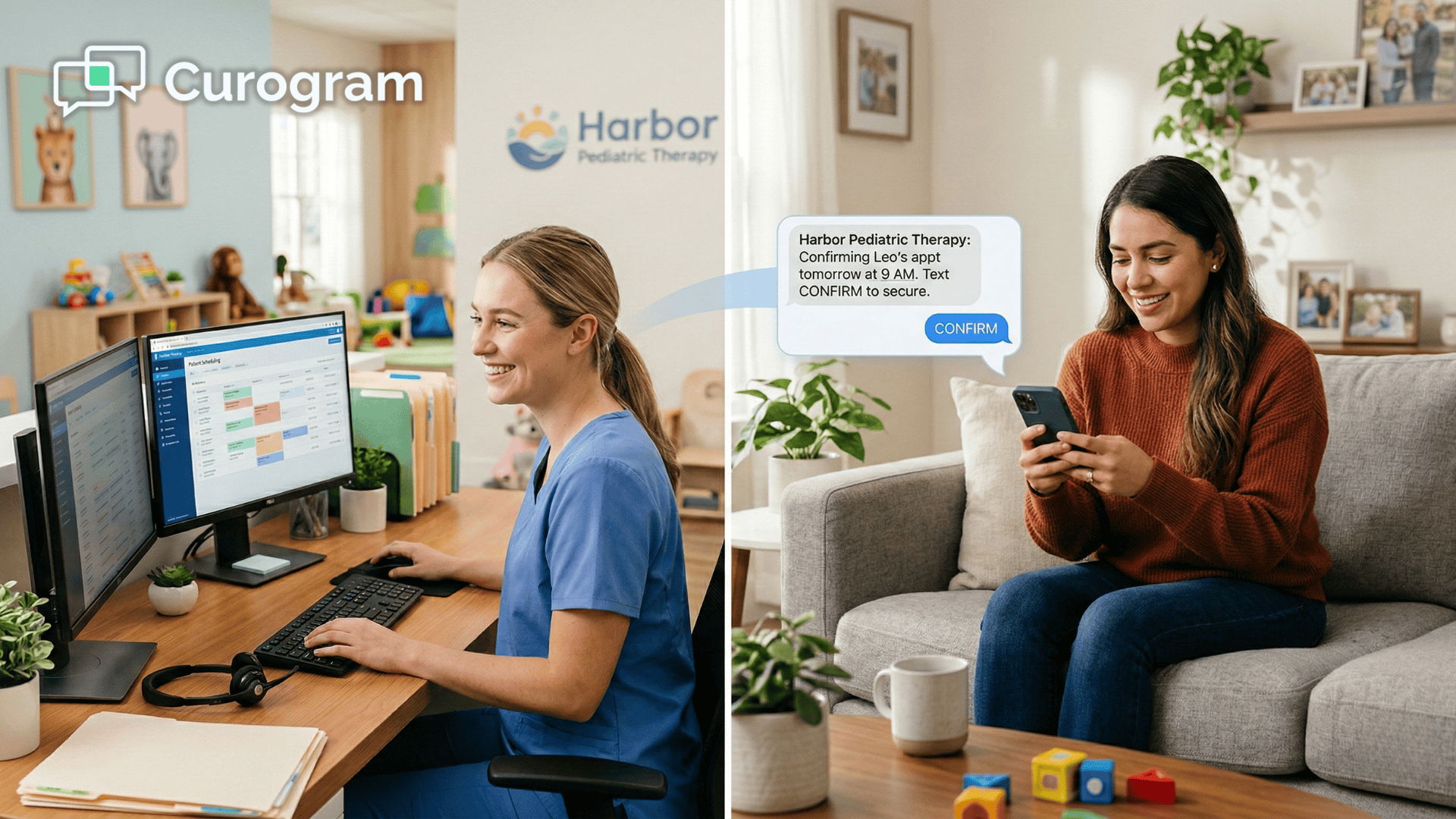
  • Curogram sends a single, simultaneous text to all of them: "We have a 4 PM OT opening today. First to reply 'YES' gets it!"
  • The first parent to respond claims the spot. Staff update Fusion. Done — usually in under three minutes.

No phones. No voicemails. No callbacks to manage. T

he entire outreach happens in a single step, and the schedule is healed before the slot goes cold.

Think of it this way:

Fusion is the data source, and Curogram is the action layer that activates it. Fusion holds the precise information your team needs — who is waiting, for how long, and for what.

Curogram delivers that information directly to parents at the speed of a text message. Together, they close the gap between "we have a waitlist" and "the slot is filled."

This approach is also what makes meaningful pediatric manual waitlist automation possible without replacing your existing systems.

You're not rebuilding your workflow from scratch.

You're adding one fast, direct step that handles the part of the process that was always the bottleneck: actually reaching people.

Clinics that adopt this method often find that the shift feels almost surprisingly simple. Staff stop dreading last-minute cancellations because they know exactly what to do and how quickly it works.

The process becomes repeatable and low-stress — which matters a great deal in a front office environment that already has a full plate.

Phone Calls vs. Text-Based Outreach: A Quick Comparison

  Phone Call-Down Group Text via Curogram
Time to fill a slot 20–30 minutes Under 3 minutes
Staff effort required High — one call at a time Minimal — one text to all
Parent response rate Low — voicemails rarely returned High — text replies are instant
Works for same-day fills? Rarely Consistently
Staff experience Stressful and time-consuming Quick and low-pressure

What a Full Schedule Does for Your Revenue — and Your Therapists

A single unfilled slot might look like a small loss in the moment. But when you add up missed sessions across a week, a month, and a full year, the picture changes fast.

A pediatric therapy practice that fills just one additional cancellation per day can recover more than $30,000 in annual revenue per therapist.

That's not a rounding error — that's a real, recurring financial impact that compounds quietly in the background of every schedule that runs below capacity.

The math behind therapist utilization in pediatric therapy is straightforward but easy to underestimate.

Overhead costs — rent, salaries, equipment, billing — stay fixed regardless of how many sessions are actually delivered. When utilization drops, even slightly, those fixed costs don't shrink to match.

Revenue falls while expenses hold steady. The margin tightens, and over time that tightening becomes a structural problem rather than an occasional inconvenience.

Most clinic owners know this intuitively. What's less obvious is how much of the utilization gap is driven not by a shortage of willing patients, but by the inability to reach them fast enough when a slot opens. The families are there.

The demand is real. The bottleneck is the outreach process — and that's entirely fixable.

Mother receiving a waitlist text from her child's pediatric therapy clinic

Three Ways a Full Schedule Pays Off

  • Revenue protection: Each recovered slot translates directly to profitability. Based on our internal data, clinics consistently see a 10-20% improvement in recovered revenue when they reduce therapy revenue loss by filling cancellations faster.
  • Therapist utilization: When therapists are fully scheduled, overhead stays covered and the clinic runs at peak capacity. Even a small, sustained improvement in fill rates can meaningfully shift the financial picture over a quarter.
  • Plan of Care integrity: Fusion Web Clinic is built around structured, goal-driven therapy plans. Every missed session is a gap in the prescribed dosage — and gaps compound over time, slowing progress and extending the overall duration of care.

This is where a faster, text-driven approach to filling pediatric therapy cancellations pays for itself many times over. The clinic recovers revenue that would have been permanently lost. Children receive the consistent care their plans call for.

And front desk staff aren't starting every afternoon in damage-control mode, burning time on a phone process that rarely produces a same-day result.

There's a clinical dimension here that deserves to be named plainly. The Plans of Care documented in Fusion aren't suggestions — they reflect clinical judgments about what a child needs to make progress.

When the schedule stays full, those plans get executed as designed.

When it doesn't, the gap between what was planned and what was delivered widens quietly, session by session, week by week.

Keeping the schedule full isn't just a revenue strategy.

It's a clinical responsibility — and one that a single well-timed text can help your team meet every single day.

Revenue Recovery Snapshot: What One Filled Slot Per Day Can Mean

Scenario Estimated Impact
1 filled cancellation/day per therapist $30,000+ in recovered annual revenue
Time to fill a slot via phone ~20–30 minutes
Time to fill a slot via group text Under 3 minutes
Revenue impact with 10-20% slot recovery Directly contributes to clinic profitability (based on our internal data)


When Texting Is Easier, Parents Actually Respond

Parents of children in pediatric therapy juggle school schedules, sibling activities, insurance paperwork, and therapy logs — all alongside work.

Voicemails are easy to miss or forget, and returning calls within a narrow window can be impossible. Texts, sent via HIPAA compliant texting, let parents respond while in the school pickup line, between meetings, or during a five-minute break.

A quick reply secures the spot immediately, which is why text-based outreach consistently outperforms phone calls for same-day scheduling.

Most parents today grew up texting. SMS is their default communication mode, not an alternative. Phone calls can feel like interruptions; texts feel like conversations.

Why the “First to Reply” Model Builds Trust

Parents on a waitlist have often been waiting weeks or months. Receiving a text offering first access to a prime-time slot shows your clinic is attentive and values their time.

The “first to reply wins” format keeps the process transparent and gives parents control, turning a passive wait into an active, positive experience.

This approach also creates a light sense of urgency — energizing rather than stressful. Parents feel empowered, and clinics benefit from improved loyalty and word-of-mouth referrals.

For staff, group texts reduce pressure: what once took 30 minutes of phone calls now takes seconds, freeing teams to focus on families, authorizations, and other essential tasks.

Stop Losing Ground to Empty Slots — Let's Fix That Together

Every unfilled cancellation in your pediatric therapy clinic is more than a gap on the schedule. It's a missed session for a child who needs it. It's revenue that doesn't come back.

And it's a few more minutes of stress for a front desk team that already has too much on its plate.

The good news is that this is a solvable problem — and you don't need to overhaul your systems to fix it. Curogram works alongside Fusion Web Clinic as a lightweight, powerful action layer that turns your existing waitlist data into fast, effective outreach.

Your staff sends one text. The right family replies. The slot gets filled.

Practices that make this shift see meaningful results quickly. Based on our internal research, clinics recover 10-20% in lost revenue simply by reaching waitlisted patients faster.

That's not a future goal — it's a near-term reality for practices that make the switch.

Reducing therapy revenue loss doesn't require a new EMR, a large budget, or months of implementation. It requires a smarter way to communicate with the parents who are already waiting to hear from you.

Curogram gives your team that capability in a tool that is simple to learn and even simpler to use.

If your clinic is running Fusion Web Clinic and dealing with same-day cancellations you can't fill fast enough, we'd love to show you exactly how this works in practice. The workflow is straightforward, the results are real, and the setup is fast.

Schedule a demo today and see how Curogram's 2-way texting integration can help your team fill cancellations in minutes, protect your schedule, and keep more children on track with their care — starting right away.


Frequently Asked Questions

Does Curogram automatically pull the waitlist from Fusion?

Curogram provides the 2-way SMS interface your staff needs to reach waitlisted families fast. Your team identifies the best candidates directly from the Fusion waitlist, then uses Curogram to send a targeted group text. The process is simple and takes only seconds — it doesn't require automated syncing between the two platforms to be effective.

Won't parents be annoyed if multiple families get the same text?

Not when it's framed the right way. A "first to reply wins" message creates a clear, transparent process that parents actually appreciate — especially when they're trying to secure a high-demand after-school slot. It feels fair, not spammy. Parents on a pediatric therapy waitlist understand that open slots are competitive, and most welcome the heads-up.

How does this help with clinical regression?

Every week a child spends on a stagnant waitlist is a week without progress toward the goals in their Fusion care plan. By filling gaps faster, you get children into therapy sooner — reducing the risk of developmental setbacks caused by prolonged breaks in treatment. A full schedule isn't just better for revenue. It's better for outcomes.

Is this compliant with HIPAA?

Yes. Curogram is built as a HIPAA-compliant communication platform. All patient messaging through the system is handled in accordance with applicable privacy regulations, so your team can use it for outreach with confidence.

How quickly can a clinic get started with Curogram?

Setup is fast. Curogram integrates with Fusion Web Clinic without requiring major changes to your existing workflow. Most practices are up and running quickly, and the platform is designed to be straightforward enough that front desk staff can begin using it with minimal training.