
GE Centricity Appointment Reminders: Reduce No-Shows With Curogram
💡 GE Centricity specialty clinics face ongoing challenges with patient no-shows and incomplete appointment preparation. Automated appointment...
12 min read
Aubreigh Lee Daculug
:
March 5, 2026
Table of Contents
If you run a pediatric therapy clinic on Fusion Web Clinic, you already know the drill. A parent misses an appointment, the child loses a week of progress, and your front desk team scrambles to fill the gap. It happens more often than it should.
The real problem is not careless parents. It is the way most clinics try to reach them.
Patient portals were built for a world where people sit at desktops and check email. That is not the world of a parent managing speech therapy, occupational therapy, school pickups, and a toddler who just discovered the dog's water bowl.
These parents live on their phones. They read text messages within minutes.
But most clinics are still leaving voicemails that sit unanswered for days. The gap between how clinics communicate and how parents actually respond is where appointments go to die.
Fusion Web Clinic 2-way texting for pediatric parents through Curogram closes that gap. Instead of forcing families through a portal login wall, Curogram meets them where they already are—their text inbox.
Parents can confirm appointments, ask quick questions, and complete intake forms, all from the same screen they use to text their family.
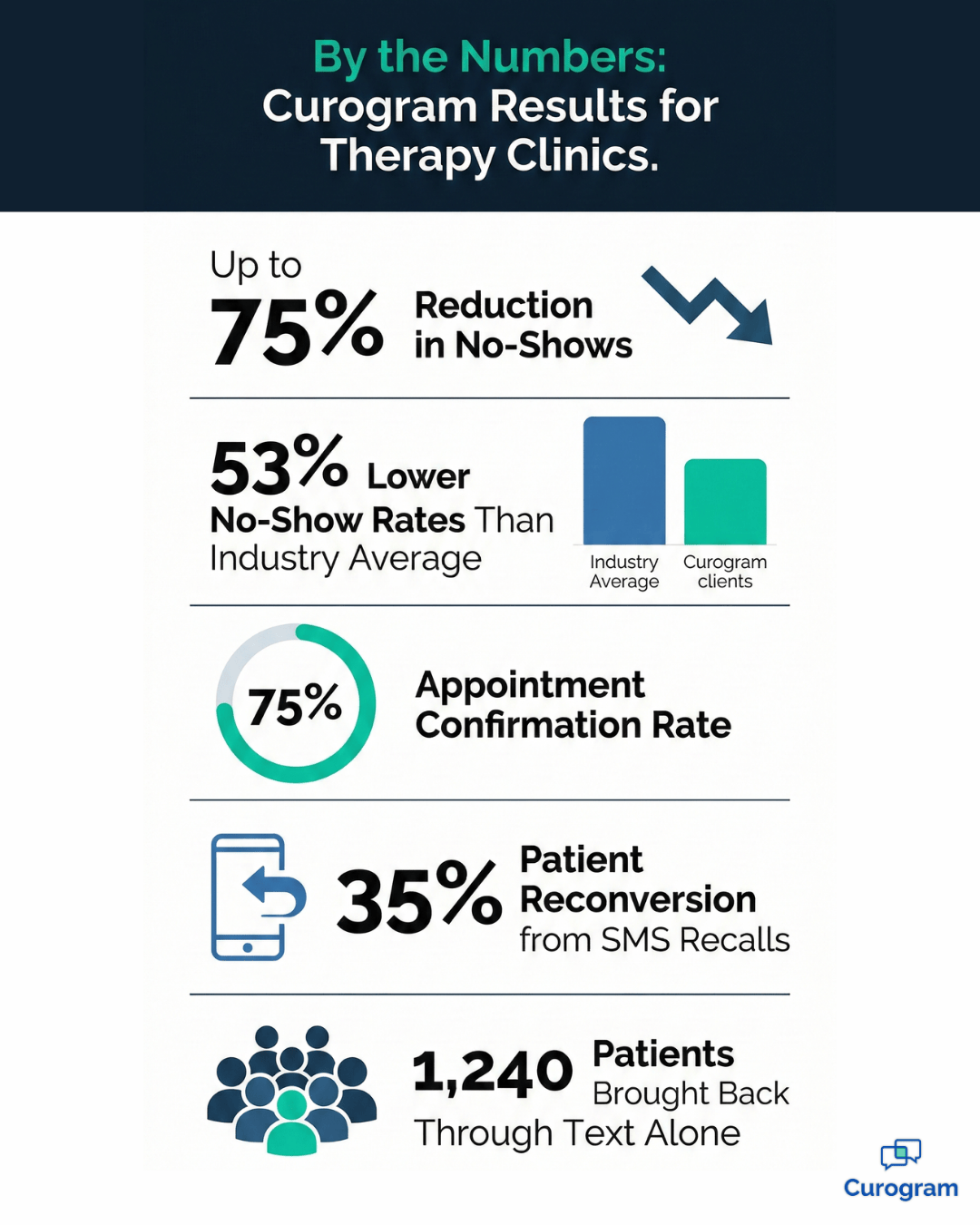
The results speak for themselves. Based on our internal research, clinics using Curogram's automated reminders and 2-way texting see no-show rates drop by up to 75%.
One practice cut their rate from 14.20% to 4.91% in just three months—a result that is three times better than the industry average.
This article shows you exactly how Curogram works with Fusion Web Clinic to keep your schedule full, your staff sane, and your young patients on track.
If pediatric therapy SMS engagement is what your practice needs, keep reading.
Let's be honest about something. Patient portals are useful for certain tasks—reviewing billing history, signing long-term consent forms, or checking lab results.
But for the fast-paced, day-to-day communication that pediatric therapy clinics depend on, they create more friction than they solve.
The idea behind portals made sense at the time. Give patients one secure place to manage their healthcare, and everyone benefits. But that vision assumed patients would check their portal the way they check their email—regularly, from a computer, with time to spare.
For most people, that assumption was already shaky. For pediatric therapy parents, it falls apart completely.
Think about the parents you serve. Many of them are managing multiple therapy schedules for children with special needs.
They are juggling occupational therapy on Monday, speech on Wednesday, and physical therapy on Friday. Their days are a kind of logistical chaos that does not leave time for remembering portal passwords.
Some of these parents are also coordinating with schools, insurance companies, and other specialists. They might have two or three portals for different providers, each with its own login and its own notification system.
Asking them to add one more step to an already packed routine is asking for dropped balls.
When a parent has to download an app, create an account, and log in just to confirm a Tuesday appointment, most of them simply will not do it. That is not laziness. It is a barrier that your practice placed in their path without meaning to.
Portal designers built these systems with adult patients in mind—people managing their own care on their own schedule. Pediatric therapy parents are different.
They are managing someone else's care while also running a household, working a job, and keeping track of multiple children. The extra steps that a portal demands are the exact steps these parents cannot afford.
The damage from portal friction shows up in places most clinic owners do not immediately connect.
Here is what it looks like day to day:
These costs stack up fast. A clinic with 200 weekly appointments and a 15% no-show rate is losing 30 sessions every single week. That is lost revenue, lost progress for children, and lost morale for a staff that worked hard to build those treatment plans.
And the ripple effect goes beyond your walls.
When a child misses therapy consistently, it can delay milestones that are tied to school readiness, social development, and family wellbeing.
The stakes are higher in pediatrics than in almost any other specialty, and a clunky communication system makes the problem worse.
The parents who want to bypass the Fusion patient portal are not ignoring their child's care. They are overwhelmed by a system that was not designed for how they live.
If your practice wants to reduce pediatric no-shows, the first step is meeting families on the device they actually use—their phone.
A common concern when adding a new tool is whether it will replace or disrupt what already works. With Curogram and Fusion Web Clinic, that is not the case.
Each platform does what it does best, and together they cover the full picture of pediatric clinic operations.
Most clinic owners have spent years building their workflow around Fusion.
Their therapists know where to find the data they need, how to enter documentation, and how to pull reports. Asking them to switch systems or learn a new clinical platform would be disruptive and unnecessary. That is not what Curogram asks you to do.
Think of Fusion as the vault.
It is where your therapists store clinical documentation, track developmental milestones, write SOAP notes, and manage treatment plans.
Fusion is the source of truth for everything clinical. Nothing about that changes when you add Curogram.
Curogram is the door.
It handles the high-frequency, quick-touch interactions that keep parents connected and your schedule running smoothly.
Appointment confirmations, reschedule requests, quick questions from a worried mom—these are the interactions that happen dozens of times a day.
They do not need to go through a clinical portal. They need to happen fast, through a text message.
The distinction matters because it protects what your therapists already depend on. Fusion's documentation, goal tracking, and reporting stay untouched.
There is no migration, no data transfer, and no learning curve on the clinical side. The only thing that changes is how your front desk and your parents talk to each other.
When both tools work in their lane, your clinic runs more smoothly than either tool could deliver on its own.
The clinical data stays rich and accurate inside Fusion. The communication stays fast and frictionless through Curogram. And the two stay connected, so nothing falls through the cracks.

What makes this pairing powerful is how Curogram syncs information back to Fusion automatically.
When a parent confirms an appointment by text, that response is logged. When an intake form is completed through a mobile link, the data flows back into the Fusion record as a PDF.
Your medical record stays current without staff having to manually scan or enter anything.
This means your therapists walk into every session with complete, up-to-date information. The intake forms are already attached. The appointment status is already confirmed. There are no sticky notes, no verbal handoffs, and no guessing about whether a parent is actually coming.
For clinic managers, the write-back also simplifies auditing and compliance.
Every interaction is documented automatically, which means your records are always audit-ready without anyone on staff doing extra work. That kind of passive documentation is rare in healthcare, and it saves hours every week.
This write-back capability means that adding Curogram does not create a second system to manage. It creates a communication layer on top of the clinical system you already trust. OTs and PTs get the engagement they need from parents.
Clinic owners get a fuller schedule. And nobody has to choose between convenience and compliance.
From the first intake form to the follow-up message after a tough session, every interaction between your clinic and a family shapes their experience. Here is how Curogram changes each of those moments for the better.
Most pediatric clinics think of the patient journey as something that starts when the child walks through the door.
But for parents, the journey starts much earlier—with the first reminder, the first form, and the first time they realize how easy or how difficult your clinic is to communicate with. Those early moments set expectations for everything that follows.
Pediatric intake paperwork is more complex than most specialties. Expecting a parent to complete all of it on a clipboard while managing an anxious child in a waiting room is a recipe for incomplete forms and frustrated families.
The documents they need to fill out are not simple—they often include:
Many of these forms require thoughtful answers that parents cannot rush. They need to recall specific developmental timelines, medication histories, and behavioral patterns.
Filling all of that out under fluorescent lights while their child pulls magazines off a shelf is not exactly a recipe for accuracy.
With mobile intake forms for Fusion Web Clinic through Curogram, you send a text link before the appointment. Parents complete everything on their phone at home—during naptime, after bedtime, whenever works for them.
The completed forms sync directly back to the Fusion record, ready for the therapist to review before the session starts.
The difference this makes on appointment day is hard to overstate. The therapist is prepared. The parent is relaxed.
And the child's first experience at your clinic is not sitting in a waiting room while their caregiver fills out 12 pages of paperwork. That kind of first impression sets the tone for the entire care relationship.

Every pediatric clinic owner knows the golden time slots:
3 PM to 6 PM, when kids are out of school. These are the most valuable hours on your schedule, and a single cancellation during this window hurts.
Traditional methods of filling a last-minute opening—calling down a waitlist one by one—take too long.
Think about the math.
If your front desk starts calling at 1 PM after a cancellation, they might reach five parents in 45 minutes—assuming anyone picks up.
By the time someone says yes, the slot might already be too close to fill. The child on your waitlist misses an opportunity, and your clinic eats the lost revenue.
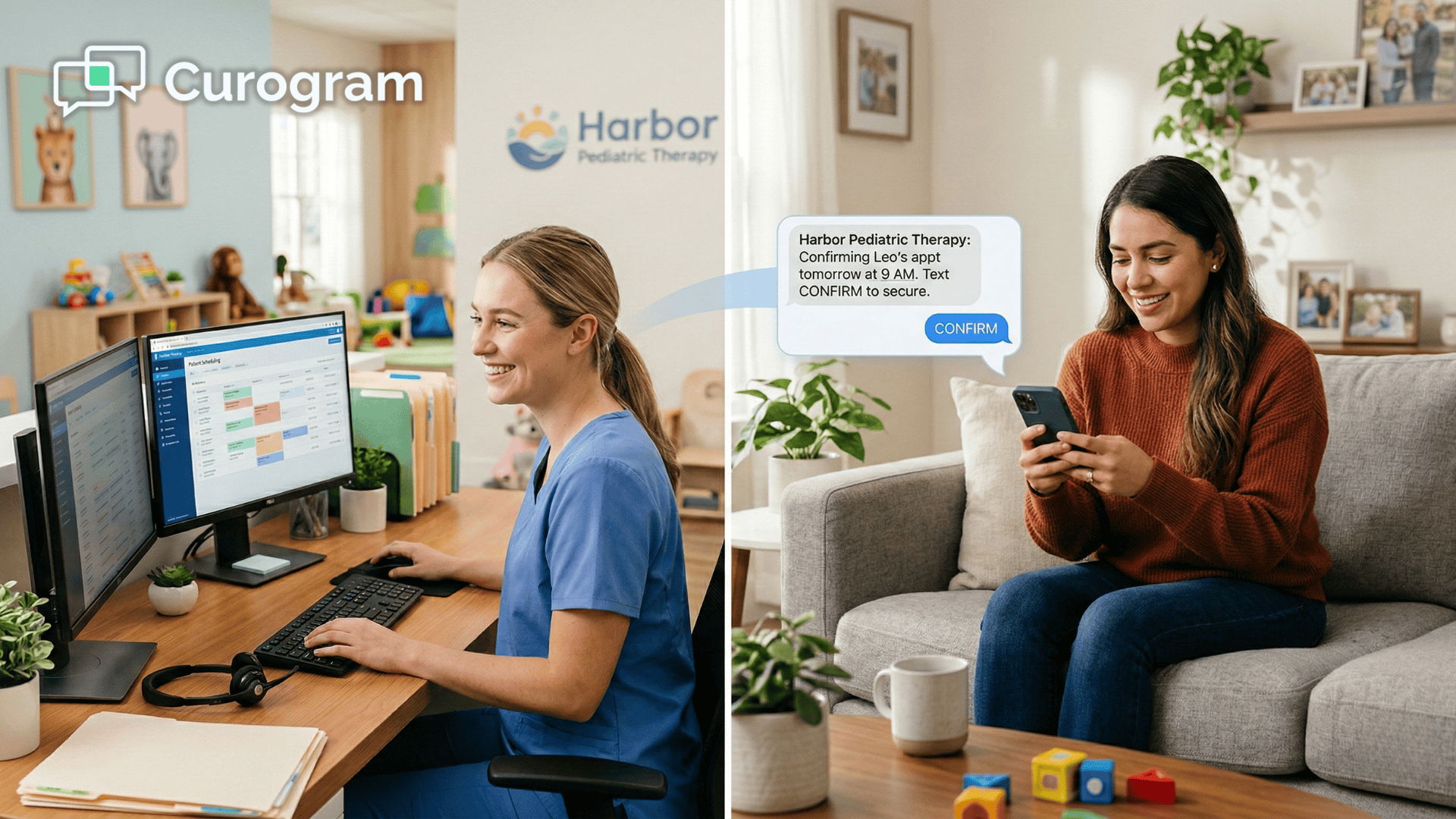
Curogram's 2-way SMS lets you message your entire waitlist at once. The first parent to reply "Yes" gets the slot. What used to take 45 minutes of phone calls now takes seconds.
Based on our internal data, practices using automated reminders and two-way texting see average appointment confirmation rates above 75%, which means fewer empty chairs during peak hours.
For many pediatric clinics, those after-school hours represent the majority of their revenue. Protecting that window is not just about efficiency—it is about keeping your practice financially healthy. A smart waitlist powered by text messaging does what phone calls simply cannot do fast enough.
Pediatric therapy is personal. Parents are trusting your team with their child's development, and many of them carry guilt about whether they are doing enough.
A simple follow-up text—"How is Mia doing after today's session?"—takes seconds to send but can build the kind of loyalty that lasts for years.
These small moments of connection add up. A parent who feels that the clinic genuinely cares about their child outside of the appointment room is a parent who keeps coming back.
They are also a parent who talks—to other families at school, in Facebook groups, and at support groups for children with special needs.
Word of mouth is the most powerful referral channel in pediatric therapy. Parents of children with special needs tend to form tight communities, and a recommendation from a trusted friend carries more weight than any ad.
When your clinic is known as the one that is easy to communicate with, those referrals come naturally.
This level of pediatric therapy SMS engagement turns your clinic from a service provider into a trusted partner.
Parents who feel seen and supported are the ones who leave five-star Google reviews and recommend your practice to every parent in their circle. They become your most powerful marketing channel, and it starts with a text.
Curogram was not built as a generic messaging tool and then adapted for healthcare. It was designed from the ground up for medical practices, and many of its features map directly to the daily needs of pediatric therapy clinics.
That distinction shows up in the details. Other texting platforms might let you send a message, but they do not understand the workflow of a therapy clinic that sees 40 kids a day across three disciplines.
Curogram does, and it was built to handle exactly that level of complexity without making things harder for your staff.
What separates a healthcare communication platform from a regular texting app is not just encryption.
It is the understanding that every message might involve protected health information, that multiple providers might need to see the same conversation, and that the response needs to end up in the right patient record. Curogram was built with all of that in mind from the start.
The first thing parents notice is that Curogram requires no app download. If a parent can text their family, they can text your clinic. That simple fact removes the single biggest adoption barrier for busy caregivers.
Beyond that, the tools your staff gets are built for how therapy clinics actually operate:
Each of these tools works within the same simple interface.
Your staff does not need to switch between platforms or learn a new piece of software for each task. Everything lives in one place, which means less training and fewer mistakes.
The shared inbox deserves special attention because it solves a problem that many therapy clinics do not talk about openly. When therapists use their personal phones to text parents—even with good intentions—it creates compliance risks and blurs professional boundaries.
Curogram gives every provider a way to communicate quickly without ever sharing a personal number.
Every message sent through Curogram is encrypted and fully compliant with HIPAA and SOC 2 standards. Your practice gets the convenience of modern SMS without any risk to patient privacy or protected health information.
For clinics that work with children who have special needs, this level of security is not optional—it is essential.
Parents trust you with sensitive information about their children every day. Diagnostic details, behavioral concerns, medication changes—these are not the kinds of things that should travel over an unsecured channel. Curogram makes sure they never do.
Compliance is handled behind the scenes so that your staff never has to think about it. There are no extra steps, no encryption toggles, and no disclaimers to add before sending a message.
The system is secure by default, which means your team can focus on communicating with parents instead of worrying about regulations.
All of these features work together to create a communication system that feels effortless for parents and efficient for staff. There is no steep learning curve. Training takes about 10 minutes, and your team can be up and running the same day.
Pediatric therapy works best when it is consistent. A child who attends every session, week after week, makes the kind of progress that changes lives. But consistency depends on communication—and that is exactly where most clinics lose families.
You already have the clinical tools you need in Fusion Web Clinic. Your therapists are skilled. Your treatment plans are solid. The missing piece is a communication system that actually matches how parents live today. That is what Curogram provides.
With Curogram's Fusion Web Clinic 2-way texting for pediatric parents, your practice can reach families through the one channel they never ignore—text. Appointment reminders go out automatically.
Parents confirm with a single tap. Intake forms get completed before the visit even starts. And when a cancellation opens up that coveted after-school slot, your waitlist fills it in minutes, not hours.
The numbers back it up. Based on our internal research, practices using Curogram see no-show rates drop by up to 75%. One clinic went from a 14.20% no-show rate to 4.91% in just three months.
Another saw 35% of patients who received SMS recall messages schedule an appointment within a month—bringing back over 1,240 patients through text alone.
Your young patients deserve every session on their care plan. Their parents deserve a clinic that makes it easy to show up. And your staff deserves to spend their time on patient care, not phone tag.
Curogram offers a free 30-day trial with no setup fees and training that takes just 10 minutes. There is nothing to lose and a full schedule to gain.
Schedule a demo today and see how 2-way texting can transform your pediatric therapy practice.
No. Fusion Web Clinic remains your clinical source of truth for documentation, billing, and treatment planning. Curogram serves as a notification and engagement layer that handles daily parent communication. It only drives parents to the portal when they need to access formal documents like billing history or long-term consent forms.
With 2-way SMS, parents can reply to confirm or reschedule an appointment in seconds—right from their lock screen. There is no app to open and no portal to log into. This prevents the "forgotten appointment" that leads to missed sessions and therapy regression. Based on our internal data, clinics using Curogram see no-show rates that are 53% lower than the national average.
Yes. Curogram lets you send mobile-friendly links for any intake form, including complex pediatric assessments like Sensory Profiles and developmental questionnaires. Parents complete them on their phone, and the finished form syncs back to the Fusion record as a PDF. No printing, no scanning, and no lost paperwork.
Absolutely. Curogram is fully HIPAA compliant and SOC 2 certified. Every message is encrypted, and your practice maintains total control over what information is shared via text. Protected health information stays protected.
Setup is fast. Most clinics are up and running within a day. Staff training takes about 10 minutes because the interface works just like regular texting. There is no complicated software to learn and no lengthy onboarding process.
💡 GE Centricity specialty clinics face ongoing challenges with patient no-shows and incomplete appointment preparation. Automated appointment...
💡 Improving patient engagement for CharmHealth practices starts with removing the biggest roadblock: the patient portal itself.Most patients never...
💡 Multi-location specialty clinics using GE Centricity face workflow problems in radiology, vascular, and interventional procedures. For vascular...