

9 min read

Fill Cancellations Fast: 2-Way Texting Waitlist Integration for WebPT

Fill Cancellations Fast: 2-Way Texting Waitlist Integration for WebPT
💡 High-volume rehab clinics lose $80–$120 or more every time a patient cancels and the slot stays empty.

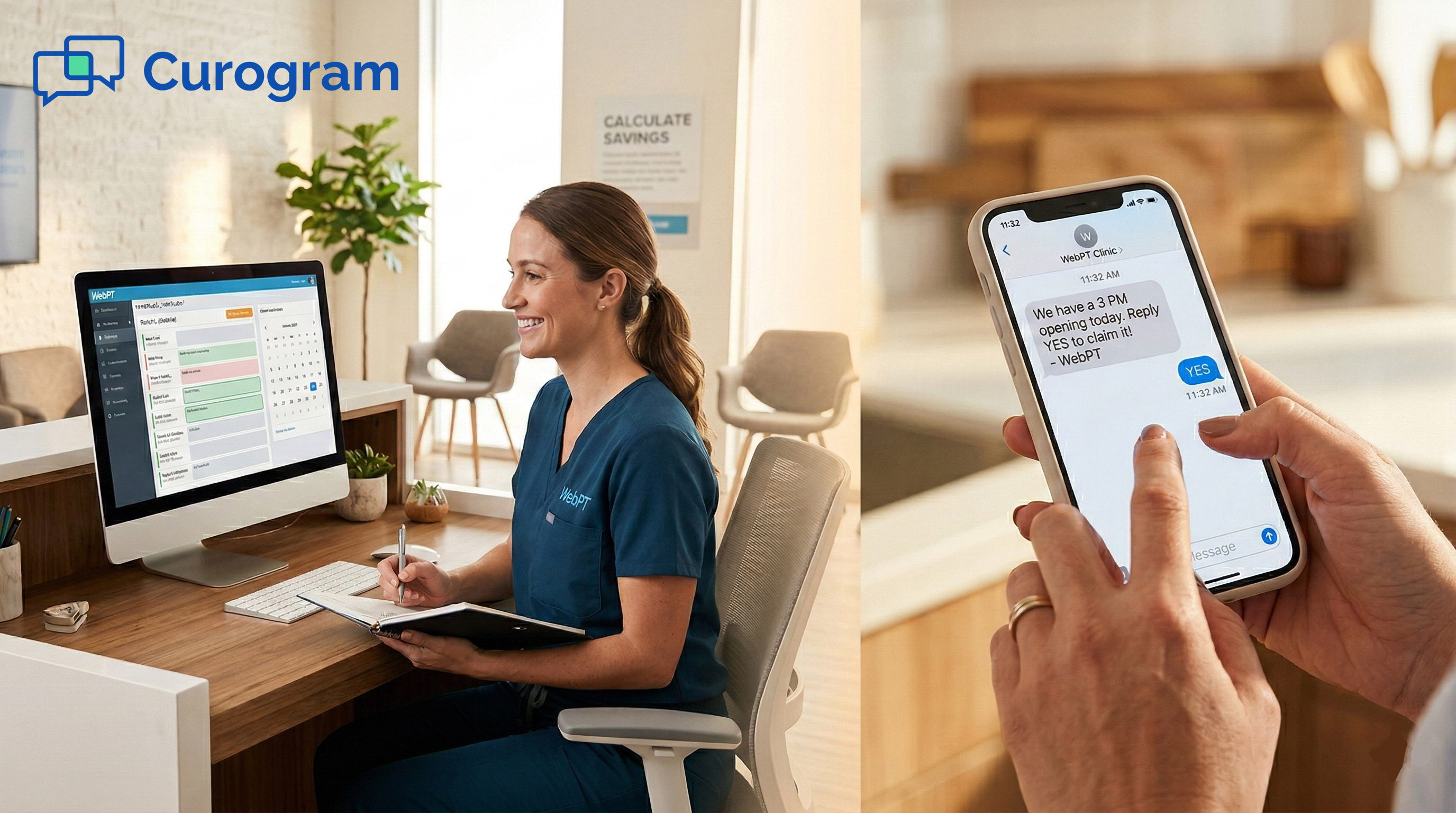
A 2-way texting waitlist integration for WebPT solves this by letting front desk staff text waitlisted patients the moment a slot opens.

Instead of calling ten people and leaving ten voicemails, your team sends one group text and gets a "YES" back in seconds.

Curogram adds this missing layer to WebPT. It keeps your phones quiet, helps fill cancelled physical therapy slots fast, and protects plan of care revenue so patients stay on track with their treatment.

The result is a self-healing schedule that runs with less stress and more income.


Picture this. It's 8:47 AM on a Tuesday. Your front desk phone rings. A patient won't make their 2:00 PM therapy visit. Now, the clock starts ticking.

Your staff grabs a sticky note, pulls up a paper waitlist, and starts the dreaded "call down." Ten calls. Ten voicemails. Endless phone tag. By 1:45 PM, that slot is still empty—and so is the revenue it should have brought in.

This scene plays out every single day in rehab clinics across the country. It's what we call Schedule Tetris: the frantic, manual scramble to fill a gap that should never have stayed open in the first place.

WebPT does a great job of tracking your schedule and your clinical notes. But when a patient cancels, it doesn't refill the slot for you. There's no built-in tool that pings your waitlist and secures a replacement in minutes. That gap is where revenue goes to die.

The fix? Stop calling. Start texting.

A 2-way texting waitlist integration for WebPT turns your front desk from a call center back into a patient-first team. One text goes out. One "YES" comes back. The slot is filled. Done.

In this guide, we'll break down why the old WebPT cancellation workflow fails, how 2-way texting acts like a surgical strike for your schedule, and what a "self-healing schedule" actually looks like in practice.

We'll also share real numbers from clinics that made the switch—and show you exactly how this protects plan of care revenue from day one.

Let's stop the phone tag.

The Villain: Schedule Tetris & The Broken Plan of Care

Before we talk about the fix, let's look at what's really going wrong. The problem isn't just one empty slot. It's a chain reaction that hits your staff, your revenue, and your patients' outcomes all at once.

The Call Down Nobody Wants to Make

Why Phone Tag Fails Every Time

Here's how the typical WebPT cancellation workflow plays out. A patient calls in to cancel. Your front desk logs it in WebPT, then turns to a paper list—or worse, a sticky note—to start filling the gap.

They dial the first name. No answer. Voicemail. Second name. No answer. Voicemail again.

This goes on for five, six, sometimes ten calls. Most of those patients are at work or busy.

They can't pick up a random phone call in the middle of their day. Even the ones who do answer often need time to check their own schedules before they can commit.

Meanwhile, the clock keeps ticking. That 2:00 PM slot gets closer and closer, and your staff is stuck on the phone instead of helping the patients standing right in front of them.

The Real Cost of One Empty Slot

A single unfilled PT visit costs your clinic $80–$120 or more in lost revenue. Multiply that by just two or three cancellations a day, and you're looking at thousands of dollars walking out the door each month.

But the money is only part of the story. When a patient misses a visit, it breaks the rhythm of their plan of care.

Physical therapy works because it's consistent—two to three visits per week, building on the last session. One missed visit can set a patient back and push their recovery off course.

The Broken Plan of Care Problem

Why Missed Visits Lead to Patient Dropout

A cancelled visit isn't just a gap in the schedule. It's a crack in the patient's trust and momentum.

Early dropout means worse outcomes. The patient doesn't get better as fast or at all. Once they leave, they rarely come back. That's lost lifetime value for your clinic and a worse result for the patient.

Staff Burnout and the 80-Call Day

Your front desk team didn't sign up to be a call center. But in many high-volume PT clinics, staff handle 80 or more calls a day.

Many of them tied to filling last-minute gaps. That kind of volume leads to burnout, mistakes, and turnover.

The result? Silent waiting rooms during prime hours. Burned-out staff who can't give patients the attention they deserve. A schedule full of holes that never should have been there. The old way of doing things simply doesn't scale.


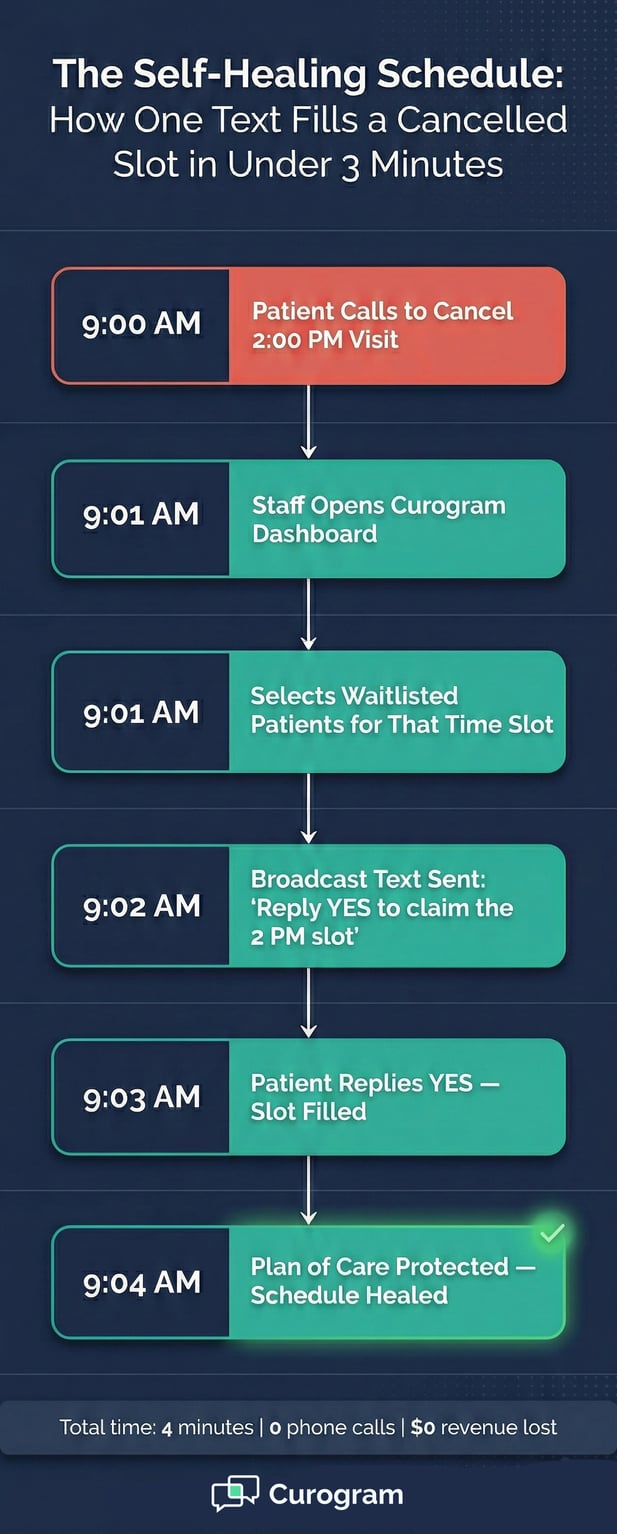
Vertical infographic showing an automated text-based waitlist to fill canceled patient slots

The Guide: The Surgical Strike of 2-Way Texting

Now that you see the damage Schedule Tetris causes, let's talk about how to end it. The answer isn't a bigger phone system or more staff. It's a smarter channel—one your patients already prefer.

How Instant Broadcasts Replace Ten Phone Calls

One Text, One "YES," One Filled Slot

Here's how it works with Curogram's WebPT 2-way texting integration. A patient cancels their 2:00 PM visit.

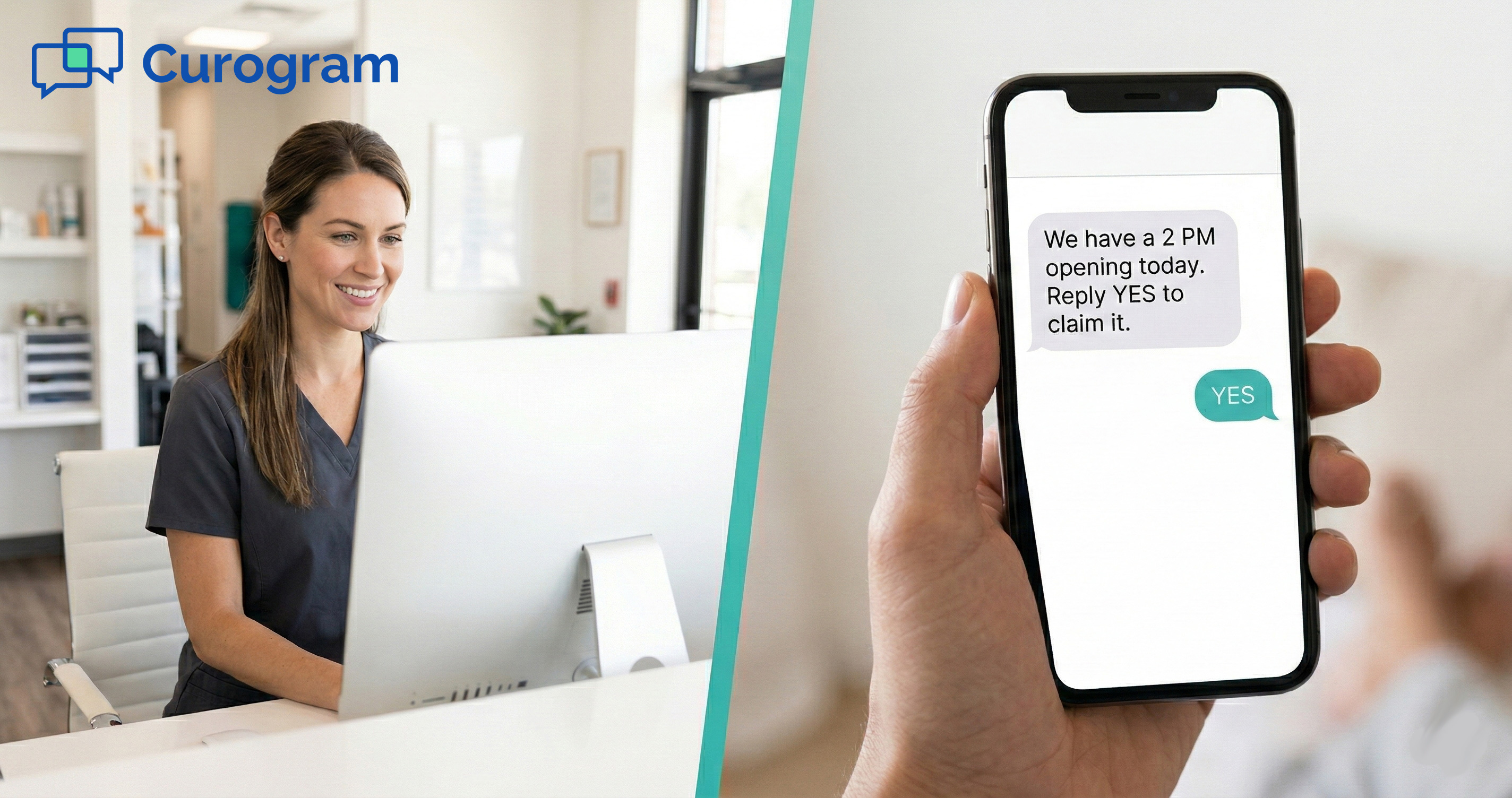
Your front desk staff opens Curogram, selects the waitlisted patients who match that time slot, and sends one text: "We have a 2 PM opening today with Dr. Smith. Reply YES to claim it."

Within seconds—not minutes, not hours—patients start replying. The first "YES" wins the slot. Your staff confirms the booking right from the dashboard. No phone calls. No voicemails. No tag.

This is what we call the "surgical strike." It's fast, targeted, and it works because 98% of text messages get read within three minutes.

Compare that to phone calls, where most go straight to voicemail and half never get returned.

Why SMS Beats Every Other Channel

Email? Most patients won't see it for hours—if they open it at all. Patient portals? Only a small fraction of patients log in regularly.

Phone calls? We've already covered why those fail. Automated waitlist SMS is the only channel that reaches patients where they already are: their phone's lock screen.

Texts are short, clear, and easy to act on. There's no app to download, no portal to log into, and no callback to schedule. Patients just reply "YES." That's it. This simplicity is what makes the whole process work at scale.

Protecting the Plan of Care with Every Filled Slot

Keeping Patients on Track

Physical therapy margins are tight. Insurance rates keep getting cut. Every single visit matters—not just for revenue, but for clinical outcomes.

When you can fill cancelled physical therapy slots within minutes, you're doing more than saving money. You're keeping patients on their plan of care.

A patient who gets a quick text saying "hey, can you come in at 2 PM today?" is far more likely to say yes than one who gets a voicemail they hear three hours later.

Speed matters, and texting delivers that speed every time.

Curogram vs. WebPT Reach: Different Tools, Different Jobs

If your clinic already uses WebPT Reach, you might wonder why you need another tool. The answer is simple: Reach is built for marketing.

It sends newsletters, runs reactivation campaigns, and helps you stay visible to past patients. That's valuable work—but it's not the same as filling a 2 PM slot that just opened up ten minutes ago.

Curogram is an operations tool. It's the layer that handles the real-time, back-and-forth texting your front desk needs to manage daily chaos. Think of Reach as your long game and Curogram as your fast break.

Together, they cover both sides. But only one of them can protect the plan of care revenue the moment a cancellation hits. 


The Success: The Self-Healing Schedule

So what does life actually look like after you make the switch? The best way to describe it is a self-healing schedule. It’s one that fills its own gaps without burning out your team.

Cut Phone Volume by Up to 50%

Fewer Calls, More Time for Patients

Based on our internal data, clinics using Curogram reduce phone call volume by up to 50%. Think about what that means for a front desk team that's fielding 80 or more calls a day. That's 40 fewer calls—40 fewer interruptions—every single day.

Your staff can finally focus on the patients who are actually in the clinic. They can greet people warmly, handle check-ins smoothly, and answer questions without rushing to pick up a ringing phone. The vibe in your lobby changes when the phones go quiet.

What the Numbers Look Like

Here's a quick look at the impact clinics see after switching to a text-first approach:

Metric

Before Curogram

After Curogram

Daily outbound calls to fill slots

40–80+

5–15

Average time to fill a cancellation

2–4 hours

Under 15 minutes

Phone-related staff burnout

High

Low

Revenue recovered from cancellations

Minimal

10–20% increase

No-show rates vs. industry average

At or above average

Up to 53% lower


Based on our internal research, clients using Curogram's reminder tools see no-show rates that are 53% lower than the industry average.

One clinic—Atlas Medical Center—dropped its rate from 14.20% to 4.91% in just three months. That's three times better than average.

Revenue Recovery That Adds Up Fast

Turning Cancellations into Cash

Every refilled slot puts $80–$120 or more back into your bottom line. Based on our internal data, practices using Curogram see a 10–20% increase in revenue because they recover appointments that used to just vanish.

Let's say your clinic fills just five extra cancellations per week at $100 each. That's $500 a week, $2,000 a month, and $24,000 a year in revenue that would have been lost. For most PT clinics, that's a game changer.

The Bigger Win: A Schedule That Heals Itself

The real goal isn't just to fill one slot here and there. It's to build a schedule that reacts to change on its own.

When your team can fire off a text in ten seconds and get a response in under a minute, the whole rhythm of your clinic shifts.

Therapists walk into full treatment rooms. Staff aren't stressed. Patients get the consistent care they need. That's what a self-healing schedule looks like—and it starts with replacing the phone call with a text.


Wide-angle photo of a modern, efficient physical therapy clinic reception area with diverse staff and patients

Stop the Phone Tag

Managing recurring appointments in WebPT doesn't have to mean your front desk is chained to a ringing phone all day.

The old way—paper waitlists, manual call downs, endless voicemails—costs you time, money, and staff morale. Worse, it costs your patients the care they need.

You can't afford to let cancellations sit empty while your team leaves messages no one returns. Your therapists need full schedules. Your patients need consistent visits. And your front desk needs a better way to make it all happen.

That's where a 2-way texting waitlist integration for WebPT changes the game. One text replaces ten calls. One "YES" fills the slot. And your whole clinic runs smoother because of it.

We've seen it work across hundreds of clinics. Based on our internal data, practices that adopt Curogram see up to 50% fewer phone calls and a 10–20% bump in revenue from recovered appointments alone. Over 75% of appointments get confirmed without a single staff member picking up the phone.

The best part? You don't have to overhaul your whole system. Curogram works alongside WebPT as a seamless add-on.

Your staff can learn it in about ten minutes. There's no portal for patients to log into, no complex setup, and no long-term contract to worry about.

Switch to the integration that respects your front desk's time and rescues your revenue.  

Book a demo todayLet your staff "try before they buy" and watch the daily call volume drop risk-free.


Frequently Asked Questions

We already have WebPT Reach. Why do we need this?

Great question—and one we get a lot. WebPT Reach is a solid marketing tool. It helps your team send newsletters, run reactivation campaigns, and stay in front of past patients. That work matters for your long-term growth.

But Reach wasn't built to handle the real-time chaos of a cancelled 2 PM slot. Curogram is an operations tool designed for your front desk.

It's built to stop the phone from ringing 80 times a day by moving urgent, time-sensitive tasks to text. They solve completely different problems—and they work even better together.

Do patients need to log into a portal to claim the waitlist spot?

Not at all. Patients simply reply "YES" to your text message. There's no app to download and no portal to access.

Curogram's HIPAA-compliant 2-way texting routes their reply straight to your dashboard so you can book them right away.

This matters because portal fatigue is real. Most patients don't check their health portals regularly.

But they do check their texts—usually within three minutes. That speed is what makes automated waitlist SMS so effective at filling last-minute gaps.

Will this work for multi-location, high-volume PT clinics?

Yes. Curogram is designed for high-volume rehab teams managing complex, recurring schedules across multiple providers and locations.

Whether your patients come in two or three times a week, the platform handles the volume without breaking a sweat.

Each location can manage its own waitlist and text threads from one central dashboard.

That means your admin team gets a bird's-eye view while each clinic keeps full control of its own schedule. It scales with you as you grow.

Is texting patients through Curogram HIPAA-compliant?

Yes. Curogram is built from the ground up to meet HIPAA standards.

All messages sent through the platform are logged, tracked, and managed through a secure dashboard. Your staff never uses personal phones or unsecured channels to reach patients.

For general texts like waitlist alerts and appointment reminders, standard SMS works fine because no protected health information is shared. When a conversation does need to include sensitive details,

Curogram offers an encrypted messaging option so you stay compliant without switching to a separate tool.

How long does it take to set up Curogram with our WebPT system?

Most clinics are up and running within a day. Curogram works as an add-on that syncs with WebPT, so there's no need to rip out your current system or change how your team charts.

The platform pulls in your schedule data and lets your staff start texting right away.

Training is fast, too. Based on our internal data, staff learn the platform in about ten minutes because it works just like the texting apps they already use on their own phones.

There's no steep learning curve and no complex setup to slow you down.