
1 min read
Mastering Radiology Coding: 12 Essential Guidelines for Accuracy
💡 Radiology coding is the process of turning imaging reports into billing codes that payers accept. Coders review each X-ray, MRI, CT scan, and...
12 min read

A single missed modifier can hold up thousands in reimbursement. Radiology billing runs on small details, and the margin for error is thin.
Imaging practices sit in an odd spot. Every study is really two services stacked together: the scan itself and the read that follows. Each carries its own code, its own payer rule, and its own way of getting denied. Miss the split and money stalls in accounts receivable.
So the work is exacting, and it rewards people who respect the details. This guide is built for radiologists, practice managers, coders, and billers who want fewer denials and steadier cash.
At the center of the whole financial cycle is radiology coding, the practice of converting medical imaging services into standardized codes that payers can read and pay. When that step is clean, claims move. When it drifts, the denials follow, and staff spend their afternoons on the phone with payers instead of patients.
We wrote this as people who have sat in the billing queue, not as a vendor pitch. The 12 pillars below map the parts that actually decide whether a claim clears: the code sets, the professional and technical split, payer policies, denials, modifiers, reporting, software, and the harder subspecialty cases.
We also make one claim up front. Most radiology revenue leaks start before a coder ever opens the chart. Insurance that was never verified, prior authorization that nobody chased, and a patient who no-showed the MRI.
Fix the front desk and the back office gets easier. That is where patient communication earns its place in a billing conversation, and we will show exactly where it fits.
Every clean claim starts with the same basic loop. Knowing that loop by heart is what separates a smooth month from a backlog.
Radiology medical billing is the work of filing claims with insurers and chasing them until they pay. It is not simple invoicing. It is a coded conversation between your practice and the payer.
A radiology claim passes through more hands than most people expect. The radiologist reads the study and writes the report, while the technologist runs the machine. A coder turns that report into billable codes, and a biller files the claim and works the follow-up.
Then there is the payer, whether Medicare, Medicaid, or a commercial plan, deciding what gets paid. One weak link slows the whole chain.
The cycle opens at the front desk with registration and insurance checks. From there it moves to coding, then claim creation, then submission, then the payer's review. A clean claim gets paid and posted. A flawed one drops into denial management.
Accuracy compounds at every stage. A wrong birthdate or a mismatched code at intake can sink a claim that was otherwise perfect.
Three code sets carry most of the weight in radiology. Learn what each one does and when it applies, and half your denials never happen.
Accurate radiology coding is the base everything else rests on. It uses three tools: CPT codes for the procedure, ICD-10-CM codes for the diagnosis, and HCPCS Level II codes for supplies and drugs.
CPT codes come from the American Medical Association, and radiology lives mostly in the 70000 series. A single-view chest X-ray is 71045, and a CT of the head without contrast is 70450. An MRI of the lumbar spine without contrast is 72141, while a complete abdominal ultrasound is 76700.
Interventional work and nuclear medicine each have their own ranges. Picking the exact code for the exact study is the whole job.
ICD-10-CM codes prove the scan was medically necessary. Payers read them hard. "Pain in right lower leg" supports a claim far better than plain "leg pain," because the vague version invites a denial.
HCPCS Level II codes cover the extras CPT skips, like contrast media for an MRI or CT. Link the right diagnosis to the right procedure, or the claim stalls.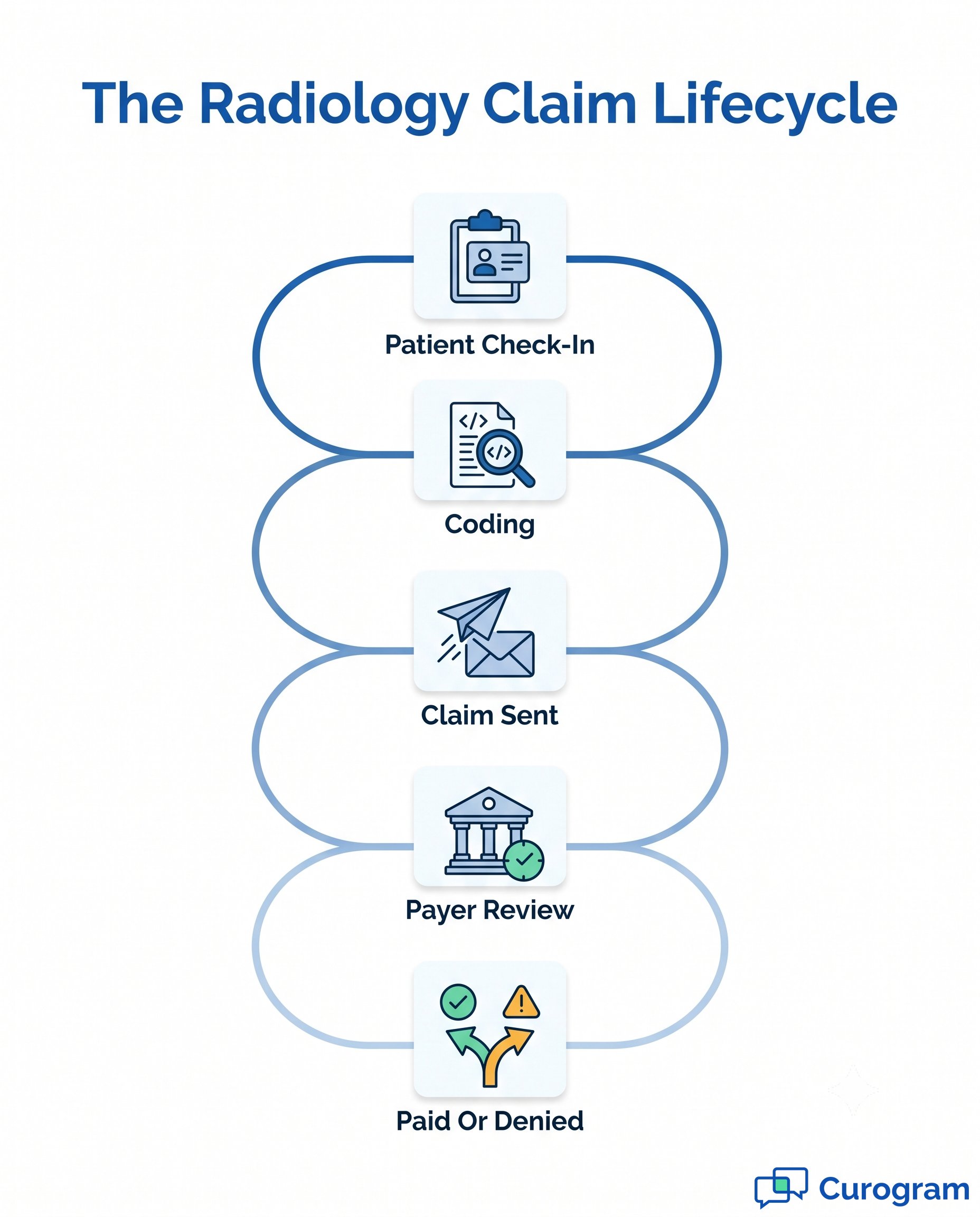
Almost every imaging study can be billed as two separate pieces. Confusing them is one of the most common ways money goes missing.
The professional component is the radiologist's read. The technical component is the machine, the supplies, and the staff. Modifier 26 flags the first. Modifier TC flags the second.
A hospital-based radiologist who only reads studies bills the PC with modifier 26. The hospital, which owns the scanner and pays the techs, bills the TC. Neither can claim both.
When one group owns the equipment and employs the readers, they bill the code with no modifier at all. That is global billing, and it says one entity did everything.
Billing globally when you only did the read is a fast way to a denial or a clawback. So is dropping the wrong modifier on a split service.
Place of service drives most of these calls. A read done at an outside imaging center is almost never a global bill for the reading physician.
Every payer writes its own rulebook. Knowing the codes is not enough if you do not know what each plan wants.
Medicare, Medicaid, and commercial plans each set their own coverage rules and documentation demands. Compliance means tracking all of them and never guessing.
Medicare pays for a large share of imaging, and it is strict. Local Coverage Determinations and National Coverage Determinations spell out what counts as necessary for which diagnosis.
Get the supervision rules or the modifiers wrong and you invite an audit. Precise documentation is the cheapest insurance you can buy here.
Advanced imaging, like MRI and CT, usually needs prior authorization from commercial payers. Skip it, and the denial is automatic, no matter how clean the code.
A strong front desk verifies coverage and secures auth before the patient is on the table. That single habit prevents more write-offs than any back-end fix.
A perfectly coded claim still fails if it goes out wrong or nobody watches it. Submission is where good coding turns into cash, or does not.
The target is a high clean claim rate, meaning claims that pay on the first try. Every point you add there speeds up cash flow.
Claim scrubbing catches the errors that trip payers: mismatched procedure and diagnosis codes, missing details, wrong demographics, bad formatting. Software or a sharp reviewer runs the check before the claim ever leaves.
Most practices file electronically through EDI now. It is faster than paper, and it tracks better, so you can see exactly where a claim sits.
The Electronic Remittance Advice tells you what paid, what got adjusted, and why anything was denied. Reading it well turns a denial into a quick correction instead of a lost dollar.
Timely filing limits are hard walls. Miss a payer's deadline and the money is usually gone for good, coded correctly or not.
Denials are going to happen. What matters is whether you recover the revenue or let it drain away quietly.
The first move on any denial is figuring out why it happened. Fix the cause, not just the one claim.
A handful of reasons cause most radiology denials: missing or invalid patient info, no prior authorization, questioned medical necessity, coding errors, and blown filing deadlines. That short list drives the bulk of lost revenue.
Each one has a front-end fix, whether tighter intake, stronger auth workflows, better ICD-10 specificity, or firm submission deadlines. Most denials are preventable upstream.
Track every denial by root cause, correct it, and resubmit or appeal within the payer's window. Appeal rules differ by payer, so keep a cheat sheet for each.
Then watch the trends. When one payer or one code keeps failing, that pattern is telling you where to retrain or retool before the next batch goes out.

Two digits can change how a whole claim is read. Modifiers are small, and their impact on payment is not.
Modifiers are two-digit tags added to CPT or HCPCS codes. They tell the payer the exact story of what happened, so the claim is not misread as a duplicate or a bundle.
Modifier 26 is the professional read. TC is the technical side. 50 marks a bilateral procedure, like both knees in one visit. RT and LT call out which side.
Modifiers 76 and 77 handle repeat studies, one for the same physician and one for a different physician on the same day. They tell the payer this is not a double-billing slip.
Modifier 59 marks a service as distinct from another that it might normally be bundled with. It is powerful and heavily audited, so it is not a tool for forcing past payer edits on truly related work.
Check the NCCI edits before you apply them. If imaging leads to a separate interventional procedure later that same day, 59 may fit the second service. If the two are genuinely bundled, leave it off.
|
Modifier |
What It Signals |
|---|---|
|
26 |
Professional component (the read) |
|
TC |
Technical component (equipment, staff) |
|
50 |
Bilateral procedure |
|
59 |
Distinct, unbundled service |
|
76 / 77 |
Repeat study, same / different physician |
|
RT / LT |
Right side / left side |
You cannot fix what you do not measure. A few numbers, watched monthly, will tell you where the revenue is stuck.
Reporting turns a pile of claims into a clear picture of financial health. The right metrics point straight at your weak spots.
Days in A/R shows how long money sits before you collect it, and lower is better. Net collection rate shows how much of what you are owed you actually get, with the goal near 100%.
Denial rate and clean claim rate together tell you how healthy the front end is. Aged A/R broken into buckets flags collection trouble before it becomes a write-off.
|
Metric |
What Good Looks Like |
|---|---|
|
Days in A/R |
Lower; collect faster |
|
Net Collection Rate |
Near 100% |
|
Denial Rate |
Low and trending down |
|
Clean Claim Rate |
High first-pass pay rate |
|
Aged A/R (90+ days) |
Small share of total |
A monthly look at A/R aging, collection by payer, and denial trends surfaces the bottlenecks. Maybe one payer drags every claim. Maybe one code keeps failing.
That is how a billing operation shifts from reacting to problems to heading them off. The data tells you where to train and where to push.
The right tools cut errors and speed the whole cycle. The wrong ones, or none at all, leave money on the table.
A practice management system is usually the hub for radiology billing. It handles scheduling, eligibility checks, charge capture, claim submission, payment posting, denials, and reporting in one place.
Radiology has needs a general tool may miss: clean handling of professional and technical splits, modifier logic, and the common imaging procedures. Check that the software knows your specialty, not just billing in general.
It should also connect with your EHR so data flows without rekeying. Every manual re-entry is a fresh chance for a typo to cause a denial.
AI tools can read documentation and suggest CPT and ICD-10 codes, which speeds up coders and catches misses. Robotic process automation handles the dull, repetitive work like eligibility checks and status follow-ups.
None of it replaces a skilled coder. It clears the busywork so people can focus on the messy cases that need real judgment. And every system touching PHI has to stay HIPAA compliant.
Routine diagnostic work is complicated enough. The subspecialties add layers that demand real expertise.
Interventional radiology and nuclear medicine carry unique coding rules and payer demands. They reward practices that know the details cold.
IR procedures are image-guided and minimally invasive, and one session often needs several CPT codes: catheter placement, imaging guidance, and the treatment itself. This is component coding, and skipping a piece leaves money uncollected.
Many IR procedures carry global periods, so related follow-up for a set number of days is already paid for and cannot be billed again. Reading the operative report closely against NCCI edits is the only way to get it right.
Nuclear studies use radiopharmaceuticals, and those supplies need their own HCPCS Level II codes on top of the study code. Forget the supply, and you undercharge the service.
Some procedures, like cardiac stress tests, have several parts to code separately: the stress, the imaging, and the read. The documentation has to back up every piece.
In-house or outsourced, the goal is the same: skilled hands on your claims. The right answer depends on your size and volume.
Both models work. An in-house team gives you control. A specialized partner gives you depth. The tradeoff is cost against convenience.
A strong internal team wants certified coders with radiology credentials, billers who can work denials and A/R across payers, and staff fluent in HIPAA, Stark, and the Anti-Kickback rules.
You gain direct control and close ties to clinical staff. You also carry the full cost of salaries, benefits, training, and turnover when a coder leaves.
Ask hard questions before you sign. Do they have real radiology experience and references to prove it? What software do they run, and how transparent is their reporting? Are they HIPAA compliant, and how does their fee structure work?
A good partner feels like an extension of your practice. A weak one just adds a layer between you and your money.
The rulebook never stops changing. Staying current is not optional; it is the difference between compliance and slow decay.
New CPT codes drop yearly, and ICD-10 updates regularly. NCCI edits shift quarterly, and payer policies change with little warning. A practice that stops learning starts losing money.
Everyone in the chain needs to keep up, from the front desk verifying insurance to the coder assigning codes. Fall behind, and denials climb while legitimate reimbursement slips away.
Treat training as a standing cost, not a one-time event. It is cheaper than the audits and write-offs that follow neglect.
The AAPC, RBMA, and AHIMA run certifications, webinars, and conferences worth the time. Payer bulletins and MAC newsletters flag the changes that hit your claims directly.
The CMS website is the source for federal rules on imaging. Specialty journals round out the picture with practical coding notes.
A few shifts are already reshaping this work. Practices that read them early will adapt without pain.
AI and machine learning will keep taking over routine coding tasks and sharpening accuracy. Value-based care is nudging reimbursement toward outcomes instead of pure fee-for-service.
More coding steps will move to software that suggests and checks codes, leaving people for the hard calls. Teleradiology and telehealth are adding their own billing wrinkles that payers are still sorting out.
None of this removes the need for human judgment. It just moves that judgment to where it matters most.
Here is the piece most billing guides skip. A scan that never happens cannot be billed, and no-shows quietly drain imaging revenue every week.
That is why patient communication belongs in a billing plan, not just a marketing one. Confirmed appointments and verified coverage protect the claim before it exists.
The 12 pillars here are less a checklist than a working system. Clean coding feeds clean claims. Clean claims feed steady cash. Every pillar leans on the ones around it.
Master the codes, split the components correctly, chase denials with a method, and keep learning as the rules move. Do that, and your revenue cycle holds up under pressure.
One last point we will stand behind. The cheapest revenue you will ever protect is the appointment that actually shows up. That is where front-desk communication and back-office billing meet.
Missed scans and unverified insurance sink imaging revenue before coding even starts. Curogram's automated reminders and two-way texting help keep patients confirmed and coverage checked, so more studies happen, and more claims are cleared.
Based on our internal data, practices using Curogram see no-show rates 53% below the industry average, with one clinic cutting no-shows from 14.20% to 4.91% in three months. That is revenue that would otherwise never reach your billing team.
Book a demo to see how Curogram fits your imaging workflow.

1 min read
💡 Radiology coding is the process of turning imaging reports into billing codes that payers accept. Coders review each X-ray, MRI, CT scan, and...
1 min read
💡 A Radiology Information System (RIS) is the software that runs the non-image side of a radiology department — scheduling exams, tracking...

1 min read
💡 The medical billing process is the workflow that turns patient care into paid claims. It runs from the first phone call to the final payment,...