
1 min read
12 Key Pillars of Expert Radiology Medical Billing Service
💡Radiology billing turns imaging work into paid claims. It covers the codes, the payer rules, and the follow-up that decide whether a scan actually...
8 min read

One wrong code can cost a radiology practice thousands of dollars.
It sounds dramatic. It isn't.
A single miscoded scan can trigger a denial, hold up payment for weeks, or invite an audit you never saw coming. Multiply that across hundreds of claims a month, and small errors quietly turn into a serious revenue problem.
Radiology coding is the work that turns every X-ray, MRI, and CT scan into a claim payers will actually pay. Get it right, and reimbursement flows. Get it wrong, and the whole revenue cycle stalls.
Here's the good news. Accuracy is a skill you can build, not a talent you're born with. The coders who rarely see denials aren't luckier than everyone else. They just follow a consistent set of rules.
This guide breaks down 12 practical radiology coding guidelines. Each one helps you code with more confidence, stay compliant, and protect the revenue your practice depends on. Let's start where every clean claim begins: the documentation.
Every accurate code starts with a clear report. The radiologist's report is your source of truth, and its quality shapes everything you do next.
A strong report gives you what you need to code without guessing.
At a minimum, it should include:
When a report is vague or missing details, it's your job to ask. Query the radiologist instead of guessing your way to a code.
That one habit prevents denials, helps reduce delays, and builds a better working relationship with your clinical team. Over time, those conversations also lead to cleaner reports, which makes your job easier down the road.
Radiology splits into two broad worlds, and each one codes differently. Knowing which side you're on tells you how much complexity to expect before you start.
Diagnostic radiology is about reading images to find a problem.
Think X-rays, mammograms, CT scans, and MRIs.
Here you pick the CPT code that matches the imaging, then link it to the ICD-10-CM code that explains the patient's condition.
Interventional radiology is a different animal. These procedures use imaging to guide small, non-surgical treatments, so one session can involve several billable parts. That means more codes and far more careful bundling.
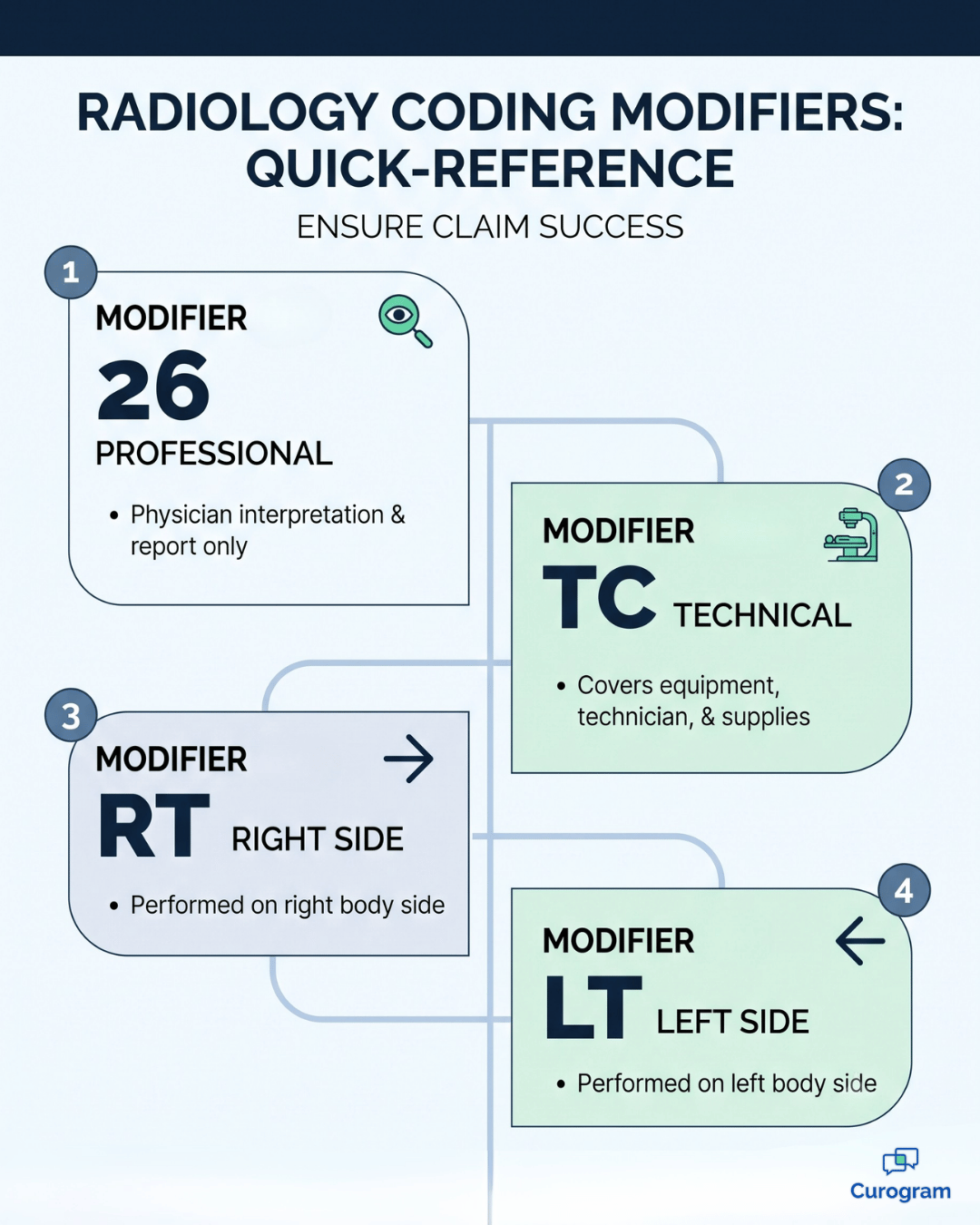
Modifiers are two-digit codes that add context to a service without changing what it is. In radiology, they often decide how much you get paid.
The two you'll reach for most involve who did what. When the radiologist only reads the image but the facility owns the equipment, you add modifier 26. When the facility bills for the equipment and technologist instead, you use modifier TC.
Here's a quick reference for the modifiers that show up most often:
| Modifier | What it means | When you use it |
|---|---|---|
| 26 | Professional component | Radiologist interprets only; facility owns the equipment |
| TC | Technical component | Facility bills for equipment and technologist work |
| RT | Right side | Procedure performed on the right |
| LT | Left side | Procedure performed on the left |
Using the wrong modifier, or forgetting one, is an easy way to lose money on an otherwise correct claim. Treat modifiers as part of the code, not an afterthought.
If CPT codes describe what you did, ICD-10-CM codes explain why you did it. They capture the patient's signs, symptoms, injuries, and conditions.
That "why" matters more than it seems. Payers use it to decide whether a scan was medically necessary and worth paying for. No clear reason, no reimbursement.
The most common trap is reaching for a vague code when a sharper one exists.
The difference usually looks like this:
Read the clinical notes carefully and choose the most exact diagnosis the documentation supports. The more specific your code, the stronger your claim.
Some services are meant to be billed together, not apart. The National Correct Coding Initiative (NCCI), run by CMS, spells out which ones.
When one procedure already includes another, you can't bill for both separately. A CT scan of the abdomen, for example, usually covers both the technical scan and the radiologist's read. Splitting those into two charges, known as unbundling, breaks the rules.
These edits update every quarter, so last year's knowledge won't cut it. Reviewing the latest NCCI edits before you submit keeps you compliant and keeps improper payments off your books.
Radiology coding never sits still. CPT, ICD-10-CM, and HCPCS code sets change every year, with codes added, revised, and retired. Payers also update their coverage rules on their own schedule.
Falling behind is one of the quietest ways to rack up denials.
To stay sharp, build a habit of learning from trusted sources:
A little ongoing education each quarter beats a scramble every January. Treat it as part of the job, not an extra.
|
Quick win: Before you submit a batch of claims, confirm three things — the documentation is complete, the diagnosis code is as specific as the notes allow, and the contrast detail matches the report. Those three checks alone catch a large share of preventable denials. |
Contrast is a small detail that changes the code completely. Whether a scan was done with, without, or with and without contrast decides which CPT code you use.
The report has to say so clearly. Here's how the three options break down:
If the documentation is unclear, don't assume. Query the radiologist and confirm. Guessing on contrast is one of the most common errors in this work, and it leads straight to denials and compliance questions.
Interventional procedures rarely fit into one tidy code. Instead, they often call for component coding, where several codes describe a single session.
A typical case needs a code for the main procedure. It also needs one for the imaging supervision and read, plus extra codes for things like catheter placements, injections, or supplies. Each piece has to be captured.
The official radiology coding guidelines lay out how to bundle or separate these components the right way. Missing even one component means leaving money on the table. Slow down and account for every billable part before you submit.

Payers won't reimburse a scan they don't see as medically necessary, making proper documentation essential.Proving that necessity falls on you, and your main tool is the diagnosis code.
The diagnosis has to logically support the imaging. A quick gut check makes the point:
Your goal is to connect the dots clearly. Link every procedure to a valid clinical reason in the patient's record. When the reason and the service match, the claim tells a story payers can approve.
The Merit-based Incentive Payment System (MIPS) has integrated quality and cost performance into the reimbursement model.
While this may seem like a high-level administrative concern, it has direct implications for radiology coding. Coders are often responsible for applying specific G-codes or CPT Category II codes that report on quality measures, such as tracking radiation exposure or communication of critical results. Understanding how these quality data codes fit into the broader framework of medical coding radiology is becoming increasingly important.
Staying informed about MIPS requirements is a modern radiology coding guideline that impacts a practice's financial health.

For any interventional radiology coding scenario, the radiologist's operative report is the single source of truth.
A coder must be able to deconstruct this report to identify every billable component.
This includes identifying the main procedure, any additional procedures performed, the type of imaging guidance used (e.g., fluoroscopy, ultrasound, CT), and whether the procedure was bilateral or unilateral. The details within the operative report are paramount.
A successful career in medical coding radiology depends on the ability to translate this complex narrative into the precise language of CPT and ICD-10-CM codes, following all relevant radiology coding guidelines.
Your work doesn't end when the claim goes out. What you do next often decides how healthy your revenue stays.
Every denial is a clue. When you dig into the reasons, patterns appear, and those patterns point to fixes you can make once and benefit from for months.
Consider a simple example. Say your practice sends out 1,000 imaging claims a month and 8% get denied.
That's 80 denials a month, or nearly 1,000 a year.
If even half come from repeat coding errors, fixing the root cause could recover hundreds of claims a year. This is an illustrative scenario, not verified data.
Audit readiness works the same way. Meticulous records and steady adherence to the rules are your best defense. When every claim is backed by clear documentation, an audit becomes a formality instead of a threat.
Clean coding protects the money you've already earned. But it's only half the revenue story.
The other half happens before the scan ever gets coded. Patients who forget their appointment, skip contrast prep, or experience long check-in times all drain revenue that no modifier can recover. In fact, front-desk friction often costs a practice as much as coding errors do.
That's where patient communication comes in. Automated reminders cut no-shows, clear prep instructions reduce wasted appointments, and easy text-to-pay options help balances get paid faster. Curogram helps practices handle all of that in one place, so the revenue you code for actually shows up.
Accurate coding and smooth patient communication aren't competing priorities. They're two sides of the same paycheck.
If you want to see how the front-desk side works, you can book a demo and explore Curogram's patient communication platform to protect revenue from the first reminder to the final payment.
1 min read
💡Radiology billing turns imaging work into paid claims. It covers the codes, the payer rules, and the follow-up that decide whether a scan actually...
1 min read
💡 Radiology scheduling software books, confirms, and manages imaging visits for CT, MRI, X-ray, ultrasound, and nuclear medicine. It swaps phone...
1 min read
.jpg?width=30&name=square-formal-photo%20(1).jpg) Mira Gwehn Revilla : 7/24/26, 9:00 AM
Mira Gwehn Revilla : 7/24/26, 9:00 AM
💡 Curogram is a HIPAA-compliant, two-way texting platform for radiology practices. Patients confirm scans, get prep steps, and receive results...