


8 min read
TherapyNotes Client Intake: Remove Clipboard Anxiety with Mobile Forms
Jo Galvez
:
June 9, 2026
No printer is needed. No portal login is needed. The client walks in ready to talk, not ready to write. The clinician already has the answers and can prepare. This small shift lowers stress and builds trust from the first moment. It turns a tense start into a calm one.
A brand new client booked their first therapy session after months of doubt. They feel nervous but hopeful. Then a clipboard lands in their lap.
The waiting room is quiet. The pen feels heavy. The form asks about trauma, medication, and family history. Strangers sit a few feet away.
This is the moment many practices lose trust. The client came to feel safe. Instead, they feel exposed. Their hands shake as they write down the hardest parts of their life.
For people with anxiety, this is not a small thing. The clipboard becomes a wall. Some clients rush the form. A few think about walking out.
Paper intake was never built for comfort. It was built for the front desk. And in behavioral health, comfort is the whole point.
The cost is real. A rough start can make a client cancel the next visit. The first ten minutes set the tone for the whole relationship.
There is a better way. The form does not have to live on a clipboard. It can live on the client's phone, where they already feel at home.
Curogram texts secure forms to clients before the visit. They tap a link and answer at their own pace. They can pause, breathe, and finish later. The hard questions get answered in private, not in public.
This changes the therapy client first session experience in a real way. The first face-to-face moment becomes a conversation.
The clinician has already read the answers. The client just sits down and talks.
This article looks at the clipboard problem from the client's side. We will show why paper hurts trust. We will show how texted forms fix it.
Also, we will show what a calm first session looks like when intake happens at home.
The Villain: The Paper Packet Pileup (From the Client's Side)
The paper packet feels normal to the front desk. To a nervous client, it feels like a wall. Let us walk through it from their point of view.
A 19-Page Welcome
A client makes a brave choice. They book their first session. Days later, an email arrives. It holds a 19-page PDF.
Inside are consent forms, a privacy notice, and a health history. There are also screening tools like the PHQ-9 and GAD-7. The email says to print it all and bring it in. Or come 15 minutes early to write it by hand.
The email sounds simple to the office. To the client, it reads like homework before a hard day. The to-do list grows before care has even begun.
No Printer, No Luck
Most people do not own a printer now. So the client tries to fill the PDF on their phone. The layout breaks. Fields shift, and the text overlaps.
They save it for later, hoping to print at work. Then life gets busy and they forget. By session day, the form is still blank. Now they must do it all under pressure.
Filling It Out in Public
Session day comes. The client arrives early, as asked. A clipboard and pen are waiting. The questions are deeply personal.
The Waiting Room Audience
They write about past trauma while strangers sit nearby. They list medications and an emergency contact. Their hand shakes. The courage that got them here starts to slip.
This is the wrong tone for a first visit. The client wanted a safe space. Instead, they feel watched. The form pulls them backward, not forward.
Each personal question feels like a small exposure. The client guards what they share. Honest answers get traded for safe ones. The clinician loses the full picture.
When Intake Becomes the Reason to Quit
For some clients, the packet itself ends care. They see the clipboard and freeze. A few decide not to come back.
Others rush to finish and skip whole sections. The clinician then opens a half-empty file. The first session starts with gaps, not insight.
Looking at TherapyNotes intake forms from the client perspective changes everything. The goal was never just to collect data. The goal was to start healing. Paper gets in the way of both.
A practice built to lower stress should not raise it at the door. There is also a hidden cost behind the desk. Staff later retype every handwritten answer into the system, which leads to errors and a backlog of data entry.
The format also sends a quiet message. It says the office comes first, the person second. For someone seeking help with anxiety, that message stings. Trust is hard to win back once the first touch goes wrong.

The Guide: The First Impression Fixer
Curogram acts as the first impression fixer. It moves intake off the clipboard and onto the client's phone. The change is simple, and it lands before the visit even starts.
Forms That Arrive by Text
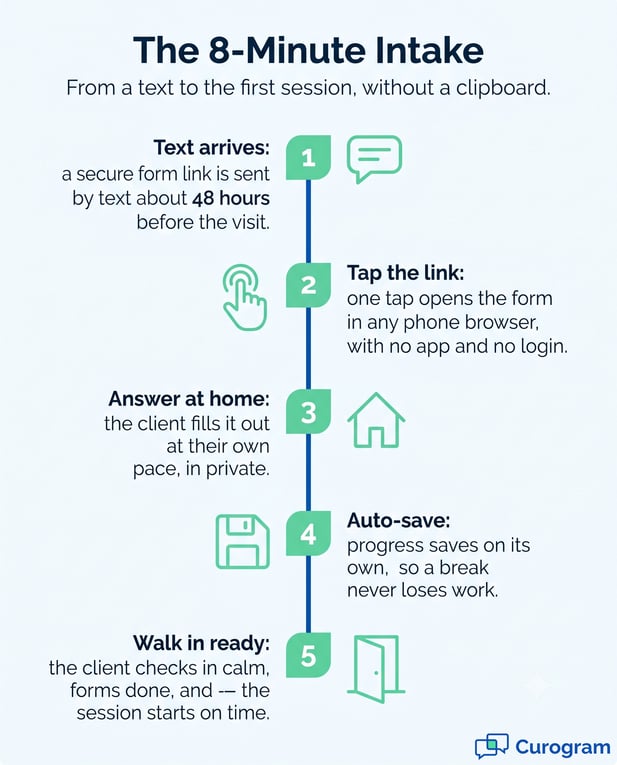
About 48 hours before the session, the client gets a text. It holds a short, friendly link. They tap it, and the forms open right away.
No app download is needed. No portal login is needed. The forms work in any phone browser.
Mobile intake forms for counseling clients feel less like paperwork and more like texting. That texted channel is the same secure, two-way HIPAA texting that powers the rest of the client journey.
The link feels familiar, like any text from a friend. There is nothing to install and nothing to remember. The client opens it, fills it in, and moves on with their day.
A Home-First Intake Built for Comfort
The client answers at home, in their own space. They can pause for a break, then come back. Progress saves on its own, so nothing is lost.
Private by Design
The hardest sections stay private. A client can share trauma or substance use history alone, with no one watching. For a person with PTSD, that privacy is not a small detail. Sharing in private feels less like a public confession.
Easy on Every Phone
Fields are large and easy to tap. Steps are short and clear. A client with ADHD is far less likely to stall. The form feels light, not like a 19-page packet.
It Works Alongside TherapyNotes
Curogram fits next to TherapyNotes without a heavy setup. It does not need deep API access to help. The client never sees the moving parts.
From their side, the flow is one text and one tap. The clinician gets the finished answers before the visit.
They can read the PHQ-9 score and plan the session. This is the client-friendly TherapyNotes intake that practices want.
The handoff is quiet and clean. Answers flow to the right place without extra clicks. Staff do not chase paper, and clients do not repeat themselves.
The format itself carries a message. A calm, private form says, “We thought about you.” A clipboard in a busy room says the opposite. Digital forms shape the behavioral health client experience long before the first hello.
Comfort and clarity are not extras here. They are the point. A form built for a person, not a desk, changes how care begins.
The table below shows the contrast at a glance.
|
Step |
Paper clipboard |
Curogram texted forms |
|
Where |
Waiting room |
Client's home |
|
Privacy |
Strangers nearby |
Private and alone |
|
Format |
19-page packet |
Mobile, easy to tap |
|
Saving |
None |
Auto-save |
|
Clinician prep |
After arrival |
Before the visit |
The Success: Walk In Ready, Not Anxious
What does success look like? It looks like a client who walks in calm and ready. The forms are done, and the session can start on time.
Higher Completion, Fewer Gaps
Texted forms get finished far more often than portal forms. The reason is simple. The link arrives where the client already lives, on their phone.
Texts Get Read
People open texts fast. They often ignore portal logins and email PDFs. So the delivery channel matters as much as the form. Match the channel to the habit, and completion climbs.
A clipboard waits for the client to arrive. A text meets them where they already are. That head start is the whole game.
Curogram clients see strong engagement across the board. No-show rates run 53% lower than the industry average, based on Curogram client data from clinical settings.
One practice cut no-shows from 14.2% to 4.91% in just three months. Average appointment confirmation rates top 75% among current clients.
|
Result |
What Curogram clients see |
|
No-show rate |
53% lower than the industry average |
|
One practice |
No-shows fell from 14.2% to 4.91% in 3 months |
|
Confirmation rate |
Over 75% on average |
These numbers come from broad client use, not intake alone. But the lesson carries over. When a message lands by text, people act. Pre-visit forms follow the same rule.
The Welcome, Not the Clipboard
Now the first touch is a kind text, not a PDF. It might read: “We look forward to seeing you Thursday. Tap here to finish your forms from home. It takes about 8 minutes.” The tone is warm and human.
The client answers on Sunday night from the couch. On Thursday, they check in and hear, “You are all set. We have your forms.” Then they walk straight into the room.
Small words carry weight here. “We have your forms” tells the client they are expected and welcome. The visit starts on a note of care.
A Calmer First Session
The clinician already read the answers. They saw the PHQ-9 score and noted key points. The session opens with care, not catch-up.
Prepared clinicians ask better questions. They spend the hour on the person, not the paperwork. The client feels seen from the first minute.
From Compliance to Connection
The first words are not “let me find your paperwork.” They are “I read your answers. Tell me more about what brought you in.”
That shift changes the whole mood. Steps that reduce intake anxiety help therapy practices keep clients in care.
The calm does not have to stop at intake. For virtual visits, a texted link can launch telehealth the same easy way. The low-friction feeling carries from the first form to ongoing care.
Conclusion: The Therapeutic Relationship Starts Before the Session
The first impression should not be a clipboard. It should be a calm, simple form on the client's phone. That one change shifts the whole start of care.
Paper intake asks a nervous person to perform. They write hard truths in a public room. Texted intake asks for nothing more than a few quiet minutes at home.
Think about what the client carries on day one. Doubt, hope, and a lot of courage. The intake step should protect that courage, not test it.
Most clients judge a practice in the first minutes. A warm start earns the benefit of the doubt. A cold one invites second thoughts.
TherapyNotes does important work. It guards your clinical records and keeps your practice running. But it was not built to shape the client's first feeling at the door.
That is where Curogram fits. TherapyNotes protects your records. Curogram protects your client's first impression. The two work side by side.
When intake is private and easy, the relationship starts early. It starts the moment the client taps the link at home. By the time they arrive, trust is already forming.
This is not about fancy tech. It is about meeting people where they are. The phone is simply the calmer room.
Your clients already took the hardest step. They booked the session. They chose to show up. Do not make the next step a 19-page paper packet.
Text them the forms instead. Let them answer in their own space. Let them walk in ready to heal, not ready to write.
The payoff reaches the whole practice. Clients feel cared for from the first text. Clinicians start prepared. Front-desk staff stop retyping handwriting, which ties back to the work of cutting data entry.
A calmer intake is not just a nice touch. It is part of good care. The format of intake shapes the feel of the first session.
Book a free demo and see how Curogram's mobile-first forms fit your TherapyNotes practice.
Frequently Asked Questions
The forms open as a web link in any phone browser. No app or printer is needed. Most basic phones with web access can open them, too. For the few clients without a capable phone, staff can offer another option while most clients still go digital.
The client answers at home, in a space that feels safe. There is no clipboard and no audience. Hard questions get answered in private, at the client's own pace. That calm start protects the courage it took to book the session.
The forms are filled out on the client's own phone, alone. No one in a waiting room can see the screen. Trauma or substance use questions are answered without an audience. For many clients, that privacy leads to more honest and complete answers.
Curogram sends gentle reminder texts as the deadline nears. If the client still arrives without finishing, they can complete the form on their phone in the lobby. That is still faster and more private than a clipboard. Staff can also see who is incomplete and follow up with a quick nudge.
Curogram runs next to TherapyNotes without deep API access. The client just gets a text, taps a link, and answers. The finished data reaches the clinician before the visit. Setup is light, so practices start fast.