

8 min read
Why Therapy Clients Drop Out | How SMS Recall Texts Bring Them Back
Jo Galvez
:
June 13, 2026
TherapyNotes holds their records but cannot text them at scale. A recall text closes that gap. Curogram sends a warm, no-pressure message that invites the client back. No call. No login. Just a tap to book a time.
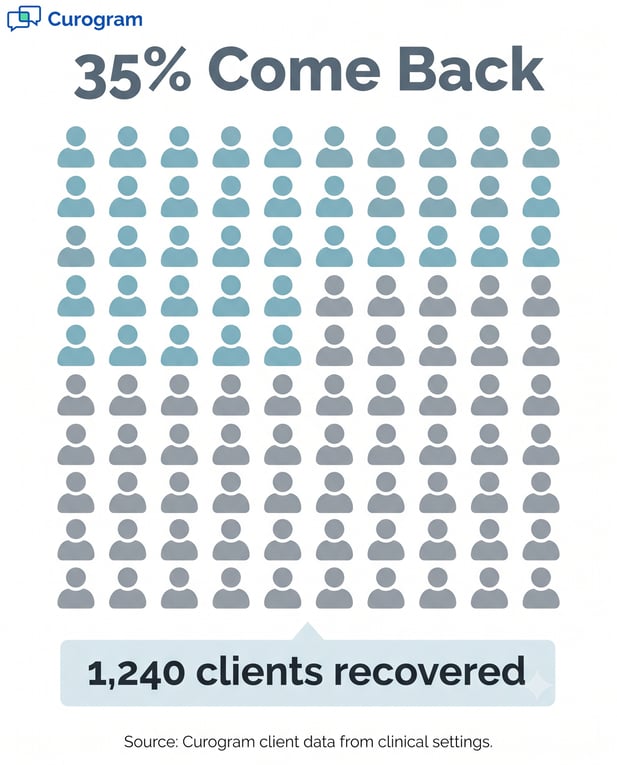
Based on Curogram client data from clinical settings, recall texts reach a 35% reconversion rate. One practice saw 1,240 clients return this way. A recall text is not a pitch. It is an open door for someone who wanted to come back but did not know how.
A client came every week for three months. Her mood lifted. Her coping skills grew. Then life hit hard.
A work crisis. A rough week when leaving bed felt like too much. She missed one session, then a second.
Each week, calling back felt heavier than the last. The gap widened until it felt too big to cross.
She did not quit because therapy failed. She quit because the thing therapy treats made coming back hard.
This is the quiet story behind most dropouts. People do not vanish because they are well. They slip away when money gets tight, motivation dips, or the schedule breaks. The door never closes. They just stop walking through it.
A behavioral health client dropout recall text for TherapyNotes re-engagement is a short, kind message. It meets the client on their phone, where they already are.
It does not ask why they left. It does not name a diagnosis. It says one simple thing: we are still here.
TherapyNotes is a strong record system. But it cannot send a wave of warm texts to clients who drifted.
So those clients sit in the database, waiting. Meanwhile, the practice spends money to find brand-new clients.
There is a better path. Reach the people who already know and trust you. A single text can turn “I should go back” into a booked visit.
In this guide, we look at why clients leave, how a recall text brings them home, and what the results look like.
We will keep this plain and honest. No hype and no jargon. Just a clear look at a small tool with a big payoff.
If you run a behavioral health practice, this is for you. The clients you helped before are your warmest leads. A few kind words can bring many of them back to care.
The Villain: The Dormant Database (Client Perspective)
Most clients do not quit therapy on purpose. They drift, one missed week at a time. To bring them back, you first need to see why they leave. The cause is rarely the care itself.
The Drift Is Quiet, Not a Choice
A client misses one session. Maybe the car broke down. Maybe the week was rough. They mean to reschedule. Then a second week slips by.
The longer the gap grows, the harder the call feels. Shame creeps in. “What will they think?” So they wait, and waiting becomes the new normal.
This is why clients stop coming to therapy more than any dramatic reason. There is no fight and no clear ending. Just silence. The client still needs help, and the practice still has room, but no bridge connects them.
Think about what the client carries. They remember the gap. They worry the slot is gone. They fear an awkward talk about why they left. None of that is true, but it feels true, so they stay away.
Life Crowds Out Care
Real life is loud. A job loss. A sick child. A tight budget. These push therapy down the list.
Self-care feels selfish when the week is on fire, so the appointment slides, then it disappears. The need does not leave. It just gets buried under the noise.
Money plays a big role here. A copay can feel like a luxury during a hard stretch. So the client drops the visit to cover a bill. The choice feels practical, even when it hurts their care.
The Symptoms Block the Return
Here is the cruel twist. The very issues therapy treats make coming back hard. Depression saps drive. Anxiety turns a phone call into a wall. ADHD makes small steps slip the mind.
Each task piles up: find the number, call in work hours, explain the gap, pick a time. For a struggling client, that is a steep climb.
A friendly text removes the climb. No call. No script to rehearse. Just read and tap.
Time of day matters as well. Practices answer phones during work hours. That is the same window when clients sit at their own jobs. So the call keeps getting pushed, and the gap keeps growing.
There is a clear pattern, too. Clients who miss two or three sessions in a row are far more likely to leave for good. The window to reconnect is short, then it shuts quietly.
This is why therapy client retention texting matters so much. A timely text message recall for therapy dropouts can catch a client before that window closes.

The Guide: The Gentle Reconnection
The fix is not complex. It is a kind, well-timed text. Done right, it feels like a friend checking in, not a brand chasing a sale. Here is how it works, and why it lands.
A Warm Text That Meets People Where They Are
Curogram sends recall texts to clients who have drifted. The message is brief and warm. “Hi Sarah, it has been a while.
We have openings this week if you would like to reconnect. Tap here whenever you are ready.”
That is it. No guilt. No clinical words. Just an open door. The client taps a link to book an appointment. No portal login. No phone tag. The whole thing takes seconds.
For SMS re-engagement in behavioral health, low friction is the whole game. The easier the step, the more clients take it.
Timing is part of the magic. A recall text can go out at the right moment, like a slow season or a set gap since the last visit. The client gets a nudge just when a fresh start feels possible.
|
Channel |
Effort to respond |
Why it matters |
|
Phone call |
High |
Needs a live talk, often during work hours |
|
|
Medium |
Easy to skip or lose in a crowded inbox |
|
Text |
Low |
Read in seconds, answered with a tap |
The lower the effort, the more likely a drifted client responds.
Built for Behavioral Health, Not Generic Blasts
These are not loud sales texts. Curogram’s recall templates avoid clinical language. They never name a diagnosis or treatment detail.
The tone stays gentle and human. A client feels cared for, not processed, and that care is what makes them tap instead of delete.
Word choice is careful by design. “We miss you” beats “You missed your appointment.” One invites. The other scolds. The right tone turns a cold list into a warm welcome.
Works Alongside TherapyNotes
Curogram does not replace TherapyNotes. It works beside it. Recall texts go out by SMS to client phone numbers. The client never touches a portal or app.
Look at a TherapyNotes client recall from the client perspective, and it feels simple. A text arrives. They tap. They book. The hard system work stays behind the scenes.
This is how practices reconnect with inactive therapy clients at scale. One campaign can reach hundreds of people in minutes.
Each gets a personal, warm nudge. Staff do not dial numbers all day. The database does the heavy lifting.
Setup is light, too. There is no risky data swap and no new system to learn. Your team picks a list, picks a template, and sends. The clients feel a personal touch, even at scale.
The Success: The Door Was Always Open—We Just Texted to Remind Them
So what happens when practices send these texts? Clients come back. Not all of them, but far more than most expect. The numbers tell a clear story.
Real Results From a Simple Text
Based on Curogram client data from clinical settings, recall texts reach a 35% appointment reconversion rate. That means more than one in three contacted clients book a new visit.
One practice brought back 1,240 clients from recall texts alone. These are not new leads. They are people who already knew and trusted the practice.
|
What we measured |
Result |
|
Appointment reconversion rate |
35% of contacted clients book again |
|
Clients recovered by one practice |
1,240 from recall texts alone |
|
Cost to reach an existing client |
Pennies per text |
|
Cost to find a new client through ads |
$50 to $200 each |
Source: Curogram client data from clinical settings.
Sit with that 35% for a moment. In a list of 300 lapsed clients, that is more than 100 visits. Those visits would not exist without a single, simple text. The database was the source all along.
A Fraction of the Cost of Ads
Finding a brand-new client is pricey. Paid ads can cost $50 to $200 per new patient. A recall text costs pennies.
You are not buying a stranger’s attention. You are reaching people who already chose you once. The math is hard to beat.
There is a hidden bonus here. Returning clients often refer friends and leave reviews. So one recovered visit can spark more growth down the line. Few ad dollars work that hard.
The Permission to Return
For the client, the win is emotional. A warm text lifts the guilt of the gap. It does not ask why they left. It says, in plain words, we are here. For many clients, that is the exact nudge they needed. Intention finally turns into action.
Many clients say the same thing when they return. They wanted to come back but felt stuck. The text gave them a reason and a route. That small push is often all it takes.
Take one client. She stopped anxiety therapy four months ago.
On a quiet Sunday night, a text arrives: “Hi, it has been a while. We are thinking of you and have openings this week. No pressure, just tap when you are ready.”
She reads it in bed. She taps. She books for Wednesday. At the session she tells her therapist, “I am glad you texted. I wanted to come back but did not know how to start.”
That is the whole point. The door was open the entire time. The text just reminded her.
Conclusion: Some Clients Just Need a Nudge, Not a Call
Clients rarely leave because they are done. They leave because life is loud and symptoms are heavy. The need for care stays. The path back just gets blocked. A recall text clears that path.
Think of it this way. TherapyNotes guards your records of the relationship. Curogram helps guard the relationship itself.
When a client drifts, a text is the bridge. Not a call. Not a portal. A few warm words on a phone.
That bridge matters most for behavioral health. The clients who struggle to reach out are often the ones who need care the most. A gentle text lowers the wall they cannot climb alone. It gives them permission to come back without shame.
A recall text is not marketing. It is follow-up care. Many guidelines urge providers to check in with clients who drop off. A brief, kind text fits that duty well, and it shows the practice still cares.
Your team feels this too. Manual outreach eats hours no one has. Calling lapsed clients one by one is slow and draining.
A recall campaign hands that work to a simple system, so staff stay focused on the people in the room.
The results back this up. Based on Curogram client data from clinical settings, recall texts reconvert 35% of contacted clients.
One practice welcomed back 1,240 people. Each return continues care that was already working, and each one fills a slot that would have stayed empty.
And the cost stays small. You are not chasing strangers with ads. You are reaching people who already trust you. The best source of your next session is often a client you have already helped.
Your inactive clients are not gone. They are waiting. They are waiting for a sign that the door is still open. They are waiting for proof that coming back is easy. A short text can be that sign.
This is care, not just commerce. A drifted client is a person whose progress paused. A recall text helps press play again. That is a clinical win first, and a revenue win second.
Start small if you like. Pick one batch of lapsed clients and send a warm note. Watch how many tap to book. The proof will show up in your own schedule within weeks.
The takeaway is short. Your records hold value you have not tapped. A kind text unlocks it. The people you helped before are ready to return, if you simply reach out.
So the choice is simple. Let the database sit quiet, or send the text that brings people home to care.
If you want to see it in action, we can show you. Book a free demo to watch how Curogram’s warm recall texts work beside TherapyNotes.
Frequently Asked Questions
Most do not stop because they feel cured. They drift when life gets busy, money gets tight, or motivation dips. Often the symptoms they treat, like low mood or worry, make reaching back out feel too hard. The need for care usually stays, even when the visits stop.
The message is short, warm, and free of pressure. It does not ask why they left or name any diagnosis. It simply notes that the door is open and offers an easy way to book. Based on Curogram client data from clinical settings, this gentle approach reconverts 35% of contacted clients.
A phone call demands a live talk, often during work hours. For a client with anxiety or low energy, that is a real wall. A text takes seconds to read and a tap to answer. The lower the effort, the more likely a client returns.
Curogram works beside TherapyNotes, not on top of it. Recall texts go out by SMS to client phone numbers. The client never logs into a portal or app, they just tap a link to book. The complex record-keeping stays where it belongs, inside TherapyNotes.
New patients found through ads can cost $50 to $200 each. A recall text costs only pennies to send. You are reaching people who already know and trust your practice. Based on Curogram client data from clinical settings, one practice brought back 1,240 clients this way.