11 min read

SmartCare EHR Recall SMS: Re-Engage Behavioral Health Clients Fast

SmartCare EHR Recall SMS: Re-Engage Behavioral Health Clients Fast
💡 The best way to re-engage clients who left behavioral health treatment is a short, kind text. SMS recall reaches people on the phone they already carry.
  • No app, portal, or phone call they might dodge.
  • Messages stay HIPAA-compliant and protect client privacy.
  • Curogram works alongside SmartCare EHR, not in place of it.
  • One text can reopen the door to care at scale.
  • One practice brought back 1,240 clients with a 35% return rate, based on our internal data.
A simple text supports treatment continuity. It reaches your whole client panel at once and invites dropped clients back to care.

Behavioral health clients rarely announce that they are leaving. They simply stop showing up. A missed session turns into a missed month. Soon the chart goes quiet, and no one reaches back.

This is the hidden gap in public behavioral health. Your team carries a population health mandate. You are asked to serve every client, even the ones who slowly fade away. Yet the tools you have rarely match that broad mission.

SmartCare EHR does its core job well. It holds your clinical notes, your billing, and your records. But it was built to document care, not to chase it. When thousands of clients drift away, SmartCare has no native way to text them all at once.

That gap is not a small one. It is the exact place where treatment continuity breaks down. The people who need support the most often slip through, unseen and unreached by anyone.

There is a simple fix that costs less than a phone tree. A short, warm text can bring a client back. SMS recall reaches people where they already are, right in their pocket.

This is the heart of behavioral health client recall. You send one kind message. You skip the app, the portal, and the call they may avoid. You open a door instead of waiting for one to close.

The results here are real. Based on our internal data, one practice brought back 1,240 clients through SMS recall. A strong 35% return rate followed a single set of recall texts.

This article shows how SMS re-engagement works alongside SmartCare EHR. You will see why clients leave, what a recall text feels like, and how one message can restart care.

The goal here stays plain and simple. Reach your whole client panel, and gently bring your people back home.

The Villain: Why Behavioral Health Clients Drop Out — and Why No One Reaches Back

Clients drop out of behavioral health care for human reasons, not careless ones. Their lives shift fast, and treatment is often the first thing to fall away. Understanding why they leave is the first step to bringing them back.

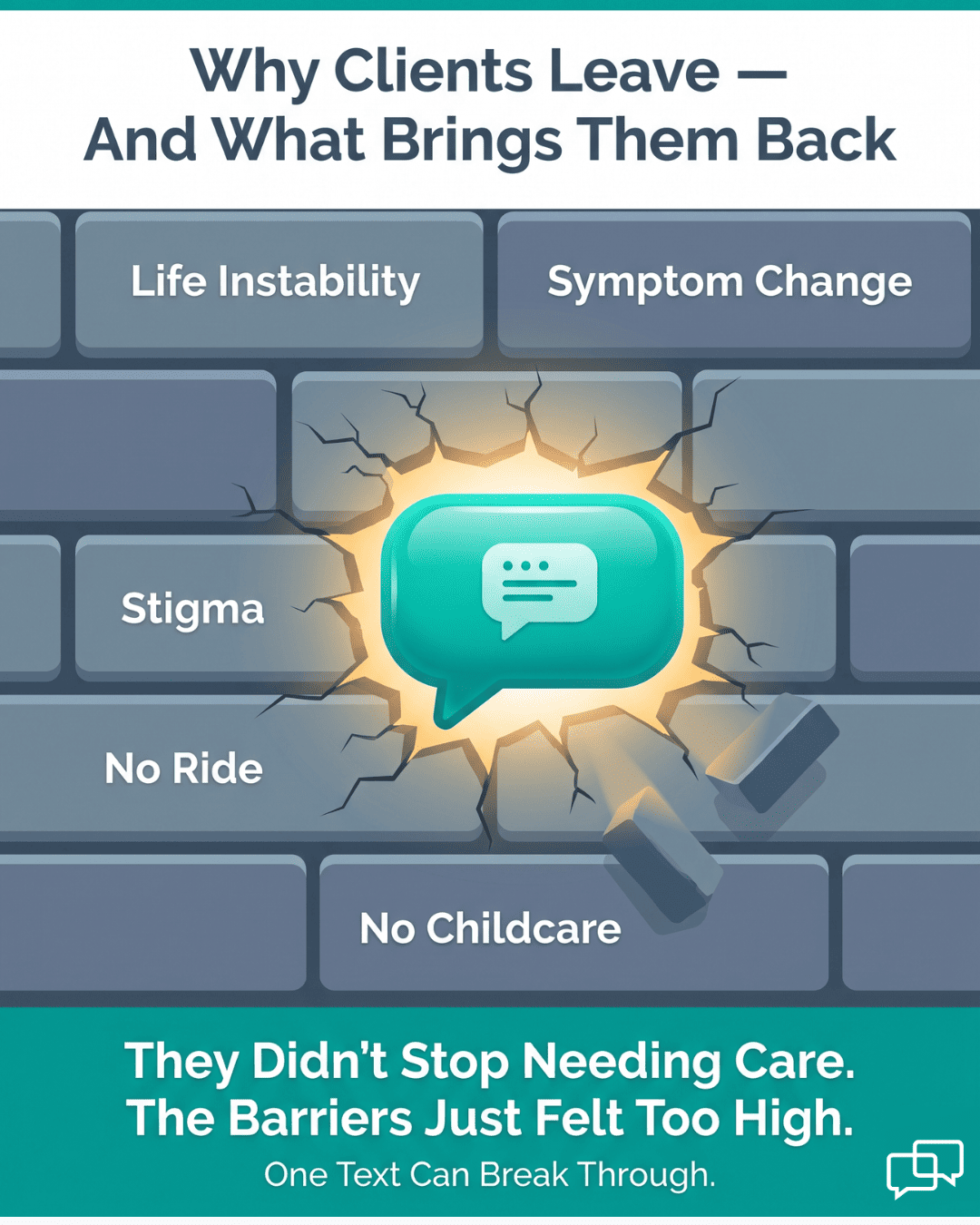
Life instability is the most common cause. A client loses a job, a home, or a relationship. A short jail stay or a move across town can break the routine. When daily life turns upside down, a standing appointment feels impossible to keep.

Symptoms also move in two directions:

  • Some clients feel better and decide they no longer need help

  • Others feel worse and lose the energy to call or show up

Stigma adds another layer. In many communities, ongoing mental health or addiction treatment still carries shame. A client may skip a visit to avoid being seen at the clinic. The fear of judgment can outweigh the need for support.

Then there are plain system barriers. No ride. No childcare. A confusing web of phone lines and service desks. Each hurdle is small on its own, but together they form a wall.

Here is the truth that matters most. Most clients do not leave because they are done with treatment. They leave because the barriers feel too high to climb. The intent to heal is still there, buried under stress.

So why does no one reach back? This is the real villain in the story. It is not a lazy team or a careless system. It is the outreach gap, and it is built into the tools themselves.

What SmartCare Does

SmartCare EHR was designed to manage clinical work. It documents sessions, tracks billing, and stores secure records. It does this job with skill. But it was never built to launch a broadcast to thousands of people who stopped coming in.

Consider an agency with 8,000 active clients. Each month, a few hundred quietly drift away. To call them all would take staff weeks they do not have. So the list grows, and the gap widens, month after month.

This is more than a missed chance. For many agencies, proactive outreach is a formal duty. Public behavioral health organizations carry population health mandates.

These duties ask them to find and re-engage clients who fall out of care. SAMHSA's CCBHC certification criteria name outreach, engagement, and retention as core requirements for serving underserved people.

The mandate is clear. The native tool to meet it is missing. Staff are asked to reach an entire panel with software built for one chart at a time.

The Mismatch Where Treatment Recall Efforts Stall

A counselor knows a client has not returned in 90 days. The clinical record shows the gap plainly. Yet there is no simple button to send that client a caring nudge.

The cost of this gap is steep, and it is measured in people. A client who leaves a substance use program in week three is at real risk. Each week without contact makes return harder and relapse more likely. The window to reconnect does not stay open forever.

Dropped client re-engagement fails most often for one reason. The reach-out never happens. Not because no one cares, but because no one has the means to act at scale.

This is the heart of the problem. The clients are findable. The will is there. The clinical system is strong. What is missing is a way to turn intent into a message that lands.

SmartCare EHR Recall SMS Re-Engage Behavioral Health Clients Fast-inlineBehavioral health client overwhelmed by daily life

The Guide: What a Recall Text Feels Like to a Client

The fix is not a new clinical system. You do not need to replace anything. You need one layer that handles the part SmartCare was never built to do: reaching people at scale.

This is where Curogram acts as your Population Health Partner. It is a HIPAA-compliant platform that lets behavioral health organizations text their entire client panel in one move.

With it, you can run targeted campaigns and re-engage clients who fell away. You meet your outreach duties without adding staff hours.

The feature that drives this is Mass Messaging. It lets your team send one secure text to thousands of clients at once. You can filter by gap length, service line, or location. A counselor can reach every client who missed care in the last 90 days with a few clicks.

Think of the math for a moment. A staff member calling 2,000 clients by hand might reach 40 in a day. The same person can send 2,000 caring texts in minutes. The labor cost drops to near zero, and the reach goes up a hundredfold.

How the Integration Works

Curogram does not compete with SmartCare EHR. It works alongside it. Your clinical documentation, billing, and records stay right where they belong, inside SmartCare. The communication simply flows through Curogram.

This split matters for your team. Clinicians keep their workflow. Charts do not move. Notes do not change. The only new thing is a fast, safe way to reach clients on the channel they actually answer.

That channel is the difference maker. People ignore voicemail and skip portal logins. But most read a text within minutes. SMS re-engagement meets clients on the device they already trust and check all day.

The Fit with Behavioral Health Populations

This is what makes this approach feel personal, not cold. Consider the people you serve. Many live with serious mental illness.

Many face substance use disorders. Some attend through CCBHCs or court-mandated programs. These are exactly the clients who avoid calls and dread the front desk.

  • For someone with serious mental illness - A phone call can feel like pressure. A text feels safe and low-stakes. They can read it in their own time. They can reply when they feel ready, without a tense conversation.

  • For substance use treatment recall - Timing and tone are everything. A warm, judgment-free message can catch a client in a moment of openness. It says, in effect, the door is still open. That gentle reach often lands better than any formal letter.

  • Court-mandated clients - Many fear that any contact will feel like surveillance. A simple, plain text about scheduling lowers that fear. It treats them as a person, not a case file.

Here is the part that surprises many teams: Reaching thousands at once does not make care feel mass-produced. It makes care feel more present. Each client gets a message that seems written for them, even when the system sent many at once.

That is the promise of treatment continuity in behavioral health. Care does not have to stop when a client misses a visit. The relationship can stay warm in the space between sessions. A short text keeps the thread from breaking.

This is also how you can send targeted SMS campaigns to thousands of clients without losing the human touch. You group clients by need, then speak to that need. A wellness check, a schedule change, or a gentle recall each gets its own message.

The role here is clear. SmartCare EHR is the clinical backbone. Curogram is the reach. One records the care. The other makes sure the care never quietly disappears. Together, they turn a population health mandate into action your team can actually take.

Infographic showing behavioral health client drop-out reasons as a brick wall broken by a recall text

The Success: When One Text Reconnects a Client to Treatment

The proof of this approach is not a promise. It is a pattern that shows up in real numbers. When agencies reach dropped clients with a simple text, a meaningful share comes back.

Based on our internal data, one multi-location practice ran a single SMS recall effort. The result was striking. A 35% reconversion rate. In plain terms, more than a third of contacted clients scheduled an appointment within a month.

The raw count tells the human story even better. From those recall messages alone, 1,240 clients returned to care. That is 1,240 people who had drifted away and then chose to come back. One text restarted each of those journeys.

Let us put that in context with a simple example. Say your agency has 4,000 clients who have not been seen in 90 days. You send each a warm recall text through your client recall text message effort. If even one in three responds, that is over 1,300 people back in treatment.

Now weigh the alternative. Without outreach, most of those 4,000 stay gone. The list just sits in the system. Each name is a person who may slide further from care, with no nudge to return.

The Math Scales in your Favor

A phone-only approach might reach a few dozen of those clients per week. A single mass text reaches all 4,000 at once. The cost per re-engaged client drops to pennies, while the human payoff climbs.

This is the quiet power of SmartCare EHR behavioral health re-engagement SMS done at scale.

The clinical system flags who has lapsed. The messaging layer reaches them. The two work as one, and clients who were invisible become reachable again.

But the numbers only matter because of the moment behind them. A client who responds to a recall text is at a critical window. They have stepped away, but not for good. The gap has opened, yet it has not hardened into a permanent break.

That window is everything in behavioral health. In substance use care, weeks of silence raise relapse risk. In serious mental illness, a long lapse can mean a crisis or a hospital stay. Reaching out early, before the gap sets, can change the whole path.

The Deeper Effect

Clients who return after a recall often re-engage more fully than before. They feel pursued in a good way. They sense that the agency noticed their absence and cared enough to reach out.

This is why client recall text message treatment works beyond the first visit. The return is not just a single appointment. It is a renewed bond between the client and the care team. That bond is the foundation of treatment continuity behavioral health programs depend on.

It also pays off in trust across the community. A client who feels welcomed back tells others. Once re-engaged, many keep communicating with the clinic by text between visits. That ongoing two-way contact keeps the relationship steady and warm.

Reputation: The Downstream Benefit

Clients who feel cared for are far more likely to share a positive review. A grateful client who returned because of one text becomes a trusted voice. That voice builds trust for the next person searching for help.

So the success is layered. First, the immediate return: 1,240 clients and a 35% reconversion rate. Then the deeper re-engagement that follows. Then the steady, ongoing contact that keeps care from lapsing again.

This is what dropped client re-engagement looks like when the tools finally match the mission. The clients were never truly lost. They were simply unreached. A single, well-timed text closed that distance and brought them home.

It helps to see the contrast side by side. The table below compares two ways to reach 4,000 lapsed clients. The gap in reach and effort is hard to ignore.

Outreach Method

Clients Reached

Staff Time

Likely Returns at 35%

Manual phone calls

~40 per day

Weeks of work

Slow, partial

Mass recall texts

4,000 at once

Minutes

~1,400 over a month


The story repeats across client types. Take a single mother who left care after losing childcare. A call during work hours would go unanswered. A text reaches her at night, when she finally has a quiet moment to read and reply.


How Curogram Reaches Thousands of Clients While Keeping Each Message Personal

Most teams want to know one thing: how does Curogram reach an entire client panel without losing the personal touch? The answer is the Mass Messaging feature, built for behavioral health scale.

Mass Messaging lets your team send one secure text to thousands of clients at once. You start by building a list inside Curogram. You can filter clients by how long they have been gone, by service line, or by location. A counselor can target every client with a 90-day gap in seconds.

Next, you write one warm message. Curogram sends it to the whole group at the same time. Each client receives it as a private, personal text, not a group blast. No one sees another client's name or number.

Privacy stays protected at every step. The platform is HIPAA-compliant by design. For substance use programs under 42 CFR Part 2, messages are written to avoid naming any diagnosis or treatment type. The text reads as a simple wellness or scheduling note.

Replies flow back into one secure inbox. When a client texts back, your staff can answer in real time. That turns a one-way recall into a two-way conversation. The client schedules, asks a question, or just reconnects.

The feature also respects choice. Every message includes a clear way to opt out. A client can reply STOP at any time and leave future campaigns. Their individual care and reminders continue without change.

Here is what makes it work for behavioral health. Reaching many feels like reaching one. The client sees a kind, direct text on their own phone. They reply on their own terms. That comfort is the quiet reason dropped clients feel safe enough to come back to care.

Conclusion: Bring Your Clients Back with One Text

Bringing clients back does not require a new clinical system. It requires a way to reach them. That is the simple shift this whole approach asks you to make.

SmartCare EHR remains your clinical backbone. It holds your notes, your billing, and your records with care.

Curogram adds the mass messaging and population health reach that extends SmartCare's value all the way to the client's phone. One records the care. The other makes sure care never quietly slips away.

Think of the split this way. SmartCare EHR is for your clinical data. Curogram is for your clients' convenience and contact. Together, they build a practice that is both clinically strong and easy to reach. That pairing is what closes the outreach gap for good.

The need is real, and it is large. Public behavioral health teams carry a duty to find and re-engage the people who fall out of care. The data shows the path works. Based on our internal data, one practice brought back 1,240 clients with a 35% return rate from recall texts alone.

Each of those numbers is a person. A client who felt better and stopped. A client whose life got hard. A client who feared judgment or could not find a ride. One text reached past every barrier and said, plainly, you are welcome back.

That is the relief at the center of this work. Your clients did not leave because they stopped needing help. They left because the barriers felt too high. Sometimes all it takes to lower them is a text.

Your lapsed client list is a recovery waiting to happen. Schedule a demo to watch Curogram turn that silent list into booked appointments alongside SmartCare EHR.


Frequently Asked Questions

How does an SMS recall text protect my privacy if I'm in substance use treatment?

Messages go through Curogram's HIPAA-compliant platform. For programs under 42 CFR Part 2, the text avoids naming any diagnosis or treatment type. It reads as a general wellness or scheduling note, so your privacy stays protected.

Why would a clinic text me if I haven't visited in months?

Your provider is reaching out because they want to reconnect you with care. Recall texts go to clients who may benefit from a follow-up. You are never obligated to reply, but the door stays open if you want it.

How can I stop receiving mass texts from my behavioral health provider?

You can opt out anytime by replying STOP to any message. The system removes you from future campaigns right away. Opting out does not affect your individual appointment reminders or your ongoing clinical care.

Why does a short text work better than a phone call for re-engagement?

A call can feel like pressure and is easy to dodge or miss. A text arrives quietly and waits. You can read it on your own time and reply when you feel ready, without a tense conversation.

How does reaching thousands of clients at once still feel personal?

Each person receives a private, one-to-one text, not a group blast. No one sees another client's name or number. The message reads as if it were written just for you, even when the system sent many at once.