9 min read
Population Health SMS Outreach for SmartCare EHR CCBHC Agencies
Mira Gwehn Revilla
:
June 19, 2026
- Send segmented SMS by program, diagnosis, or last-visit date.
- Reach thousands of behavioral health clients in minutes, not weeks.
- Keep records in SmartCare while outreach flows through Curogram.
- Use opt-out tracking, BAA coverage, and 42 CFR Part 2 settings.
- Recover lost clients with proven recall campaigns at scale.
Behavioral health care has a quiet leak. Clients begin treatment with hope, then slowly fade away. Research points to dropout rates of 40% to 60% in behavioral health. The number shifts with the condition and the type of care.
For a community mental health agency, that gap is more than sad. It is a missed duty. Many of these clients live with serious mental illness or substance use disorders. When they drift, the agency loses touch with the people it serves.
The hard part is reach. A Certified Community Behavioral Health Clinic may serve tens of thousands of clients. Staff cannot call each one who has gone quiet. Phones ring out, voicemails fill up, and weeks slip by. The panel keeps shrinking while good intentions stall.
SmartCare EHR runs the clinical side well. It holds records, claims, and care plans in one place. But it was not built to text thousands of clients at once. When you need one broadcast to reach a whole program, no native tool exists.
That gap has a name in this article. We call it the Outreach Gap. It sits between a population health mandate and the means to meet it. Agencies must engage their whole panel, yet rarely get a way to do it at scale.
This is where a dedicated messaging layer changes the math. SmartCare EHR population health SMS outreach for CCBHC and community mental health teams becomes real with the right partner. You keep your clinical home base. You add a way to reach everyone.
The rest of this guide shows how that works. We will cover the gap, the fix, and the results behind it. The goal is simple. Stop letting your clients quietly drift away from care. With the right setup, a quiet panel can become an active one again.
The Villain: Why SmartCare Cannot Reach Thousands of Clients at Once
Every behavioral health agency faces the same hidden foe. It is not a rival clinic or a budget cut. It is the Outreach Gap. This is the space between who you should reach and who you actually can.
Start with the size of the problem. Dropout in behavioral health care runs high, often 40% to 60%. Clients with serious mental illness or substance use disorders are most at risk. They miss one visit, then another, then go silent for months.
Now add scale. County and public sector agencies often serve huge panels. A single CCBHC may carry 5,000 to 50,000 active clients. Some networks manage far more across many sites. Population-scale work needs population-scale tools.
Where the Gap Opens Wide
SmartCare EHR was built for clinical work. It documents care, drives billing, and tracks outcomes well. But it has no native mass SMS capability. You cannot select 4,000 lapsed clients and send one secure text.
So teams fall back on the phone. Picture the math behind that choice. Say one caller reaches 30 clients an hour. To call 6,000 lapsed clients takes 200 staff hours. That is five full work weeks for one person.
Most of those calls never connect. Lines are busy. Numbers change. Voicemail boxes are full. By the time staff finish the list, more clients have already lapsed. The work never ends, and the panel keeps slipping.
For the CCBHCs
Their certification ties funding to active engagement. They are asked to track and re-engage their whole population. A mandate to reach everyone means little without a way to do it.
Letters and portals do not close the gap either. Mailers are slow and easy to ignore. Many clients never log into a patient portal. Email open rates stay low for this group. None of these tools reach a whole panel in minutes.
|
Consider a real-world scene: A county agency wants to alert 8,000 clients about a clinic move. Or it wants to push a winter wellness check to one program. With phones and mail, that effort drags on for weeks. By then, the moment to act has passed. |
The cost of the gap is human, not just clerical. Each lapsed client is a person who may relapse or land in crisis. Missed contact can lead to an ER visit instead of a check-in. Proactive outreach is cheaper and far kinder than reactive care.
The Outreach Gap is the true villain of this story. It is quiet, steady, and easy to overlook. SmartCare EHR alone cannot defeat it. To win, you need a partner built for reach at scale.
The Guide: How Mass Messaging Works Alongside SmartCare EHR
Every hero needs a guide, and so does every agency. SmartCare EHR is your clinical home. Curogram is your Population Health Partner. It gives you the reach that records alone cannot.
The fix is simple in concept. You add a HIPAA-compliant layer that texts your whole panel. Curogram lets you reach every active and lapsed client by SMS. You re-engage people who slipped away and meet your population health goals at scale.
The core tool here is Curogram Mass Messaging. It lets you send one secure text to thousands of clients at once. You write the message, pick the audience, and hit send. Delivery happens in minutes, not weeks.
What are Smart Filters?
You do not blast every client the same note. You segment by program, diagnosis, or last-visit date. You can target clients with no visit in the past 90 days, or one specific program.
This is what real community mental health text outreach looks like. A peer support program can ping its own members. A medication clinic can remind clients about refills. A SUD program can send a gentle, private check-in. Each group hears only what fits its care.
Now picture SmartCare mass SMS in daily use. Your case manager sees a list of lapsed clients in your workflow. Instead of dialing all day, the team launches one campaign. Replies come back by text, where clients feel at ease.
Balance, Not Replacement
Curogram does not compete with SmartCare EHR. The two work side by side. Your clinical notes, claims, and care plans stay in SmartCare. Your client communication flows through Curogram.
That split keeps each system in its lane. SmartCare EHR stays your source of clinical truth. Curogram becomes your channel to the client. You gain reach without disrupting your records or your billing.
This approach also fits behavioral health better than it may seem. Mass texting sounds cold, but it is the opposite here. A short, kind text meets clients where they live, on their phones. Many feel safer replying to a text than answering a call.

Think about the people you serve. Clients with serious mental illness may avoid phone calls. Those in court-mandated treatment may fear judgment. People with substance use disorders value privacy above all. A discreet text respects all of these needs at once.
Curogram protects that privacy by design. It is HIPAA-compliant, backed by a BAA, and SOC 2 Type II audited. For 42 CFR Part 2 programs, messages can avoid naming any treatment detail. Consent and opt-out tracking are built into every campaign.
So the guide does two jobs at once. It extends your reach to the whole panel. And it does so in a way that feels personal, private, and safe. That is the heart of the Population Health Partner.
The Success: Recall and Population Health Results
This is the part where the gap finally closes. When you pair SmartCare EHR with Curogram, the panel reconnects. Lapsed clients come back. Outreach that once took weeks now takes minutes.
Start with the proof from real behavioral health recall campaigns. One multi-location practice ran SMS recalls to clients overdue for follow-up.
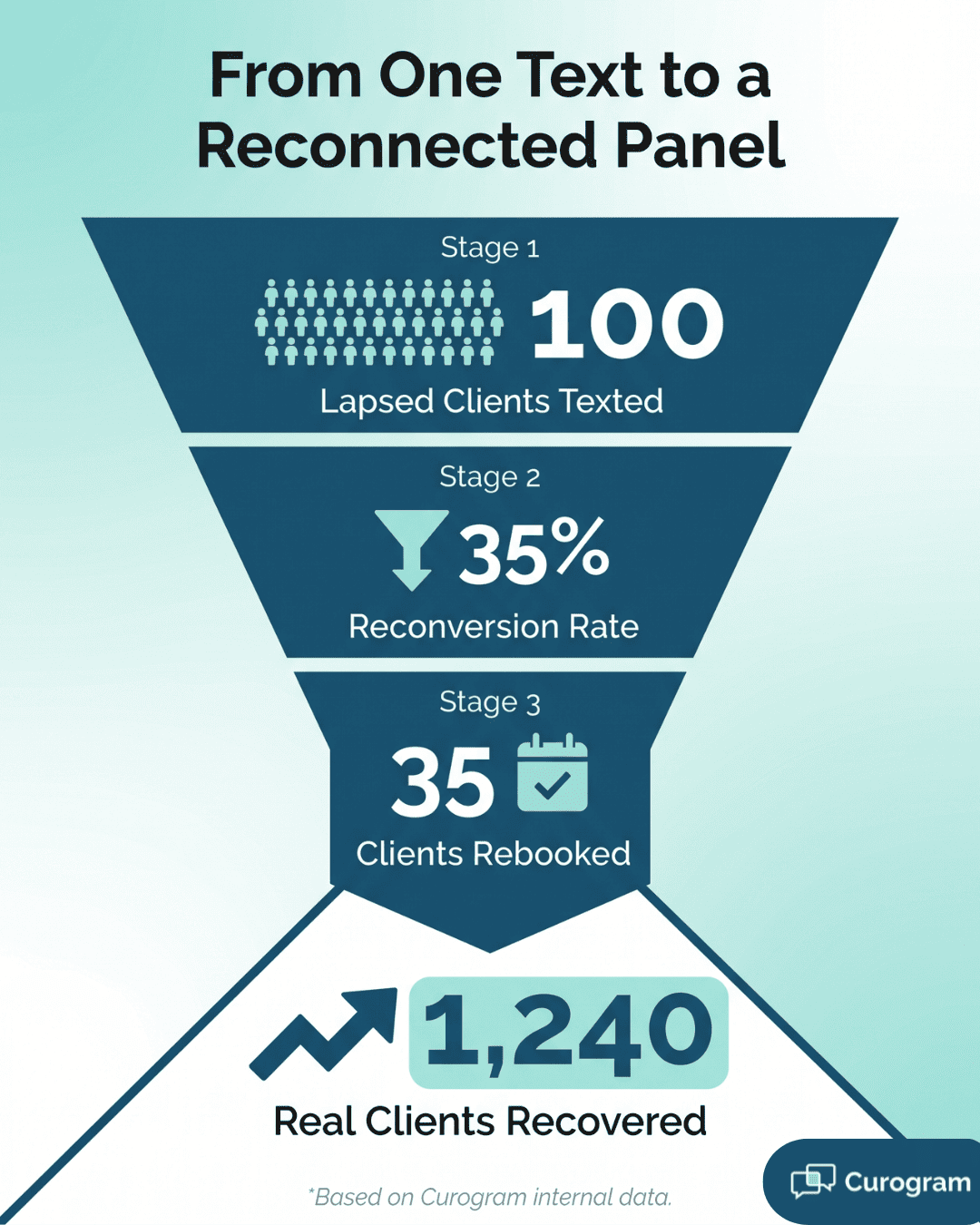
The result was a 35% appointment reconversion rate in a single month, based on our internal data. Of every 100 lapsed clients texted, about 35 booked a visit.
The raw count tells the rest of the story. That same practice saw 1,240 clients return from recall texts alone, per our internal data. These were people who had drifted out of care. One round of messages brought them back through the door.
Let us turn that into a simple model for your own agency. The numbers below are illustrative estimates, scaled from that 35% reconversion benchmark. They show how a single campaign might perform at different panel sizes.
|
Lapsed clients texted |
Reconversion rate |
Clients re-engaged |
Staff phone hours saved* |
|
2,000 |
35% |
~700 |
~67 hours |
|
5,000 |
35% |
~1,750 |
~167 hours |
|
10,000 |
35% |
~3,500 |
~333 hours |
*Phone-hour estimate assumes 30 calls per staff hour. Reconversion figures are illustrative, scaled from the verified 35% internal benchmark.
The speed gain is just as striking. A broadcast to 10,000 clients sends in minutes. The same outreach by phone could take 300-plus staff hours. That is months of work for one caller, done before lunch.
This is the heart of CCBHC population health outreach. Certification asks agencies to engage their whole population. It rewards proactive contact, not passive waiting. A mass text campaign turns that mandate into a same-day action.
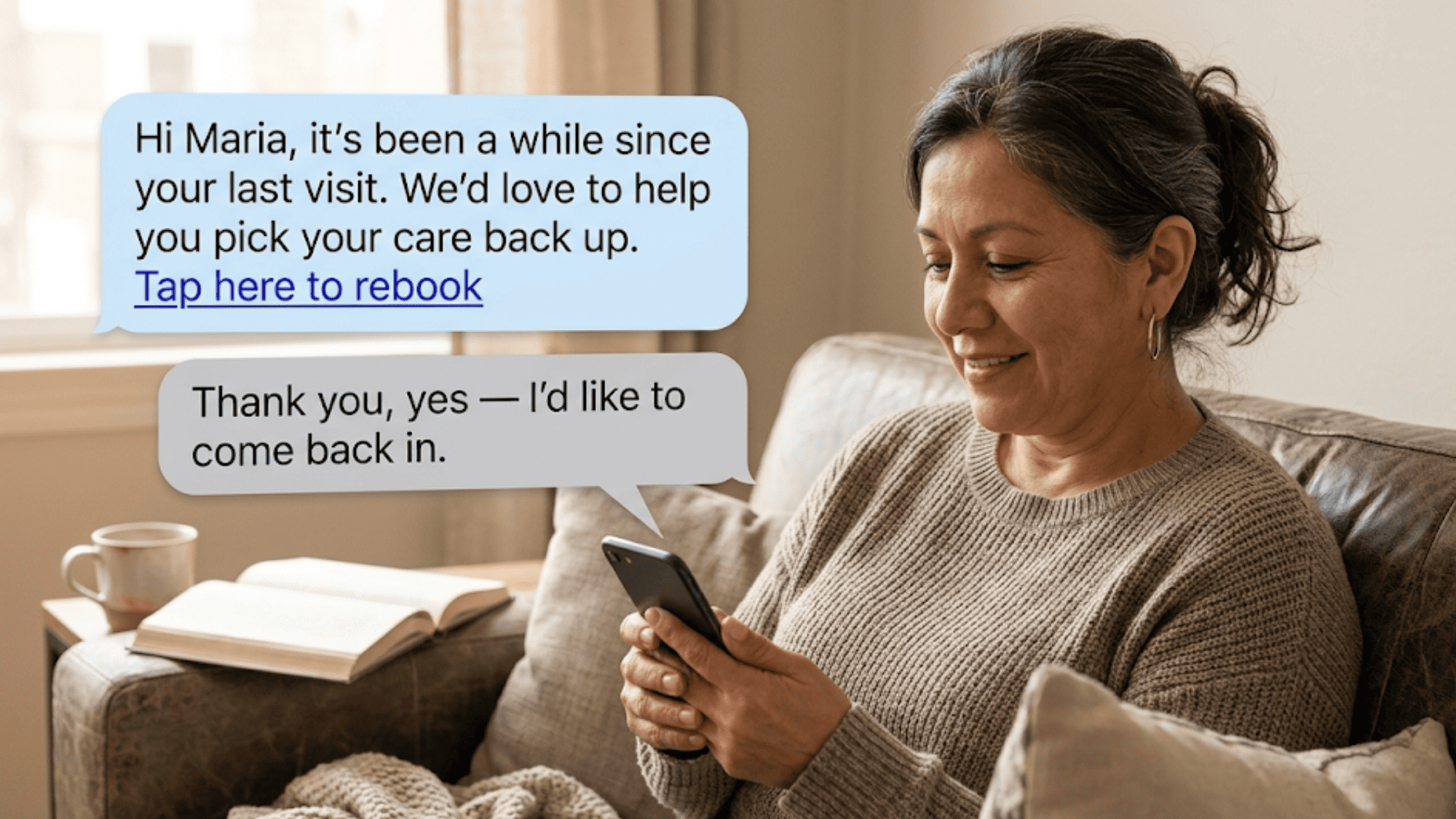
Here is one practical scenario. A CCBHC notices 4,000 clients with no visit in 90 days. Staff segment that group inside the workflow. They send a warm recall text with a simple booking link. Within a week, hundreds reply and rebook.
The same engine powers more than recalls. You can run a flu or wellness push to one program.
You can alert a whole panel to a clinic closure. You can send seasonal screening reminders to a target group. Each is a fresh form of public sector client engagement.
Consider the downstream value too. Each reconnected client is a chance to prevent crisis. A timely check-in may stop a relapse or an ER trip. Continuity of care improves when contact stays steady. That is better for clients and for your outcome metrics.
The Financial Upside
Recovered visits fill slots that would sit empty. They support staff capacity and program funding. For value-based or grant-funded agencies, engagement data also strengthens reporting. Strong outreach numbers help defend and renew contracts.
Let us frame the win for a 20,000-client agency. Suppose 6,000 clients have lapsed over the year. A single recall campaign at the 35% benchmark could re-engage about 2,100. By phone, reaching those 6,000 would demand 200 staff hours. By text, it is one afternoon of work.
The contrast is the whole point. Without a partner, the Outreach Gap quietly drains your panel. With one, you reverse the flow. Clients return, staff time is freed, and engagement metrics climb.
None of this requires you to leave SmartCare EHR. Your records stay exactly where they belong. Curogram simply adds the missing reach. The clinical core and the communication layer finally work as one.
The success story, then, is a reconnected panel. It is measured in clients seen, not just messages sent. It is built on real recall results and honest math. And it scales from a single clinic to a county-wide network.

How Curogram Turns One Message Into Thousands of Reconnections
The magic is not in the text itself. It is in how Curogram scales a single message. You write one note, and it reaches your whole target group. The platform handles the rest behind the scenes.
It starts with the audience. You filter your client list by the rules you choose. You might pick everyone in one program with no recent visit. Or you might select a diagnosis group for a wellness push. The right people are grouped in seconds.
Then comes the send. Curogram Mass Messaging delivers your text to thousands of clients at once. Each message lands as a private, one-to-one text on the client's phone. To the client, it feels personal, not mass-produced.
Replies flow into one shared inbox. Staff answer real conversations without dialing a single number. A client can rebook, ask a question, or opt out by text. The whole exchange stays secure and on record.
Compliance is baked in, not bolted on. Curogram is HIPAA-compliant and backed by a BAA. For 42 CFR Part 2 programs, messages avoid revealing treatment details. STOP replies are processed and tracked for you. Staff can check opt-out status before any campaign goes live.
This is why the recall numbers hold up. One practice recovered 1,240 clients and hit a 35% reconversion rate, based on our internal data. That outcome came from sending the right text to the right group at scale. Curogram makes that workflow repeatable for any behavioral health team.
Conclusion: Reach Your Entire Client Panel — Do Not Let Them Drift Away
Your clients do not leave on purpose. They drift, one missed week at a time. The Outreach Gap is what lets that drift go unchecked. Close it, and you keep more people in care.
SmartCare EHR gives you the clinical backbone. It holds your records, claims, and care plans with care. Curogram adds the mass messaging and population health layer on top. Together they reach the client touchpoint that records alone cannot.
Think of the split this way. SmartCare EHR is built for your clinical data. Curogram is built for your clients' convenience. One keeps you accurate and audit-ready. The other keeps you reachable and human at scale.
The proof is plain in the numbers. One multi-location practice recovered 1,240 clients through recall texts. It earned a 35% reconversion rate in a single month, based on our internal data. For a CCBHC with engagement mandates, that is real public health progress.
The math also favors speed. A broadcast reaches thousands of clients in minutes. The same job by phone would take staff many weeks. That time goes back into care, not into voicemail tag.
You do not have to choose between clinical depth and broad reach. You can have both. Keep your documentation in SmartCare EHR. Run your outreach through Curogram, with consent and opt-out built in.
Stop losing clients to silence. Book a demo today and learn how segmented SMS recall campaigns bring lapsed behavioral health clients back to care.
Frequently Asked Questions
Curogram is HIPAA-compliant and backed by a BAA, with SOC 2 Type II auditing. For 42 CFR Part 2 programs, you configure messages so they never reveal substance use treatment. Consent and opt-out tracking run on every campaign.
You filter clients by program, diagnosis, last-visit date, or custom rules. This lets you send recall texts to clients overdue 90 days, wellness alerts to one program, or screening reminders to a defined group.
Curogram automatically processes STOP replies and removes those clients from future sends. Opt-out status is tracked to meet TCPA rules. Staff can review opt-out lists from one dashboard before launching any new campaign.
Many clients with serious mental illness or substance use disorders avoid calls. A short, private text feels safer and less like pressure. They can reply on their own time, which lowers the barrier to rebooking.
CCBHC certification ties funding to active engagement. Mass texting lets you reach a whole panel, re-engage lapsed clients, and document outreach. That turns a population health mandate into a same-day, measurable action.