


8 min read
TherapyNotes Client Recall Revenue | Fill Gaps with SMS Campaigns
Jo Galvez
:
June 18, 2026
TherapyNotes stores records well, but it has no built-in bulk texting. Curogram fills that gap with mass SMS recalls. Based on Curogram client data from clinical settings, recall texts reached a 35% appointment reconversion rate. One practice brought back 1,240 clients from recalls alone.
The cost gap is wide. A recall text costs pennies. A new client from ads can cost $50 to $200. Your former clients already trust you and know your office.
Want fuller chairs without bigger ad spend? Start with the people already in your system.
Your TherapyNotes account looks neat and full right now. Thousands of names, session notes, and billing lines sit inside it. Now, ask one simple question.
How many of those clients have not booked in months?
For most practices, the number is large. Often it is hundreds. These people are not strangers. They walked through your door, trusted your team, and shared hard, private things.
Then life happened. They drifted away. Work stalled, money got tight, or a busy week pushed care aside. Their file stayed put while their care quietly stopped.
Here is the painful part. While those clients sit idle, many practices spend on ads to find new ones.
They chase cold leads who have never heard of them. Meanwhile, warm clients who already trust the team go untouched.
Why does this happen? TherapyNotes is great at storing records. It was not built to reach out in bulk.
So TherapyNotes inactive client outreach turns into a slow, manual grind. Staff call one person at a time, leave voicemails, and burn out fast.
That grind is the real barrier here. It is not a lack of clients at all. It is a lack of an easy way to reach them. A single text blast could do in minutes what calls cannot do in weeks.
This is the path to TherapyNotes practice growth without advertising. You stop paying to find strangers. You start texting people who already know you. The math is hard to argue with.
In this guide, we show how mass SMS recalls work. You will see the real cost, the actual results, and the simple steps to start.
By the end of this read, you will view your database in a whole new way. Not as a dusty filing cabinet, but as your best growth channel yet.
The Villain: The One-at-a-Time Trap
Every practice has the same hidden cost. It is not the rent or the software. It is the slow, manual way teams try to reach old clients.
We call it the one-at-a-time trap. It quietly drains both time and revenue, year after year.
Why TherapyNotes Cannot Reach Clients in Bulk
TherapyNotes tracks records with care. It holds session history, billing, and clinical notes. But it has no tool to send mass messages. When you spot 300 clients gone quiet, your choices are grim.
You can call each one. That means 90 or more hours of staff time. You can send single emails. In healthcare, most go unread, with open rates near 20%.
Or you can do nothing and hope they come back. None of these paths work well at scale. Each one trades staff hours for tiny results.
The Manual Recall That Falls Apart
Picture a real attempt. Staff get a list of 50 quiet clients to call this week. After two days, they reach just 12. The rest go to voicemail.
Of those 12, only 4 want to book. So the team spent 6 hours for 4 maybe-sessions. Meanwhile, 250 other clients stay untouched. Soon the effort dies, because it simply does not scale. The list never shrinks. The staff just get tired.
The Cost Gap Nobody Talks About
Now look at the money. Many practices spend around $1,500 a month on Google Ads. Each new client can cost $75 to $150 to land. That is a steep price for a stranger.
At the same time, 500 or more past clients sit in the database. They already trust the practice. They know the office and have notes on file. A recall text to them costs about $0.02 to $0.05 each.
The gap is wild. Reaching a known client by text can cost a tiny slice of an ad. Yet without a bulk text tool, the database stays frozen. You see the gap clearly. You just cannot close it by hand.
Reaching old clients: by hand vs. by mass text
|
What you compare |
Manual calls and emails |
Mass SMS recalls |
|
Time to reach 500 clients |
90+ staff hours |
A few minutes |
|
Cost per contact |
High staff time |
$0.02 to $0.05 |
|
Typical reach |
About 1 in 4 answered |
Most texts delivered |
|
Can it scale? |
No |
Yes |
The Result of the Trap
The practice manager knows the math is broken. Paying to chase strangers while ignoring 2,000 known clients makes no sense. But the team has no way to fix it alone.
What is missing is a TherapyNotes bulk text campaign staff can actually run. Not a longer call list. A faster, simpler way to reach everyone at once.
So the records just sit there. Organized. Documented. Unused for growth. The filing cabinet stays full, and the schedule stays thin. Every quiet client is a slot you could fill. Every missed slot is money left on the table.
This is the trap in one line. Your biggest growth asset is locked behind a manual process. The clients are willing. The data is ready. Only the right tool is missing.

The Guide: The Revenue Recovery System
There is a simple fix for the trap. You do not need new staff or a bigger ad budget. You need a way to text many clients at once.
That is what a recall system does. It takes a job that once took weeks and shrinks it to minutes.
How the Revenue Recovery System Works
Curogram acts as your recovery system. It is a bulk SMS tool that sends recall texts to client lists in minutes. You pick clients by last visit date, provider, or tags.
You write one warm message. Then you send it to 500 people with a single click. The work that broke your staff now takes one short setup.
Replies land in one shared inbox. Staff answer and book right from there. No phone tag. No long call lists.
This is behavioral health practice revenue recovery SMS in plain, daily action. The flow stays calm and clear. Your team works one inbox, not fifty calls.
Track Every Campaign in Real Time
Curogram includes a Campaign Analytics Dashboard. It shows delivery rates, reply rates, and bookings as they happen.
You can see exactly what each recall earns. No more wondering if outreach pays off. The proof shows up on the screen.
That means clear numbers, not guesses. Texts sent. Replies back. Sessions booked. Revenue brought back.
The whole effort becomes a process you can repeat and trust. You learn which message works. You sharpen the next send. Over time, results climb.
Works Alongside TherapyNotes
You do not need API access to start. Curogram runs next to TherapyNotes, not on top of it. You can build lists from what you know about your clients.
You can also upload a segmented list. Group clients by last visit, provider, or need. Send the right message to the right people.
No data move from TherapyNotes is required. Most teams build their first recall list during onboarding. Then they keep it as a living outreach asset.
Setup is simple, and support helps along the way. There is no risky migration and no long wait to begin.
More Than Marketing, It Is Care
Here is the part that matters most in this field. Recall texts do double duty. They bring in revenue. They also meet your duty to follow up.
A client who dropped out of depression care may still need help. A gentle text can reopen that door. So strong client recall operations behavioral health teams run are both smart business and good care.
Curogram makes that outreach easy to do well. One short text can guide someone back toward the care they paused.
The Success: Revenue on Demand
When the tool fits the need, results come fast. Practices stop hoping clients return. They start bringing them back on purpose.
Growth turns into something you can plan. You no longer rely on luck or word of mouth alone.
The Numbers Behind Recall Campaigns
The proof is in the data. Based on Curogram client data from clinical settings, SMS recalls hit a 35% appointment reconversion rate. That means more than one in three quiet clients booked again.
For an outreach effort, that rate is huge. Few ad campaigns ever come close. These clients convert because they already know you.
One practice brought back 1,240 clients from recall texts alone. The cost stayed at pennies per message.
Each returning client is worth far more than that text ever cost. The return on a few dollars can run into the thousands.
What One Returning Client Is Worth
Do the simple math. A session may bring $120 or more. A returning client often books 4 to 6 visits. That puts each recovered relationship near $480 to $720. One text can spark months of ongoing care.
Now scale that across hundreds of clients. The total adds up fast. This is how you fill empty therapy schedule slots without buying a single ad.
The value was always there, just out of reach. A recall tool finally puts it within grasp.
A Real March Example
Picture a 10-clinician practice in March. The winter rush has faded. The spring calendar sits at 15% open. The manager wants those slots filled.
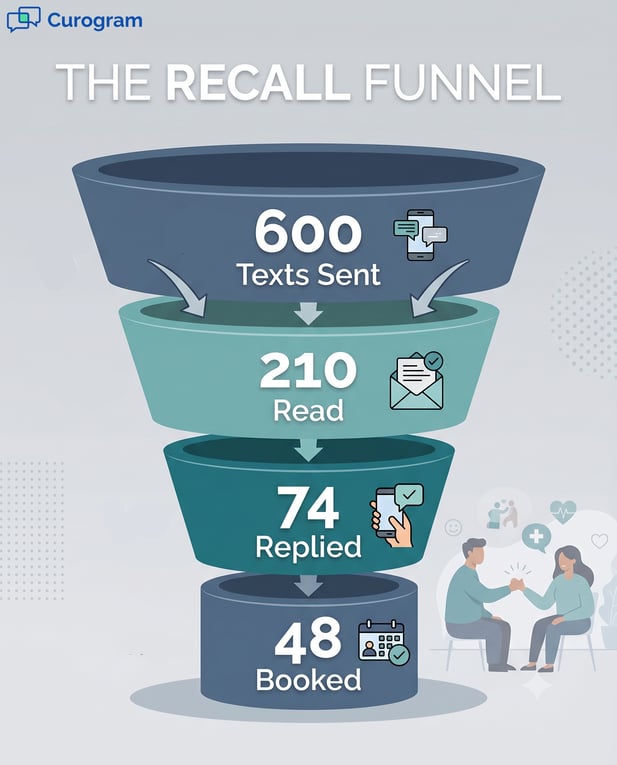
She sends a recall to 600 clients not seen in 120 days. The message is short and warm. "Spring is a good time to reconnect. We have openings. Tap here to book."
Within 72 hours, 210 people read it. 74 reply. 48 book a session. That is over $5,760 in just two weeks. The campaign cost about $30.
That is a return most ad budgets can only dream of. And it came from clients she already had.
One spring recall campaign, start to finish:
|
Campaign step |
Result |
|
Texts sent |
600 |
|
Clients who read it |
210 |
|
Clients who replied |
74 |
|
Sessions booked |
48 |
|
Revenue in 2 weeks |
$5,760+ |
|
Campaign cost |
About $30 |
Growth You Can Turn On
This is the real shift. Recalls become a lever you can pull. Slow week ahead? Run a campaign. Season changing? Send a wellness nudge.
You no longer wait and hope. You act with intent. Need to fill next month? You already know what to do. Growth becomes a managed habit, not a lucky break.
That is what revenue on demand means for a busy practice. The schedule stops feeling random and starts feeling steady. You pull the lever, and the chairs fill.
Conclusion: Your Database Is Your Best Marketing Channel
Let us bring it home. Your client list is not old paperwork. It is your warmest, cheapest growth channel. The trick is simply reaching it. Once you see it that way, the path forward gets clear.
Think of the two systems this way. TherapyNotes is your records system. It holds the full client story with care. But it does not act on that story. It waits, quiet and complete, for someone to make the call.
Curogram is your reach system. It takes those records and brings them back to life. One stores the history. The other restarts it.
Together, they turn a quiet database into a working engine. Records and reach, side by side, do what neither can do alone.
Here is the core insight. You do not need to chase new faces first. Hundreds of past clients are one text away from returning. They already trust your team and know your space.
A single recall campaign can book more sessions than a month of ads. And it can do so at a tiny slice of the cost.
That is growth that starts from inside your own practice. No new ad spend. No cold leads. Just warm clients coming home.
Start with a quick count. How many clients have not booked in 90 days? Multiply that by your average session value.
The hidden revenue will surprise you. For many practices, it dwarfs a full month of ad spend.
Then run one small recall campaign and watch what comes back. The cost is low. The risk is small.
The upside is sitting in your database right now. You have nothing to lose by trying one send.
Your schedule gaps are not a client problem. They are a reach problem. The people you need are already in your system, waiting for a simple nudge. They liked your care once. Many would gladly return.
So treat your database like the asset it is. Send the text. Open the inbox. Fill the chairs. Your best source of new sessions is often a past client who just needs to come back.
Ready to see the numbers for your own practice? Book a free demo.
Frequently Asked Questions
You can pull client lists from TherapyNotes reports, or build lists right inside Curogram. Most teams set up their first list during onboarding, with help from support. After that, you keep it as a living outreach tool. No data transfer from TherapyNotes is needed.
A single recall text costs only pennies to send. A new client from ads can cost $50 to $200. Past clients already trust you, so more of them book. That mix makes recalls one of the lowest-cost ways to fill slots.
Most practices run a recall each quarter, targeting clients not seen in 90 to 180 days. Many add seasonal sends, like fall mood check-ins or New Year wellness goals. The right pace depends on your client base and open slots. The dashboard helps you spot the best timing.
Many clients stop care before they are truly ready. A check-in text can reopen a needed conversation. So a recall fills a slot and supports ongoing care at once. In behavioral health, that overlap makes outreach both kind and smart.
Recalls often move quickly, because the audience already knows you. In one example, a practice booked 48 sessions within 72 hours of a single send. Replies tend to arrive in the first day or two. You can track every booking in real time on the dashboard.