15 min read

Automate Patient Alerts Through Mass Texting in StreamlineMD

Automate Patient Alerts Through Mass Texting in StreamlineMD
💡 Mass texting in StreamlineMD helps radiology, vascular, and IR practices reach hundreds of patients at once. Curogram integrates with StreamlineMD to deliver HIPAA-compliant bulk messaging for imaging centers. 
  • Send prep reminders for MRI, CT, ultrasound, and IR procedures in one click
  • Broadcast equipment downtime or weather closures to all affected patients instantly
  • Reduce call center volume by replacing manual phone calls with automated texts
  • Maintain audit trails and encryption for full HIPAA compliance
  • Standardize messages across multiple locations and exam type.
When paired with StreamlineMD, Curogram creates a unified system for patient outreach. 

Your CT scanner just went down. Twenty-three patients are on today's schedule. Your team starts dialing.

Three hours later, half the patients are reached. The rest went to voicemail. Five people showed up anyway and now demand answers at your front desk. Your staff is drained. The day is ruined.

This happens at imaging centers more than anyone admits. Schedules shift without warning. Equipment fails. Weather closes roads. And staff scramble to reach patients one painful call at a time.

Mass texting in StreamlineMD changes this picture completely. One message reaches all 23 patients in seconds. Everyone knows the CT is down before they leave home. No wasted trips. No angry arrivals. No hours lost to phone calls.

For radiology, vascular, and IR practices, the stakes are high. MRI patients need metal screening reminders. CT patients need fasting instructions. IR patients must stop blood thinners days ahead. Missing any step means cancelled exams and lost revenue.

StreamlineMD patient outreach through Curogram solves these problems at scale. Send prep messages to your entire MRI schedule with one click. Broadcast weather closures across all locations instantly. Alert IR patients about medication holds days before their procedures.

HIPAA-compliant bulk messaging keeps you safe while reaching patients fast. Every text is encrypted. Every send creates an audit trail. You get speed without risking fines or data breaches.

This guide shows you exactly how mass texting works with StreamlineMD. You'll see real workflow examples from imaging centers. Ready to stop the phone chaos and start reaching patients the smart way? Let's explore what mass texting can do for your practice.

Why Imaging, Vascular, and IR Practices Need Automated Mass Communication

Imaging centers operate differently than typical medical offices. Patient volumes are high, and schedules are tight. Prep rules also vary by exam type. When communication fails, everything falls apart. Take a look at why automated mass messaging matters.

Radiology Schedules Change Frequently

Equipment downtime hits without warning. An MRI magnet needs an emergency cooldown. A CT tube fails mid-morning. An ultrasound probe breaks during a scan. Each outage affects multiple patients. A four-hour MRI shutdown might cancel 12 scans. Reaching all those patients by phone takes two to three hours of staff time.

Meanwhile, some patients are already driving to your office. Modality delays also disrupt schedules. An emergency trauma case bumps routine CT scans. A complex IR procedure runs long and pushes afternoon patients back. Each delay needs fast communication to multiple people.

For example, if your afternoon CT runs 45 minutes behind, you might have eight patients affected. Calling each takes 40 minutes. A mass text takes 30 seconds and reaches everyone at once.

Vascular and IR Cases Require Coordinated Prep and Reminders

IR procedures need precise patient preparation. Blood thinner holds must happen days in advance. Fasting rules are strict. Lab work may be required beforehand. Transportation arrangements are essential.

Miss any step and the procedure cancels. An IR suite sitting empty costs hundreds in lost revenue. The patient waits weeks for a new slot. Clinical outcomes may suffer from the delay.

Consider a typical IR schedule with six patients. Each needs medication reminders, fasting instructions, arrival details, and ride confirmation. Manually calling each patient takes 45 minutes to an hour. Mass texting handles all six in under five minutes.

Patients Need Clear Instructions Across Hundreds of Appointments

A busy imaging center might see 80 patients daily. Each exam type has different prep. MRI patients remove metal. CT with contrast patients fast. Pelvic ultrasound patients drink water. Abdominal ultrasound patients skip meals.

Explaining these rules one patient at a time consumes massive staff hours. At five minutes per call, prepping 80 patients takes nearly seven hours of phone time daily.

Mistakes multiply at this volume. One rushed call leads to one confused patient. That patient arrives unprepared. The scan gets delayed. Staff stress increases. The cycle continues.

Call Volumes Overwhelm Scheduling Teams

Your phones ring constantly. "What time is my scan?" "Can I eat breakfast?" "Where do I park?" "Do I stop my medication?" The same questions come in dozens of times each day.

Each call pulls staff from other work. Hold times grow. Patients get frustrated. Some hang up and arrive unprepared because they couldn't get through.

Call center burnout is real. Staff who repeat the same answers all day lose focus and energy. Turnover increases. Training new hires costs time and money.

Mass Texting Provides Fast, Consistent Communication Without Manual Dialing

The solution is clear. One message to many patients beats many calls to many patients. Mass texting delivers speed, consistency, and scale that phone calls simply cannot match.

A single staff member can reach 200 patients in the time it takes to make one phone call. Every patient gets the exact same accurate information. No details get forgotten. No instructions get garbled.

The math is compelling. If you replace 60 daily prep calls with three mass texts (one per modality), you save over four hours of labor daily. That's 20+ hours weekly freed for higher-value work.

What HIPAA-Compliant Mass Texting Means for StreamlineMD Users

Not all texting is safe for healthcare. Regular SMS puts patient data at risk. Mass texting in StreamlineMD through Curogram keeps you compliant while reaching patients fast.

Secure Broadcast Messaging Without Compliance Risk

Standard text messages have no encryption. Anyone who intercepts them can read the content. For healthcare, this creates serious HIPAA exposure.

Encrypted communication protects every message you send. The text gets scrambled before leaving your system. Only the intended recipient can read it. Even if someone intercepts the data, they see only gibberish.

No personal device texting keeps PHI off staff phones. When employees text patients from personal numbers, you lose control of that data. They might screenshot conversations. They might lose their phone. HIPAA-compliant bulk messaging keeps everything within secure, managed systems.

Audit trails for every message provide documentation when you need it. You can prove exactly what you sent to each patient and when. If a patient claims they never received prep instructions, you have records showing delivery.

For example, if a patient arrives unprepared and blames your staff, you can pull the audit log. It shows the prep message sent three days ago, delivered successfully, and even opened by the patient. Documentation protects your practice.

Scaled outreach fully aligned with HIPAA and SOC 2 standards means you can message hundreds of patients without increasing risk. The same security applies whether you text one person or one thousand.

SOC 2 certification adds another layer of trust. This audit proves Curogram follows strict security practices for data handling, access controls, and system monitoring. You're not just taking their word for it.

Consistent Instructions Across All Locations and Modalities

Multi-site imaging networks struggle with message consistency. Different locations might give slightly different prep instructions. Staff at one site might forget important details. Patients get confused.

Same prep instructions for similar exams solves this problem. Your MRI prep message is identical whether the patient goes to your north location or south location. No variation. No confusion.

Consider this scenario: Your network has four imaging centers. Each does 20 MRIs daily. Without standardization, you might have four slightly different prep scripts. One site mentions jewelry removal. Another forgets. Patients arrive inconsistently prepared.

With mass texting templates, all 80 MRI patients across all sites get identical, approved instructions. The message was reviewed by clinical staff, tested for clarity, and locked in. No site can accidentally modify it.

Clear expectations reduce confusion at every touchpoint. Patients know exactly what to do. They don't call asking for clarification. They arrive prepared. Exams happen on schedule.

Standardized message templates also speed up staff work. Nobody writes messages from scratch. They select the right template and send. New hires can send perfect messages on their first day because the template does the heavy lifting.

StreamlineMD patient outreach becomes predictable and professional. Every patient interaction reflects your brand standards. The experience feels polished regardless of which location they visit or which staff member sends the message.

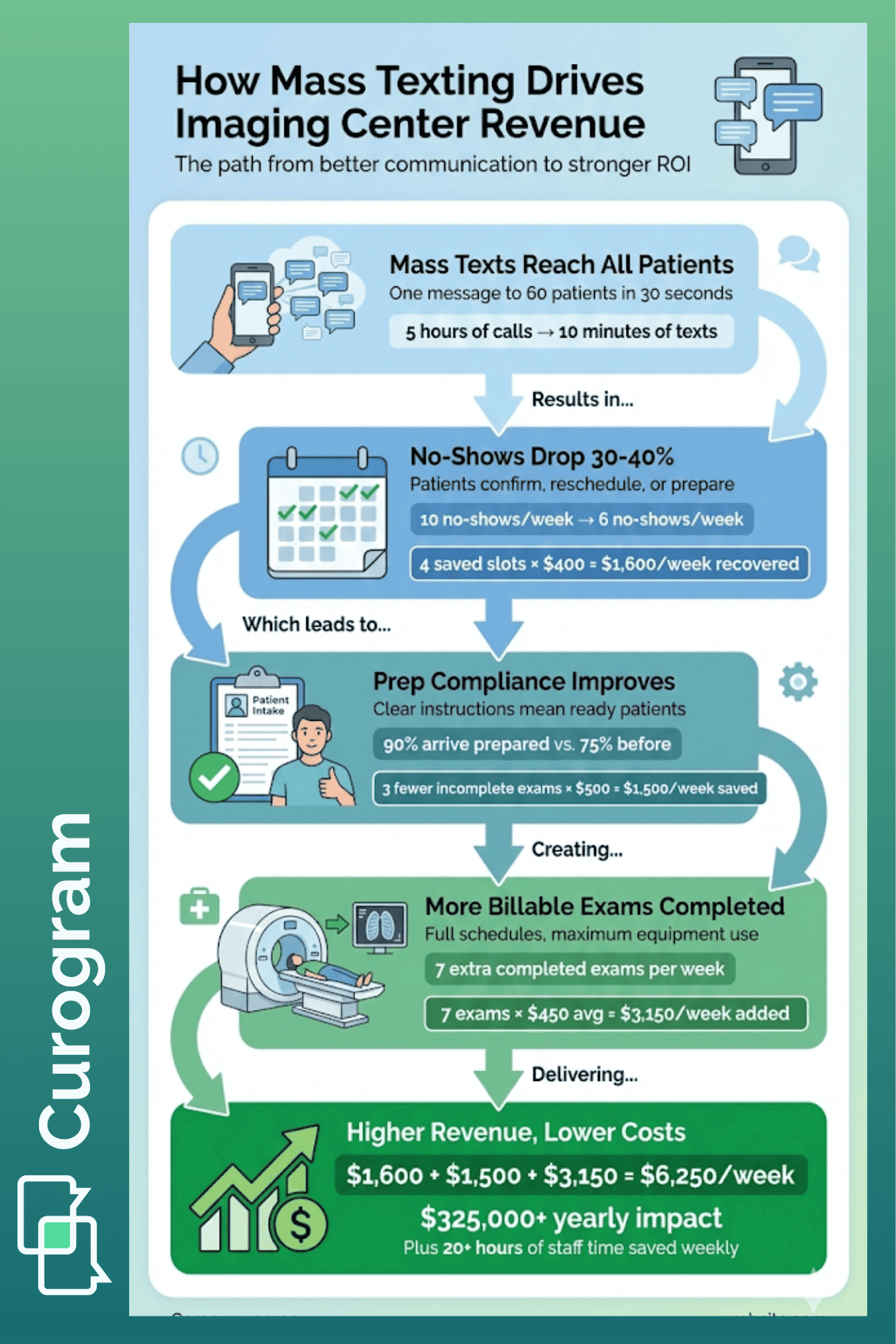
Visual flow of how mass texting reduces no-shows and increases completed exams

How Curogram Integrates With StreamlineMD to Improve Patient Outreach

Technology only works when systems talk to each other. Curogram connects directly with StreamlineMD to make mass texting seamless. No manual data entry. No exported spreadsheets. Just smooth, automated workflows.

Unified Scheduling and Communication Workflows

The integration pulls appointment data directly from StreamlineMD. When you want to message tomorrow's MRI patients, the system already knows who they are. You don't search through lists or copy phone numbers.

Broadcast messages aligned with StreamlineMD appointment data means targeting is automatic. Select "MRI patients for tomorrow" and the system builds the list. Select "CT with contrast this week" and you get that group. The data is already there.

Elimination of redundant updates saves time and prevents errors. When a patient reschedules in StreamlineMD, Curogram sees the change. You don't accidentally text someone about a cancelled appointment. The systems stay in sync.

For example, imagine a patient reschedules their Thursday CT to Friday. In a disconnected system, they might get Thursday's prep reminder even though they're coming Friday. With integration, the Thursday message skips them automatically. They get the right reminder for Friday.

Message targeting based on exam type or location opens powerful options. Need to reach only ultrasound patients at your downtown location? Two clicks. Want to alert all IR patients across your network? Just as easy.

This targeting matters for practical reasons. If your MRI at one site goes down, you message only patients scheduled for that machine at that location. Patients at other sites don't get confused by irrelevant alerts.

Automatically Send Prep and Safety Instructions

Different exams need different prep. Mass texting lets you automate the right message to the right patient based on their scheduled procedure.

MRI and CT prep instructions go out automatically based on appointment type. Your StreamlineMD schedule shows 15 MRIs tomorrow. Curogram sends all 15 patients the MRI prep template at 6 PM the night before. No staff action needed.

The MRI message might say: "Your MRI is tomorrow at 10 AM. Remove all metal jewelry. Wear clothes without zippers or metal buttons. Arrive 15 minutes early. Reply YES to confirm."

CT prep varies by whether contrast is involved. Non-contrast CT patients need minimal prep. Contrast patients must fast and may need kidney function labs. Separate templates handle each scenario automatically.

Ultrasound fasting reminders depend on the exam area. Abdominal ultrasound requires fasting. Pelvic ultrasound needs a full bladder. The system sends the right instructions based on the specific exam code in StreamlineMD.

IR medication and anticoagulant hold messaging requires careful timing. Blood thinner holds start days before the procedure. A patient on Eliquis might stop three days ahead. A patient on warfarin might stop five days ahead.

Curogram handles these timelines through day-before and week-before workflows. Set up a sequence: Five days out, send medication hold reminder. Two days out, send fasting and arrival instructions. Morning of, send a final confirmation.

For example, an IR patient scheduled for next Monday would receive:

  • Wednesday (5 days before): "Stop taking warfarin today. Do not restart until Dr. Smith says so."
  • Saturday (2 days before): "Your procedure is Monday. Don't eat after midnight Sunday. Arrive at 7 AM."
  • Monday morning: "We're ready for you today. Enter through the South Tower. Check in at IR desk, Floor 3."

This sequenced approach catches patients at the right time with the right information. Nothing falls through the cracks.

Systemwide Announcements Across Radiology Networks

Some messages need to reach everyone immediately. Weather, emergencies, and equipment issues don't wait for scheduled reminders.

Weather closures require instant communication. A snowstorm hits overnight. Your facilities close. Every patient scheduled for the day needs to know before they leave home.

One mass text reaches your entire day's schedule in minutes.  Modality downtime alerts target affected patients specifically. Your CT scanner at the Oak Street location fails. You message only CT patients scheduled at that location.

Patients at other locations or scheduled for other modalities don't get confused by irrelevant messages. The targeting keeps communication clean.

Location-specific updates handle site-by-site issues. Parking garage closed at one location? Elevator out at another? Each site's patients get relevant information without bothering patients elsewhere.

Workflow Improvements Enabled by Mass Texting

Better tools create better workflows. Mass texting in StreamlineMD improves daily operations in ways that compound over time. Let's look at the specific gains.

Reducing Call Center Overload

Phone calls consume staff hours. The same questions repeat endlessly. Mass texting breaks this cycle by answering questions before patients ask them.

One message replaces hundreds of outbound calls. Your Monday schedule has 70 patients across MRI, CT, and ultrasound. Calling each for prep takes five to six hours. Three mass texts (one per modality) take ten minutes total.

The math is simple. At five minutes per call, 70 calls equal 350 minutes of labor. Three mass texts take about three minutes each. You've saved nearly six hours of staff time in one morning.

Fewer inbound questions follow clear outbound messages. When patients receive detailed prep texts, they don't need to call and ask. "Can I drink water?" is answered in the text. "What time should I arrive?" is right there.

Consider this: If clear prep texts cut inbound questions by 50%, and you normally get 40 prep-related calls daily, you've eliminated 20 calls. At three minutes each, that's another hour saved daily.

Less time wasted repeating prep instructions means staff focus on work that matters. Instead of saying "no food after midnight" for the twentieth time today, they help patients with complex scheduling needs or insurance questions.

Improving Exam Preparedness and Reducing Incomplete Studies

Prepared patients complete their exams. Unprepared patients waste everyone's time. Mass texting dramatically improves preparedness.

Patients receive clear reminders they can reference anytime. A phone call happens once and gets forgotten. A text sits in the patient's phone. They can re-read it the night before. They can check it the morning of. The information is always there.

Better prep compliance leads to fewer delays. When patients follow instructions, scans start on time. The MRI schedule flows smoothly. CT patients don't need to wait because someone ate breakfast.

For example, if 10% of your patients currently arrive unprepared, and mass texting cuts that to 3%, you've reduced prep-related delays by 70%. On a schedule of 50 daily scans, that's three to four fewer disruptions every day.

More accurate scheduling capacity follows from reliable patient behavior. When you trust that most patients will arrive prepared, you can schedule more confidently. You stop building in buffer time for problems that no longer happen.

Keeping Vascular and IR Procedures on Schedule

IR and vascular cases need everything to align perfectly. One missing step cancels the whole procedure. Mass texting keeps all the pieces in place.

Clear instructions reduce same-day cancellations dramatically. When IR patients receive sequenced reminders about medication holds, fasting, and arrival, they follow through. The message is there in writing. No "I thought you said..." confusion.

Better patient flow equals higher completion rates. IR suites are expensive to operate. Staff, equipment, and supplies all cost money whether you do the case or not.  Keeping procedures on schedule maximizes return on those fixed costs.

Consider an IR suite that does six cases daily. If unclear communication causes one cancellation per day, you've lost about 17% of your capacity. That's roughly one full day of cases lost every week. Mass texting can recover most of that capacity through better prep compliance.

Business and ROI Impact for StreamlineMD Organizations

Workflow improvements translate to financial results. Mass texting in StreamlineMD delivers ROI through multiple channels. Let's examine the business case.

Protecting Revenue Through Better Modality Utilization

Imaging equipment represents massive capital investment. ROI depends on keeping machines running at full capacity. Empty slots cost real money.

Full schedules preserved through better communication protect your revenue base. When patients show up prepared, scans happen as planned. Your MRI generates revenue every hour it runs. Downtime from no-shows or unprepared patients is pure loss.

For example, an MRI scan might generate $500 to $1,500 depending on the exam type and payer. One prevented no-show per day equals $2,500 to $7,500 weekly in protected revenue. Over a year, that's $130,000 to $390,000 from just one daily save.

Reduced cancellations and no-shows directly impact the bottom line. Studies suggest text reminders can reduce no-shows by 30% to 40%. If your baseline no-show rate is 15% and texting cuts it to 9%, you've recovered 6% of your schedule.

Higher exam completion rates follow from better prep. When patients arrive ready, scans finish successfully. You bill for completed exams. Partial or failed exams often can't be billed at full rates.

Fewer wasted time slots mean more patients served per day. If you recover two slots daily through better communication, that's 10 extra exams weekly. At an average of $400 per exam, that's $4,000 weekly or $208,000 annually in additional revenue.

Lowering Operational Costs Through Automation

Revenue protection is half the equation. Cost reduction is the other half. Mass texting delivers significant savings.

Labor time drops dramatically when calls become texts. If you currently spend five hours daily on prep calls and mass texting reduces that to 30 minutes, you've saved 4.5 hours of labor daily. At $20 per hour, that's $90 daily or $23,400 annually.

Fewer manual calls means you need fewer staff hours for routine communication. Some practices find they can reallocate a full-time position to higher-value work. Others avoid hiring additional staff as patient volumes grow.

Scaled communication without staffing increases is the ultimate efficiency win. Your patient volume can double, but your communication workload doesn't. Mass texting handles 100 patients as easily as 10.

Reducing Compliance and Legal Risk

Risk reduction has real financial value. Avoiding fines and lawsuits protects your practice. Eliminating non-secure communication channels removes HIPAA exposure. Every text through personal phones or standard SMS creates potential liability.

HIPAA-compliant bulk messaging through Curogram eliminates that risk entirely. HIPAA fines range from $100 to $50,000 per violation, with annual maximums up to $1.5 million. One breach can devastate a practice financially. Compliant texting is cheap insurance against these penalties.

Standardized messaging lowers error risk across your organization. When staff use approved templates, they can't accidentally give wrong instructions. The template is correct. Every patient gets accurate information.

Clean audit trails for internal review protect you if questions arise. If a patient claims they weren't told about prep requirements, you can show the message, delivery confirmation, and even open receipt. Documentation wins disputes.

Enhancing the Patient Experience With Clear, Timely Communication

Patient satisfaction drives referrals, reviews, and retention. Clear patient communication improves experience at every touchpoint. Mass texting delivers that clarity at scale.

Patients Understand Prep and Expectations

Medical procedures make patients nervous. Uncertainty makes anxiety worse. Clear information calms fears and builds confidence.

Simpler instructions decrease anxiety throughout the process. Patients know exactly what to do. They don't worry about forgetting verbal instructions. The text is right there on their phone.

Consider two patients preparing for the same MRI. Patient A received a phone call while at work in a noisy office. She scribbled notes but isn't sure she caught everything. She's anxious and confused.

Patient B received a clear text message. She read it at home that evening. She shared it with her husband. She checked it again this morning. She arrives calm and prepared.

Patients feel informed and supported when communication is consistent. Regular touchpoints show you care about their experience. They trust your practice because you keep them in the loop.

Faster Responses and Higher Engagement

Speed matters in patient communication. Quick information delivery shows respect for patients' time and needs.

Broadcast instructions reduce confusion across your patient population. Everyone gets the same accurate information at the same time. No one feels left out or poorly informed.

Patients enter exams better prepared when they receive timely reminders. A text the night before gives them time to remove jewelry, stop eating, or arrange transportation. Last-minute calls often come too late to help.

Engagement increases when communication feels convenient. Patients prefer texts over phone calls. They can read on their schedule. They can respond when it's convenient. The interaction feels modern and respectful.


Related Workflow Enhancements for StreamlineMD Practices

Mass texting works best as part of a complete toolkit. Curogram offers several features that integrate with StreamlineMD to improve imaging workflows further.

HIPAA-compliant texting enables secure two-way conversations beyond broadcast messages. Patients reply with questions. Staff respond without phone calls. Communication flows naturally while staying compliant.

Appointment reminders go out automatically based on your schedule. No staff action needed. Patients get timely nudges that reduce no-shows by reminding them of upcoming visits.

Reputation management collects reviews from satisfied patients. After a good experience, patients receive a gentle prompt to share feedback online. Your star ratings improve over time, attracting new patients.

Online patient forms cut paperwork before visits. Patients complete intake on their phones. Staff skip the clipboard routine. Check-in moves faster and feels more modern.

Telehealth support expands your reach beyond in-person visits. Some follow-ups work fine over video. Patients save travel time. You capture revenue that might otherwise go elsewhere.

Text-to-Pay simplifies billing and speeds collection. Send a payment link after the visit. Patients tap to pay from their phones. Collections improve without awkward phone calls or mailed statements.

Each tool adds value alone. Together, they create a connected patient engagement system that handles communication from first contact through final payment.


What Makes Curogram the Ideal Mass Texting Solution for StreamlineMD


Dozens of texting tools exist. Most were built for retail or general marketing. Curogram was built for healthcare, and it shows in every detail.

Forget manual work and clunky exports. Curogram pulls patient lists and schedules straight from StreamlineMD. Your appointment data flows into the messaging platform without spreadsheets or uploads. Select tomorrow's MRI patients and send. The connection handles the rest.

Generic tools need workarounds to fit medical settings. Curogram needs none. Templates already include exam types, prep steps, and location fields. Message workflows mirror how radiology and IR teams actually work. The fit is natural, not forced.

Security isn't an add-on with Curogram. Encryption protects every message from the start. Audit logs capture every send automatically. BAA agreements come standard. You stay HIPAA safe without extra setup or ongoing worry.

Call with a question and talk to someone who knows imaging. The Curogram team understands modality schedules, prep workflows, and IR coordination. They've solved these problems for other StreamlineMD practices already. You won't explain basic radiology terms to confused support agents.

Results don't take months to appear. Phone volume drops in the first week. Staff feel relief from day one. No-show rates fall within 30 days. You see the impact quickly and clearly.

Growth never outpaces your tools with Curogram. One location or twenty, the platform keeps pace. Add new sites without added complexity. Increase patient volume without increasing effort. Your communication scales as fast as your practice does.

Conclusion

Your imaging center handles dozens of patients daily. Each one needs the right prep info at the right time. Phone calls can't keep up. Mass texting in StreamlineMD can.

Think about what changes when one message reaches 60 patients instantly. Your MRI goes down? Everyone knows in seconds. Snow closes your facility? No one drives in confused. IR patients need medication holds? The reminder lands days ahead without a single dial.

The ripple effects touch everything. Front desk staff stop drowning in calls. Schedulers fill slots instead of leaving voicemails. Techs start scans on time because patients arrive ready. The chaos fades. Predictability takes its place.

StreamlineMD already runs your scheduling. Curogram adds the communication layer that was missing. Together, they create something neither offers alone: a complete system where data flows and patients stay informed without manual effort.

The numbers tell the story. Hours saved daily. No-shows cut by a third or more. Revenue protected from empty slots and incomplete exams. Staff who can finally breathe.

But beyond the metrics, there's something simpler. Patients feel cared for when they get clear, timely updates. They trust practices that communicate well. They come back. They refer others.

Mass texting isn't complicated technology. It's just the right tool for a real problem. Imaging centers move fast. Communication should move faster.

See how it works for your practice. Book your demo today and watch Curogram and StreamlineMD work together in real time.


Frequently Asked Questions

How does mass texting handle different prep instructions for different exam types?
The system uses templates tied to exam codes in StreamlineMD. MRI patients get metal screening reminders. CT contrast patients get fasting rules. Ultrasound patients get fluid instructions. Each group receives only what applies to their specific scan automatically.
Why choose mass texting over email for patient outreach?
Emails sit unread in crowded inboxes. Text messages get opened within minutes. Patients carry their phones everywhere. A prep reminder via text gets seen and acted on. Email often gets buried or filtered to spam folders.
How does mass texting work during equipment emergencies?

When your CT or MRI goes down, you select the affected patients from StreamlineMD and send one alert. All 15 or 20 patients learn about the outage in under a minute. No one drives to your facility for a cancelled scan. Staff avoid hours of phone calls during an already stressful situation.

What happens when patients reply to mass text messages?

Replies route to your staff through the Curogram platform. Patients can confirm appointments, ask questions, or request callbacks. Staff see all responses in one organized queue rather than scattered voicemails. Two-way conversation stays secure and documented.

How do multi-site imaging networks manage mass texting across locations?

Central templates ensure every location sends identical approved messages. Location filtering lets you target only patients at affected sites. A weather closure at your north campus reaches only north patients. Your south location keeps running without confusing alerts reaching the wrong people.


HIPAA-Compliant Texting in StreamlineMD: Boost Your Workflow

HIPAA-Compliant Texting in StreamlineMD: Boost Your Workflow

💡 HIPAA-compliant texting in StreamlineMD lets radiology, vascular, and IR practices send secure messages to patients. Curogram links with...

Read More
Automate Patient Notifications in StreamlineMD With Mass Texting

Automate Patient Notifications in StreamlineMD With Mass Texting

💡 StreamlineMD practices use mass texting to automate patient notifications and streamline imaging workflows. This tool helps radiology, vascular,...

Read More
Improving HIPAA-Secure Texting & Patient Communication in StreamlineMD

Improving HIPAA-Secure Texting & Patient Communication in StreamlineMD

💡 StreamlineMD practices use HIPAA-compliant texting to solve common workflow problems in radiology, vascular, and interventional radiology....

Read More