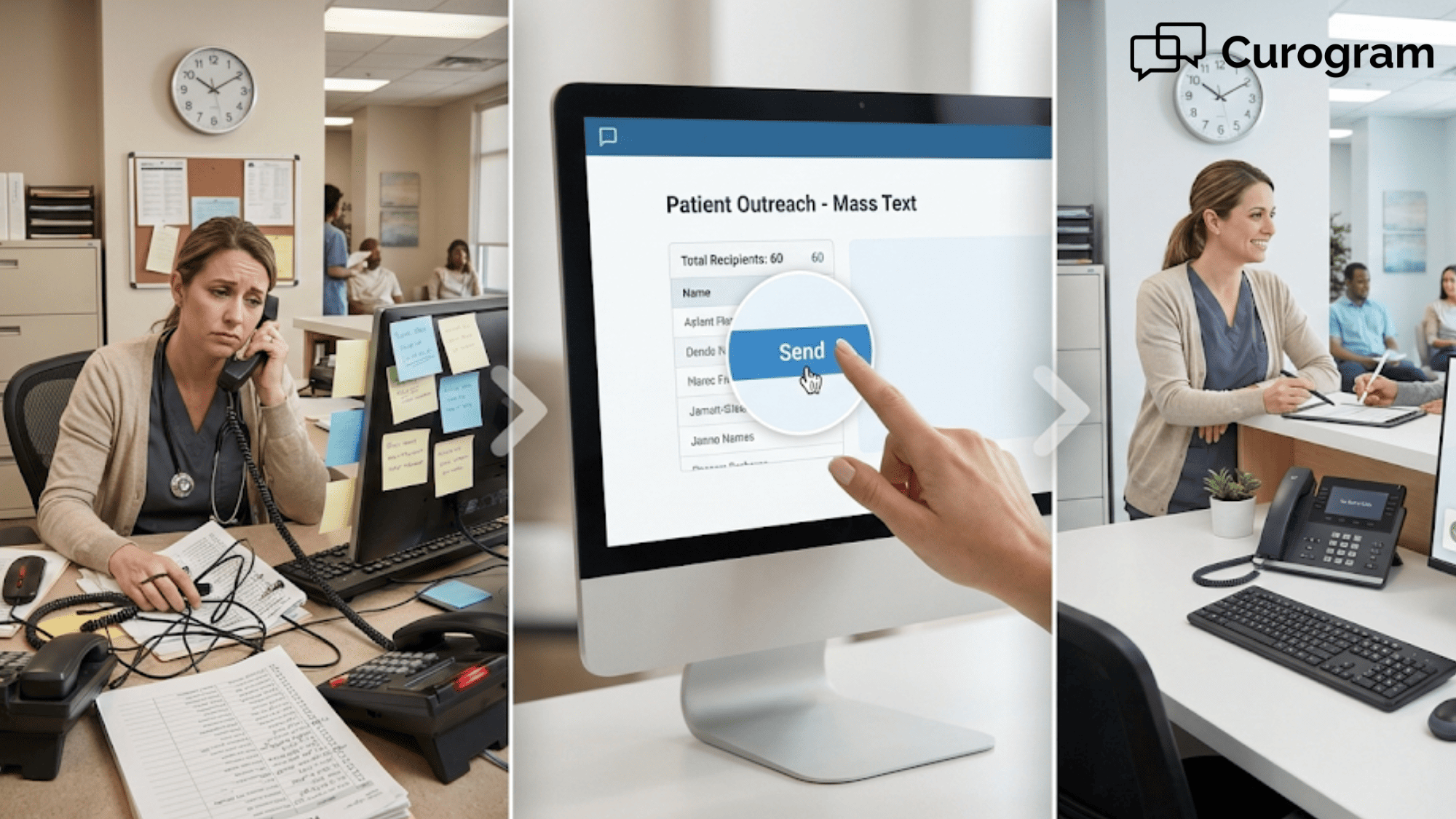
Boosting Patient Engagement and Revenue: Mass Texting in Allscripts PM
💡 Boosting engagement with Allscripts mass texting is what health organizations need. You can help your organization reach more patients in ways...
13 min read
Mira Gwehn Revilla
:
Dec 29, 2025 8:00:00 PM
Table of Contents
Your MRI is down for emergency repairs. Twelve patients are scheduled for the next four hours. Your front desk starts dialing.
Two hours later, they reached eight people. Four went to voicemail. Meanwhile, two patients already drove to your office. They're upset. Your staff is frazzled. The day is off the rails.
This scene plays out at imaging centers every week. Equipment fails. Schedules shift. Weather closes roads. And staff scramble to notify patients one call at a time.
Mass texting changes everything. One message reaches all twelve patients in seconds. Everyone knows the MRI is down before they leave home. No wasted trips, angry arrivals, or hours lost to phone calls.
For StreamlineMD practices, the ability to automate patient notifications makes daily operations smoother. Radiology teams send prep reminders without manual calls. Vascular staff coordinate complex procedures. IR teams ensure patients follow strict pre-op rules.
The use cases go far beyond simple reminders. Bulk scheduling notifications help when you need to reschedule a full day of patients. Recall alerts bring patients back for follow-up scans they might forget. Weather closures reach everyone before they hit the road.
Your call center feels the relief too. Instead of answering the same prep questions all day, staff handle only the calls that truly need a human touch. Patients still feel supported. Your team gets time back.
This guide shows you exactly how imaging centers use mass texting with StreamlineMD. You'll see real workflow examples from radiology, vascular, and IR settings. We'll cover equipment outages, prep automation, multi-site coordination, and more.
Before we dive into solutions, let's look at the real problems imaging teams face daily. These challenges cost time, money, and patient trust. Understanding them helps you see why mass texting matters.
A busy imaging center might scan 60 to 100 patients per day. Each exam type has different prep rules. MRI patients remove metal. CT patients may fast. Ultrasound patients drink water or skip meals depending on the scan area.
Explaining these rules one patient at a time takes hours. A scheduler spending five minutes per prep call handles only twelve patients per hour. At that rate, prepping tomorrow's 80 patients takes nearly seven hours of staff time.
Mistakes multiply at this volume. One rushed call leads to one confused patient. That patient arrives unprepared. The scan gets delayed or cancelled. Everyone's day gets harder.
Imaging schedules change constantly. A radiologist calls in sick. An emergency case bumps routine scans. A contrast injector breaks down mid-morning.
Each change affects multiple patients. If your CT goes down at 10 AM, you might have 15 patients scheduled for the afternoon. Reaching all of them by phone before they leave home is nearly impossible.
The patients you can't reach show up anyway. Now staff must apologize, reschedule, and calm frustrated people. The front desk backs up. Other patients wait longer. Stress ripples through the whole team.
MRI magnets need cooldowns. CT tubes fail. Ultrasound probes break. These outages happen without warning and affect many patients at once.
For example, an MRI cooldown might take four to six hours. That's potentially 20 cancelled scans. Calling each patient, explaining the issue, and rescheduling takes massive staff effort.
Without fast communication, patients arrive to locked doors or apology signs. Their trust in your center drops. Some never come back.
Interventional radiology cases need precise prep. Patients stop blood thinners days in advance. They fast overnight. They arrange rides home. They complete lab work beforehand.
Miss any step, and the procedure cancels. An IR suite sitting empty for a cancelled case costs hundreds in lost revenue. The patient waits weeks for a new slot. Clinical outcomes may suffer from the delay.
Consistent communication prevents these failures. But reaching every IR patient with detailed instructions is time-consuming. Staff often rely on phone calls that patients don't answer or don't remember.
Your phones ring constantly. "What time is my appointment?" "Where do I park?" "Can I eat breakfast?" "Do I stop my blood thinner?" The same questions come in dozens of times daily.
Each call takes staff away from other tasks. Hold times grow. Patients get frustrated waiting. Some hang up and show up unprepared.
Call center burnout is real. Staff who answer the same questions all day lose energy and focus. Turnover increases. Training new hires costs money and time.
Verbal instructions get forgotten. Mailed letters go unread. Patients mix up details from different calls. "I thought you said I could eat until midnight, not stop eating at midnight."
Confusion leads to unprepared patients. Unprepared patients mean cancelled scans. Cancelled scans mean lost revenue and longer wait times for everyone.
For a deeper look at how HIPAA-compliant texting addresses these communication gaps, see our complete guide to secure messaging for StreamlineMD practices. The right foundation makes all the automation that follows much more effective.
Radiology departments usually handle the highest patient volumes in most imaging centers. Mass texting helps manage this flow efficiently while keeping patients properly prepared.
Different scans need different prep. Mass texting lets you send the right instructions to the right patients automatically. No manual sorting and individual calls.
For MRI patients, your message might say:
"Your MRI is tomorrow at 2 PM. Remove all metal jewelry and wear clothes without zippers. No metal implants? Reply YES to confirm."
CT with contrast patients get different instructions: "Your CT scan is Thursday at 9 AM. Don't eat or drink after midnight. Stay hydrated today. Bring your lab results if you had blood work."
Ultrasound prep varies by exam area. Abdominal ultrasound patients fast. Pelvic ultrasound patients drink water beforehand. Mass texting sends each group their specific instructions based on exam type.
Day-before or week-before prep automation catches patients at the right time. Complex preps like bowel prep for CT colonography need earlier notice. Simple fasting rules can go out the night before.
Consider the math: If you have 40 imaging patients tomorrow across MRI, CT, and ultrasound, manual calls take three to four hours. Mass texts to all three groups take about five minutes to set up and send. That's a 97% time savings.
Standardized templates reduce staff workload even further. Once you create a template for each exam type, staff just select and send. You don't have to type, remember details, or encounter inconsistency between callers.
Equipment failures don't wait for convenient times. When your MRI goes down at 8 AM, you need to reach that day's patients immediately. Mass texting makes this possible.
MRI magnet cooldowns happen periodically for maintenance or after quench events. A message like this goes out instantly:
"Our MRI is down for repairs today. Your 10:30 AM scan must be rescheduled. We'll call you within 24 hours with a new time. We're sorry for the trouble."
Contrast injector outages affect CT scans that need contrast. Patients scheduled for non-contrast CTs can still come. Mass texting lets you notify only the affected group.
CT delays due to emergent cases happen in hospital settings. A trauma patient takes priority. Routine scans shift later. Broadcast messages minimize confusion and limit inbound calls.
When patients know what's happening, they don't call to ask. Your phones stay quieter. Staff focus on solving the problem instead of explaining it repeatedly.
Multi-site imaging networks face coordination challenges. Each location has different equipment, staff, and schedules. Mass texting keeps communication consistent.
Location-based announcement filtering lets you message only the right patients. If your north location closes for weather but your south location stays open, only north patients get the closure alert.
Unified messaging across the entire imaging network maintains brand consistency. Patients at every location get the same professional communication style. No site goes rogue with confusing or incomplete messages.
This coordination becomes critical during large-scale events. The ability to automate patient notifications across all locations from one platform saves administrative time and prevents communication gaps between sites.

Vascular and IR procedures need more coordination than routine imaging. Patients follow complex prep protocols. Teams coordinate across departments. Mass texting keeps everyone aligned.
IR patients often take blood thinners. Stopping these medications at the wrong time creates bleeding risks. Stopping them too late cancels the procedure. Clear, timely communication is critical.
Anticoagulant hold reminders go out days before the procedure. For example:
"Your IR procedure is Monday. Stop taking Eliquis on Friday morning. Do not restart until Dr. Smith tells you. Reply YES to confirm you understand."
Different medications need different hold times. Warfarin typically stops five days before. Eliquis stops two to three days before. Plavix may stop five to seven days before. Mass texting lets you send the right message to patients on each medication.
Medication adjustments beyond blood thinners also matter. Diabetic patients may need to hold metformin. Blood pressure medications might continue or stop depending on the procedure. Specific messages for each group prevent dangerous errors.
NPO instructions for IR cases are strict. Prep clarification for multiple patients simultaneously becomes possible with templates. Instead of calling each patient to verify they understood, send a message asking for confirmation. Those who reply "YES" are set. Staff call only those who don't respond.
Consider an IR schedule with eight patients tomorrow. Each needs medication reminders, fasting instructions, and arrival details. Calling each patient takes 30 to 45 minutes of staff time. Mass texts with confirmation requests take five minutes and create a clear record of who confirmed.
IR procedure days are hectic. Patients arrive at different times. Parking fills up. Check-in backs up. Last-minute changes throw off the schedule. Mass texting helps manage the chaos.
Broadcast arrival time updates keep patients informed. If procedures are running behind, a quick message sets expectations. Parking and entrance guidance also prevents confusion. Many hospitals have multiple buildings and entrances.
This detail matters more than you might think. A patient who parks in the wrong garage and enters the wrong building wastes 15 to 20 minutes finding their way. They arrive late and flustered. Their stress affects the procedure. Clear directions prevent this cascade.
Rapid communication was impossible before mass texting. Staff would spend an hour making calls. Some patients wouldn't answer. Some would already be driving in. Now everyone knows the new plan within minutes.
Patient care doesn't end when the procedure does. Recovery instructions matter for safety. Follow-up appointments need scheduling. Warning signs need clear explanation.
Standardized safety reminders go out the day after procedures. At-home expectations help patients know what's normal. Initial recovery check-ins via secure communication show patients you care.
A simple message asking how they feel opens a two-way conversation. Patients can reply with questions. Staff can address concerns before they become emergencies.
These follow-up messages also satisfy quality metrics. Many payers and accreditation bodies require documented post-procedure follow-up. Mass text records provide that documentation automatically.
Call centers drain resources. Staff answer the same questions repeatedly. Patients wait on hold. Meanwhile, mass texting offers relief by handling routine communication automatically.
Think about your prep call volume. If you see 60 imaging patients per day and call each one, that's 60 calls daily. At five minutes per call, you're spending five hours just on prep reminders.
Prep messages sent to entire modality schedules replace those calls. One staff member spends five minutes creating and sending messages. The other four hours and 55 minutes go to other work.
Let's make this concrete. Your Monday MRI schedule has 18 patients. Your CT schedule has 24 patients. Your ultrasound schedule has 20 patients. That's 62 prep calls.
With mass texting, you send three messages: one to MRI patients, one to CT patients, one to ultrasound patients. Total time: about 10 minutes. Time saved: over four hours.
Fewer inbound questions follow clear outbound messages. When patients get detailed prep texts, they don't need to call and ask. "Can I drink water?" is answered in the text. "What time should I arrive?" is right there in the message.
Staff focus shifts to high-value tasks. Instead of making routine calls, schedulers fill open slots. Front desk staff help patients in person. Nurses answer complex medical questions. Everyone works at the top of their skill level.
Mass messages reduce questions, but some patients still need help. Mass texting makes even this easier to manage. Mass message followed by fewer clarifying calls is the pattern. You send prep instructions to 40 patients. Maybe five have questions. That's five calls instead of 40. Your staff handles them quickly.
Patients feel supported without live phone assistance. They got their information via text. They can re-read it anytime. If they need more help, they know they can reach you. The combination of automated messages and available staff creates confidence.
Staff manage inquiries in a more organized queue. Instead of random inbound calls throughout the day, questions cluster after message sends. Staff can batch their responses. Workflow becomes predictable.
Consider bulk scheduling notifications for appointment changes. If you need to reschedule 15 patients due to a doctor's absence, mass texting delivers the news.
Patients who can easily reschedule do so online or via text reply. Only those with complex needs call in. Your staff handles five calls instead of 15.
Large imaging organizations face unique challenges. Multiple locations mean multiple schedules, staff, and patient populations. Mass texting creates consistency and enables rapid response.
Weather doesn't check your schedule. Snow, ice, floods, and storms close roads and buildings. Patients need to know before they leave home.
A notifying message must reach every scheduled patient across all sites in minutes. No one drives through dangerous conditions only to find locked doors. Your staff stays safe at home too.
Power outages affect imaging equipment especially hard. MRI magnets need constant power. CT scanners require specific electrical conditions. Building issues like water leaks, fire alarms, or HVAC failures also need quick communication. Patients immediately informed and redirected saves frustration and maintains trust.
Recall alerts work well at the network level too. If a batch of contrast has a quality issue, you can notify every patient who received it across all sites within minutes.
Consistency matters for large imaging networks. Patients at every location should receive the same quality of communication. Templates make this possible.
Templates ensure consistent messaging across all sites. Your marketing team or compliance officer creates approved messages. Staff at each location select and send without rewriting. The message a patient gets in your north location matches what patients in your south location receive.
Less risk of staff giving incomplete instructions follows from template use. A new hire at one site can't accidentally skip important prep steps. The template includes everything. Experience differences between sites disappear.
Fewer communication errors between sites result from centralized messaging. If corporate updates a prep protocol, the template changes everywhere at once. No site falls behind. No patients get outdated information.
For example, if your network changes its MRI metal screening process, the new instructions appear in the MRI prep template. Every site sends the updated version immediately. No memo to read. No training session to schedule. The change just happens.
Patient satisfaction drives referrals, reviews, and repeat visits. Clear communication improves experience at every touchpoint. Mass texting delivers that clarity at scale.
Medical procedures make patients nervous. They worry about what to expect, what might go wrong, and whether they're doing everything right. Clear information calms these fears.
Radiology and IR patients appreciate clarity above all. A simple text explaining exactly what to do feels caring.
Consider the difference between these two experiences. Patient A gets a phone call at work. They can barely hear. They scribble notes. They forget half of what was said. They show up anxious and uncertain.
Patient B gets a text with step-by-step instructions. They read it at home that evening. They share it with their spouse. They check it again the morning of their exam. They arrive calm and prepared.
Clear messages reduce uncertainty throughout the process. Patients know where to go, what to bring, and what will happen. The unknown becomes known. Anxiety drops.
Engaged patients show up. Disengaged patients forget, cancel, or arrive unprepared. Mass texting drives engagement through consistent touchpoints.
Better preparedness equals higher satisfaction. Patients who follow prep rules have smoother exams. Scans finish on time. Results come back clear. The whole experience feels professional.
Patients appreciate predictable communication. They know they'll get a text two days before their scan. They expect a reminder the morning of. This pattern builds trust. "They have a system. They're on top of things."
That trust translates into loyalty. Patients return for future imaging needs. They refer friends and family. They leave positive reviews. The connection between communication quality and business growth is direct.
Mass texting works even better as part of a complete toolkit. Curogram offers several features that integrate with StreamlineMD to improve radiology workflows further.
HIPAA-compliant texting enables secure two-way conversations beyond broadcast messages. Patients reply with questions. Staff respond without phone calls. Communication flows naturally while staying compliant.
Appointment reminders go out automatically based on your schedule. No staff action needed. Patients get timely nudges that reduce no-shows.
Reputation management collects reviews from satisfied patients. After a good experience, patients receive a gentle prompt to share feedback online. Your star ratings improve over time.
Online patient forms cut paperwork before visits. Patients complete intake on their phones. Staff skip the clipboard routine. Check-in moves faster.
Telehealth support expands your reach beyond in-person visits. Some follow-ups work fine over video. Patients save travel time. You capture revenue that might go elsewhere.
Text-to-Pay simplifies billing. Send a payment link after the visit. Patients tap to pay from their phones. Collections improve without awkward phone calls.
Each tool adds value alone. Together, they create a connected patient engagement system that handles communication from first contact through final payment.
Why Curogram Is the Right Mass Texting Partner for StreamlineMD Practices
Many platforms offer mass texting. Few understand imaging workflows. Curogram stands out for StreamlineMD practices in several key ways.
Direct integration makes setup simple. Curogram connects with StreamlineMD to pull patient lists and appointment data automatically. You don't export files or copy information by hand. The systems talk to each other.
Healthcare-specific templates save time from day one. Curogram includes pre-built messages for MRI prep, CT prep, IR instructions, and more. You can use them as-is or customize to match your protocols.
HIPAA compliance is built in, not bolted on. Every message uses encryption. Audit trails track every send. Business Associate Agreements are standard. You stay compliant without extra work.
Support understands radiology. When you call with questions, you talk to people who know imaging workflows. They've helped other StreamlineMD practices solve the same challenges you face.
Results come quickly. Most practices see reduced phone volume within the first week. No-show rates drop within the first month. Staff morale improves as repetitive tasks disappear.
Scalability supports growth. Whether you have one scanner or twenty locations, the platform handles your volume. Adding sites or modalities doesn't add complexity.
Mass texting transforms how StreamlineMD imaging practices communicate. The benefits touch every part of your operation.
Workflow disruptions shrink dramatically. Equipment outages don't mean hours of phone calls. Schedule changes reach patients in minutes. Snow days don't catch anyone off guard.
Radiology, vascular, and IR teams coordinate more effectively. Prep instructions go out automatically. Medication holds get confirmed. Post-procedure follow-ups happen consistently. Everyone stays aligned.
Patients receive accurate information at the right time. No more forgotten phone instructions. No more confusion about prep rules. No more showing up unprepared.
Clear texts make clear patients. Your call center finally catches a break. Staff stop answering the same questions all day. They focus on complex issues that need human judgment. Burnout drops and retention improves.
The ability to automate patient notifications in StreamlineMD creates efficiency that compounds over time. Each automated message saves a few minutes. Across hundreds of patients per week, those minutes become hours. Those hours become full staff days reclaimed.
Recall alerts bring patients back for needed follow-ups without manual tracking. Bulk scheduling notifications handle reschedules without chaos. Every feature works together.
StreamlineMD paired with Curogram creates a unified communication pathway. Your scheduling system feeds your messaging platform. Data flows without manual entry. Nothing falls through the cracks.
The technology exists. The workflows are proven. The ROI is clear.
Ready to see how mass texting can improve your radiology and IR operations? Book your demo today to see Curogram and StreamlineMD working together for your practice.
Central templates ensure consistent messaging across all locations. Weather closures or policy changes reach every affected patient at once. No site falls behind or sends conflicting information.
Medication hold reminders, fasting instructions, and arrival details drive the most value. Send messages days ahead for blood thinner stops and the night before for NPO rules. Include reply options for confirmation.
Patients who receive clear prep texts don't call with basic questions. Staff handle fewer repetitive calls and focus on complex issues. Workload drops while job satisfaction rises.
💡 Boosting engagement with Allscripts mass texting is what health organizations need. You can help your organization reach more patients in ways...
💡 Patient notifications in DrChrono become easier when you use secure mass texting. By integrating mass texts into your workflow, you can: Send...
💡 Mass texting in Office Ally helps you send patient notifications without overloading staff. By integrating mass texting to your EMR, you can: ...