Automate Patient Alerts Through Mass Texting in StreamlineMD
💡 Mass texting in StreamlineMD helps radiology, vascular, and IR practices reach hundreds of patients at once. Curogram integrates with...
13 min read
Mira Gwehn Revilla
:
Jan 6, 2026 8:00:01 AM
Table of Contents
A patient shows up for an MRI. They ate breakfast. Now your scanner sits idle while staff scramble to reschedule.
This scene plays out daily in imaging centers across the country. Radiology, vascular, and IR teams lose hours each week to missed prep steps and last-minute delays. The cost adds up fast. Revenue slips away. Staff morale drops.
The root cause is often simple: poor communication. Patients forget what they were told. Phone calls go to voicemail. Paper handouts end up in the trash. By the time staff catch the problem, it is too late.
Practices using StreamlineMD have found a better path. They pair their EMR with Curogram's automated reminders to reach patients at the right time. A text goes out a week before the scan. Another arrives the night before. A final nudge lands the morning of the visit.
Each message is clear and direct. It tells patients exactly what to do and when to do it. No jargon. No confusion. Just the facts they need to arrive ready.
The results speak for themselves. No-show rates drop. Prep compliance goes up. Call center phones ring less often. Technologists stay on schedule instead of waiting around.
This blog breaks down how imaging centers use automated reminders StreamlineMD integration to fix common workflow problems. You will learn practical steps to reduce delays, boost patient readiness, and free up your team to focus on what matters most: delivering great care.
Running an imaging center is tough. Every day brings a fresh set of hurdles that test your staff and strain your schedule. Let's look at the main issues that slow down radiology, vascular, and IR teams, and how StreamlineMD automated reminders can help.
MRI, CT, and ultrasound exams come with strict rules. Patients must follow each step to the letter. A CT with contrast may require fasting for four hours. An abdominal ultrasound might need an empty bladder—or a full one, depending on the type. Integrating StreamlineMD with Curogram ensures these specific instructions reach patients automatically, timed perfectly before their scheduled exam.
When patients miss even one step, the exam cannot happen. Your team has to turn them away and start over. That open slot costs money and pushes other patients back.
Vascular and IR procedures go beyond basic fasting. Many patients take blood thinners that must be paused days in advance. Others use GLP-1 drugs for diabetes or weight loss, which also need schedule changes before sedation.
If a patient shows up still on their meds, you face a hard choice. Proceed and risk a bleed? Or cancel and lose the slot? Neither option is good. Both waste time and put patients at risk.
Phones ring nonstop at most imaging centers. Staff spend hours each day calling patients to confirm visits and repeat prep steps. By the time they finish one round of calls, it is time to start the next.
This cycle drains energy and pulls staff away from other tasks. It also does not work well. Many calls go straight to voicemail. Patients who do answer may forget what they heard within hours.
Even the best verbal rundown fades quickly. A patient might nod along during a phone call, then forget half of it by dinner. Paper handouts get lost in purses or tossed with junk mail.
Some patients mix up details from past visits. Others assume "no food" means they can still drink coffee with cream. These honest mistakes lead to failed exams and frustrated staff.
One late patient can derail an entire modality schedule. If an MRI runs 15 minutes behind, every scan after it shifts. Technologists rush and wait times grow, causing patient tempers to flare.
The ripple effect hits hardest in the afternoon. Staff who hoped to leave on time end up staying late. Overtime costs climb as burnout sets in.
Imaging networks with several locations face another layer of trouble. Each site may have its own way of explaining prep. One office might stress fasting. Another might focus on arrival time. Patients get mixed signals and end up confused.
Standardizing prep messages across the board is hard when you rely on phone calls and paper. Staff turnover makes it worse. New hires learn from whoever trains them, which leads to drift over time.
For a deeper look at how patient communication tools solve these problems, explore our guide to patient communication software for healthcare.
Automated reminders StreamlineMD integration changes how imaging centers prepare patients. Instead of chasing people by phone, your system does the heavy lifting. Here's how it works in practice:
Timing matters when it comes to prep. Send a message too early and patients forget. Send it too late and they cannot adjust. The sweet spot is a layered approach.
A week before the exam, the patient gets a text with high-level details. It tells them what type of scan they have and flags any major prep steps. This gives them time to plan around fasting or other needs.
The night before, a second message arrives. This one is more direct. It spells out exactly what to eat, drink, or avoid. It reminds them of their arrival time and what to bring.
On the morning of the scan, a final nudge goes out. It confirms the appointment and gives last-minute reminders. Patients who followed the steps feel confident. Those who did not have one last chance to call and reschedule.
Each message is tailored to the modality. An MRI reminder might warn about metal objects. A CT message might focus on contrast dye and hydration. An ultrasound text might explain bladder prep. This level of detail cuts down on confusion and boosts exam success rates.
Prep is only part of the puzzle. Patients also need to know where to go and when to get there. This is trickier than it sounds, especially for multi-site imaging groups.
Automated messages can include the exact address and a link to a map. They can note which entrance to use and where to park. For large hospital campuses, they might specify which building or floor.
These small details make a big difference. A patient who knows exactly where to go arrives calm and on time. A patient who circles the lot for ten minutes shows up stressed and late.
Practices with procedural prep reminders see fewer bottlenecks at check-in. Front desk staff spend less time giving directions and more time moving patients through the queue.
Questions come up. A patient might wonder if they can take their morning meds. Another might ask if they need a ride home after sedation. In the past, these queries meant phone calls that clogged the lines.
With two-way texting, patients can reply directly to their reminder. Staff see the question pop up in their queue and answer within minutes. No hold music. No voicemail tag.
This shift saves time on both ends. Patients get quick answers without carving out time for a call. Staff handle more inquiries in less time, often while juggling other tasks.
Patient confirmation SMS also lets you know who is coming and who is not. A quick "Yes" or "No" reply updates your schedule in real time. You can fill open slots faster and avoid wasted capacity.

Vascular and IR cases carry higher stakes than routine scans. Patients often need sedation, contrast dye, or both. They may be on blood thinners or other drugs that affect clotting. Getting prep right is not just about convenience—it is about safety.
NPO—nothing by mouth—is a basic rule for many procedures. But patients often trip up on the details. Can they have water? What about black coffee? When exactly does the cutoff start?
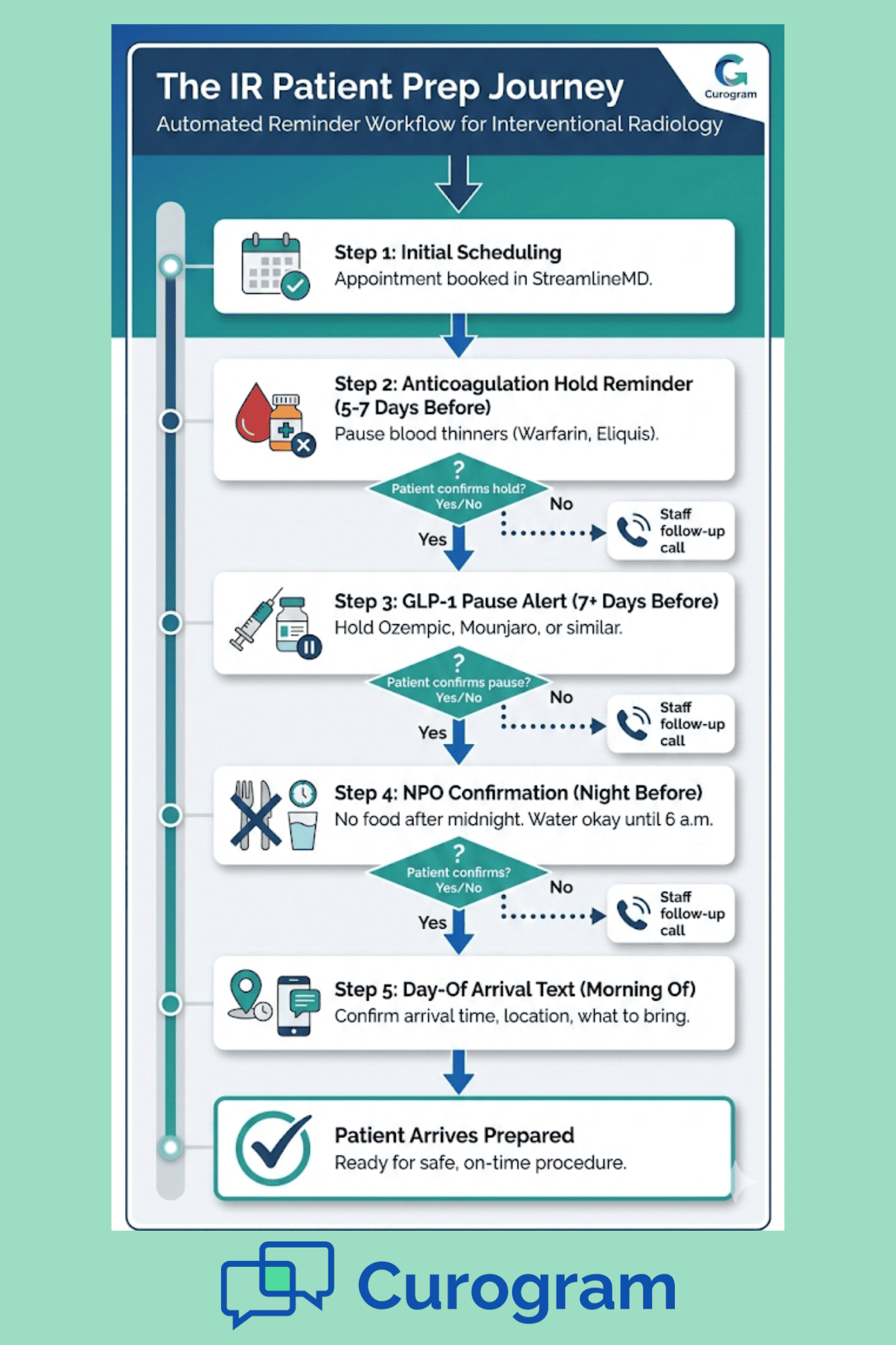
Automated messages spell this out clearly. A text might say: "Do not eat or drink after midnight. Water is okay until 6 a.m." This removes guesswork and gives patients a clear target.
Medication holds are even more critical. A patient on warfarin may need to stop five days before the procedure. Someone on Eliquis might only need two days off. The timing depends on the drug and the case.
Procedural prep reminders can be set to fire at the right interval. A message goes out when it is time to pause the med. Another arrives the day before to confirm the patient followed through. This layered approach catches problems before they reach the procedure room.
GLP-1 drugs like Ozempic and Mounjaro add another wrinkle. These meds slow stomach emptying, which raises risks during sedation. Patients may need to hold them a week or more in advance. Automated texts make sure they know this and have time to act.
IR suites run on tight schedules. A single delay can ripple through the entire day. When a patient arrives unprepared, the team faces a tough call: push forward and risk a complication, or cancel and lose the slot.
Automated reminders cut down on these no-win moments. Patients who get clear, timely messages are far more likely to show up ready. Your schedule stays on track. Throughput stays high.
Think of it this way: if your IR suite runs six cases a day and one gets canceled for poor prep, you have lost nearly 17% of your daily capacity. Over a month, that adds up fast. Preventing even one or two of those cancellations each week can make a real dent in revenue.
Beyond the numbers, there is a safety angle. A patient who followed their anticoagulation hold correctly is at lower risk for bleeding. A patient who fasted properly will not aspirate during sedation. Good prep protects patients and protects your team.
IR workflows involve many hands. Schedulers book the case. Nurses review the patient's history. Techs prep the room. Physicians perform the procedure. Each person needs the same information about patient readiness.
When reminders go out through a shared platform like Curogram, everyone can see what was sent. Nurses know the patient got the NPO reminder. Schedulers know the patient confirmed via patient confirmation SMS. Techs know the patient was told to arrive at 7:30 a.m.
This visibility prevents confusion. There is no more "I thought you called them" back-and-forth. No more mixed messages about what the patient was told. The whole team works from the same playbook.
Integration with StreamlineMD makes this even smoother. Appointment data flows from the EMR to Curogram. Reminders fire based on the procedure type and date. Staff do not have to set up each message by hand.
The result is a tighter loop. Fewer gaps. Fewer surprises. More time spent on patient care and less on chasing down details.
Consider a mid-sized vascular center that runs ten IR cases per day. Before automation, nurses spent about 30 minutes per patient on prep calls. That is five hours a day just on the phone.
After switching to automated reminders StreamlineMD integration, call time dropped by 80%. Nurses now spend about one hour a day fielding questions via text. The rest of that time goes back to clinical work.
Prep compliance also improved. The center tracked a 40% drop in same-day cancellations due to unprep. That is four extra cases per week that would have been lost.
Numbers like these show why imaging centers are moving toward automated workflows. The ROI becomes clear, the patient experience is better, and staff finally have breathing room.
Call centers are the backbone of most imaging operations. They book appointments, confirm visits, answer questions, and handle rescheduling. But without automation, this work can bury even the best teams.
Before automation, staff had to call every patient ahead of their scan. They would read through prep instructions, answer questions, and ask for confirmation. One call might take five to ten minutes.
Multiply that by 50 or 100 patients a day and you have lost an entire shift to the phone. Worse, many calls go to voicemail. Staff have to follow up, sometimes two or three times, before reaching the patient.
Automated reminders flip this model. The system sends prep info by text. Patients read it when it is convenient for them. They can reply with questions or confirm with a tap. No back-and-forth phone tag.
Practices using Curogram report a 50% drop in outbound calls. That is hours returned to staff each day—hours they can spend on complex cases or in-person support.
Busy imaging centers see dozens of patients each hour. Phone lines light up. Staff bounce between tasks. Interruptions pile on until no one can focus.
Text-based reminders smooth out these spikes. Messages go out in batches, often overnight or early morning. Patients respond on their own time. Staff check a queue of replies when they are ready.
This async flow cuts down on chaos. No more phones ringing off the hook at 8 a.m. No more scrambling to answer while helping someone at the desk. Work becomes calmer and more controlled.
Imaging networks with many sites face a unique challenge: consistency. Each location might handle reminders differently. Patients get confused when messages vary from one office to the next.
A centralized texting platform fixes this. Curogram lets you create standard templates that apply across all sites. Every patient gets the same clear message, whether they are at your north campus or your south clinic.
You can still customize for local details. One location might include parking tips. Another might note a different entrance. But the core prep info stays uniform.
This approach also simplifies training. New hires learn one system, not five. Turnover hurts less because the process lives in the platform, not in someone's head.
An incomplete exam is worse than a no-show. The patient showed up, and the tech prepped the room. But something went wrong and the scan could not finish. You have spent resources without getting a result.
Most incomplete exams trace back to poor prep. A patient ate before their abdominal CT. Another forgot to remove a metal implant for their MRI. These issues stop the scan cold.
Automated reminders tackle this head-on. When patients know exactly what to do, they are far more likely to do it. Exam completion rates climb. Repeat scans drop. Machine utilization goes up.
Higher completion also means faster turnaround on results. Patients get answers sooner. Physicians can move forward with treatment plans. Everyone wins.
Technologists thrive on rhythm. They prep a room, run a scan, reset, and repeat. When that flow gets disrupted, stress builds. Quality can slip.
Unprepared patients are the biggest disruptor. A tech might spend ten minutes explaining why the scan cannot happen. Then they have to clean the room and reset for the next patient. The day slips further behind.
With better prep compliance, schedules hold. Techs stay in their groove. Morale improves. And you can often squeeze in an extra scan or two per day without adding hours.
Patient experience matters more than ever. People have choices about where to get their scans. A smooth, low-stress visit can earn loyalty and referrals. A confusing one can send patients elsewhere.
Scans make people nervous. They worry about results, costs, and what the process will feel like. A lot of that anxiety comes from not knowing what is ahead.
Clear reminders calm those fears. A text that says "Your MRI takes about 30 minutes. You will lie in a tube-shaped machine. You will hear loud knocking sounds, but earplugs help" sets expectations. The patient walks in prepared instead of scared.
When patients feel informed, they also feel cared for. They sense that your practice thought ahead and looked out for them. That goodwill sticks.
Questions often spike right before an appointment. Patients suddenly wonder if they did the prep right. They scramble to call, adding to your queue.
Good reminders head off these calls. By covering common concerns in advance, you reduce last-minute panic. Patients feel confident. Staff stay focused.
Two-way texting catches the stragglers. A quick reply of "Yes, you can take your blood pressure pill with a small sip of water" puts minds at ease in seconds.
Automated reminders are just one piece of the puzzle. StreamlineMD practices that use Curogram can tap into a full suite of tools to boost efficiency and patient satisfaction.
HIPAA-compliant texting keeps all messages secure. You can discuss sensitive details without worrying about privacy breaches. Patients trust that their information stays protected.
Mass texting lets you reach your entire patient base at once. Need to announce a new location? Alert patients to a weather closure? One message goes to thousands in minutes.
Reputation management automates review requests. After a visit, patients get a text inviting them to leave feedback. Happy patients post 5-star reviews that boost your online presence.
Online patient forms cut down on clipboard clutter. Patients fill out intake paperwork on their phones before they arrive. Check-in moves faster. Wait times shrink.
Telehealth integration supports virtual follow-ups. A radiologist can review results with a patient over video, saving everyone a trip to the office.
Text-to-Pay simplifies billing. Patients get a link, tap to pay, and you get cash faster. No more chasing paper invoices.
Why Curogram Is the Right Fit for StreamlineMD Imaging Practices
Choosing a patient communication platform is a big decision. You need something that works with your EMR, fits your budget, and actually delivers results. Curogram checks all those boxes for StreamlineMD practices.
First, there is the integration. Curogram syncs directly with StreamlineMD, pulling appointment data and patient details. Reminders go out without manual entry. Staff do not have to copy and paste information between systems.
Setup is fast. Most teams are up and running in under an hour. Training takes about ten minutes because the interface feels like regular texting. There is no steep learning curve to slow adoption.
Customization is another strength. You can build reminder templates for each modality and procedure type. An MRI message looks different from a CT message. An IR reminder covers medication holds and NPO rules. Everything fits your workflow.
Two-way messaging keeps patients engaged. They can reply with questions, confirm their visit, or ask to reschedule. Staff handle it all from one dashboard. No more juggling phone lines and voicemail boxes.
Outcomes speak for themselves. Practices using automated reminders StreamlineMD integration through Curogram see no-show rates drop by up to 75%. Phone call volume falls by 50%. Staff productivity climbs. Patient satisfaction scores improve.
Last but not least, it is all HIPAA-compliant. Every message is encrypted. Patient data stays secure. You can communicate with confidence, knowing you are meeting regulatory standards.
Imaging centers face real challenges every day. Patients forget prep steps. Call centers drown in volume. Schedules fall apart when someone shows up unready.
Automated reminders offer a clear path forward. They reach patients at the right time with the right message. They cut phone calls and free up staff. They keep schedules tight and throughput high.
For practices using StreamlineMD, Curogram makes this easy. The platform integrates smoothly, sets up quickly, and delivers fast results. No-shows drop. Prep compliance climbs. Patients feel cared for.
The math is simple. Better communication leads to better outcomes. Better outcomes lead to more revenue and happier staff. It is a cycle that pays off in every direction.
Your radiology, vascular, and IR teams deserve tools that work as hard as they do. Procedural prep reminders and patient confirmation SMS keep everyone aligned. Staff focus on care instead of chasing patients.
If you are ready to transform your workflow, now is the time to act. Book your demo today and see automated reminders StreamlineMD integration can change your practice.
These reminders fire at the right time for medication holds and NPO rules. A patient on blood thinners gets an alert five days out. This prevents unsafe situations from unprepared patients.
Curogram pulls appointment data directly from StreamlineMD. The system generates reminders based on procedure type and date. Staff skip manual entry. Setup takes under an hour for most practices.
A centralized platform ensures every patient gets the same core message across all sites. You can still add local details like parking tips. This reduces errors and simplifies staff training.
💡 Mass texting in StreamlineMD helps radiology, vascular, and IR practices reach hundreds of patients at once. Curogram integrates with...
💡 Compliance texting StreamlineMD delivers measurable ROI through revenue protection, cost reduction, and risk management. Practices report 40-60%...
💡 Automated appointment reminders help imaging centers using Veradigm reduce no-shows and improve daily operations.Key Benefits: Cut missed...