Improve Radiology Prep With Automated Reminders on StreamlineMD
💡 Imaging centers using StreamlineMD can cut no-shows and boost prep success with automated reminders. Curogram's platform sends timely, clear...
14 min read
Mira Gwehn Revilla
:
Jan 6, 2026 11:00:00 AM
Table of Contents
A patient walks into your imaging center for an MRI. They haven't fasted. They're wearing metal jewelry. They forgot about contrast prep. Now, your team scrambles to reschedule or risk a poor-quality scan.
This scene plays out daily in radiology, vascular, and IR practices across the country. It drains revenue. It frustrates staff. It delays care for patients who did prepare correctly.
The fix can be simpler than it seems . Automated appointment reminders in StreamlineMD that reach patients before they leave home.
Imaging exams aren't like routine checkups. An MRI requires metal screening. A CT with contrast needs hydration steps. Vascular and IR procedures demand strict rules about eating and medications. When patients forget these details, the fallout hits your schedule hard.
Manual reminder calls can't keep up. Your front desk already juggles check-ins, insurance questions, and phone traffic. Expecting them to also call every patient multiple times before each exam is unrealistic. Mistakes happen, and calls get missed. Patients show up unprepared anyway.
Curogram changes this dynamic. It connects directly with StreamlineMD to send automated, timely reminders based on each patient's exam type and location. There's no need for extra data entry or guesswork about who got called and who didn't.
The best part is, these aren't generic texts. Each reminder can include specific prep instructions for MRI, CT, ultrasound, or IR procedures. Patients know exactly what to do and when to arrive. Your staff spends less time on the phone and more time on patient care.
In this guide, you'll learn why imaging practices need StreamlineMD reminder automation, how HIPAA-compliant reminders protect your organization, and the real ROI impact of getting this right.
If no-shows and unprepared patients cost you money, keep reading.
No-shows aren't just annoying. They're expensive. For imaging centers, every empty MRI or CT slot represents lost revenue that's hard to recover. Unlike a quick office visit, these exams require expensive equipment, trained technologists, and tight scheduling windows.
Here are reasons radiology centers need automated patient reminders:
Imaging exams aren't simple. Each modality has its own rules. MRI patients must remove all metal and report implants. CT patients getting contrast need to hydrate and may need to stop certain medications. Ultrasound exams often require fasting. StreamlineMD and Curogram integration lets you automate these specific prep instructions for each exam type.
Vascular and IR procedures are even more demanding. Patients may need to hold blood thinners for days before. They might need to stop eating at midnight. One forgotten instruction can cancel a procedure that took weeks to schedule.
Most patients don't memorize prep details from a phone call made two weeks ago. They need reminders closer to the exam date. They also need those reminders in writing so they can reference them again.
Many imaging practices rely on staff to make outbound reminder calls. This approach has serious limits. A single scheduler might handle 50 to 100 calls per day. That's hours spent on repetitive work that automation can handle in seconds.
When call volume spikes, reminders get skipped. When staff members are sick or busy, patients don't get called at all. The result is inconsistent communication and higher no-show rates.
Worse, phone calls often go to voicemail. Patients may not listen to messages or may forget details they heard. A text message stays on their phone. They can read it again right before leaving home.
Even when patients do show up, late arrivals throw off the whole day. Imagine an MRI schedule packed with 30-minute slots. One patient arrives 20 minutes late. Now, every exam after that runs behind.
Technologists may rush, causing image quality to suffer. Patients waiting in the lobby get frustrated. Staff stress levels climb. What started as one late arrival snowballs into a chaotic afternoon.
This is where automated reminders come to the rescue. Morning-of texts can confirm the appointment time and remind patients to arrive early. This simple nudge reduces late arrivals and keeps your schedule on track.
Many patients feel anxious about imaging exams. They don't know what to expect. They worry about pain, claustrophobia, or bad results. This anxiety can lead to last-minute cancellations or no-shows.
Clear, friendly reminders reduce this uncertainty. When patients know exactly what will happen and how to prepare, they feel more confident. Confident patients are more likely to show up and follow instructions.
Appointment reminders in StreamlineMD aren't a luxury. They're a necessity for any imaging, vascular, or IR practice that wants to protect revenue and run efficiently. Automated systems handle the repetitive work. Staff can focus on patients who need human attention.
Without automation, your team fights an uphill battle against human nature. People forget and get busy. They need multiple touchpoints before important appointments. Automation provides those touchpoints without burning out your staff.
The practices that thrive in imaging are the ones that embrace these tools. They fill more slots and complete more exams successfully. They build reputations for smooth, professional patient experiences.
Sending appointment reminders sounds simple. But in healthcare, nothing is simple when patient privacy is involved. Every text, email, or call that mentions a patient's health information must follow strict rules. Ignoring these rules puts your practice at serious risk.
Appointment reminders often include details that qualify as protected health information. The type of exam, the location, and even the fact that someone has an appointment can reveal sensitive data. A message saying "Don't forget your breast MRI tomorrow" tells anyone who sees that phone something private.
Regular texting apps don't protect this information. Standard SMS messages travel through unsecured networks. They can be intercepted. They sit on servers owned by phone carriers. If a breach happens, your practice is liable.
HIPAA-compliant reminders solve this problem. They use secure channels that encrypt messages in transit and at rest. They limit what information appears in notifications. They also give patients control over how they receive communications.
Curogram provides this level of security. Every message sent through the platform meets HIPAA standards. Your practice can send detailed prep instructions without worrying about compliance violations.
Large imaging groups face extra scrutiny. Hospital networks and health systems demand proof that vendors meet security standards. SOC 2 certification shows that a platform has passed rigorous third-party audits.
Curogram holds this certification. This matters when you're negotiating contracts with referring physicians or joining larger healthcare networks. You can demonstrate that your patient communication system meets enterprise-level security requirements
Audit trails add another layer of protection. Every message sent through Curogram gets logged. You can see exactly when a reminder went out and whether the patient received it. If a patient claims they never got a reminder, you have documentation to prove otherwise.
This documentation also helps with internal quality improvement. You can track which reminders lead to better show rates. You can identify patterns in no-shows and adjust your messaging strategy accordingly.
Many imaging practices operate multiple locations. A radiology group might have outpatient centers, hospital partnerships, and mobile units. Keeping reminder messages consistent across all these sites is challenging without the right system.
Manual processes lead to variation. One office might send reminders three days before. Another might send them the day before. One location uses detailed prep instructions. Another sends vague messages that leave patients confused.
Curogram's integration with StreamlineMD eliminates this inconsistency. Standardized templates ensure every patient gets the same quality of communication regardless of location. Templates can be customized by exam type, so MRI patients get MRI instructions and CT patients get CT instructions automatically.
The system matches reminders to scheduling data. When a patient books an exam at Location A, they get reminders specific to that site's address, parking instructions, and check-in process. No manual intervention required.
Compliance isn't just about avoiding fines. It's about trust. Patients share sensitive health information with you. They expect you to protect it. When you use HIPAA-compliant reminders, you honor that trust.
Insurance companies and legal teams also pay attention. A single privacy breach can trigger audits, lawsuits, and reputation damage that takes years to repair. The cost of implementing secure systems is tiny compared to the cost of a breach.
StreamlineMD reminder automation through Curogram gives you both efficiency and compliance. You don't have to choose between sending helpful reminders and protecting patient privacy. You get both in one integrated solution.

Getting patients to show up is only half the battle. They also need to arrive prepared. An MRI patient who ate breakfast when they should have fasted wastes everyone's time. A vascular patient who didn't stop their blood thinner may need to reschedule entirely.
Curogram's integration with StreamlineMD tackles both problems at once. It automates reminders while delivering the specific prep instructions each exam type requires.
Different imaging exams have very different requirements. Generic reminders don't work. Patients need specific, actionable instructions based on what they're having done.
Effective MRI reminders include prep details. They tell patients to wear comfortable clothes without zippers or snaps. They remind patients to disclose implants like pacemakers, cochlear devices, or joint replacements. They explain what to expect so anxious patients feel more at ease.
CT reminders should specify whether contrast is involved. They should include fasting instructions with exact timeframes. They should ask about allergies and kidney problems so staff can prepare before the patient arrives.
Reminders for ultrasound need to match the specific exam ordered, whether abdominal, pelvic, or vascular. A patient getting a gallbladder ultrasound needs different instructions than one getting a thyroid ultrasound. Automated matching ensures the right message reaches the right patient.
Interventional radiology and vascular procedures demand the most rigorous preparation. Patients may need to stop anticoagulants like warfarin or newer blood thinners days in advance. They often must follow NPO (nothing by mouth) rules starting at midnight.
Some procedures require medication adjustments for diabetes or blood pressure. Others need patients to arrange transportation because sedation prevents driving afterward. Missing any of these steps can force cancellation of procedures that took weeks to coordinate.
Timing matters as much as content. A reminder sent too early gets forgotten. A reminder sent too late doesn't give patients time to prepare properly.
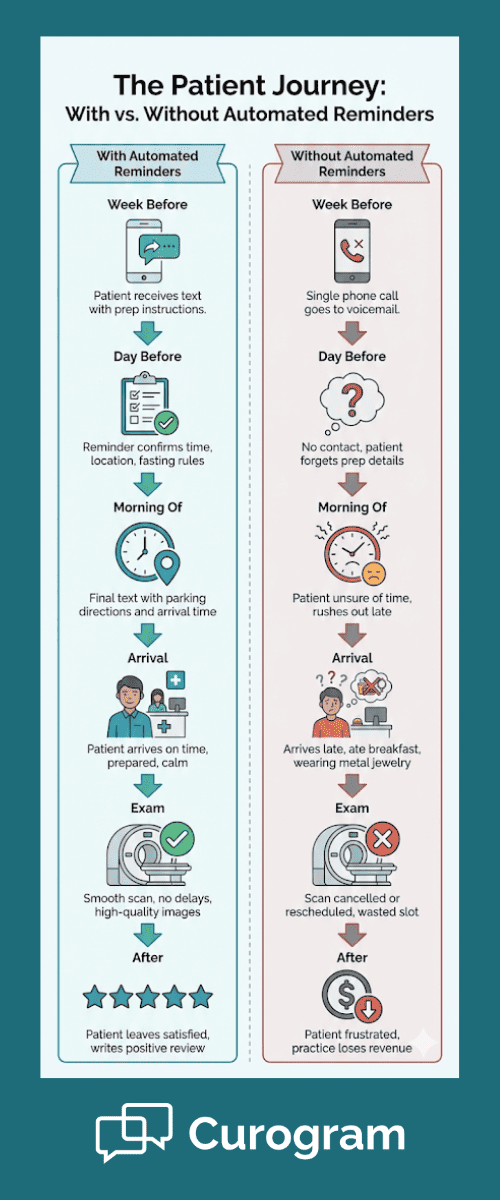
For complex procedures, the first reminder should arrive about a week before. This gives patients time to stop medications, arrange rides, or reschedule if conflicts arise. It also prompts them to call with questions while there's still time to address concerns.
A week-before message might say:
"Your IR procedure is scheduled for next Thursday at 9 AM. Please stop taking aspirin starting Monday. Call us if you have questions about medication changes."
The day-before reminder reinforces preparation steps. It confirms the appointment time and location. It repeats the most critical instructions so patients don't have to search through older messages.
This reminder might include:
"Remember, nothing to eat or drink after midnight tonight. Arrive at our Main Street location at 8:30 AM for your 9 AM procedure. Bring a photo ID and your insurance card."
Same-day reminders serve as final confirmation. They reduce late arrivals by reminding patients exactly when to leave. They can include parking instructions or directions to the correct entrance.
A morning-of text might read:
"See you at 9 AM today for your procedure. Park in the north lot and enter through the outpatient entrance. We're looking forward to seeing you."
Not every patient can keep their appointment. When someone needs to reschedule, automated systems can send links to online booking tools or prompt them to call. This fills canceled slots faster and keeps communication flowing without extra staff effort.
Manual reminder systems create extra work. Staff must check the schedule, draft messages, and track who received what. This is where errors come in. Patients get wrong instructions, resulting in time getting wasted.
Curogram's integration with StreamlineMD eliminates this friction. When a patient gets scheduled in StreamlineMD, Curogram automatically pulls the relevant details. The system knows the exam type, location, date, and time without anyone entering data twice.
This clean alignment means fewer mistakes. The reminder for an MRI patient won't accidentally include CT contrast instructions. The message for Location A won't list the address for Location B.
Integration isn't just a technical feature. It transforms how your practice runs day to day. Front desk staff aren't chasing down patients by phone. Technologists aren't surprised by unprepared patients. Schedules run smoother because everyone arrives ready.
The compound effect is significant. Fewer no-shows mean more revenue. Better prep means fewer repeat exams. Happier staff means lower turnover. All of this flows from one core change: automated, integrated appointment reminders that actually work.
Good reminder systems do more than reduce no-shows. They transform daily workflows across your entire practice. From front desk operations to technologist efficiency, the benefits ripple outward.
The math is straightforward. Automated reminders increase attendance. Patients who receive multiple touchpoints before their exam are far more likely to show up than those who get a single phone call two weeks prior.
Real-time confirmations add another layer of value. When patients respond to confirm their appointment, your staff gains visibility into who's definitely coming. They can identify no-show risks early and work to fill those slots proactively.
This stabilizes modality utilization. Your MRI suite runs at capacity. Your CT scanner stays busy. Your IR suite handles the cases it was built for instead of sitting idle due to last-minute cancellations.
No-shows hurt revenue. But so do exams that start but can't finish. When patients arrive unprepared, technologists face difficult choices. Do we proceed with a suboptimal exam or send the patient home and reschedule?
Clear prep instructions prevent these scenarios. Patients who know to fast actually fast. Patients who know to hold medications actually hold them. Exam completion rates climb because patients arrive ready.
Higher completion rates protect daily revenue directly. Each successful exam generates payment. Each failed exam generates nothing but frustration and rework.
Traditional reminder processes consume enormous staff time. Consider a practice with 200 daily appointments. If each reminder call takes three minutes, that's ten hours of phone work daily—more than one full-time employee's entire shift.
Automated reminders eliminate most of this burden. Staff no longer make routine calls. They don't spend time verifying whether someone received information. They also don't repeat the same prep instructions dozens of times per day.
This freed capacity can go toward higher-value work. Staff can assist patients with complex questions. They can handle insurance issues. They can also provide the human touch where it actually matters.
Every operational improvement ultimately affects the bottom line. Automated reminders aren't just convenient. They deliver measurable financial returns.
Imaging centers make money when equipment stays busy. Empty slots generate zero revenue but still carry fixed costs. Staff salaries, equipment leases, and facility expenses continue regardless of volume.
Better schedule predictability means more slots get filled. When you know who's coming, you can identify gaps and work to fill them. And when fewer patients cancel at the last minute, you capture revenue that would otherwise disappear.
Vascular and IR cases represent especially high-value appointments. These procedures often bring significant reimbursement. Losing even one IR case per week to a preventable no-show can cost thousands monthly.
Staff time has real costs. Every hour spent on manual reminder calls is an hour not spent on other productive work. Automation shifts this balance dramatically.
Practices using automated reminders often reallocate staff to revenue-generating activities. Schedulers can focus on filling slots rather than confirming them. Front desk teams can improve check-in experiences rather than chasing down no-shows.
Fewer errors also reduce costs. When reminders go to the wrong patients or contain incorrect instructions, staff must spend time fixing problems. Automated systems with clean data integration minimize these errors.
Unsafe texting practices expose practices to HIPAA penalties. Staff using personal phones to text patients create compliance nightmares. Curogram eliminates this risk with secure, documented messaging.
Simple access controls ensure only authorized staff send patient communications. Documentation provides proof of compliance during audits. The combination protects your practice from regulatory exposure while improving patient communication.
While clinical efficiency matters, patient experience must never be compromised. In competitive markets, how patients feel about your practice affects referrals, reviews, and long-term loyalty. Here's how appointment reminders provide better experience for your patients:
Radiology and IR procedures can intimidate patients. The equipment looks imposing. The prep requirements feel confusing. Uncertainty breeds anxiety, and anxious patients may cancel or arrive stressed.
Straightforward reminders change this dynamic. When patients know exactly what to expect, fear decreases. With clear, easy-to-follow instructions, preparation feels manageable rather than overwhelming.
Consider the difference between a vague message and a specific one. "Prepare for your procedure" means nothing. Meanwhile, "Don't eat after midnight, wear comfortable clothes, and arrive at 8:30 AM at our Oak Street entrance" tells patients exactly what to do.
Patients notice when practices communicate well. Timely, helpful reminders signal that you care about their experience. This builds trust before they even walk through your doors.
Better preparation also leads to smoother exam experiences. Patients who arrive ready don't face delays or cancellations. They complete their exams successfully and leave feeling good about the visit.
Satisfied patients leave positive reviews. They return for future imaging needs. They recommend your practice to family and friends. Strong patient experience drives sustainable growth.
Appointment reminders are just one piece of modern patient communication. Curogram offers additional tools that integrate with StreamlineMD to streamline your entire operation.
HIPAA-compliant texting lets you communicate with patients beyond just reminders. You can answer questions, share results, and coordinate care through secure channels.
Mass texting helps you reach large patient groups quickly. Need to announce a schedule change or new service? Send one message to hundreds of patients instantly.
Reputation management tools help you collect and respond to patient reviews. Building a strong online presence attracts new patients to your practice.
Online patient forms reduce paperwork and wait times. Patients complete intake documents before arriving, speeding up check-in.
Telehealth capabilities enable virtual visits when appropriate. Some follow-up consultations don't require in-person appointments.
Text-to-pay simplifies collections. Patients receive payment links via text and settle balances with a few taps on their phone.
Together, these tools create a unified communication ecosystem. Every patient touchpoint becomes more efficient and more effective.
Why Curogram Is the Right Choice for StreamlineMD Practices
Choosing a communication platform matters. The wrong choice creates headaches, while the right choice transforms operations. Curogram stands out for imaging, vascular, and IR practices using StreamlineMD.
Curogram connects directly with StreamlineMD through purpose-built integration. This isn't a generic texting tool bolted onto your system. It's a platform designed to work with your existing scheduling workflow. Data flows smoothly between systems without manual intervention.
Generic messaging platforms don't understand healthcare requirements. They can't handle HIPAA compliance or support the specialized workflows imaging centers need. Curogram was built for medical practices from the ground up with healthcare-specific features that address these gaps.
Your MRI patients need different reminders than your ultrasound patients. Curogram supports modality-specific templates matched to exam types. Set up your messaging once, and the system handles matching automatically based on scheduling data.
Growing imaging groups often operate multiple sites. Curogram scales with you through robust multi-location support. Each location can have customized messaging while maintaining brand consistency across your organization.
Practices using Curogram report significant reductions in no-show rates. They describe freed staff time and improved patient satisfaction. The platform delivers proven results and measurable ROI that justifies the investment.
Technology only helps when it works correctly. Curogram provides responsive support that understands healthcare workflows. When questions arise, you get answers from people who know imaging operations.
Complex software implementations drain resources and delay benefits. Curogram's setup process is straightforward and simple. Most practices go live quickly and see benefits within weeks rather than months.
For StreamlineMD users seeking better patient communication, Curogram offers the combination of integration, compliance, and healthcare expertise that generic platforms simply can't match.
Missed appointments cost imaging practices real money. Every empty MRI slot, cancelled CT scan, or postponed IR procedure represents lost revenue. Beyond dollars, no-shows disrupt schedules and frustrate staff.
The solution isn't more phone calls. Your team already has enough to do. The solution is automated, integrated communication that reaches patients at the right time with the right information.
Appointment reminders in StreamlineMD through Curogram deliver exactly that. Patients receive timely texts with specific prep instructions. They know when to arrive and what to expect. They show up ready.
Radiology and IR success depends on patient preparedness. Complex exams require complex preparation. When patients understand requirements and receive multiple reminders, compliance improves dramatically.
Automation also improves operational predictability. You know who confirmed their appointment. You can identify potential no-shows early. Your schedule runs smoothly because surprises decrease.
The combination of StreamlineMD and Curogram creates a unified, efficient reminder system. No double data entry. No inconsistent messaging across locations. No compliance worries from unsecured texting.
Staff also benefit. Fewer manual calls mean more time for meaningful patient interactions. Less chaos means lower stress. Better tools mean higher job satisfaction. Patient experience improves when communication improves. Clear instructions reduce anxiety. Timely reminders build trust. Smooth exam experiences generate positive reviews and referrals.
The practices that thrive in imaging embrace these tools. They recognize that patient communication isn't an option but an essential. They invest in systems that scale with growth and protect against compliance risks.
Your imaging center deserves better than missed appointments and scrambling staff. Likewise, your patients deserve better than confusing prep instructions and forgotten reminders.
Discover how automated communication can transform your practice. Book your demo today to see Curogram and StreamlineMD appointment reminders in action.
Curogram pulls appointment details directly from StreamlineMD automatically. When exams get scheduled or changed, reminders update without manual data entry, reducing errors and saving staff time.
These procedures require complex preparation like stopping blood thinners and fasting. Week-before reminders give patients enough time to make medication changes and arrange transportation, preventing last-minute cancellations.
Clear, timely messages reduce anxiety by telling patients exactly what to expect and how to prepare. Patients feel informed and cared for, leading to smoother exams and higher satisfaction with your practice.
💡 Imaging centers using StreamlineMD can cut no-shows and boost prep success with automated reminders. Curogram's platform sends timely, clear...
💡 Knowing how to reduce no-shows for radiology teams is a constant struggle. But with reminders powered by Curogram, scanners stay active and...
💡 Compliance texting with Veradigm brings secure, automated messaging that improves both operations and revenue. This approach reduces no-shows and...