Streamlining Veradigm Enterprise Scheduling with Automated Reminders
💡 Automated appointment reminders help imaging centers using Veradigm reduce no-shows and improve daily operations.Key Benefits: Cut missed...
12 min read
Mira Gwehn Revilla
:
Jan 5, 2026 8:00:00 PM
Table of Contents
Empty scan rooms cost money. Every missed MRI or CT slot is lost revenue you can't recover.
For imaging centers on StreamlineMD, no-shows and prep errors are more than just schedule problems. They drain profits, waste staff time, and throw off your entire day.
Think about it this way. Your MRI machine runs at full cost whether a patient shows or not. When someone skips their slot, you lose the fee but still pay for the room, the staff, and the machine. For IR suites, a late cancel can wreck a full day of planned cases.
Manual reminder calls don't fix the problem. They take too long, and staff may forget to call. Patients may not pick up, and when they do, they still miss key prep steps.
That's where automated reminders change the game. When you reduce no-shows StreamlineMD becomes a more powerful tool. Patients get timely texts with clear prep info.
They confirm or cancel with a tap. Your front desk sees updates in real time. No more guessing who will show. The result is a fewer empty slots, fewer repeat scans, and less chaos.
This blog breaks down the true reminder ROI for radiology, vascular, and IR teams. We'll look at how automated reminders protect revenue, cut admin costs, lower risk, and improve patient flow.
If your imaging center still relies on phone calls and sticky notes, it's time to see what smart reminders can do.
Let's dive in.
Radiology revenue runs on throughput. The more scans you complete, the more you earn. But no-shows and prep errors break that cycle fast. This makes automated reminders with Curogram matter for imaging practices.
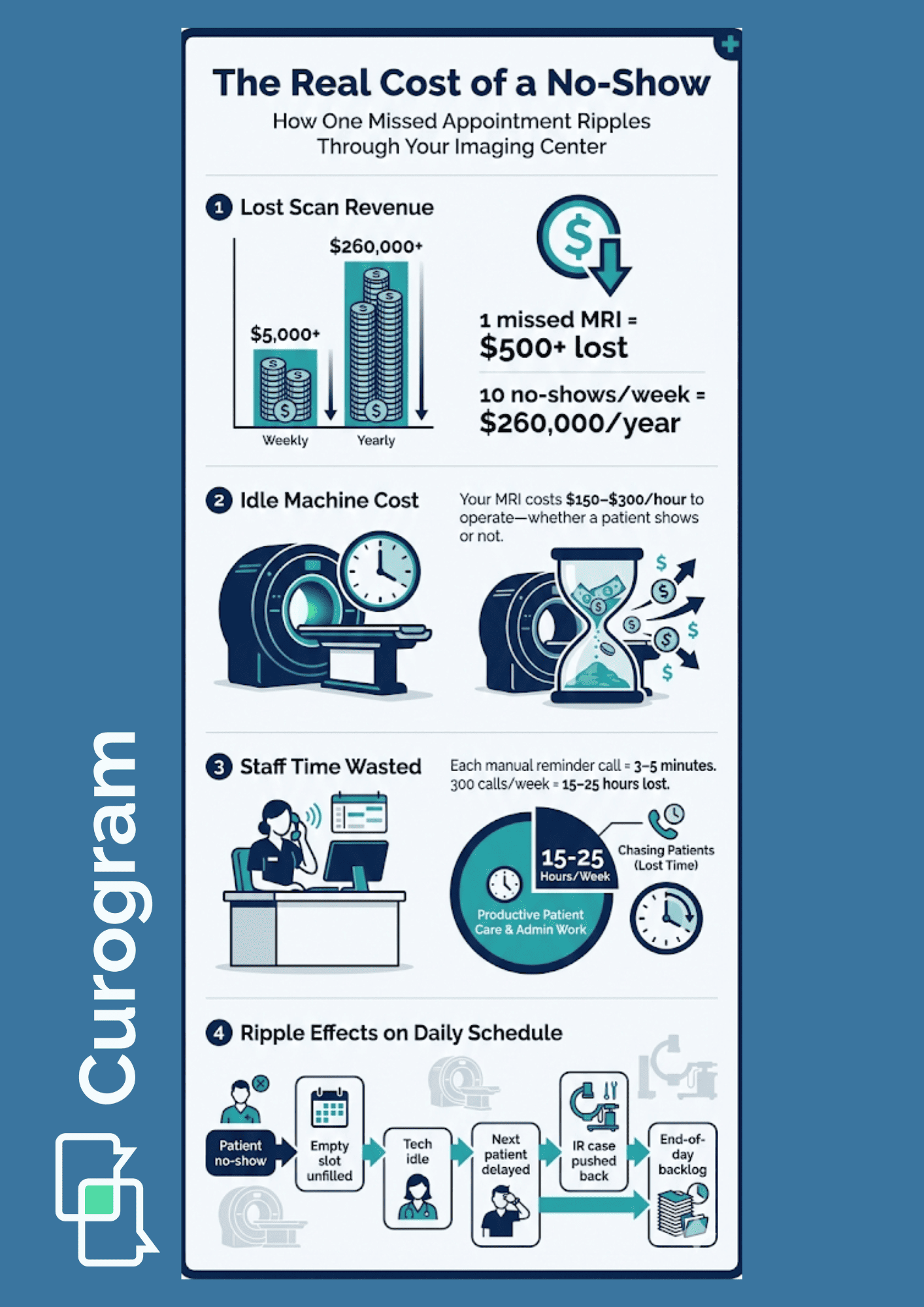
Your MRI, CT, and ultrasound machines are some of the most costly tools in your building. Each hour they sit idle is an hour of lost income. If a patient skips a 45-minute MRI slot, that gap often can't be filled. You lose the full revenue from that scan.
Now, multiply that by five or ten missed slots per week. The total adds up fast. IR cancels hit even harder. These cases often need a full team: nurses, techs, and doctors. Supplies get prepped. Rooms get blocked. When a patient bails at the last minute, you can't just swap in a walk-in. The whole day's flow takes a hit.
Manual calling is no match for this problem. Staff spend hours each week dialing patients. Most calls go to voicemail. When someone does pick up, they may not write down the prep steps. This leads to patients who show up having eaten before a fasting exam or forgot to stop blood thinners.
A single prep error can force a full reschedule. The patient leaves upset, and the tech has dead time. On top of this, your billing team has nothing to submit.
Let's put some numbers to this. Say your imaging center sees 100 patients per week. A 10% no-show rate means 10 missed slots. If each scan brings in $300 on average, that's $3,000 lost weekly. Over a year? That's more than $150,000 in lost revenue. Add in prep-related repeats, and the number climbs higher.
The worst part is most of these losses are avoidable. Patients want to show up. They just need the right nudge at the right time. This is what automated reminders provide.
With smart, timed texts, you reach patients before they forget. You give them clear prep steps they can read and re-read. You let them confirm or cancel with a tap. And you give your staff real-time updates so they can fill gaps fast.
When you reduce no-shows StreamlineMD schedules stay full. Your machines stay busy, your team stays on task, and your bottom line stays healthy.
Automated reminders don't just save time. They protect the revenue your imaging center counts on every single day.
For a deeper look at how automated reminders work with StreamlineMD, check out our full guide to patient communication for imaging centers.
Revenue protection starts with getting patients through the door, prepped and ready. Automated reminders make that happen. Here's how:
Every exam type has its own no-show risk. MRI patients may feel nervous about the scan. CT patients may forget fasting rules. IR cases may skip due to fear or confusion about prep. Automated texts cut through all of that.
A well-timed reminder does more than say "don't forget." It includes the date, time, and exact prep steps. It links to maps or parking info. It answers questions before patients have to call.
Real-time confirms take the guesswork out of your schedule. When a patient taps "Yes," your front desk sees it instantly. When they cancel, you can fill the slot before it goes empty. This kind of scheduling efficiency keeps your day tight and your revenue steady.
For IR and vascular cases, prep compliance is even more critical. Patients may need to stop certain meds or follow strict diet rules. Automated reminders can send these steps in stages, days before the visit. This way, patients don't get overwhelmed with info all at once.
A patient who shows up unprepared is almost as costly as one who doesn't show. If they ate before a fasting scan, you can't run the exam. If they didn't hold their meds, you may have to reschedule for safety.
Automated reminders fix this by giving patients what they need, when they need it. Two days out, they get a heads-up. One day out, they get detailed prep steps. Morning of, they get a final nudge.
This layered approach raises completion rates across MRI, CT, US, and IR. Patients arrive ready. Techs don't waste time re-explaining. More exams go out the door, fully billed.
When your schedule stays steady, your forecasts get sharper. You know how many scans to expect. You can staff to match. You can plan purchases and manage cash flow with more confidence.
Automated reminders bring that kind of order. You get fewer surprise gaps, fewer last-minute scrambles, and your imaging center runs like a well-tuned machine.
This stability also helps with equipment planning. If your MRI runs at 90% use instead of 70%, you get more value from that investment. You may even delay the need for a second unit.
The reminder ROI here is clear: consistent patient flow means consistent income.

Beyond protecting revenue, automated reminders also slash the admin costs that eat into your margins. StreamlineMD integration with Curogram makes this seamless, connecting your existing workflow to powerful automation without adding extra steps for staff.
Think about how many calls your front desk makes each week just for reminders. For a mid-sized imaging center, that could be 300 to 500 calls. Each call takes two to five minutes. That's 10 to 40 hours of staff time every week, just on reminders.
And that's assuming every call connections. In reality, most go to voicemail. Patients call back at odd hours. Staff play phone tag. The cycle repeats.
Automated texts cut through this mess. One message goes out to all patients with the right timing and info. No dialing, no waiting, or missed calls. Your team reclaims hours each day.
Call center overload also drops. When patients get prep info by text, they don't call to ask. When they can confirm by text, they don't call to say they're coming. The result is fewer inbound calls, shorter hold times, and happier patients.
For multi-site imaging groups, this adds up fast. A network of five centers might save 100 staff hours per week. That's the work of two or three full-time employees, freed up for other tasks.
Reminder calls are low-skill but high-time tasks. They don't require clinical training, but they still pull staff away from other work. When you automate reminders, you can right-size your front desk.
You may not need to lay anyone off. Instead, you can shift staff to higher-value work. They can help with patient check-in, billing follow-up, or care coordination. These tasks have more impact on patient satisfaction and revenue.
Techs benefit too. When patients show up prepped, exams start on time. Techs don't spend 15 minutes re-explaining fasting rules. They don't wait for patients who are running late. They stay focused on clinical work, which is what they're trained for.
This bump in productivity shows up in your metrics. There can be more scans per tech per day, shorter wait times, and better patient reviews. Scheduling efficiency improves across the board. Your team spends less time fixing problems and more time moving patients through.
New hires on the front desk often struggle with reminder calls. They have to learn scripts for each exam type. They have to know when to call and what to say if a patient asks questions.
Automated reminders shrink that learning curve. Templates handle the "what to say" part. Timing rules handle the "when to send" part. New staff just need to know how to use the system, not memorize a dozen scripts.
This cuts training time. It also cuts errors. A new hire can't say the wrong prep steps if the system sends the right ones every time.
For large imaging networks, this is a big deal. You may hire dozens of front desk staff each year. If you save even five hours of training per hire, that adds up to hundreds of hours saved.
Uniform messaging also protects your brand. Every patient gets the same clear, professional message. No variation based on who called or how rushed they were. This builds trust and keeps your communication consistent across all sites.
Let's run some rough numbers. Say your imaging center pays front desk staff $18 per hour. If automated reminders save 20 hours per week, that's $360 in labor costs saved weekly. Over a year, that's nearly $19,000.
Now, add in the time saved on training, the reduced call center load, and the gains in tech productivity. The total admin savings can reach $30,000 to $50,000 per year for a single location.
For a five-site network, you're looking at six figures in savings.
This is the reminder ROI that shows up on your P&L. Not just protected revenue, but real cost cuts. The best part is these savings don't come at the expense of patient care.
Patients actually prefer texts. They like getting clear, timely info without having to pick up the phone. So, you save money and improve the experience at the same time. This is the power of automation done right.
Compliance isn't just about avoiding fines. It's about protecting patients and your practice from real harm.
When staff text patients from personal phones, you're exposed. Those messages aren't encrypted. They aren't logged. And if something goes wrong, you have no record.
Automated, HIPAA-compliant reminders fix this. Every message goes through a secure platform. Every text is logged and stored. If you ever face an audit, you have the proof you need.
This matters even more for imaging centers. You're sending prep info that may include medical details. A secure system keeps that data safe.
What if a patient gets the wrong prep steps? What if they stop a med they shouldn't have? What if they have a bad outcome because of a missed instruction?
Manual calls leave room for human error. Staff may skip a step. They may rush through the script or give outdated info.
Automated templates remove that risk. Every patient gets the same validated message. If a question comes up, staff can refer back to the exact text that was sent.
This protects your practice from liability claims tied to poor communication.
For networks with many locations, security gets harder to manage. Each site may have its own habits. Some staff may use email, while others may text from personal devices.
Centralized automation brings everyone under one roof. Message governance happens at the top. This means no rogue texting or email leaks. Every site follows the same rules. This is especially important for groups that serve high-risk patients or handle sensitive imaging data.
Beyond cost and compliance, automation makes your daily work smoother through the following ways:
When a patient confirms or cancels by text, your team sees it right away. There's no need to wait for a callback or check voicemail at the end of the day.
Staff can respond on their own time, too. They don't have to sit on long calls. They can handle questions between tasks. This keeps the front desk moving without constant phone interruptions.
In a busy imaging center, MRI, CT, US, IR, and vascular teams often share space and staff. When one team falls behind, it ripples to the others.
Automated reminders keep everyone aligned. Schedule changes go out fast. Patients get updates without delay. Fewer surprises hit during peak hours.
This kind of cross-team coordination is hard to achieve with manual calls. Automation makes it the default.
Your MRI machine may cost over a million dollars. Your CT scanner isn't far behind. Every empty slot chips away at your return on that investment.
When you reduce no-shows StreamlineMD schedules stay packed with prepped patients. Machines run at higher capacity. Your capital investment pays off faster.
This is one of the clearest measures of reminder ROI for imaging centers.
Satisfied patients come back and refer their friends. They also leave good reviews, all of which drives more revenue. With automated reminders, you're looking at the following financial benefits:
Imaging exams can feel scary. Patients worry about what to expect, what to wear, and whether it will hurt. When they get clear, friendly texts with answers, their stress drops.
Less anxiety means fewer no-shows. It also means better prep compliance. Patients follow steps when they understand why they matter.
Patients notice when you reach out before they have to call. It shows you care and you're organized. This builds trust.
Loyal patients are more likely to return for future exams. They're also more forgiving if something goes wrong.
A smooth visit often leads to a 5-star review. Over time, those reviews lift your online rating. Referring doctors notice. So do patients searching for imaging options.
Your reputation becomes a growth engine. And it starts with simple, timely communication.
Appointment reminders are just the start. Curogram offers a full suite of tools that work together to boost your bottom line.
HIPAA-compliant texting lets you handle patient questions securely. Mass texting helps you reach large groups for outreach or alerts. Reputation management turns happy visits into positive reviews.
Online patient forms cut wait times and paper costs. Telehealth expands your reach without adding rooms. Text-to-pay speeds up collections and improves cash flow.
Each tool adds its own value. Together, they create a communication system that drives scheduling efficiency, protects revenue, and keeps patients engaged.
For StreamlineMD practices, these features plug in fast and work with your existing setup.
Why Curogram Is the Right Fit for StreamlineMD Imaging Centers
Curogram was built for busy medical practices. It integrates with StreamlineMD and dozens of other EMRs. This means no double entry, no clunky workarounds, and no learning curve for your team.
Setup takes minutes, and training takes even less. Front desk staff pick it up fast because the interface works like the texting apps they already know.
Curogram's smart reminders go beyond basic alerts. You can customize messages by exam type. You can time them by days, hours, or both. You can include prep links, maps, or forms. Patients get what they need, when they need it.
Two-way texting lets patients reply without calling. They can confirm, cancel, or ask questions. Your staff sees every message in one inbox. This means no missed threads or lost info.
For multi-site imaging groups, Curogram offers centralized control with local flexibility. You can set org-wide templates while letting each site adjust for local needs. This keeps branding consistent without compromising adaptability.
HIPAA compliance is also baked in. Every message is encrypted and logged. You get audit trails without extra effort.
And because Curogram works across texting, forms, payments, and reviews, you get more than a reminder tool. You benefit from a full patient communication platform that improves every touchpoint.
The reminder ROI is clear. You have fewer no-shows, lower admin costs, better patient flow, and a team that spends less time on the phone and more time on care.
If you want to reduce no-shows StreamlineMD users face every day, Curogram is the partner to make it happen.
Missed appointments drain revenue, prep errors waste time, and manual calls burn out staff. For imaging centers on StreamlineMD, these problems hit hard.
Automated reminders fix all three. When you reduce no-shows StreamlineMD becomes a more efficient platform. Patients get timely, clear messages. They show up ready. Your schedule stays full. Your team stays focused.
You'll notice the ROI fast. Revenue goes up because more exams get billed. Costs go down because staff spend less time on calls. Risk drops because every message is logged and compliant.
For IR and vascular teams, reminders bring extra value. Complex prep steps get delivered in stages. Patients follow through, and cases run on time.
Multi-site radiology groups benefit from consistency. Every location sends the same messages, while every patient gets the same care. Branding stays strong across the board.
Curogram makes this easy. It plugs into StreamlineMD without fuss. It gives your team tools they can learn in minutes. If you're still relying on phone calls and paper logs, you're leaving money on the table. You're also leaving your team stretched thin and your patients in the dark.
It's time to upgrade. Your machines are ready. Your team is ready. Let's make sure your patients are, too.
Book your demo today to see how Curogram and StreamlineMD work together.
Include the date, time, location, and exam type. Add specific prep steps like fasting rules or med holds. Link to maps or forms if needed, and keep the tone clear and friendly.
When a patient cancels by text, staff see it right away. They can contact waitlisted patients or offer open slots to same-day callers. Real-time updates turn cancels into filled appointments.
Track no-show rate, exam completion rate, staff hours spent on calls, and patient confirmation response time. Compare monthly totals before and after launch to measure true reminder ROI.
💡 Automated appointment reminders help imaging centers using Veradigm reduce no-shows and improve daily operations.Key Benefits: Cut missed...
💡 Automated reminders help reduce no-shows that Veradigm users face daily. These tools send texts and emails at the right time. Patients get clear...
💡 Knowing how to reduce no-shows for radiology teams is a constant struggle. But with reminders powered by Curogram, scanners stay active and...