17 min read

Text-to-Pay ROI for StreamlineMD Radiology, Vascular, and IR Practices

Text-to-Pay ROI for StreamlineMD Radiology, Vascular, and IR Practices
💡 StreamlineMD practices often struggle with slow payments, aging balances, and rising billing costs. Text-to-pay changes how imaging centers collect revenue. 
  • Digital payment links reach patients instantly
  • Faster co-pay and balance collection improves cash flow
  • Billing teams spend less time on calls and follow-ups
  • Patients pay with fewer steps and less confusion
By using Curogram’s text-to-pay inside StreamlineMD workflows, radiology, vascular, and IR practices reduce A/R delays and stabilize revenue. This article explains how modern payment workflows improve efficiency, lower costs, and create predictable cash flow without adding staff or complexity. 

Imaging centers run on volume, precision, and timing. When payments lag, every part of the operation feels the strain. Delayed co-pays. Unpaid balances. Billing teams chasing patients weeks after a visit. These gaps quietly disrupt cash flow and make planning harder for leadership.

Many StreamlineMD practices still rely on paper statements or phone-based collections. These methods slow payments and increase labor costs. Patients forget mailed bills. Calls go unanswered. Staff spend hours following up on balances that should have been resolved earlier.

This is not a patient problem. It is a workflow problem.

Today’s patients expect simple, mobile payment options. They manage banking, shopping, and subscriptions on their phones. When healthcare billing feels harder than everything else, payments get delayed.

Text-to-pay solves this gap by meeting patients where they already are. Secure payment links sent by text make it easy to pay before or after a visit. No portals. No apps.

For StreamlineMD users, text-to-pay works inside existing workflows. Payment requests are tied to appointments, procedures, and balances. Billing teams gain visibility. Patients gain clarity.

The result is faster collections, lower A/R, and improved payment efficiency across radiology, vascular, and IR departments.

This article breaks down the real return on investment of text-to-pay for imaging centers. You will see how digital billing protects revenue, reduces staff workload, and improves patient experience.

Why Traditional Billing Workflows Slow Down Revenue for Imaging Centers

Imaging centers depend on steady cash flow to support staff, equipment, and daily operations. Yet, many practices still rely on billing workflows that were built for a different era.

Paper statements are one of the biggest sources of delay. Bills arrive days or weeks after a visit. Patients set them aside or forget them entirely. By the time payment arrives, the balance has already aged.

Phone-based collections create another bottleneck. Billing staff spend hours calling patients who do not answer. Voicemails go unreturned. Each call increases labor costs without guaranteeing results. Over time, this model becomes expensive and inefficient.

Radiology and vascular cases often involve higher patient responsibility. Deductibles and co-insurance amounts can be significant. When these balances are not collected early, financial risk increases. IR procedures add another layer of complexity due to staged care and follow-up visits.

Disconnected billing systems make the problem worse. When payments are not linked to appointments or procedures, staff lose visibility. Follow-ups become manual. Errors increase. A/R reduction becomes harder to achieve.

Digital billing solves these issues by shortening the payment timeline. Text-to-pay allows practices to request payment at the right moment. Patients receive a clear message with a secure link. The process feels familiar and fast.

Practices that modernize billing workflows see immediate gains in payment efficiency. Fewer statements are mailed. Fewer calls are made. Payments arrive sooner.

Traditional billing slows revenue because it depends on patient memory and staff persistence. Digital workflows improve cash flow by removing friction from the process.

Faster Payment Collection Protects Revenue for StreamlineMD Practices

For imaging groups, cash flow depends on how fast patient pay is captured. When payments slip, balances age, staff time rises, and revenue gets less sure. StreamlineMD practices can protect margin by using text-to-pay to collect co-pays and balances with less delay and less work.

Immediate Digital Requests Increase Co-Pay Collection Rates

Timing matters in healthcare billing. When patients get a payment request close to the visit, they are more likely to act. With text-to-pay, the request arrives as a secure link while the appointment is still top of mind.

That “right time” can be pre-visit, at check-in, or right after the scan. For a routine CT with a $60 co-pay, a link sent the day prior can help the patient pay before they arrive. The front desk starts the day with fewer “we need to take a card” talks, and the visit flows with less strain.

Same-day pay also helps when a patient is in a rush. If a patient has to drive back to work, they may not want to stop at the desk to sort a bill. A text link sent as they leave lets them pay in two taps, not two calls and a paper bill weeks later.

To see the impact, use a simple, real math check:

If a site sees 90 appointments a day and the mean co-pay is $45, that is $4,050 in daily patient pay. If even 10% slips to “bill later,” that is $405 pushed into A/R each day. Over 20 workdays, that is $8,100 in cash that could have been on hand. Text-to-pay helps shrink that gap by making pay easy at the point of care.

This also cuts “missed” co-pays that are hard to chase. When staff do not have to key cards or run calls, fewer items fall through cracks. The net gain is not just more pay, but more steady pay—key to improve cash flow StreamlineMD text-to-pay goals.

Smoother Check-In Improves Throughput and Daily Revenue

In radiology and IR, the day can fall off pace fast. A few slow check-ins can back up the line, push scans late, and cause staff to skip steps just to keep up. When co-pays are handled by text, check-in gets lean.

Here is what that looks like in a high-volume site:

A patient gets a text the night prior: “Your scan is set for 9:20 AM. Pay your co-pay here.” The patient pays at home. When they walk in, the desk can focus on ID, need-to-know forms, and wayfinding.

Even small time saves add up. If a desk saves just 90 seconds per patient on pay steps, and the site checks in 80 patient that day, that is 120 min saved—two full hours. Those hours can be used for high-value work: prior authorization, slot fills from a wait list, or fast reply to ref sites.

More on-time starts also raise daily output. When techs start on time, fewer gaps form in the scan grid. This can mean one more add-on case per day, which is real rev in many sites. A single add-on US, CT, or MR slot can be worth far more than the co-pay.

It also helps patient mood. When patient pay is easy, the first touch of the visit feels less like a “bill chat” and more like care. That lowers front desk stress and helps keep the day calm.

Faster Resolution of Post-Visit Balances Stabilizes A/R Cycles

Post-visit balance due is where many groups lose time and cash. Paper bills get tossed. Phone calls get missed. Each pass adds days, and each day adds A/R drag. Text-to-pay can cut that drag by turning “bill later” into “pay now.”

For example:

A patient has an IR visit with a balance due once the claim is set. When the bal is ready, staff can send a clear text: “Your balance is $120 for your visit on Jan 8. Pay here.” The patient sees it in the same place as all other life tasks—their phone—and can pay in less than a min.

This is where A/R reduction gets real. If a group has 400 open patient bal items a month and the mean balance is $95, that is $38,000 in patient A/R. If text-to-pay helps pull even 25% of that in faster, that is $9,500 moved from “owed” to “in hand” in the same month.

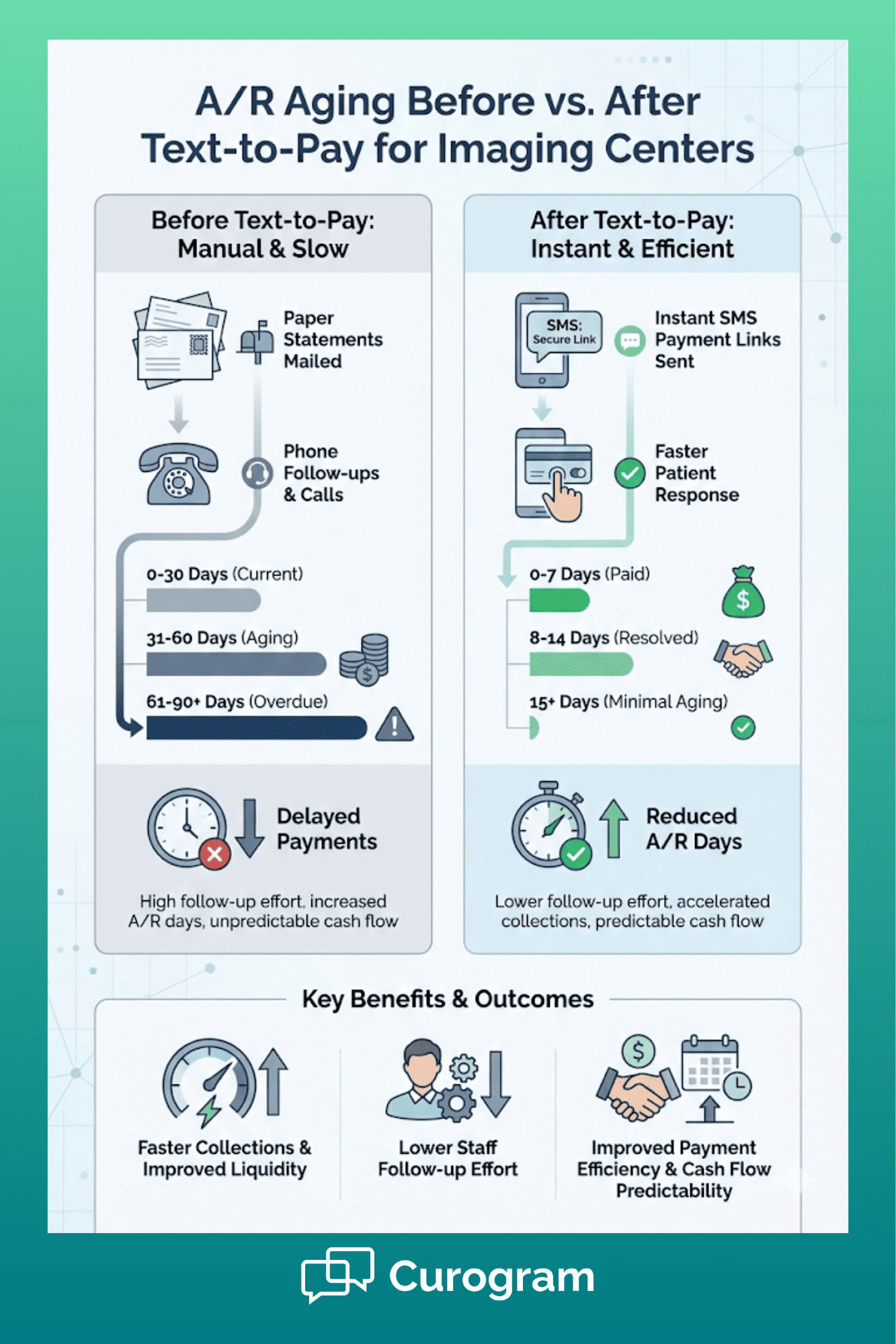
A/R aging comparison before and after text-to-pay

Reducing Administrative Costs for Billing and Front Desk Teams

Administrative cost control is one of the biggest drivers of long-term margin in imaging centers. Billing and front desk teams handle high volumes of repetitive work, and even small inefficiencies scale into major expenses over time.

By removing manual payment steps, text-to-pay helps StreamlineMD practices lower labor costs, improve payment efficiency, and protect staff capacity without sacrificing service quality.

Automation Reduces Labor Hours on Follow-Up and Phone Collections

Phone-based collections are one of the most time-consuming tasks in billing operations. Each balance requires multiple touches: dialing, leaving a voicemail, waiting for a callback, documenting the attempt, and trying again days later. Even when staff are diligent, response rates are low.

Text-to-pay replaces most of this work with automated payment messages. When a balance is ready, the system sends a secure link to the patient. The message is clear, short, and easy to act on. Many patients pay as soon as they open it, without any staff involvement.

Instead of working through long call lists, billing teams monitor a dashboard. They see which payments are complete, which are pending, and which require follow-up. Staff only intervene when something is unclear, such as a disputed charge or a partial payment.

To understand the labor impact, consider a common scenario. A billing specialist spends an average of five minutes per call attempt, including documentation. If they make 40 follow-up calls per day, that is more than three hours spent on the phone. Over a five-day week, that is 15 hours of labor focused on one task.

With text-to-pay, many of those balances resolve after the first message. Even if only half of the balances are paid without follow-up, that saves more than seven hours per week for one staff member. Across a team of three or four, the time savings grow quickly.

The reclaimed time can be used for higher-value work. Staff can review insurance responses sooner, resolve denials faster, or assist patients who truly need help. This improves both cash flow and patient satisfaction without increasing payroll.

Automation also reduces error risk. Manual calls rely on memory and notes. Automated workflows ensure every balance receives the same clear message and follow-up cadence. This consistency supports better payment efficiency and reduces the chance that a balance is missed.

Lower Overhead From Paper Statements and Manual Processing

Paper billing carries hidden costs that often go overlooked. Printing statements, stuffing envelopes, applying postage, and reconciling returned mail all require time and money. These costs repeat every billing cycle.

For a mid-sized imaging center, even conservative math adds up:

If a practice mails 2,000 patient statements per month at a combined print and postage cost of $1.25 each, that is $2,500 per month. Over a year, that is $30,000 spent just to ask patients to pay.

Paper also slows the revenue cycle. Statements take days to arrive. Patients may set them aside. When payments finally come in, staff must open mail, post payments, and reconcile accounts. Each step introduces delay.

Text-to-pay removes most of this overhead. Payment requests are delivered instantly. There is nothing to print, mail, or file. Payments post electronically, often within minutes.

Manual reconciliation work also drops. Digital payments flow directly into billing systems with fewer posting errors. Staff no longer spend time matching checks to accounts or resolving unclear remittance details.

Another hidden cost of paper is rework. Statements get returned due to address changes. Staff must research updated contact information and resend bills. With text-based workflows, messages go to the same phone numbers patients already use for appointment reminders, reducing delivery issues.

Over time, lower overhead compounds. Savings from paper reduction free up budget that can be used for technology upgrades, staff training, or patient experience improvements. Practices gain more control over operating expenses without reducing service levels.

Staff Productivity Increases Without Additional Hiring

As imaging centers grow, administrative workload increases. More studies mean more co-pays, more balances, and more follow-up. In traditional workflows, growth often triggers hiring to keep up.

Text-to-pay changes that equation. Automation allows existing teams to handle higher volumes without a proportional increase in effort. The same number of staff can manage more accounts with less stress.

For example, a billing team that previously handled 1,200 patient balances per month may be able to manage 1,800 with text-to-pay in place. The work does not triple; it shifts. Routine payments resolve automatically, and staff focus on the smaller set of complex cases.

This scalability is critical for multi-site StreamlineMD practices. As new locations come online, standardized digital payment workflows keep operations aligned. Leaders do not need to build separate billing teams for each site.

Front desk productivity improves as well. When co-pays are handled digitally, staff spend less time discussing balances during check-in. That reduces interruptions and keeps patient flow steady.

Lower stress levels matter. Constant phone work and payment disputes contribute to burnout. When staff feel they are always chasing payments, morale suffers. Automation removes much of that friction.

Teams with manageable workloads are more likely to stay engaged and remain with the organization. Reduced turnover lowers recruitment and training costs, which are often overlooked when calculating administrative expenses.

Lean staffing also improves consistency. Fewer handoffs mean fewer mistakes. Patients receive clearer communication, and leadership gains confidence that workflows will hold as volume grows.

Improving Payment Predictability for Radiology, Vascular, and IR Departments

Fast payments are important, but predictable payments matter just as much. When imaging centers know when revenue will arrive, leaders can plan with confidence instead of reacting to gaps. 

Upfront Collection Improves Revenue Forecasting

Revenue forecasting becomes easier when payments are collected earlier in the care cycle. Co-pays handled before or on the day of the visit reduce the number of balances that drift into A/R.

For leadership teams, this predictability supports better planning. Staffing decisions, overtime coverage, and equipment purchases are easier to justify when cash flow follows a reliable pattern.

Consider this:

A vascular imaging group averages $75 in patient responsibility per visit. If 15% of those balances are delayed each month, forecasting becomes uncertain. With text-to-pay, more of that revenue is captured upfront, reducing month-end surprises.

Predictable cash flow StreamlineMD text-to-pay workflows also reduce reliance on reserve funds. Practices no longer need to buffer against delayed patient payments, which improves overall financial control.

Decreased Variability Across Multi-Site Locations

Multi-site imaging groups often struggle with uneven financial performance. One location may collect co-pays consistently, while another relies heavily on post-visit billing. These differences make it hard to compare performance or set reliable targets.

Text-to-pay helps standardize payment workflows across all locations. Each site follows the same process for co-pays and balance collection, regardless of volume or specialty. Patients receive the same type of payment message, at the same point in the visit cycle.

This consistency reduces variability in monthly results. Leadership no longer needs to adjust forecasts based on which location performed better or worse. Financial performance becomes easier to compare, measure, and improve across the network.

Standard workflows also simplify training. New staff learn one process instead of site-specific billing habits. As locations expand, operations stay aligned instead of drifting apart.

Better Payment Data Enhances Revenue Cycle Transparency

Predictability depends on visibility. When payment data is scattered across systems or tracked manually, leaders lack a clear picture of what has been collected and what is still outstanding.

Text-to-pay improves transparency by centralizing payment status. Staff can quickly see which balances are paid, which are pending, and which need follow-up. There is no need to dig through call notes or paper statements.

This visibility supports faster action. Billing teams can focus on true exceptions instead of reviewing every account. Managers can spot trends early, such as delays tied to specific visit types or locations.

Clear payment data also improves reporting. Leadership gains confidence that revenue numbers reflect real activity, not estimates. With better insight into the revenue cycle, practices move from reactive billing to controlled, predictable financial management.

Strengthening the Patient Experience Through Easy Digital Payments

Text-to-pay helps StreamlineMD practices stabilize cash flow while also improving how patients experience billing. By aligning payment timing with patient behavior, digital workflows remove uncertainty from both financial planning and front desk interactions.

Patients Appreciate Simple, Mobile-Friendly Billing

Patients want billing to feel easy and familiar. Text-to-pay meets that expectation by using the same device patients already rely on for daily tasks.

There are no portals to remember and no passwords to reset. A secure link opens, the balance is clear, and payment is complete in seconds.

This simplicity matters at check-in. Patients who have already paid feel prepared and relaxed. Front desk staff spend less time explaining charges and more time guiding care.

After the visit, the experience stays consistent. When a follow-up balance is due, the process feels like a reminder, not a demand. This reduces frustration and increases satisfaction.

Clear Expectations Build Trust and Reduce Billing Confusion

Billing confusion often comes from unclear timing or vague explanations. Text-to-pay messages provide short, direct context tied to a specific visit or procedure.

Patients know what they owe and why. Staff avoid tense conversations that can slow the day or strain relationships.

Over time, this clarity builds trust. Patients are more likely to return and recommend a practice that handles billing with transparency and respect.

A better payment experience supports loyalty, referrals, and long-term growth without added effort from staff.

Better Patient Experience Leads to Higher Retention and Referrals

Positive billing experiences shape how patients remember a visit. When payments are simple, clear, and stress-free, patients leave with a better overall impression of the practice.

Text-to-pay removes confusion, long waits, and awkward payment conversations, replacing them with a process patients understand and trust. This ease matters for repeat imaging needs, where patients often return multiple times a year.

When financial steps feel fair and respectful, patients are more likely to stay with the same provider instead of shopping elsewhere. Over time, satisfied patients also share their experience with family and friends, driving referrals that support steady growth.

Patient receiving text-to-pay message for imaging balance

Compliance and Security Advantages of Text-to-Pay

Payment speed means little if security is compromised. Imaging centers manage sensitive health and financial data every day, and even small gaps in billing workflows can create serious compliance risk.

Text-to-pay within Curogram is built to meet strict regulatory standards while reducing the operational exposure that comes with manual payment handling.

HIPAA-Compliant Digital Transactions

All text-to-pay messages are delivered through HIPAA-compliant channels designed specifically for healthcare communication. Payment links are encrypted end to end, ensuring that patient information remains protected during every step of the transaction.

Unlike ad hoc payment requests or phone-based collections, these messages are automatically logged and tied to the patient record. This creates a reliable audit trail that shows when a payment request was sent, viewed, and completed. Staff never need to document payment outreach manually.

Just as important, staff never use personal phones, emails, or unsecured tools to request payments. This removes a common compliance risk in busy imaging environments where speed often tempts workarounds.

Reduced Risk From Physical Payment Handling

Physical payment handling introduces avoidable risk. Credit cards passed at the front desk, paper checks left in trays, and mailed statements all create opportunities for loss or error.

Text-to-pay reduces these touchpoints. Fewer cards are handled in person. Fewer paper statements are printed and stored. Manual data entry drops, which lowers the chance of posting errors or mismatched accounts.

Digital payments also simplify record keeping. There is no need to store paper copies or reconcile handwritten notes, which reduces both compliance exposure and administrative burden.

Protecting Revenue and Patient Trust

Secure workflows protect revenue by preventing disputes and delays tied to unclear or undocumented payment requests. When patients receive clear, secure messages, questions are resolved faster and payments post with confidence.

Patients also notice when billing feels professional and private. Secure, mobile-friendly payments build trust, especially for higher-balance radiology and IR cases.

For StreamlineMD practices, compliance is not an extra step or a barrier to efficiency. It is built directly into daily workflows that protect income, reduce risk, and strengthen reputation at every stage of the patient payment journey.

Long-Term ROI From Modernizing Financial Workflows

The true return on text-to-pay goes beyond faster payments in a single month. When imaging centers modernize financial workflows, the benefits compound over time. Lower A/R, stronger patient preference, and scalable processes work together to improve long-term financial stability and growth.

For StreamlineMD practices, this long-term ROI becomes visible not just in reports, but in day-to-day operations that feel easier to manage and more predictable.

Lower A/R Days and Higher Monthly Collection Rates

One of the clearest long-term benefits of text-to-pay is a steady reduction in A/R days. When patient balances are collected earlier, fewer accounts roll into extended aging buckets.

Instead of carrying balances for 30, 60, or 90 days, practices resolve many payments within days of the visit. This shortens the revenue cycle and improves overall financial health.

Over time, higher monthly collection rates become the norm rather than the exception. Revenue aligns more closely with appointment volume, making financial performance easier to track and explain.

Lower A/R also reduces operational drag. Fewer aging accounts mean fewer follow-ups, fewer disputes, and fewer write-offs. This protects revenue that might otherwise be lost due to delay or patient confusion.

For leadership, this consistency matters. When collections stabilize, budgeting becomes more accurate. Practices can invest with confidence instead of holding back due to uncertain cash flow.

Competitive Advantage in High-Volume Imaging Markets

Imaging markets are competitive, especially in urban and multi-provider regions. Patients have options, and small experience details influence where they choose to go.

Modern billing plays a role in that choice. Patients increasingly expect healthcare payments to match the convenience of other services they use daily. Practices that offer text-based payments meet those expectations.

When billing feels easy and respectful, patients are more likely to return. They are also more likely to recommend the practice to others, especially for repeat imaging needs.

In contrast, practices that rely on paper bills and phone calls can feel outdated. Friction during payment may not cause immediate complaints, but it quietly affects loyalty.

By modernizing financial workflows, StreamlineMD practices gain an edge that extends beyond billing. They signal efficiency, professionalism, and patient focus in every interaction.

Supports Scalability for Growing Multi-Site Imaging Networks

Growth often exposes weaknesses in financial workflows. As practices add locations or increase volume, manual billing processes become harder to manage.

Text-to-pay supports scalability by standardizing payment workflows across sites. Each location follows the same process for co-pays, post-visit balances, and follow-ups.

This consistency keeps operations aligned. Leadership can compare performance across locations without adjusting for different billing methods.

Staff training also becomes simpler. New hires learn one system instead of multiple workflows. This reduces ramp-up time and limits errors as teams expand.

Most importantly, scalable workflows protect margins during growth. Practices can increase volume without increasing administrative burden at the same rate.

Over time, this balance between growth and efficiency defines sustainable success. StreamlineMD practices that modernize financial workflows are better positioned to expand while maintaining control, consistency, and confidence in their revenue cycle.


Related Automations That Multiply ROI for StreamlineMD Users

Text-to-pay delivers strong results on its own, but its impact grows when paired with other connected automations inside StreamlineMD workflows.

Each tool removes friction at a different stage of the patient journey, creating a system where revenue moves faster and staff effort stays low.

HIPAA-compliant texting reduces phone volume and speeds up patient responses, making it easier to resolve questions tied to appointments and billing.

Mass texting supports high-volume outreach, such as payment reminders or service updates, without adding manual work.

Appointment reminders protect revenue before the visit even happens. Fewer missed appointments mean fewer gaps in the schedule and fewer downstream billing issues. When reminders include payment links, collections begin earlier.

Reputation management supports long-term growth by improving online reviews and patient trust. Practices that communicate clearly and bill transparently are more likely to receive positive feedback, which drives new patient volume.

Online patient forms reduce check-in delays and billing errors by collecting accurate information upfront. This improves claim processing and reduces payment disputes.

Telehealth expands access and fills schedule gaps while maintaining consistent billing workflows.

Together, these automations strengthen the financial efficiency gained from text-to-pay and help StreamlineMD practices maximize ROI across the entire care cycle.


How Text-to-Pay Enhance StreamlineMD Practices


Curogram integrates text-to-pay directly into StreamlineMD workflows, making digital payments a natural extension of patient communication. Payment requests align with appointment reminders, confirmations, and follow-up messages, so billing feels connected to care instead of separate from it.

Patients do not need to download apps or log into portals. A secure payment link arrives by text, opens instantly, and guides them through payment with clear context tied to a specific visit or procedure. This familiarity reduces hesitation and increases completion rates.

For staff, the experience is just as simple. There are no extra systems to manage and no manual syncing between tools. Payments post automatically, and teams can track paid, pending, and overdue balances from a single view. This visibility reduces guesswork and supports faster follow-up when needed.

Adoption is fast because workflows match how teams already work. Front desk staff continue using reminders and messaging, now with payments included. Billing teams shift from chasing balances to monitoring outcomes. Training time stays short, and disruption stays minimal.

Across radiology, vascular, and IR departments, payment efficiency improves without adding steps to the day. Co-pays are collected earlier. Post-visit balances resolve faster. A/R reduction becomes steady and predictable.

Curogram helps imaging centers improve cash flow StreamlineMD text-to-pay while keeping operations simple, secure, and scalable. As volumes grow or new locations are added, the same workflows apply, supporting consistent financial performance across the organization.

Conclusion

Text-to-pay is not just a billing upgrade. It is a revenue protection strategy for imaging centers that depend on steady, predictable cash flow. When patient payments arrive late, pressure spreads across scheduling, staffing, and long-term planning. Modern payment workflows address that risk directly by collecting revenue closer to the point of care.

For StreamlineMD radiology, vascular, and IR practices, text-to-pay resolves long-standing billing challenges. Co-pays are collected before or on the day of service. Post-visit balances are followed up automatically instead of sitting idle. A/R reduction becomes consistent rather than reactive, giving leaders clearer insight into monthly performance.

Operational impact matters just as much as payment speed. Billing teams spend less time on phone calls and paper tasks. Front desk staff avoid tense payment conversations during check-in. Fewer interruptions keep patient flow moving and reduce daily stress across departments.

Patients benefit in clear and practical ways. Billing feels simple and familiar. Payment requests explain what is owed and why. Secure links let patients pay in seconds without portals or passwords. When financial steps feel respectful and easy, trust grows and frustration fades.

Security remains built in. Messages are encrypted. Transactions are logged. Audit trails stay complete. Staff never rely on personal devices or manual workarounds. These safeguards protect patient data, reduce compliance risk, and support clean audits.

Curogram and StreamlineMD together deliver a scalable digital payment ecosystem designed for imaging workflows. Text-to-pay aligns with reminders and patient messaging, creating a smooth experience from scheduling through payment. As practices grow, the system scales without adding complexity.

Predictable cash flow no longer requires guesswork or added staff. It becomes a controlled outcome.

Text-to-pay is the next step forward. Book a demo today to learn how Curogram supports growth across locations, volumes, and patient expectations.


Frequently Asked Questions

How does text-to-pay improve cash flow for imaging centers?
Text-to-pay sends secure payment links close to the visit, when patients are most likely to respond. This leads to earlier co-pay and balance collection, reduces payment delays, and creates steadier, more predictable cash flow.
Why is A/R reduction important for StreamlineMD practices?
Lower A/R means fewer unpaid balances sitting for weeks. This reduces follow-up work, improves monthly revenue visibility, and helps leadership plan staffing, equipment needs, and expenses without relying on reserve funds.
How does text-to-pay improve payment efficiency?

Text-to-pay removes extra steps like portals, logins, and phone calls. Patients pay directly from their phones in seconds, which increases completion rates and reduces the time and effort needed to collect each payment.

How does this affect billing staff workload?

Automation replaces manual calls and paper follow-ups with digital payment messages. Billing teams spend less time chasing balances and more time handling exceptions, insurance issues, and patient support that truly require attention.

Why do patients prefer text-based payments?

Text-based payments feel familiar and convenient. Patients already manage bills, shopping, and banking on their phones, so paying by text feels faster, easier, and less stressful than mailed bills or phone calls.


How Radiology & IR Teams Collect Payments Efficiently in StreamlineMD

How Radiology & IR Teams Collect Payments Efficiently in StreamlineMD

💡 Billing delays are common in radiology, vascular, and IR practices due to unclear balances and manual follow-ups. Text-to-Pay lets patients...
Read More
Text-to-Pay in StreamlineMD: Faster Collections for Imaging Clinics

Text-to-Pay in StreamlineMD: Faster Collections for Imaging Clinics

💡 Text-to-Pay in StreamlineMD lets imaging and vascular practices collect payments faster through secure text messages. Patients get a direct...

Read More
Collecting Copays and Balances Faster with Text-to-Pay in Ramsoft

Collecting Copays and Balances Faster with Text-to-Pay in Ramsoft

💡 Collecting copays in Ramsoft radiology workflows help you manage payments with fewer delays. Patients often forget what they owe or wait until...

Read More