
.jpg?width=30&height=30&name=square-formal-photo%20(1).jpg) Mira Gwehn Revilla
Mira Gwehn Revilla
Text-to-Pay in Veradigm with Curogram
 Jo Galvez : Jan 13, 2026, 10:00:00 AM
Simplify enterprise billing & collections in Veradigm with Curogram’s HIPAA-compliant Text-to-Pay: faster payments, lower A/R, & better patient...
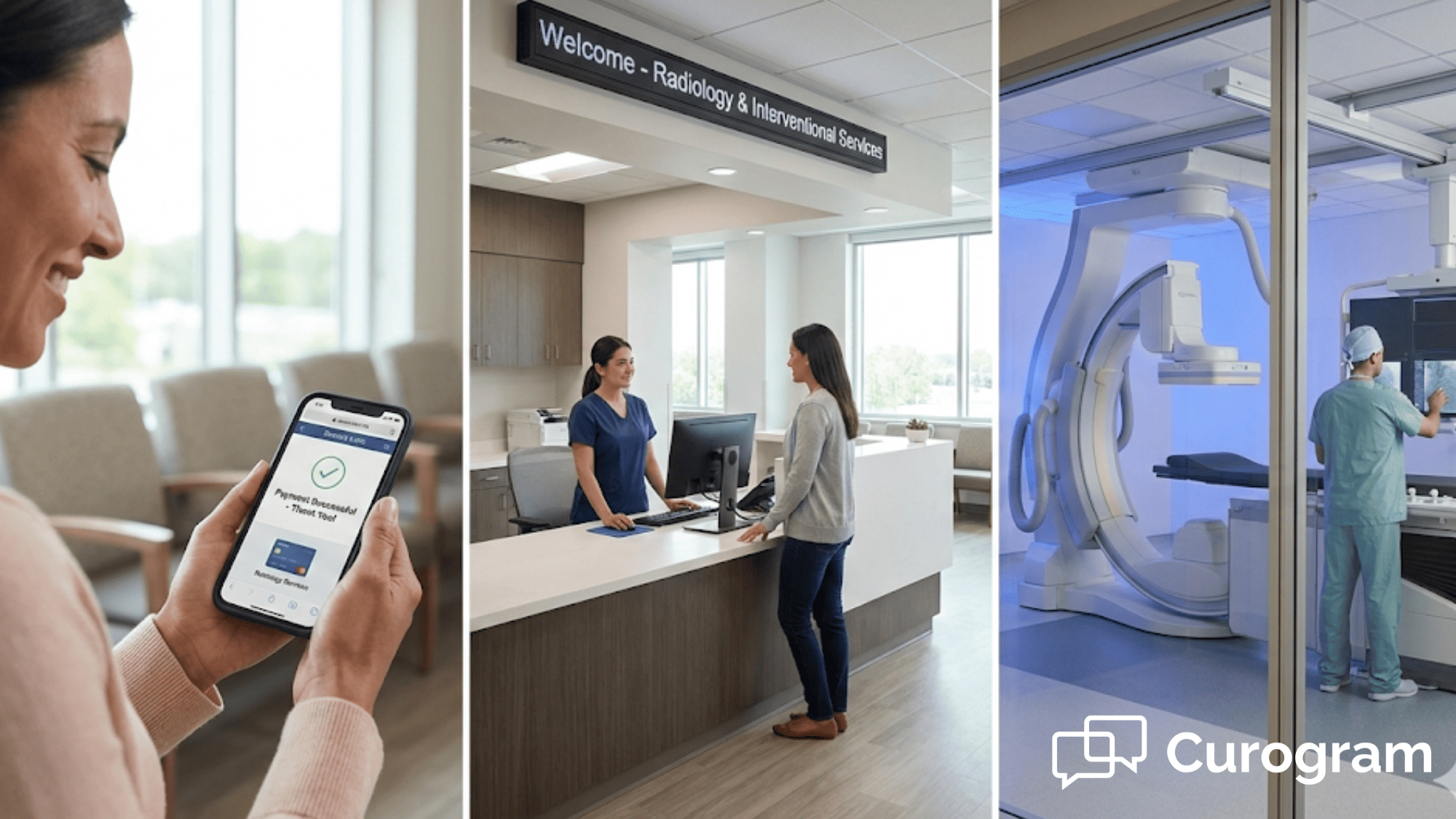
Billing problems rarely start in the billing office. In imaging centers, they usually begin at scheduling and check-in. Radiology, vascular, and IR practices operate on tight schedules. Scanners run back-to-back. Delays create ripple effects that impact staff, patients, and revenue.
Many patients arrive for imaging without knowing what they owe. Some expect insurance to cover everything. Others assume they will receive a bill weeks later. When these assumptions collide at check-in, staff are forced into long payment conversations. Lines form. Appointments start late. Patients feel rushed or embarrassed.
For billing teams, the problem continues after the visit. Unpaid balances require phone follow-ups. Calls go unanswered. Voicemails stack up. Staff spend hours repeating the same explanations. Meanwhile, days in A/R grow longer.
Vascular and IR practices face added complexity. Procedures often involve higher charges, deposits, or multiple visits. Without clear payment steps, balances are delayed or missed entirely. Financial counseling pulls staff away from clinical support.
These challenges are not caused by lack of effort. They are caused by disconnected workflows. Payment lives outside scheduling, reminders, and patient communication. Staff must remember when to ask, who to call, and how often to follow up.
Text-to-Pay addresses this gap by placing payment inside the patient communication flow. Secure payment requests are sent by text at the right time. Patients review balances on their phone and pay when it is convenient.
When Text-to-Pay is integrated into StreamlineMD workflows, billing becomes predictable instead of reactive. Patients arrive prepared. Staff stay focused. Collections improve without adding pressure.
This article breaks down how imaging practices use Text-to-Pay to fix billing workflows across radiology, vascular, and IR care.
Billing challenges without automation are often underestimated because they happen in small moments throughout the day. Each moment seems minor, but together they create serious operational drag.
Patients frequently arrive without knowing their co-pay or balance. Imaging referrals often come from outside providers. Insurance estimates may not be communicated clearly. When patients reach the front desk, staff must pause check-in to explain charges. This slows patient flow and increases tension.
Manual collection disrupts MRI and CT schedules. Imaging appointments are tightly timed. When staff step away to process payments, scanners sit idle. A few minutes of delay early in the day can cascade into longer waits by afternoon. Patients feel frustrated, and staff feel rushed.
Billing teams face a different set of challenges. After visits, unpaid balances require outreach. Phone calls remain the most common method. Staff dial numbers repeatedly, often reaching voicemail. Follow-ups stretch across weeks. Each balance becomes a task that must be tracked manually.
IR procedures add more pressure. These cases often involve higher charges, pre-procedure deposits, and follow-up visits. Patients may be anxious about costs. Without a clear payment process, staff spend significant time explaining balances. These conversations are important but time-consuming.
Multi-location imaging groups face inconsistency. One site may collect up front. Another may send statements. Patients visiting different locations receive mixed messages. Billing reports vary by site, making it harder for leadership to assess performance.
These issues share a root cause. Payment is treated as a separate step instead of part of the patient journey. Staff rely on memory, notes, or ad hoc processes. This leads to missed opportunities and delayed revenue.
Text-to-Pay changes how these workflows operate. Payment requests are triggered automatically based on scheduling or visit completion. Patients receive a secure link by text. They can review charges at home, without pressure.
By shifting payment outside the front desk and phone calls, staff regain control of their day. Check-in stays focused on patient flow. Billing teams spend less time chasing balances. Leadership sees cleaner, more predictable collections.
Radiology practices depend on speed, accuracy, and predictable patient flow. When payment collection is handled manually or left until check-in, even small delays can disrupt tightly scheduled MRI, CT, and ultrasound appointments.
Text-to-Pay improves radiology payment workflows by moving payment conversations earlier, reducing front desk strain, and giving patients clear financial expectations before they arrive.
Radiology schedules are dense, with appointments often booked back-to-back throughout the day. Patients typically arrive close to their appointment time, leaving little room for delays at check-in.
When co-pays or balances are collected in person, staff must pause the check-in process to explain charges, process payments, and answer questions. This slows patient flow and increases wait times.
Text-to-Pay allows radiology practices to collect co-pays before the day of service. After an appointment is scheduled, patients receive a secure text message with their balance and a payment link.
They can review the amount on their own time and complete payment from their phone. Many patients pay before arrival, removing the need for payment discussions at the front desk.
By the time patients arrive for their MRI, CT, or ultrasound, staff can already see payment status in the system. Check-in becomes a quick verification step rather than a financial conversation. This keeps appointments on time and prevents scanner delays caused by bottlenecks at the front desk.
Early payment collection also reduces last-minute cancellations. When patients understand their financial responsibility ahead of time, they are less likely to cancel unexpectedly or arrive unprepared.
Front desk teams in imaging centers operate under constant pressure. Phones ring with scheduling questions, patients arrive in waves, and staff must manage check-in, directions, and paperwork. Payment discussions add another layer of complexity, especially during peak hours.
With Text-to-Pay, many payment interactions are removed from the front desk entirely. Patients who have already paid do not need to stop for payment processing. Staff no longer handle card terminals, cash drawers, or repeated questions about balances during check-in. Payments are completed digitally through secure text links.
This reduction in in-person payment handling frees staff to focus on patient flow and support. They can greet patients, confirm appointments, and direct them efficiently without juggling financial tasks. During busy periods, this difference is noticeable. Lines move faster, waiting rooms feel calmer, and staff are better able to manage volume.
Reducing payment-related interruptions also lowers stress for front desk teams. Instead of reacting to payment issues throughout the day, staff work within a more predictable workflow. This improves job satisfaction and reduces burnout in high-volume imaging environments.
Financial confusion is a common source of patient frustration in radiology settings. Patients may not know their co-pay, assume insurance covers the full cost, or expect a bill weeks later. When these assumptions are challenged at check-in, trust can be damaged.
Text-to-Pay improves financial clarity by communicating balances clearly before the visit. Payment messages state exactly what is owed and include a secure link to pay. Patients can review the amount at home, without feeling rushed or pressured in a waiting room.
If patients have questions, they can reply to the text message before the appointment. This allows staff to address concerns ahead of time rather than during check-in. Issues are resolved earlier, and fewer surprises occur on the day of service.
Clear financial communication also reduces rework for staff. When patients arrive informed, staff avoid repeated explanations and corrections. Billing information is consistent, and fewer follow-up calls are needed after the visit.
For radiology practices, this transparency builds trust. Patients feel respected when costs are explained clearly and early. Payment conversations feel fair and professional rather than stressful or awkward.
Overall, Text-to-Pay supports radiology payment workflows by improving speed, reducing staff burden, and increasing patient confidence. By collecting payments before arrival, simplifying front desk operations, and clarifying financial expectations, imaging centers create a smoother experience for both patients and staff while keeping schedules on track.
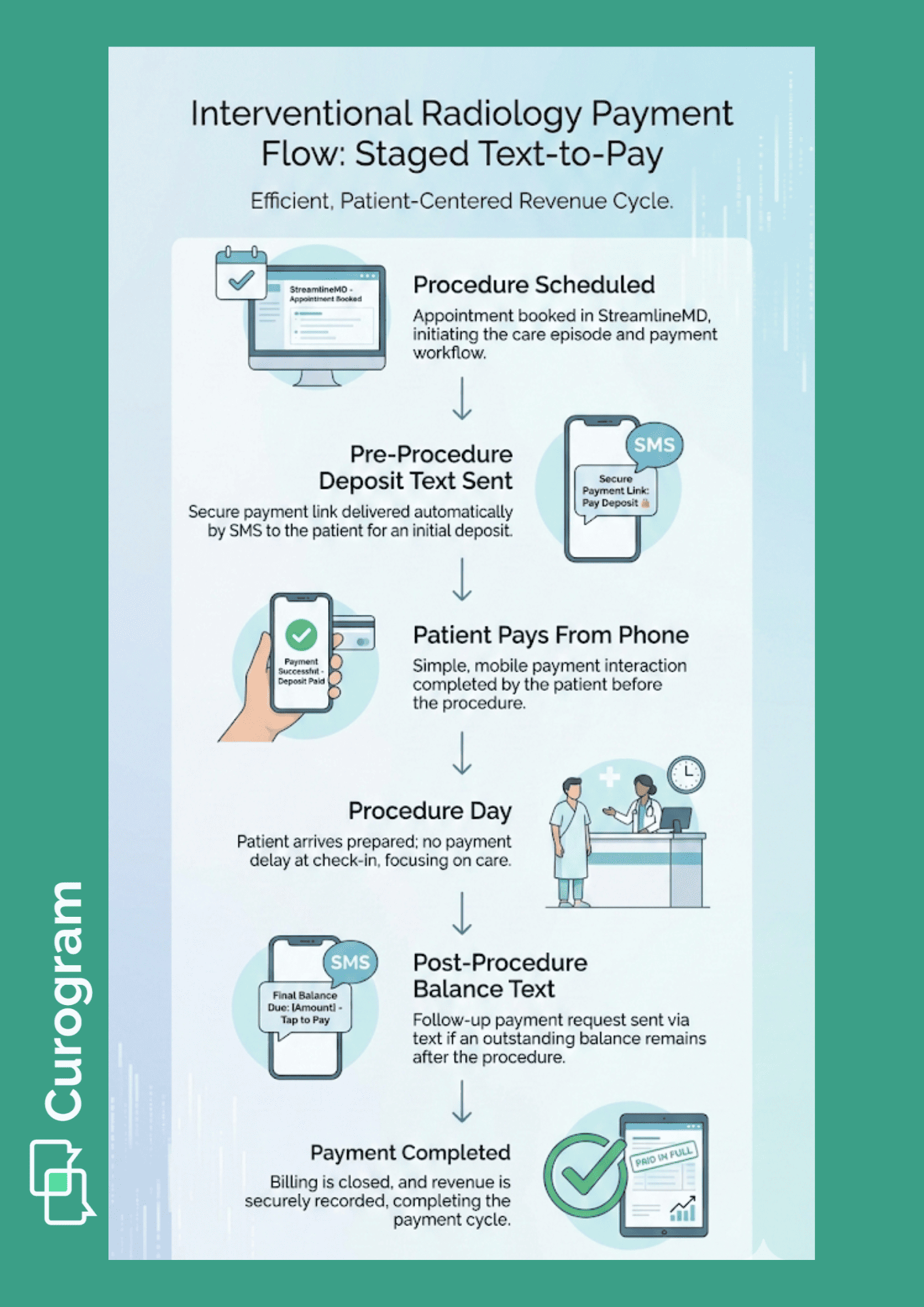
Vascular and interventional radiology practices manage some of the most complex workflows in outpatient care. Procedures often involve higher costs, advance planning, and multiple visits.
When payment steps are unclear or manual, they create stress for patients and staff. Text-to-Pay supports vascular and IR workflows by making payment clear, early, and tied directly to each step of care.
Vascular and IR procedures often require more financial coordination than standard imaging. Many cases involve higher charges, pre-procedure deposits, or partial payments before care can proceed.
When these payments are handled manually, staff must make repeated phone calls, send paper statements, or collect payments on the day of the procedure. This creates risk and delays.
Text-to-Pay allows practices to send secure deposit requests well before the procedure date. After a procedure is scheduled, patients receive a text message with clear payment instructions and a secure link.
They can review the amount and pay from their phone without calling the office or visiting in person. This gives patients time to plan and removes pressure from procedure day.
Collecting deposits digitally reduces last-minute payment issues. Without Text-to-Pay, staff often discover unpaid balances on the morning of the procedure. This leads to urgent calls, rushed explanations, or delays while payment is processed. In some cases, procedures must be postponed, wasting clinical time and resources.
With Text-to-Pay, staff can confirm deposit status days in advance. If payment is incomplete, reminders are sent automatically. Staff intervene only when necessary, rather than reacting at the last minute. This protects schedules and reduces stress for both staff and patients.
Patients also benefit from early payment requests. They receive clear expectations and are not surprised by charges on the day of care. This improves trust and helps patients arrive focused on their procedure rather than finances.
Many vascular and IR cases involve more than a single visit. Patients may need pre-procedure imaging, the procedure itself, and one or more follow-up visits. Each step may generate its own charges. Managing these payments manually is difficult and error-prone.
Text-to-Pay supports multi-step care by tying payment requests to each visit or procedure. Patients receive consistent messages for each stage of care. Payment requests reference the specific visit, helping patients understand what they are paying for and when.
This approach improves billing accuracy. Staff no longer track balances manually across multiple visits or rely on memory and notes. Each payment is tied to a specific service, keeping billing organized and transparent.
For patients, this clarity is critical. Instead of receiving a large, confusing bill weeks later, they see charges broken out over time. This makes costs easier to understand and manage. Patients know what to expect at each step, reducing anxiety.
From an operational perspective, staged payment requests improve cash flow. Payments are collected closer to the time of service, reducing days in A/R. Practices avoid large outstanding balances that are harder to collect later.
Text-to-Pay also reduces missed payments across long care episodes. Automated reminders ensure that balances do not fall through the cracks. Staff spend less time reconciling accounts and more time supporting care delivery.
Financial counseling is an important but time-consuming part of vascular and IR workflows. Patients often have questions about procedure costs, insurance coverage, and payment timing. These conversations frequently fall on clinical staff, pulling attention away from patient care.
Text-to-Pay reduces the volume of these conversations by addressing many questions upfront. Payment messages clearly state what is owed and when. Patients can review this information at home, without feeling rushed. Many common questions are resolved before the visit.
When patients do have questions, they can reply to the message ahead of time. Staff respond with context, rather than fielding calls during busy clinic hours. This shifts financial discussions out of high-pressure moments.
Reducing financial counseling workload improves clinical efficiency. Nurses, technologists, and coordinators spend less time explaining balances and more time preparing patients for procedures. This leads to smoother days and fewer delays.
From a revenue standpoint, clearer communication leads to higher payment completion. Patients who understand charges are more likely to pay promptly. This stabilizes revenue cycles and reduces the need for follow-up calls.
Predictable payment workflows also help leadership plan resources. When collections are consistent, practices can better forecast revenue, staffing needs, and equipment investments. This stability is especially important for vascular and IR services with higher operational costs.
For vascular and IR teams, Text-to-Pay supports complex care without adding complexity. By making payment clear, early, and automated, practices reduce stress, protect schedules, and improve both patient and staff experience.
Administrative work tied to billing often grows quietly over time. What starts as a few follow-up calls turns into hours of repetitive tasks for billing teams. Automated payment requests reduce this burden by replacing manual steps with consistent, system-driven workflows that scale without adding staff.
Manual payment follow-ups drain billing teams. Staff must track unpaid balances, schedule reminder calls, and leave voicemails that often go unanswered. Each balance becomes a recurring task that competes with other responsibilities.
Text-to-Pay automates balance reminders on a set cadence. After a visit or missed payment, patients receive a secure text message with their outstanding balance and a payment link. If payment is not completed, follow-up reminders are sent automatically at defined intervals.
These gentle prompts are more effective than phone calls. Patients can review and pay when it fits their schedule. Messages arrive directly on their phone, where they are more likely to be seen. This improves response rates without increasing staff effort.
For billing teams, automation removes the need to manage reminder lists manually. Staff no longer decide who to call or when to follow up. The system handles routine outreach, and staff step in only for exceptions. This reduces mental load and frees time for higher-value work.
Automation also creates consistency. Every patient receives the same reminders, reducing the risk of missed follow-ups. Billing workflows become predictable instead of reactive, which improves planning and performance.
Traditional payment processing involves many manual steps. Staff accept payments in person, handle paper checks, scan documents, and post transactions into systems. Each step introduces delays and potential errors.
With Text-to-Pay, payments arrive digitally through secure links. Funds are processed automatically, and payment records are updated without manual entry. There is no scanning, no rekeying, and no paper handling.
This reduces posting errors and speeds reconciliation. Billing teams can match payments to accounts more quickly. End-of-day and end-of-month close processes become simpler and more reliable.
Eliminating manual steps also improves staff efficiency. Hours previously spent processing payments are reclaimed. Teams can focus on account review, reporting, and patient support rather than repetitive data entry.
Digital payment workflows also support remote or hybrid billing teams. Staff do not need to be physically present to process payments, which increases flexibility and resilience during staffing changes.
Multi-site imaging groups often struggle with inconsistent billing workflows. One location may collect payments up front, while another relies on statements and calls. This inconsistency confuses patients and complicates reporting.
Automated Text-to-Pay workflows standardize collection across all sites. Every location follows the same process for payment requests, reminders, and follow-ups. Patients receive a consistent experience regardless of where they are seen.
Standardization simplifies training. New staff learn one workflow instead of multiple site-specific processes. This reduces errors and speeds onboarding.
For leadership, standardized workflows provide clear visibility. Reporting is consistent across locations, making it easier to compare performance and identify trends. Leaders can see which sites are collecting efficiently and where improvements are needed.
Most importantly, automation allows imaging groups to scale without adding administrative staff. As volume grows, the system handles increased payment activity. Billing teams remain lean while collections improve.
By automating reminders, eliminating manual processing, and standardizing workflows, Text-to-Pay significantly reduces administrative burden. Practices gain efficiency, staff regain time, and collections become more predictable—all without increasing workload or complexity.

Revenue leakage in imaging practices rarely shows up as one large problem. Instead, it builds quietly through missed balances, delayed follow-ups, and unclear payment steps. Without a simple way to collect payments on time, small gaps repeat daily and slowly reduce revenue across radiology, vascular, and IR services.
Patients are more likely to pay when the process is simple and familiar. Traditional payment methods often create friction. Paper statements arrive late. Portals require logins. Phone calls are missed. Each barrier increases the chance that a balance goes unpaid.
Text-to-Pay removes these barriers by sending a clear payment request directly to the patient’s phone. The message includes the balance and a secure link to pay. Patients do not need to remember passwords, wait for mail, or call the office. They can complete payment in seconds.
Because text messages are typically read quickly, many patients pay shortly after receiving the request. This immediate visibility improves payment completion rates and reduces the number of accounts that require follow-up. Automated reminders reinforce this behavior by gently prompting patients who have not yet paid, without staff involvement.
When payment requests and reminders are automated, fewer balances fall through the cracks. Staff no longer rely on memory or manual tracking to catch unpaid accounts. The system consistently does the work, improving overall payment reliability.
Delayed payments are a major contributor to growing A/R backlogs. When balances linger for weeks or months, billing teams spend significant time reviewing aging reports and making outbound calls. This slows collections and increases administrative burden.
Text-to-Pay shortens the time between service and payment. By requesting payment soon after the visit, practices capture revenue while the visit is still fresh in the patient’s mind. Automated follow-ups ensure that unpaid balances are addressed quickly, not weeks later.
As a result, payments are collected faster and A/R backlogs shrink. Billing teams spend less time chasing old accounts and more time managing current revenue. This improves efficiency and reduces stress across the billing function.
Predictable collections create predictable revenue. When payments are completed consistently and on time, leadership gains a clearer view of financial performance. This stability supports better decision-making across the organization.
Radiology and IR services rely on expensive equipment and skilled staff. When revenue leakage is controlled, practices can plan workforce needs, equipment upgrades, and expansion with confidence. End-of-month surprises are reduced, and cash flow becomes easier to manage.
Preventing revenue leakage is not about pressuring patients to pay. It is about removing friction from the payment process so payments happen naturally, reliably, and in line with the care workflow.
Billing is part of the patient experience, even in radiology, vascular, and IR care. When payment is unclear or handled at the last minute, patients feel stress before they even reach the exam room. Modern, mobile-friendly billing improves the experience by making payment simple, clear, and easy to complete on the patient’s terms.
Many patients feel uneasy when payment is handled at check-in. They may be worried about cost, unsure what they owe, or afraid they will hold up the line. This pressure is worse in imaging centers where schedules move fast and waiting rooms fill quickly.
Text-to-Pay reduces that anxiety by moving payment outside the check-in moment. Patients receive a secure payment request before the visit or soon after. They can pay from home, at work, or in the car, without an audience and without feeling rushed.
When patients arrive, the front desk focuses on care steps, not payment. Check-in feels smoother and more respectful. Patients start their visit calm, not stressed. Staff also benefit because they avoid tense conversations that slow the flow and create frustration.
Financial confusion is one of the fastest ways to damage trust. Patients often assume insurance will cover everything. Others expect a bill later and feel blindsided when asked to pay up front. Even when charges are valid, unclear timing and vague explanations lead to misunderstandings.
Mobile-friendly billing improves trust by setting clear expectations early. Text-to-Pay messages state the balance clearly and provide a direct link to pay. Patients can review the amount in a low-pressure setting and ask questions before the visit if needed.
This transparency reduces disputes and reduces the need for repeated explanations. Patients feel informed rather than surprised. Over time, that clarity builds confidence in the practice and makes billing feel fair and predictable.
Patients compare healthcare experiences to other services they use daily. They pay for groceries, rides, and utilities on their phone. When healthcare billing requires paper statements, phone calls, or office visits, it feels outdated and frustrating.
Text-to-Pay aligns billing with modern consumer expectations. Patients can pay in seconds, at any time, without waiting on hold or logging into a portal. This convenience improves satisfaction because it respects the patient’s time and reduces hassle.
A smoother payment experience also supports repeat visits. Patients who feel respected are more likely to return for follow-up imaging, staged IR care, or future referrals. In competitive markets, convenience is not a luxury. It is part of how practices earn loyalty and maintain long-term patient relationships.
Text-to-Pay is most effective when paired with other connected workflow tools. StreamlineMD practices that combine payment automation with patient communication and intake features reduce manual work and improve consistency across daily operations.
HIPAA-compliant texting allows staff to communicate securely with patients for questions, instructions, and follow-ups without relying on phone calls.
Mass texting supports fast outreach for schedule changes, office updates, or service notices, reducing inbound call volume.
Automated appointment reminders help patients confirm visits and arrive prepared, lowering no-show risk. When reminders include payment links, confirmation and payment happen in one simple flow.
Reputation management tools help practices request patient feedback after visits. A smooth billing experience increases the chance of positive reviews. Online patient forms replace paper intake, speeding check-in and improving billing accuracy.
Telehealth extends care access beyond the clinic while keeping communication and payments consistent.
Together, these features support a streamlined, patient-friendly workflow across StreamlineMD practices.
Text-to-Pay for StreamlineMD Practices
Curogram powers Text-to-Pay within StreamlineMD workflows to keep billing simple, secure, and connected. The goal is not to introduce another billing tool, but to embed payment into the same communication patients already use for reminders and updates.
Payment requests sent through Curogram are secure and mobile-friendly. Patients receive a text message with a clear balance and a payment link. There are no apps to download and no portals to log into. This ease of use removes common barriers that delay payment.
For staff, Text-to-Pay does not add complexity. Payment requests are triggered automatically based on scheduling or visit completion. Staff do not manage separate systems or duplicate data entry. Payment status is visible alongside other patient communication, keeping everything in one place.
Text-to-Pay works alongside appointment reminders and two-way messaging. Patients receive consistent communication before and after visits. Payment feels like a natural extension of the care journey, not a disconnected billing task.
This integration supports fast adoption. Staff learn the workflow quickly because it fits into existing processes. Patients respond well because the experience is familiar and simple. There is no disruption to daily operations.
Curogram also supports scalability for StreamlineMD practices. As patient volume grows or new locations are added, the same Text-to-Pay workflows apply. Billing teams do not need to expand at the same rate as volume. The system handles increased activity without added strain.
For StreamlineMD practices, Curogram’s Text-to-Pay delivers measurable improvements without requiring workflow overhauls. Billing becomes faster, staff workload decreases, and patients experience clear, respectful financial communication. The result is a billing process that supports care instead of slowing it down.
Text-to-Pay transforms how imaging centers collect payments by aligning billing with clinical workflows. Radiology, vascular, and IR practices no longer rely on manual follow-ups, paper statements, or day-of collections that disrupt patient flow.
When billing is integrated into scheduling and reminders, staff regain valuable time. Front desk teams focus on check-in and patient support instead of payment processing. Billing teams stop chasing balances by phone. Leadership benefits from steadier, more predictable cash flow.
Patients see meaningful improvements as well. They know what they owe before they arrive. They can pay when it is convenient, from their phone, without pressure or confusion. This transparency builds trust and reduces frustration.
StreamlineMD paired with Curogram creates a seamless financial workflow. Payment requests are sent at the right time, alongside familiar communication. Nothing feels bolted on or disruptive. Billing becomes part of the patient journey, not an afterthought.
For imaging practices under pressure to do more with limited staff, Text-to-Pay is not just a billing feature. It is a workflow improvement that reduces admin burden, protects revenue, and improves the overall experience for patients and staff.
Start simplifying how payments are requested and completed. Book a demo today to see how Curogram creates a billing process that supports sustainable growth.
 Jo Galvez : Jan 13, 2026, 10:00:00 AM
Simplify enterprise billing & collections in Veradigm with Curogram’s HIPAA-compliant Text-to-Pay: faster payments, lower A/R, & better patient...
 Jo Galvez : Jan 12, 2026, 8:00:01 AM
Discover how Curogram’s Text-to-Pay helps Veradigm users accelerate payments, improve ROI, and enhance patient satisfaction.
 Jo Galvez : Jan 12, 2026, 6:00:01 AM
Learn how Veradigm users automate billing and reduce manual payment collection using Curogram’s HIPAA-secure Text-to-Pay.