13 min read

How Automated Review Requests Work With StreamlineMD

How Automated Review Requests Work With StreamlineMD
💡 StreamlineMD practices use automated review requests to boost patient reviews and build a stronger online presence.
  • Sends review requests right after each visit when patients feel good about their care
  • Routes reviews to the correct imaging location across your network
  • Frees staff from chasing patients for feedback manually
  • Filters negative feedback so issues get fixed before going public
  • Creates a standard feedback workflow across MRI, CT, and IR departments
Practices using automated reputation tools with StreamlineMD see more 5-star Google reviews without extra work from front desk staff. This helps radiology, vascular, and IR centers grow patient volume through better online visibility.

Your imaging center just gave a patient the best MRI experience of their life. They leave happy. But two weeks later? They forgot to leave a review. Your front desk was too busy to ask. Another 5-star rating, lost forever.

This happens every single day at radiology, vascular, and IR practices across the country.
Patients rarely leave reviews on their own. In fact, most people only write reviews when something goes wrong. This means your online reputation may not reflect the great care you give. For imaging centers, this gap can cost you new patients.

Here is the real problem:  Staff cannot chase every patient for a review. They have calls to answer, forms to process, and schedules to manage. Asking for feedback falls to the bottom of the list.

But what if the process ran on its own?

This is where automated review requests through StreamlineMD come in. This system sends a text or email right after each visit. The timing catches patients while they still feel good about their care. No extra work from your team. No missed chances.

The result is more 5-star reviews, better Google rankings, and a steady flow of new patients who trust your practice before they even walk in. This blog shows how radiology, vascular, and IR practices use these tools to fix common patient experience gaps. You will learn how to route reviews to the right locations, reduce staff burden, and turn happy patients into loyal fans.

Ready to stop leaving reviews to chance? Let us show you how it works.

Common Patient Experience Challenges in Radiology, Vascular, and IR Practices

Imaging centers face unique hurdles when it comes to patient care. Unlike a routine office visit, scans and procedures often feel scary. Patients do not know what to expect. And when things go wrong, they remember it for a long time.

Prep Confusion Creates Anxiety

Think about an MRI patient who shows up after eating breakfast. The scan gets canceled. Now, they are upset, have to come back, and will likely tell others about their bad day. Without integration of automated reputation management, this negative word of mouth goes unchecked.

Prep instructions for imaging are often complex. Some scans require fasting. Others need contrast prep or special clothing. When patients miss these steps, delays happen. Frustration builds, and the whole experience feels rushed and stressful.

This confusion does not just impact patients. It wastes your staff's time too. They have to reschedule visits, explain rules again, and calm down upset people. One prep error can throw off an entire day.

Check-In Delays Hurt First Impressions

The front desk sets the tone for every visit. Long wait times at check-in make patients feel ignored. Even if the scan itself goes smoothly, that slow start sticks in their mind.

For busy imaging centers, this is a real trap. Staff juggle phones, paperwork, and walk-ins at the same time. Patients stack up. The lobby fills, and what should be a quick check-in turns into a 20-minute ordeal.

These delays shape how patients rate your practice later. A smooth check-in often leads to a good review. With a messy one, the negative feeling lingers.

Patients Feel Under-Informed Before Procedures

Radiology and IR patients often feel left in the dark. They do not know how long the scan takes. They worry about pain or side effects. They wonder if results will come fast or slow.
This lack of clarity breeds worry, and worried patients rarely become satisfied patients.

Clear communication before and after visits helps fix this. However, busy staff rarely have time to call each person and walk them through every step.

Multi-Location Networks Struggle with Consistency

If your practice has three, five, or ten imaging sites, keeping things uniform is tough. Each location may handle calls, reminders, and follow-ups in its own way.

One site sends texts before visits. Another relies on phone calls. A third does almost nothing. This patchwork approach confuses patients who visit more than one location.

Worse, it makes your brand look sloppy. Patients expect the same level of care no matter which office they visit. When they do not get it, trust drops.

Staff Cannot Manually Request Reviews

Here is a simple truth: front desk teams do not have time to ask every patient for a review.
On a busy day, an imaging center might see 50 to 100 patients. Asking each one to leave feedback would take hours, so it often does not happen.

This means only the loudest voices end up online. Angry patients take time to complain. Happy patients move on with their day. Your review profile skews negative, even if most visits go well.

Manual review requests also create uneven results. One staff member might ask often. Another might forget entirely. You end up with random spikes in feedback instead of steady growth.

These challenges hurt more than just feelings. They affect your bottom line. Patient trust drives referrals. Online reviews shape which imaging center people choose. Every gap in your feedback workflow is a gap in your growth.

Understanding how patient communication and engagement impact imaging center performance is key to building a stronger practice.

The good news is these problems have solutions. Automated tools can fill the gaps your staff cannot cover.

Using Automated Review Requests to Improve Radiology Workflow Outcomes

Manual feedback systems fail at scale. An imaging center seeing 80 patients per day cannot rely on staff to request reviews by hand. Automated review requests through StreamlineMD solve this by removing the guesswork.

Capturing Patient Feedback Immediately After the Visit

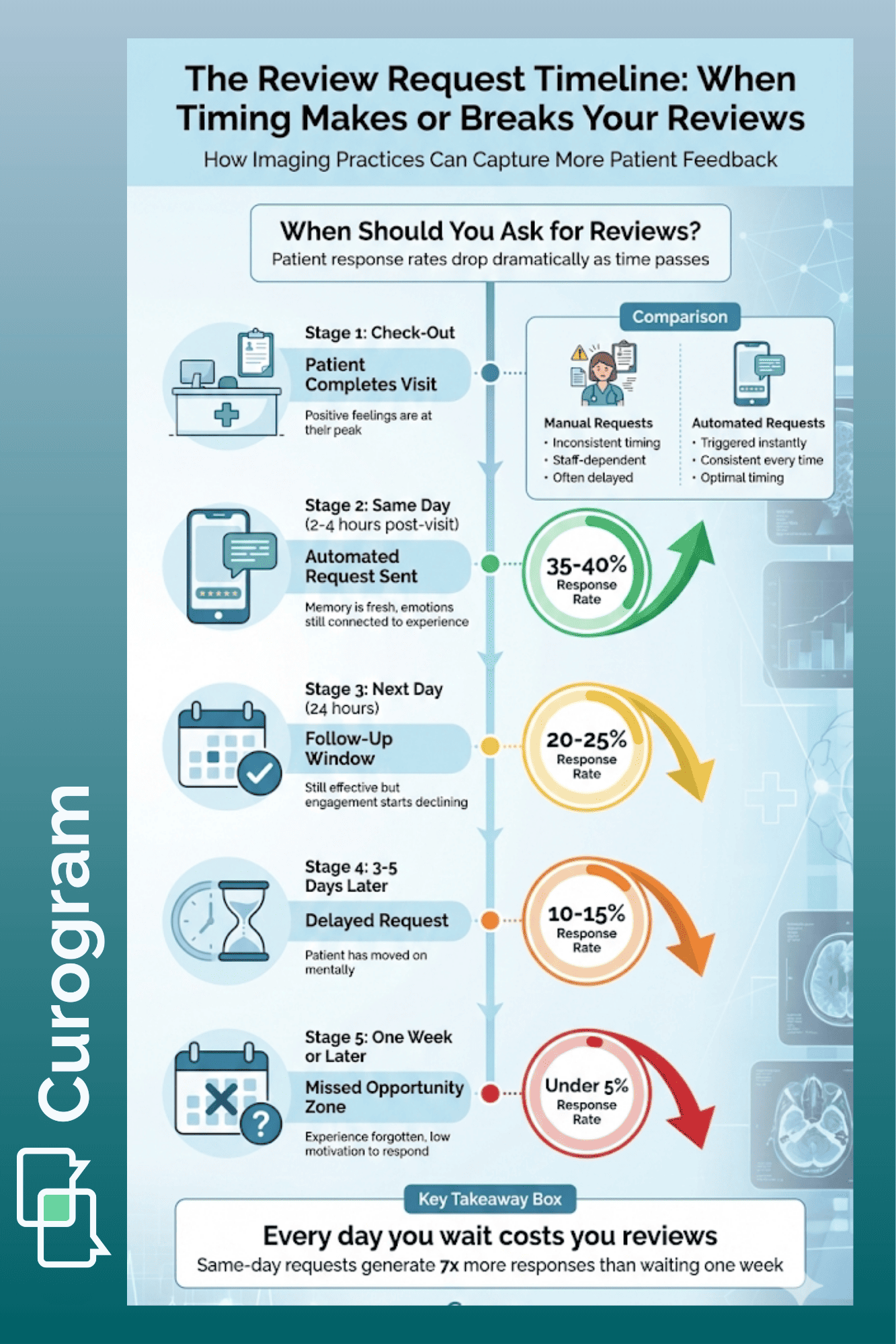
Timing matters more than most practices realize. A patient who leaves your office happy today may forget that feeling by next week. Their memory fades. Their urge to also help you fades.

Automated systems send a text or email within hours of checkout. This catches patients while the good experience is still fresh. They tap a link, leave a quick review, and move on.

Consider how this plays out in practice. A woman gets a routine breast ultrasound at 10 a.m. By noon, she receives a friendly text asking about her visit. She taps 5 stars, writes a short note, and your Google page just got stronger.

Without that prompt, she likely does nothing. Not because she was unhappy. Just because life moves fast.

This trigger-based approach ensures every patient gets asked. No one slips through the cracks. And your review count grows week after week without extra staff effort.

Routing Reviews to the Correct Imaging Location

Multi-site practices face a tricky problem. Some locations rack up dozens of reviews. Others sit nearly empty. This imbalance makes newer or smaller sites look less trustworthy.

Automated review requests can route feedback to the exact location where care happened. The patient who visited your north campus leaves a review for that specific office. The same goes for your south and downtown sites.

This keeps your review profile balanced across the network. It also helps each location build its own local presence on Google.

Say, your practice has four imaging centers. One opened last year and only has 12 reviews. The flagship site has 200. Potential patients searching for imaging near the new location may skip it because it looks unproven.

Automated routing fixes this by directing traffic where it belongs. Over time, all your sites build credibility at roughly the same pace.

Reducing Manual Workflow Burden for Front Desk and Call Center Staff

Front desk teams already juggle too many tasks. They handle check-ins, answer phones, scan documents, and manage schedules. Adding review requests to that pile rarely works.

When you automate this feedback workflow, staff get their time back. They no longer chase patients with clipboard surveys or awkward verbal asks. The system handles it behind the scenes.

This shift matters most during peak hours. A call center fielding 100 calls a day cannot also send follow-up texts. However, an automated platform can fire off 100 messages without breaking a sweat.

The result is consistent outreach across all MRI, CT, ultrasound, and IR visits. Every patient gets the same prompt. Every location follows the same process. Staff focus on higher-value work like helping patients in person.

Imagine freeing up even 30 minutes per day at each front desk. Over a month, that adds up to hours of recovered time. Time your team can spend on patients instead of paperwork.

Automated review requests also reduce errors. Staff may forget to ask. They may ask the wrong patient. They may phrase things poorly. An automated system delivers the same polished message every time.

For imaging practices tied to StreamlineMD, this integration works smoothly. Data flows from your EMR to the feedback platform without double entry. Appointments close, and prompts go out.

The outcome is more reviews, less stress, and a feedback workflow that runs itself.

Infographic showing patient review request timeline with response rates from same day to one week


Improving Vascular and Interventional Radiology Patient Experience

Vascular and IR patients face a different kind of stress. These are not routine scans. They involve needles, catheters, sedation, and real anxiety. How you communicate before and after these visits shapes their entire view of your practice.

Ensuring Patients Receive Clear Pre- and Post-Procedure Communication

IR patients judge their care based on how well you explain things. A patient going in for a PICC line insertion wants to know what will happen. How long will it take? Will it hurt? What should they do after?

When this info is missing, fear fills the gap. Patients imagine worst-case scenarios. They show up tense and leave unsure.

Automated messages fix this by sending clear instructions ahead of time. A text two days before the procedure might say:

"Your vein access appointment is scheduled for Friday at 9 a.m. Please wear loose sleeves and eat a light breakfast. The procedure takes about 30 minutes."

Simple, right? But it changes everything. The patient now knows what to expect. They feel prepared instead of panicked.

Post-procedure follow-up matters just as much. An IR patient who just had a biopsy wants to know what happens next. When will results arrive? What symptoms are normal? Who should they call if something feels wrong?

An automated text the next day can cover all of this.

"How are you feeling after your procedure yesterday? Mild soreness is normal. Call us at [number] if you have heavy bleeding or fever."

This message takes seconds to send but builds trust that lasts.

Practices that skip these steps lose patients to competitors who communicate better. In imaging, perception often matters as much as clinical skill.

Reducing Anxiety Through Better Follow-Up Workflows

Fear does not end when the procedure ends. Many IR patients go home worried. Did everything go okay? Is this pain normal? Should I call the doctor?

Left alone with these thoughts, patients spiral. And stressed patients leave stressed reviews.
A well-timed follow-up changes the tone. When patients get a check-in message the day after their visit, they feel cared for. Even if they do not reply, knowing someone thought of them helps.

Consider a patient who had a uterine fibroid procedure. She goes home tired and sore. The next morning, her phone buzzes with a text from your office:

"Hi Sarah, we hope you're resting well after your procedure. Let us know if you have any questions."

That one message shifts her view of the whole experience. She feels seen. She feels safe. And when a review request arrives a few days later, she is far more likely to respond with praise.

This feedback workflow does not require extra staff. It runs on autopilot through your StreamlineMD integration. The system knows who had a procedure, when it happened, and when to follow up. The result is higher satisfaction survey scores and more positive reviews without any manual effort.

Capturing Detailed Feedback to Identify Improvement Opportunities

Not every patient will rave about your practice. Some will have real complaints. And those complaints are gold.

A well-designed satisfaction survey does more than collect star ratings. It asks open-ended questions. What could we do better? Did anything surprise you? Would you refer us to a friend?

This detailed feedback helps IR teams spot patterns. Maybe patients keep mentioning long wait times in recovery. Or unclear discharge instructions. Or rude billing calls.

Without this data, you guess. With it, you fix problems before they spread.

Let us say your feedback shows 15% of IR patients mention feeling rushed during consent discussions. That is a clear signal. You can coach staff, adjust workflows, or add a patient education step before the procedure.

Over time, these tweaks add up. Patient scores climb. Complaints drop. And your online reputation reflects the real quality of your care.

Here is a practical example:

An interventional radiology group notices feedback complaints about parking. Multiple patients say they could not find the lot or had to walk too far. The clinic adds clearer signs and a map in their pre-visit text. Complaints stop within a month.

That fix cost almost nothing, but it lifted their Google rating and reduced front desk calls asking for directions. Automated satisfaction surveys also let you catch problems early. If a patient gives a low score, the system can flag it for follow-up. A manager calls, listens, and often turns a critic into a fan. This happens before any public review goes live.

For vascular and IR practices, this kind of service recovery matters. These patients often feel vulnerable. A fast response to their concerns shows you care. It also stops bad reviews in their tracks.

Detailed feedback also supports quality reporting. Many IR programs need to track patient outcomes for accreditation or payer contracts. Automated surveys give you clean data without paper forms or manual entry.

Finally, this feedback loop creates a culture of improvement. When staff see real comments from real patients, they pay attention. Good reviews boost morale. Critical ones spark change. Either way, the team grows.

Vascular and IR practices that invest in communication see better outcomes, happier patients, and stronger reviews. Automated tools make this possible at scale, without adding more work to your plate.

How Automated Reputation Management Standardizes Multi-Site Imaging Operations

Running one imaging center is hard. Running five or ten is a logistical puzzle. Each site has its own staff, its own habits, and its own way of handling patients. Without a standard approach, quality drifts.

Ensuring Unified Messaging and Experience Across All Locations

Patients expect the same care at every site. If your downtown office sends polished prep texts but your suburban site sends nothing, patients notice.

Automated systems create one voice for your whole network. Every location sends the same reminders. Every follow-up uses the same tone. Every review request looks identical.

This consistency builds brand trust. Patients know what to expect, no matter which office they visit. And staff do not have to reinvent the wheel at each site.

Identifying Location-Level Performance Trends

With all feedback flowing into one dashboard, leaders can compare sites side by side. Which location gets the most 5-star reviews? Which one has more complaints about wait times?

This data helps you coach underperforming teams. It also highlights what your top sites do well, so you can spread those habits across the network.

For example, your east side office may have twice as many complaints about phone hold times as your west side office. That is actionable. You can add staff, adjust scripts, or route calls differently.

Improving Accountability Across Teams

When feedback is transparent, teams pay attention. Staff know their patients will be asked about the visit. That awareness lifts performance.

Sharing review trends in team meetings also sparks healthy competition. Sites want to outperform each other. Staff take pride in good scores.

Reducing Negative Reviews Through Better Communication Workflows

Negative reviews usually come from bad communication. A patient who felt ignored, confused, or rushed will vent online. However, most of these situations are fixable.

Resolving Issues Privately Before They Appear Online

A smart feedback workflow catches problems early. When a patient gives a low satisfaction survey score, the system alerts your team. A manager can call, apologize, and fix the issue before any public post.

This service recovery step saves reputations. Many patients just want to be heard. A quick call often turns anger into loyalty.

Reducing Preventable Complaints Driven by Miscommunication

Most imaging complaints trace back to confusion. Wrong prep. Surprise bills. Unclear schedules. Automated messages cut these errors by sending the right info at the right time.

Clear communication before visits means fewer same-day cancellations. Fewer angry calls. Fewer 1-star reviews about things that should not have happened.

Encouraging Satisfied Patients to Share Their Experience

Happy patients often stay silent unless you ask. An automated nudge after a good visit prompts them to share that good feeling.

Imaging centers see dozens of patients every day. Even a small boost in review rates adds up fast. One extra review per day means 30 more per month and over 350 per year. This steady growth pushes your Google profile higher and draws in more new patients.


Related Workflow Improvements for StreamlineMD Practices

Automated review requests work best when paired with other smart tools. StreamlineMD practices using Curogram gain access to a full suite of patient communication features.

HIPAA-compliant texting keeps your messages secure. You can chat with patients about results, questions, or concerns without risking a privacy breach.

Mass texting lets you reach large groups fast. Need to alert all tomorrow's patients about a weather delay? One message does the job.

Appointment reminders cut no-shows by sending timely nudges. Patients confirm or reschedule with a tap, freeing your phone lines.

Online patient forms speed up check-in. Patients fill out paperwork at home, so they spend less time in your waiting room.

Telehealth extends your reach for follow-ups and consults. Patients connect from home, saving travel time and keeping schedules tight.

Text-to-Pay simplifies billing. Patients pay balances through a link in their text, which boosts collection rates and cuts paper invoices.

Together, these tools create a seamless feedback workflow that runs from first contact through final payment. Each piece supports the others, giving your imaging practice a modern, patient-first feel


Why Curogram Powers the Best Reputation Results for StreamlineMD Users


Curogram was built for exactly this kind of work. Its founders spent time inside real clinics, watching how front desk teams struggled with phones, forms, and follow-ups. That hands-on research shaped a platform that fits real workflows.

For imaging practices, the benefits are clear. Curogram integrates with almost any EMR, including StreamlineMD. Data flows in one direction, so staff never double-enter patient info. When a scan wraps up, the system triggers the next step automatically.

Automated review requests go out at the right time, every time. Patients receive a text while their visit is still fresh. One tap takes them to your Google page. Another tap and the review is done.

This simple flow drives big results. Practices using Curogram see their online market presence grow month after month. More 5-star reviews mean higher search rankings. Higher rankings mean more new patients choosing your imaging center.

Curogram does more than chase stars. It also captures honest feedback. Satisfaction surveys reveal what patients really think. Low scores trigger alerts so your team can respond before problems go public.

The platform is easy to learn. Staff pick it up in under 10 minutes. The interface looks and feels like normal texting, so there is no steep learning curve.

For multi-site imaging networks, Curogram keeps every location aligned. Same messaging. Same timing. Same quality. Leaders get dashboards that compare sites and track trends.

Most importantly, Curogram gives staff their time back. No more awkward review asks. No more clipboards. No more chasing patients out the door. The system handles it, and your team focuses on care.

Conclusion

Patient experience drives everything in imaging. From the first prep text to the final review request, every touchpoint shapes how people see your practice.

Radiology, vascular, and IR centers face unique challenges. Patients feel anxious. Procedures seem complex. Staff have too much to do. And reviews often go uncollected.

Automated reputation management fixes these gaps. It sends the right message at the right time. It captures feedback while feelings are fresh. And it frees your team from chasing patients for stars.

For multi-site practices, these tools bring order to chaos. Every location follows the same feedback workflow. Every patient gets the same care. And leaders can spot trends across the network in real time.

The math is simple. More reviews mean better rankings. Better rankings mean more patients. More patients mean more revenue.

StreamlineMD practices using Curogram gain all these benefits without adding staff or stress. The platform runs quietly in the background, turning everyday visits into lasting online proof of your quality.

Strong online reputation also builds trust before patients even arrive. When someone searches for an imaging center near them, your 5-star reviews speak louder than any ad.

This is not about vanity. It is about growth. Every positive review is a vote of confidence. Every satisfied patient is a future referral.

If your imaging practice still relies on manual review requests, you are leaving results on the table. Automation changes the game.

Your next wave of growth starts with a single text. Book your demo today to see how Curogram and StreamlineMD work together to improve patient experience.


Frequently Asked Questions

How do automated review requests work with StreamlineMD?
The system connects to your EMR and sends a text or email after each visit ends. Patients tap a link to leave a Google review. No staff action needed.
Why does timing matter for patient review requests?
Patients forget fast. Sending a request within hours captures their good feelings while fresh. Waiting days or weeks drops response rates sharply.
How can imaging centers route reviews to the correct location?

Automated tools tag each request with the site where care happened. The patient leaves a review for that exact office, keeping your network profile balanced.

What happens when a patient leaves negative feedback?

The system flags low scores and alerts your team. A manager can call the patient, fix the issue, and often stop a bad public review before it posts.

How does a satisfaction survey improve IR patient outcomes?

Surveys collect honest comments about what went well and what did not. Teams use this data to fix workflows, coach staff, and lift patient scores over time.


How GE Centricity Clinics Automate Reputation Management

How GE Centricity Clinics Automate Reputation Management

💡 Specialty clinics using GE Centricity face unique challenges in building their online reputation. Getting patient reviews takes time and staff...

Read More
Automating Patient Review Requests in Veradigm

Automating Patient Review Requests in Veradigm

💡 Imaging centers that use Veradigm often face a gap in post-visit care. While clinical work runs smoothly, most centers struggle to gather patient...

Read More
Improving HIPAA-Secure Texting & Patient Communication in StreamlineMD

Improving HIPAA-Secure Texting & Patient Communication in StreamlineMD

💡 StreamlineMD practices use HIPAA-compliant texting to solve common workflow problems in radiology, vascular, and interventional radiology....

Read More