10 min read

Automated Reputation Management for Medstreaming Imaging Centers

Automated Reputation Management for Medstreaming Imaging Centers
💡 Manual review requests get forgotten during busy shifts at imaging centers. Automated review requests Medstreaming integrations solve this by triggering surveys after each appointment.
  • Surveys send automatically when appointments complete
  • Feedback captured while experience is fresh
  • Zero staff involvement, consistent results
The system connects with Medstreaming data. When patients finish their scan, it waits then reaches out. Positive experiences route to Google. Concerns go to management privately. Problems get caught before going public.

Your front desk staff just finished checking in their tenth patient of the morning. Between answering phones and updating insurance information, someone forgot to ask about leaving a review. Again. By afternoon, that patient has moved on with their day, and the chance to capture their positive experience is gone.

This scene plays out at imaging centers every single day. Staff members mean well, but manual processes break down when teams get busy. Each missed request means lost visibility online. Each forgotten follow-up means potential problems go unnoticed until they show up as one-star reviews.

Multi-location imaging networks face even bigger challenges. One center might excel at gathering feedback while another barely collects any reviews. Patients notice these differences. They see one location with dozens of recent reviews and another with just a handful from months ago. That inconsistency damages trust across your entire brand.

Automated review requests Medstreaming tools change this picture completely. The technology connects with your existing appointment system. When patients finish their imaging appointment, the system handles everything. No staff involvement needed. No forgotten requests. No location-to-location variation in how feedback gets collected.

The satisfaction survey reaches patients at the perfect time, right when their experience feels fresh. Happy patients click through to share five-star reviews. Concerned patients get connected with your team before their frustration goes public. Both outcomes help your operation improve.

This guide shows exactly how imaging centers streamline reputation management through automation. You will learn how the feedback workflow integrates with Medstreaming, what results to expect, and why the automated approach works better than manual methods.

Workflow Challenges in Radiology & Cardiovascular Imaging Centers

Imaging centers operate differently than typical medical offices. Patients move through quickly, often spending just 15 to 30 minutes in your facility. Staff focus on technical precision during scans, not on asking about reviews. This creates a gap between providing good service and capturing feedback about that service.

Manual review requests break down in busy imaging centers. Staff are focused on patient care, check-ins, phone calls, insurance questions, and scheduling, leaving little time to request reviews consistently.

When requests do happen, the timing is often awkward. Patients are ready to leave after their scan, not stop to write a review, and asking them to remember later is unreliable. As daily routines take over, good intentions fade and reviews are never submitted. 

Low feedback volume creates multiple problems for your operation:

  • Weak online presence compared to competitors
  • Limited visibility that costs you new appointments
  • Blind spots hiding operational issues
  • Delayed problem identification

Without consistent feedback, issues go unnoticed until a patient leaves a negative review. By then, many others may have experienced the same problem—long waits, unclear prep instructions, or workflow gaps that never surfaced.

Reputation management becomes even harder across multiple locations. Each center handles reviews differently, if at all. Some locations ask consistently, others don’t, and past efforts often fade without a standardized process.

Patients notice these differences and draw conclusions about quality. Someone visits your downtown location and sees 80 recent reviews averaging 4.8 stars. Their friend visits your suburban location and finds 12 reviews, the most recent from four months ago. Which location seems more trustworthy?

These workflow challenges all share a common root cause. Manual processes depend on consistent human action during busy, unpredictable days. That dependency guarantees failure. Imaging centers need a different approach, one that works automatically regardless of how hectic operations get.

How Manual Review Requests Slow Down Imaging Operations

Manual review requests create operational drag beyond missed feedback. Staff must remember to ask, explain the process, and manage questions, pulling focus away from core responsibilities and lowering overall efficiency.

When front desk teams make verbal requests, they juggle these conversations alongside check-ins, ringing phones, and schedule updates. This split attention slows service and increases frustration for both staff and patients.

Each request takes two to three minutes. Across 30 or 40 patients a day, that adds up to an hour or more of staff time—time that could be used to reduce wait times, improve communication, or support more appointments.

Staff members also resist these requests because they feel awkward asking. Requesting reviews sounds like begging for compliments after providing medical services. Nobody wants to be pushy with patients who just finished their imaging appointment.

Different modalities complicate standardization across your imaging center. Should you ask for reviews after X-rays that take five minutes? What about lengthy MRI procedures? Without clear standards, staff default to asking randomly or not at all.

The manual approach creates three critical gaps:

  • No measurement of who actually requests reviews
  • No tracking of which locations perform better
  • No data to improve the process or ensure accountability

One of the biggest challenges with manual systems is limited insight into the patient experience. Feedback is often vague or missing entirely, making it hard to identify which parts of your operation work well and which need improvement.

This lack of detail complicates staff training. Without clear feedback on specific behaviors or processes, teams are left guessing instead of focusing on what truly impacts patient satisfaction.

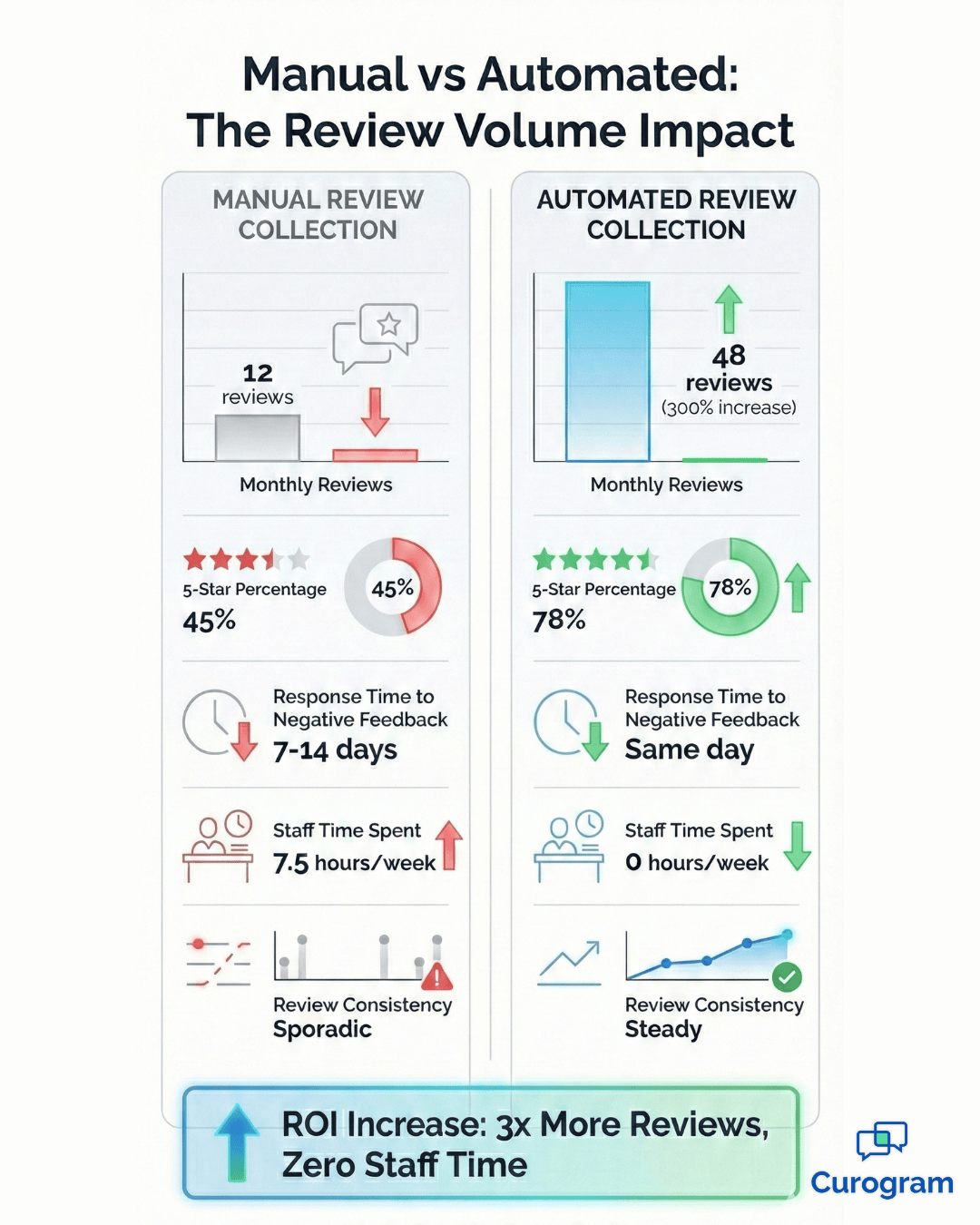
Comparison chart showing automated reviews generate 3x more feedback than manual requests

How Automated Reputation Workflows Improve Daily Operations

Automated systems remove the challenges of manual review collection. They gather feedback without staff involvement, standardize the process across locations, and capture data that supports ongoing improvement—delivering better results almost immediately.

The system continuously monitors Medstreaming appointment data and detects when an exam is completed. After an optimal delay, typically a few hours to one day, it automatically contacts the patient through their preferred channel—most often text, where response rates are highest.

This automatic post-visit outreach happens for every patient, every time, without exception. No forgotten requests. No selective asking based on staff memory or gut feeling. Whether your center sees 20 patients or 200 patients in a day, every single person receives the same professional follow-up.

Timing makes a huge difference in response rates that most centers overlook. Patients receive the satisfaction survey while their experience stays fresh in their memory. They can recall specific details about their visit with clarity. Their emotional response remains strong, whether positive or negative.

The automation delivers three immediate benefits:

  • Predictable feedback volume for tracking performance
  • Real-time visibility across all locations and modalities
  • Zero staff involvement freeing up 150+ minutes weekly

Centralized patient sentiment tracking gives you visibility that was impossible before. Your dashboard shows real-time data about patient satisfaction at any moment. You can filter by location, service type, date range, or specific staff members. This visibility makes management decisions easier and more accurate than relying on gut feeling.

For example, lower satisfaction scores might appear for Tuesday mornings at one location. The data may reveal a specific staffing pattern, allowing you to provide targeted coaching instead of guessing—and resolve the issue quickly.

Smart Routing Based on Feedback Score

The automation includes intelligent routing based on patient responses to initial questions. The initial survey asks patients to rate their experience, typically on a scale from one to five stars. The system reads this response instantly and directs patients down different paths based on their score.

Patients who rate their experience four or five stars get invited to share their positive feedback publicly. The system provides direct links to your Google Business Profile, Healthgrades, or other review platforms you specify. Happy patients often feel eager to help when you make it easy.

Patients who rate their experience three stars or below are routed to share feedback privately instead of posting publicly. This protects your reputation while still capturing issues that need attention.

Management receives immediate alerts and can follow up the same day. Prompt outreach often resolves concerns and turns negative experiences into positive ones.

Protection Against Review Fatigue

Automated systems prevent survey fatigue by tracking recent feedback requests across all locations and visits. Patients who come in frequently aren’t asked for feedback after every appointment.

This intelligent pacing protects relationships with repeat patients who need ongoing imaging. Feedback requests are spaced out—such as once every 60 or 90 days—so patients feel respected rather than overwhelmed, while centers still receive meaningful insights.

Medstreaming + Curogram Workflow Synchronization

The integration between Medstreaming and Curogram creates seamless data flow that powers reputation automation. Understanding this technical connection helps you appreciate why the system works so reliably without staff intervention or constant supervision.

Automated triggers based on imaging appointment completion

Curogram integrates securely with Medstreaming, automatically triggering feedback requests when appointments are marked complete. Patient and exam details transfer instantly and securely—no manual steps required.

Staff continue working in Medstreaming as usual while the reputation system runs in the background. Review requests are sent automatically, ensuring consistency without adding work for your team.

Location-based routing for multi-site networks

Multi-location imaging centers need location-specific reputation management. Curogram uses Medstreaming data to route feedback to the correct facility, automatically directing reviews to the right Google and review profiles.

Each location builds its own reputation and performance history. This separation makes it easier to compare locations, spot trends, and identify where operational improvements are needed over time.

PHI-safe survey and review request flow

Healthcare feedback collection must follow strict privacy rules. Curogram maintains HIPAA compliance by excluding protected health information from surveys and review requests, identifying patients by name only—never by procedure or diagnosis.

All data exchanged with Medstreaming is encrypted and securely stored, with access controls and regular audits. These safeguards keep your center compliant while enabling effective reputation management.

Unified feedback dashboard across modalities

The Curogram dashboard brings feedback from all imaging modalities into a single, easy-to-monitor view, showing real-time MRI, CT, and ultrasound satisfaction scores while still allowing you to filter by modality, location, time period, or staff member for targeted insights and improvement.

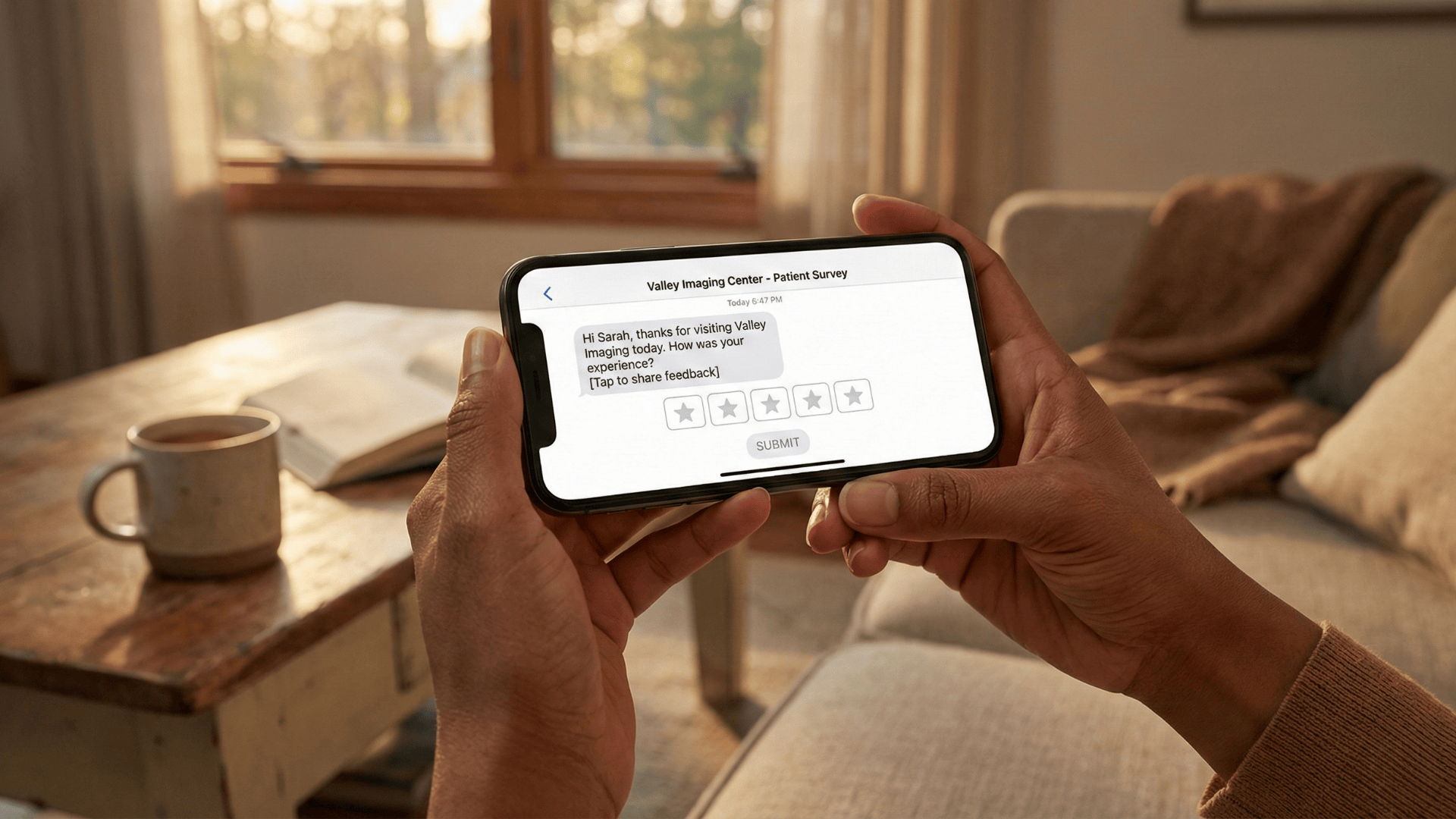
Patient receiving satisfaction survey text message after imaging appointment


Imaging Use Cases for Automated Reputation Workflows

Post-MRI/CT feedback collection

MRI and CT exams often cause patient anxiety due to enclosed spaces, noise, and the need to remain still. Automated surveys capture how well staff address these concerns, revealing whether technologists provided clear explanations and reassurance—insights that help focus training on effective anxiety management.

Ultrasound and echo experience surveys

Ultrasound and echocardiogram exams involve close patient interaction, making communication and comfort critical. Patient feedback highlights technologist explanations, draping, and pressure adjustments—factors that strongly influence satisfaction beyond technical image quality.

Vascular lab satisfaction measurement

Vascular studies rely on patient cooperation for accurate results. Surveys show whether patients understood positioning requirements, exam length, and staff explanations—insights that help improve first-time-right studies and reduce repeat imaging.

Multi-location review volume balancing

Automated systems help each location in your network collect reviews consistently based on volume. This balanced approach ensures all facilities maintain a strong, up-to-date online presence, strengthening your overall brand rather than creating uneven reputations across locations.

Operational Improvements for Patient Experience Teams

Automated reputation workflows give patient experience teams stronger tools and clearer visibility. Consistent feedback replaces guesswork with real-time data, making it easier to identify issues, measure improvements, and demonstrate impact to leadership.

Early insight into negative feedback allows teams to intervene before issues escalate publicly. When patients share concerns privately, staff can follow up the same day. These timely responses often resolve problems, rebuild trust, and turn frustrated patients into loyal advocates.

This proactive approach reduces inbound complaints and negative public reviews. Instead of calling or posting online, patients use private feedback channels, allowing teams to address concerns directly and easing stress on front desk staff.

Detailed feedback also improves training effectiveness. Satisfaction data tied to individual technologists highlights who excels and who may need coaching. Specific comments point to exact behaviors to reinforce or improve, making training more targeted and productive.

Feedback further supports better check-in and prep communication. Patterns around unclear instructions or appointment expectations signal where materials or scripts need updating, driving continuous improvement across the patient journey.

How Curogram Makes This Possible

Curogram’s reputation management platform is built specifically for healthcare workflows. It integrates securely with Medstreaming, maintains compliance, and can be set up in days—not months. Staff training takes minutes because the system runs automatically without staff involvement.

The platform manages the entire feedback process, from survey delivery to review posting, with intelligent routing and HIPAA-compliant security. Real-time analytics provide actionable insights, and automated requests begin generating results immediately.

Pricing scales with your operation, from single-location centers to multi-site networks. As your organization grows, Curogram grows with you—supported by implementation guidance and ongoing customer support to maximize long-term value.

How Automated Workflows Increase 5-Star Reviews

Five-star review volume grows dramatically when imaging centers automate their feedback workflows. Multiple factors work together to capture more positive reviews consistently. Most centers see review volume increase by 300% to 500% within the first six months after implementation.

Timely outreach while the experience is still fresh encourages more detailed and enthusiastic reviews. Patients remember specific interactions, helpful staff members, and moments that made their visit easier. These details make reviews more persuasive for prospective patients choosing an imaging center.

Uniform review prompts across all modalities help every service build reputation evenly. X-ray, MRI, ultrasound, and vascular studies all receive the same professional outreach, preventing gaps between departments.

Engagement increases because automated reviews are quick and easy. With just a few clicks, more satisfied patients follow through and leave public feedback instead of forgetting.

A stronger online presence develops as review volume grows steadily over time. Search engines favor listings with recent, frequent patient feedback. Higher visibility in local search results attracts more prospective patients, creating a compounding effect as each new review reinforces trust and discoverability.

Conclusion

Automated review request integrations with Medstreaming transform how imaging centers build and maintain their online reputation. The technology removes manual processes that break down when staff get busy and operational pressure increases.

It standardizes feedback collection across all locations and imaging modalities, creating consistency at scale. Every patient receives the same professional follow-up, regardless of exam type or site.

Most importantly, the system delivers measurable results that strengthen your competitive position. Review volume grows steadily, and positive experiences are captured more reliably.

Centers begin seeing benefits within weeks, not months. Once setup is complete, the automated workflow runs continuously in the background. Real-time dashboards give your team visibility into patient experience across operations, allowing issues to surface early and be addressed before they turn into public reputation problems.

Book a demo to See Curogram + Medstreaming in Action. Schedule a demonstration to see exactly how the integration works with your existing systems. 


Frequently Asked Questions

How does automated review request timing work for same-day appointments?

The system waits a preset period after appointment completion before sending surveys, typically four to 24 hours. This gives patients enough distance to reflect without forgetting details. For same-day appointments, surveys usually go out that evening or the next morning. You can adjust timing based on your response rate data.

Why does the satisfaction survey approach work better than directly asking for reviews?

Satisfaction surveys feel less pushy than review requests. Patients respond more willingly when asked about their experience rather than for public praise. The survey format also lets you route responses appropriately. Happy patients go toward public reviews while concerned patients get private feedback channels. This protects your reputation while maintaining high engagement. Direct requests miss the chance to intercept negative feedback before it goes public.

How do multi-location imaging centers maintain consistent review volume across all facilities?

Automation standardizes the process regardless of location size or patient volume. Every facility follows identical workflows with the same timing and messaging. Location-based routing directs reviews to the correct facility profile automatically. Each center builds reputation at a pace matching its patient volume. High-volume locations get more reviews, but lower-volume centers still maintain steady accumulation.

How does the feedback workflow handle patients who visit multiple locations within your network?

The system tracks patient history across your entire network to prevent survey fatigue. When someone visits multiple locations, survey logic spaces out requests appropriately. The platform can be configured to send feedback requests based on overall visit frequency rather than per-location visits. This maintains patient goodwill while still collecting valuable feedback about each facility.

What happens when patients report negative experiences through the private feedback channel?

The system alerts designated staff immediately when negative feedback arrives. These alerts include the patient's concerns and contact information. Your team can reach out the same day to understand and resolve issues. Quick responses often transform unhappy patients into satisfied ones. Many patients just want acknowledgment. When you follow up promptly, they remember that responsiveness more than the original problem. Some even post positive reviews praising your customer service recovery.


Medstreaming Reputation Management: More 5-Star Reviews

Medstreaming Reputation Management: More 5-Star Reviews

💡 Multi-location imaging centers struggle with uneven online reputations. One site has hundreds of reviews while another has barely a dozen, even...
Read More
How GE Centricity Clinics Automate Reputation Management

How GE Centricity Clinics Automate Reputation Management

💡 Specialty clinics using GE Centricity face unique challenges in building their online reputation. Getting patient reviews takes time and staff...

Read More
ROI of Automated Reputation Management for Medstreaming Centers

ROI of Automated Reputation Management for Medstreaming Centers

💡 Your imaging center's online reputation directly affects revenue. When patients search for MRI or CT services, they choose providers based on...

Read More