The portal asks for a login first. That is "The Portal Paradox." It hits hardest for clients with serious mental illness, substance use disorders, or co-occurring disorders. It hits just as hard for clients in court-mandated treatment, clients facing homelessness, and Medicaid beneficiaries.
A text asks for no app and no password. SMS open rates reach 98%.
A reminder goes out Monday at 9 a.m. It lands in a portal.
Your client was evicted on Saturday. His phone still works, because the phone is the last thing to go. His password does not. He set it up eight months ago on a library laptop he no longer visits.
Wednesday comes. He misses his MAT check-in, and the treatment continuity your program worked months to build breaks in a single afternoon. Nobody planned for that message to fail. It failed anyway.
This is the quiet math of behavioral health. Your organization runs on SmartCare, and SmartCare is good at what it was built to do. Streamline Healthcare designed one platform to carry outpatient, inpatient, residential, crisis, and community services in a single clinical record.
That is real engineering, which is why so many CCBHCs and community mental health centers chose it.
But clinical strength and client reach are two different problems.
Portal messaging makes four assumptions. It assumes a stable internet connection, a remembered password, the mental bandwidth to navigate a login screen, and the motivation to try. Those assumptions hold up reasonably well for a commercially insured patient with a desk job.
They fall apart for a client in early recovery, or a client moving between shelters every few weeks.
Meanwhile your front desk absorbs the difference.
Roughly 80 inbound calls a day per desk, and many of them are questions a text could have answered in nine seconds. Every one of those calls is staff time you already paid for.
Here is the part that stings. The clients least able to work a portal are the clients your engagement numbers depend on. So does your reporting. So does your funding.
The gap is not clinical. It is a friction number, and friction numbers can be fixed.
The Login That Quietly Blocks Care
Give SmartCare its due first. As a clinical system of record, it handles complexity that most behavioral health platforms cannot touch.
The friction sits one layer out, in how messages reach people. Streamline Healthcare patient communication runs through the portal by design. Portals were built for patients who act like consumers.
Many of your clients do not live that life. Community mental health client texting exists because the population is different.
Think prepaid phones, shared devices, service that cuts off mid-month, and a long history of being asked to clear one more hurdle.
Staff already know this. You hear a version of the same line every week: only their behavioral health provider requires a portal login.
The pharmacy texts. The dentist texts. The probation officer texts.
What the friction actually costs
Portal login rates in this population often land between 15% and 20%. Run that against a real caseload and the picture sharpens.
| Reaching 2,000 active clients | Portal notification | Direct SMS |
|---|---|---|
| Typical engagement rate | 15–20% | 98% open rate |
| Clients who see the message | 300–400 | ~1,960 |
| What the client must set up | Account, password, internet | Nothing |
This means about 1,600 clients per cycle either get reached or do not. Nothing clinical decides it. In practice, that is the gap between a missed check-in and a kept one.
The Part 2 question, answered plainly
Substance use programs carry a second duty under 42 CFR Part 2. It shapes what a text may say.
The rule is easy to follow. SMS bodies carry logistics and secure links only. Never a diagnosis. Never a program name that gives away treatment.
Anything sensitive sits behind a secure link. The client opens it after proving who they are.
A Second Door That Opens Without a Password
The fix is not a better portal. It is a second door. And it opens onto the one device that survives a housing change.
Curogram adds direct 2-way SMS beside SmartCare. Your clinical notes stay in SmartCare, where they belong. Only the talking moves.
Think of it less as a SmartCare patient portal alternative and more as a parallel path. It reaches the people the portal was never going to reach.
Curogram integrates with EHR systems across the behavioral health landscape, including organizations running myAvatar or CareLogic in other programs. One communication layer can sit above several clinical systems at once.
Routing keeps the right message with the right team
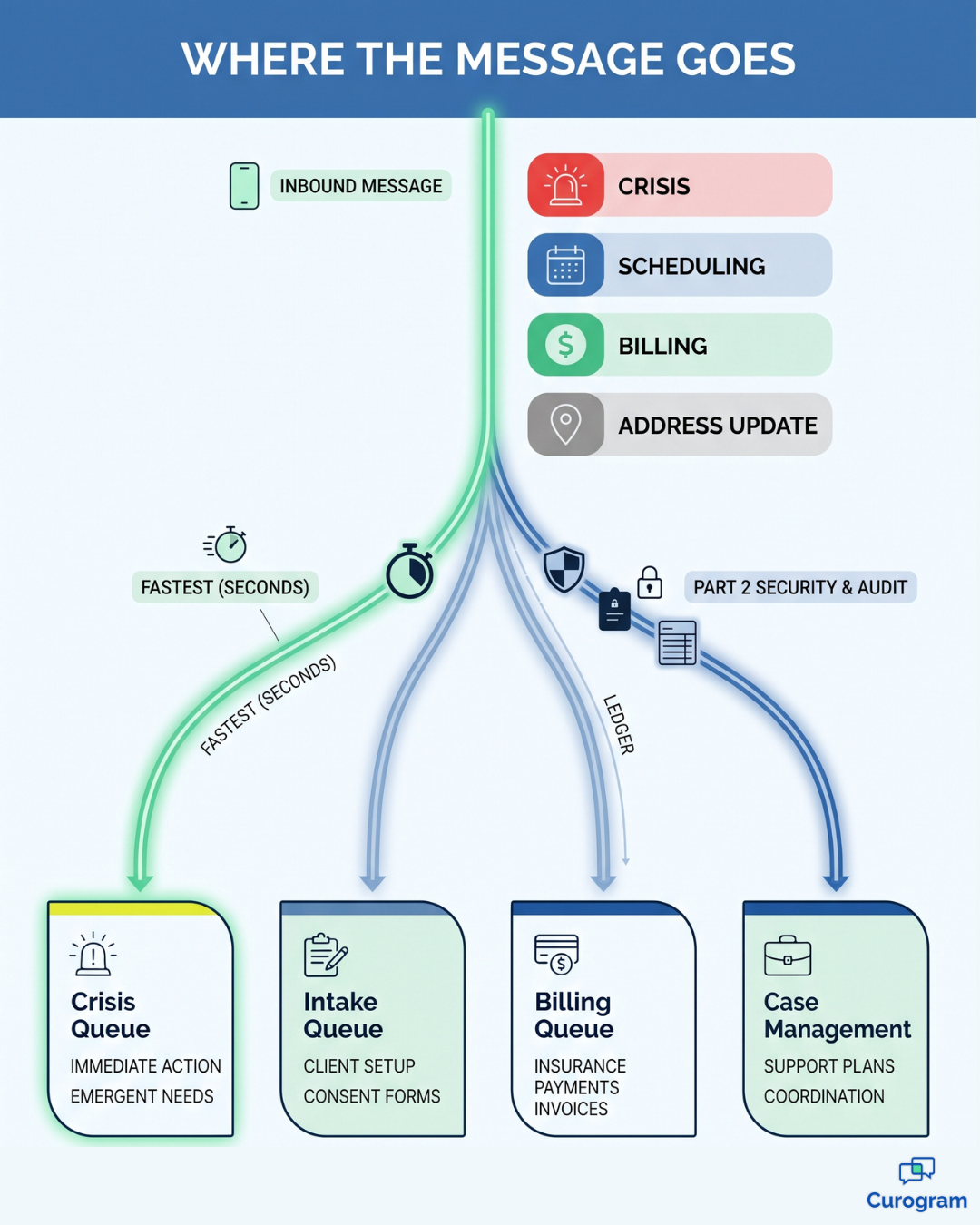
One shared number turns into chaos fast. Text message routing behavioral health programs rely on fixes that.
Each thread lands in a named queue, not a general mailbox.
| Client sends | Routes to | Why it matters |
|---|---|---|
| "I'm not okay right now" | Crisis queue | Seconds count, not hours |
| "Can I still get in this week?" | Intake queue | The referral does not go cold |
| "What do I owe?" | Billing queue | Front desk never touches it |
| "I moved, new address" | Case management | The record stays current |
Every queue has an owner, an assignment, and a full audit trail. Staff see their own work, not the whole agency's inbox. That also keeps Part 2 threads limited to the people who should read them.
For your team, it means a crisis text never waits behind 40 billing questions.
Access, not convenience
For a client with serious mental illness, an active substance use disorder, or no fixed address, texting is not a nicety. It is access.
There is nothing to download and no account to create. Any phone that receives a text message will work, including a $30 prepaid handset shared between family members.
That is also the honest test for any vendor. SmartCare EHR 2-way HIPAA texting behavioral health teams can trust has to clear a security review, not just a demo.

What Changes When Your Messages Actually Land
Delivery is where the numbers move. And the numbers are not subtle.
Across Curogram's client base, SMS open rates reach 98%. Confirmation rates run above 75%.
At Covina Arthritic Clinic, automated confirmations took a practice from 369 confirmed visits a month to more than 1,100. Different specialty, same human behavior: people answer texts.
CCBHC patient engagement texting turns that behavior into data you can report. Contact attempts become real contact. Outreach becomes a documented reply.
Here is the same shift in hours, using careful assumptions.
| Front desk workload | Before | After texting absorbs 30% |
|---|---|---|
| Inbound calls per day | 80 | 56 |
| Minutes on the phone per day | 320 | 224 |
| Staff hours per month | ~112 | ~78 |
That is about 34 hours a month handed back to one desk. Call it 400 hours a year, or most of a full-time role. Those hours go to people in the building instead of a phone queue.
This is a sample model, not a promise. But the direction holds up across sites.
There is a second effect worth naming here.
When a client can respond to a reminder with a single word, the response usually arrives.
That one habit is what lifts confirmation rates, and confirmed visits are the appointments that actually get billed.
Meet them where they are. That is the whole strategy. It is not a slogan, it is a channel choice with a number attached.
The portal does not go away. It keeps serving the clients it serves well. Everyone else finally gets a message that arrives.
Getting It Live Without a Six-Month Project
The usual objection is not about value. It is about capacity. Nobody wants a second implementation stacked on top of a SmartCare upgrade cycle.
That concern is fair, and it is also the wrong shape here. Nothing changes inside your clinical system. You are adding a channel, not migrating a record.
Most of the setup is mapping work, and your program leads can do it in one room in an afternoon.
- List your queues. Crisis, intake, billing, case management, and any program that needs its own front door.
- Name an owner for each one. One person accountable, plus a backup for coverage.
- Set the Part 2 boundary. Decide who may open substance use threads, and confirm that no template ever names a program or a diagnosis.
- Load your numbers and templates. Reminders, recalls, and confirmations first, with campaign work saved for later.
- Pilot one program. One site, two weeks, real clients.
After that, the pattern tends to repeat itself. Whatever the pilot learns about templates, timing, and response speed, the next program inherits on day one.
Your IT director's role is narrower than most expect. Access controls, number provisioning, and the security review — worth scheduling early if procurement runs on an RFP cycle.
Engagement Is a Friction Number, Not a Feature
Strip away the vendor language and one idea remains. Engagement is not something a portal hands you.
It is the effort standing between a client and a message. Effort is a number, and numbers can go down.
SmartCare is excellent at clinical care management across every level of care you run. A direct text channel makes it excellent at client communication, too. The record stays put. The reach grows.
That is the practical shape of SmartCare EHR patient texting for community mental health groups. No rip-and-replace. No migration project either. Your clinical staff never learns a new system of record.
Compliance holds up under review as well. Curogram is HIPAA-compliant and works under a signed BAA. Messaging runs Part 2–aware for substance use programs, with SMS bodies limited to logistics and secure links.
Now think about the clients you lost track of last quarter. Not the ones who refused care. The ones who simply drifted between visits, because the message never reached them.
That group is usually bigger than anyone wants to count. It is also the group most likely to answer a channel that asks nothing of them.
A text does not ask a client to remember anything. It does not ask them to find a laptop, or a password, or a stretch of quiet. It simply shows up.
If your programs run SmartCare and your engagement numbers do not match the quality of your care, the gap is in the channel. It is not in the clinical work, and it is not in your staff.
See how direct texting keeps clients connected between visits. Schedule a Demo, and bring your IT director along. We will walk the security review together, program by program, so procurement has answers before the questions get asked.
Frequently Asked Questions
Yes. Curogram is HIPAA-compliant and SOC 2 certified, and it works under a signed BAA. Messaging runs Part 2–aware for substance use programs, so SMS bodies carry logistics and secure links only, never a diagnosis or treatment detail. Access controls limit who can open Part 2–protected threads.
Routing rules send each conversation to the right team: crisis, intake, billing, or case management. Rules can follow the program or the location, and every conversation keeps a complete audit trail behind it. Staff see their own queue, not the whole organization's message flow.
No. Any phone that takes a text will work. There is nothing to download and no account to make. Opting out takes a single reply.
No. The portal stays live for the clients who already use it comfortably. Texting simply adds a second path for everyone else, which in community mental health is most of the caseload.
Most groups are texting within days, not months. Nothing changes inside your clinical system. Your IT team confirms user access, number setup, and routing rules by program. It is the same review any communication vendor should expect.