12 min read
Imaging Patient Prep | Reduce Anxiety, Boost Readiness via Text
Aubreigh Lee Daculug
:
April 14, 2026
Curogram delivers modality-specific SMS prep instructions at timed intervals before each appointment. Patients receive clear, readable guidance they can reference anytime — and reply to with questions.
Studies show a 65% reduction in unprepared arrivals and near-zero reschedules due to patient prep failures.
No app download. No portal login. Just a text to the phone your patient already checks dozens of times a day.
Imagine this. Your imaging center has a full schedule. Every scanner slot is booked, every technologist is ready, and the day looks exactly the way you planned it.
Then the 10 AM CT patient walks in — and she had coffee and orange juice for breakfast.
She listened to the voicemail. She did. But she caught "don't eat much" and figured a light breakfast was fine. She didn't know that "no food or drink after midnight" means nothing — not coffee, not juice, not a single bite.
And she definitely didn't hear that part clearly, because she was driving when she played the message.
Now your 10 AM slot is gone.
The technologist is stuck. The scheduler has to find a new opening. The patient is embarrassed and annoyed. And the referring physician won't get results until sometime next week.
This isn't a rare outlier. It's Tuesday.
Radiology imaging patient prep experience via text reminders MRI CT is one of the most underinvested areas in modern imaging operations — and it's quietly costing your center thousands of dollars every single month. The problem isn't that patients don't care.
It's that the communication model you're relying on was never designed for safety-critical instructions in the first place.
Voicemail was designed for short messages. "Call me back." "Meeting at 3." Not "fast for eight hours, disclose all metal implants, hold your blood thinner, wear metal-free clothing, and arrive 20 minutes early."
That's four to five critical pieces of information delivered once, verbally, to a patient who may be driving, distracted, or already nervous about the procedure.
You can't expect people to retain what they barely had time to hear.
And yet that's exactly the system most imaging centers are running today — not because it works, but because it's always been that way.
There's a better model.
One that treats prep communication as a patient experience issue, not just a scheduling task. One that puts the right information in the right place at the right time, in a format patients can actually use.
It starts with a text message.
When Patients Show Up Unprepared (And Why It Keeps Happening)
The voicemail lands at 4:47 PM the day before the appointment.
Your front desk staff read the script perfectly. The message is complete — fasting requirements, what to wear, when to arrive, who to call with questions. Everything a patient needs to know is in that 35-second recording.
But here's what actually happens on the other end.
The patient misses the call. She sees a missed call from a number she doesn't recognize and listens to the voicemail while merging onto the highway. She catches maybe half of it.
The rest is background noise — literally.
First-time imaging patients are already carrying imaging patient preparation anxiety before they ever receive a single instruction. They've been referred by their doctor for an MRI or CT — something unexpected, something that feels unfamiliar, something that might reveal bad news.
When they get that scheduling call, they're half-listening to logistics because their mind is already on what the scan might show.
Four critical pieces of information in a 30-second voicemail, delivered once, with no way to pause, replay, or ask a follow-up question. That's the prep communication system your imaging center is staking its daily schedule on.
It sounds simple. It isn't.
What Happens When the Instructions Don't Land
Consider a real-world scenario your team has almost certainly lived through.
A 52-year-old business owner gets a voicemail about her abdominal CT. She listens while driving. She hears "don't eat much before the scan." She has coffee and orange juice the morning of her 10 AM appointment, arrives on time, and is told she can't be scanned.
She has to reschedule, loses another half-day of work, and leaves a 3-star Google review:
"Nice staff, but they really need to explain the prep better."
She's not wrong. And her situation isn't unusual.
When voicemail is the only delivery channel for prep instructions, the failure points stack up fast:
- The patient misses the call entirely and never listens to the message.
- She listens but retains only part of it — "don't eat much" instead of "nothing after midnight."
- She has a follow-up question about her medication or a metal implant but has no easy way to ask it.
- She arrives the next morning having done her best — and it still isn't enough.
Each of those breakdowns ends the same way:
A wasted slot, a frustrated patient, and a staff team scrambling to recover.
And radiology patient no-shows and unprepared arrivals triggered by exactly this kind of communication gap are far more common than most imaging centers want to admit.
The Real Cost of a Missed Prep Instruction
Unprepared arrivals don't just delay one appointment. They ripple.
When a patient shows up having eaten before a CT, the entire appointment slot goes idle. The technologist's workflow is disrupted. The scheduler scrambles to fill the gap or push back the next patient.
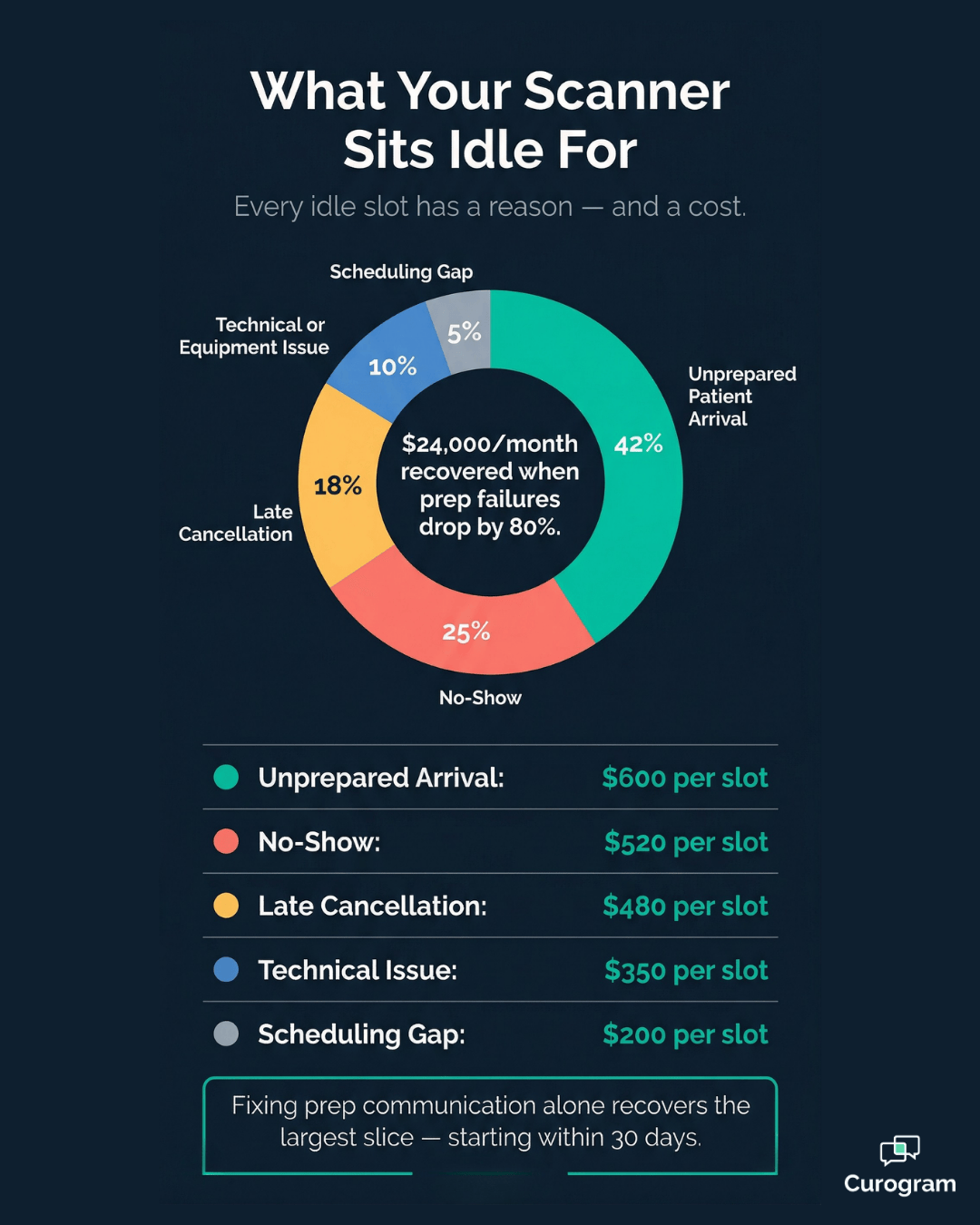
If that scanner runs at $500–$800 per 30-minute slot, a single missed prep instruction can cost your center $500 or more before lunch.
Multiply that by even five or six events per week, and you're looking at $2,500 to $4,800 in lost scanner revenue weekly — or $10,000 to $20,000 per month.
That's not a rounding error. That's a staffing decision.
| Reschedules per Week | Avg. Slot Value | Monthly Revenue Lost |
|---|---|---|
| 3 | $600 | ~$7,200 |
| 6 | $600 | ~$14,400 |
| 12 | $600 | ~$28,800 |
This means the cost of a better prep communication system — even a robust one — is typically recovered within the first few weeks of use.
The Smarter Way to Prepare Patients Before They Walk Through the Door
Here's what changes when you replace voicemail with a structured, text-based prep sequence.
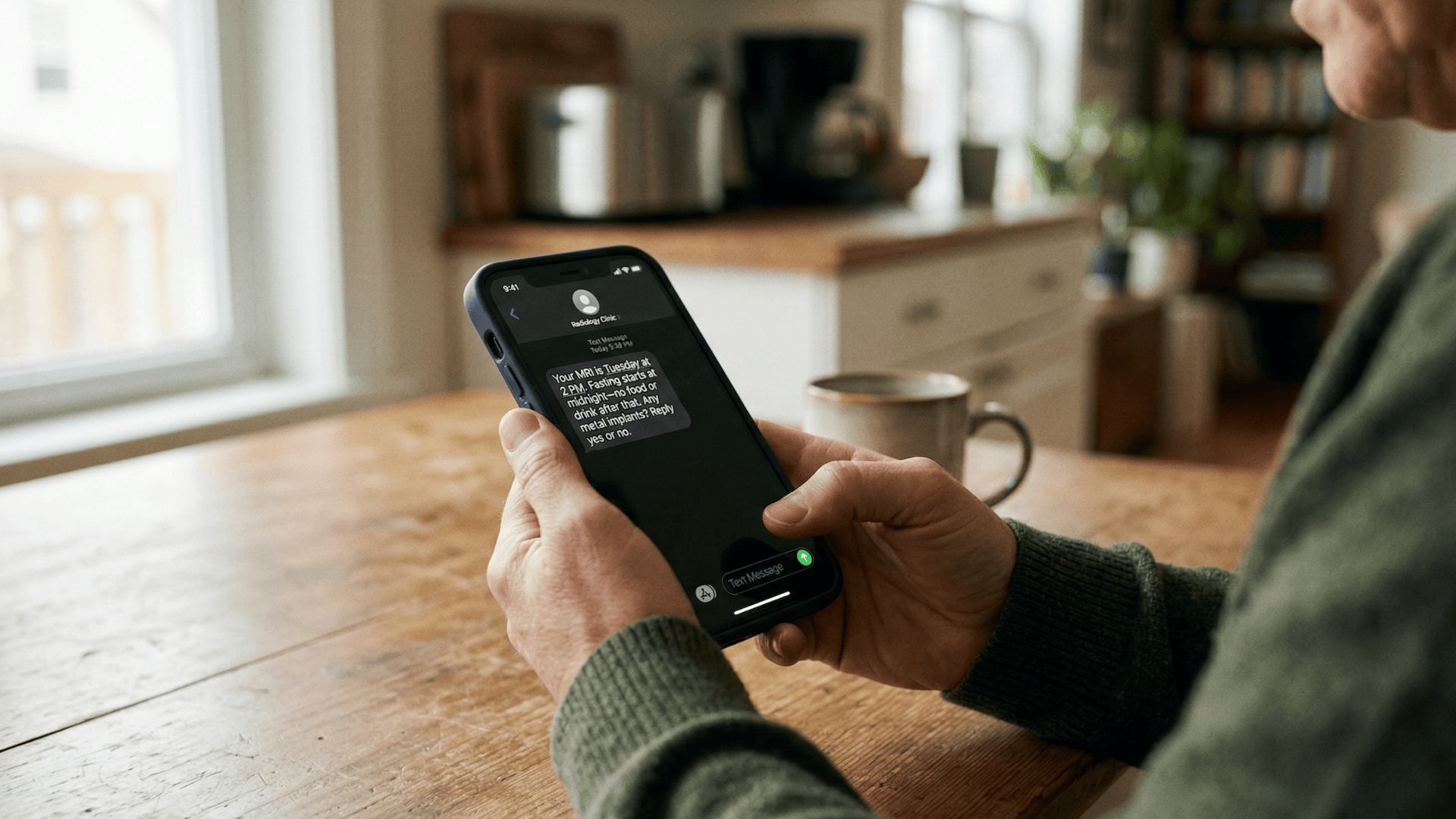
Two days before her MRI, a patient receives a text message on her phone. Not a portal notification. Not an email that lands in promotions. A text. It reads clearly, covers what she needs to know, and stays there — readable, referenceable, and accessible anytime she wants to check it.
That's the core of what Curogram delivers: modality-specific SMS prep instructions tailored to each imaging study type, sent at timed intervals before the appointment. It's designed specifically to close the prep communication gap that voicemail creates — and to do it on the channel patients actually use.
This is first-time patient communication that meets patients where they already are.
No app download required. No patient portal registration. No login credentials to remember.
Just a text to the phone they check dozens of times every day — fully HIPAA-compliant to protect patient information
How Modality-Specific Prep Sequences Work
Not every imaging study requires the same preparation. MRI prep is nothing like CT prep, which is nothing like mammography prep. A single generic reminder doesn't serve any of them well. Curogram's sequences are built around that reality.
Here's how the messaging looks across three common modality types:
MRI Prep Sequence
| Message | Timing | Content Focus |
|---|---|---|
| Message 1 | 5 days before | Metal implant screening — pacemakers, cochlear implants, joint replacements |
| Message 2 | 2 days before | Fasting instructions — no food or drink after midnight; medications with small sip of water |
| Message 3 | Day of | Arrival logistics — 15 min early, insurance card, ID, metal-free clothing |
CT Prep Sequence
| Message | Timing | Content Focus |
|---|---|---|
| Message 1 | 3 days before | Contrast allergy screening — prior reactions to IV dye |
| Message 2 | 1 day before | Fasting window — no food or drink 4 hours before; medications unless told otherwise |
| Message 3 | Day of | Arrival logistics — 20 min early, insurance ID, disclosure of kidney issues or metformin use |
Mammography Prep Sequence
| Message | Timing | Content Focus |
|---|---|---|
| Message 1 | 1 week before | Scheduling tip — 7–14 days after period for less tenderness; no deodorant or lotion day of |
| Message 2 | Day of | Arrival reminder — two-piece outfit, 15 min early, no deodorant or body lotion |
Each sequence reflects MRI prep instructions via text that are clear, concise, and written in plain language — not clinical shorthand that patients have to interpret on their own.
Two-Way Conversation, Not One-Way Broadcast
Here's where this model separates itself from a basic reminder system.
Patients aren't just receiving SMS prep instructions and moving on. They can reply. And that changes everything.
A patient receiving a CT prep message who's also managing diabetes can respond:
"I'm on metformin — do I take it the morning of?"
Curogram routes that to your staff, or matches it against a pre-built FAQ, and the patient gets an answer in minutes:
"Take metformin with a small sip of water. Call us if you have any other questions."
Loop closed. Patient prepared. No phone tag. No morning-of panic call from a worried patient while your front desk is already managing check-ins.
A patient who has a titanium hip from a joint replacement and isn't sure whether it matters for her MRI can reply "yes" to the metal implant screening message and get directed to call the center for additional screening.
That catches a potential safety issue days before the appointment — not during intake, when it's too late to act. This is what patient readiness imaging actually looks like when the communication system is built around how patients behave, not how scheduling systems are structured.

Why First-Time Patients Need This Most
The majority of imaging center patients have no prior relationship with your facility.
They were referred by another provider, they may never visit your center again, and they are absolutely not going to download a dedicated radiology app for a one-time scan.
This matters because first-time patients — the ones carrying the most imaging patient preparation anxiety and the least familiarity with what's expected — are exactly the group for whom clear prep communication is most critical.
They arrive with blind spots that feel obvious from the inside of your center but are completely invisible to them:
- They don't know that "fasting" means no coffee, no juice, nothing — not just skipping a full meal.
- They don't know whether a metal knee replacement or titanium dental implant is something they need to disclose.
- They don't know that a contrast allergy from a scan years ago is relevant information to share upfront.
SMS reaches them before any of those blind spots become a problem. It doesn't require app downloads, patient portal registrations, or any prior engagement with your center.
It works on any phone and reaches 98%+ of your patient population.
That's not a feature. That's infrastructure.
What Prepared Patients Actually Look Like (And What They're Worth to Your Center)
Let's look at a concrete example of what modality-specific exam prep communication produces in medical practice.
A 48-year-old patient receives her CT appointment confirmation on Monday.
Wednesday morning, she gets a text:
"Your CT is Monday at 10 AM. Fasting starts at 6 AM — no food or drink after that. Take all medications with water unless told otherwise. Any history of contrast dye reactions? Reply yes or no."
She replies:
"No allergies. Fasting from 6 AM — understood."
Monday morning, she arrives 18 minutes early. The technologist confirms her metal implant status (none), reviews her medication list (nothing that interferes), and the scan starts on time. Thirty minutes later, she's heading back to work. Preliminary results are with her referring physician by 2 PM.
She leaves a 5-star review:
"Professional, organized, felt well-informed the whole time."
That's the after picture. And it's not exceptional — it's repeatable.

The Numbers Behind Prepared Arrivals
One independent MRI center reduced rescheduled studies from 12 per week to just 2 per week after implementing structured text-based prep communication.
That's 10 recovered scanner slots per week — at an average of $600 per slot, that's $6,000 per week, or roughly $24,000 per month in recovered revenue.
That one metric alone — radiology patient no-shows and unprepared arrivals cut by more than 80% — represents a material operational shift. Centers using Curogram's automated reminder system see no-show rates that run 53% lower than the industry average.
Applied to prep-related disruptions specifically, that kind of reduction doesn't just recover revenue. It gives your technologists their day back, gives referring physicians faster turnaround, and gives patients a reason to recommend your facility.
The Staff Impact
This tends to get overlooked in the revenue conversation, but it's real.
When prep instructions land clearly before the appointment, a specific set of morning-of calls simply stops coming in.
Your front desk no longer fields questions like:
- "Do I have to fast, or is it just recommended?"
- "Can I take my blood pressure medication this morning?"
- "My appointment is at 10 — when exactly do I stop eating?"
Those calls don't disappear because patients stop having questions. They disappear because the questions were answered two days earlier, by text, without pulling a single staff member away from their work.
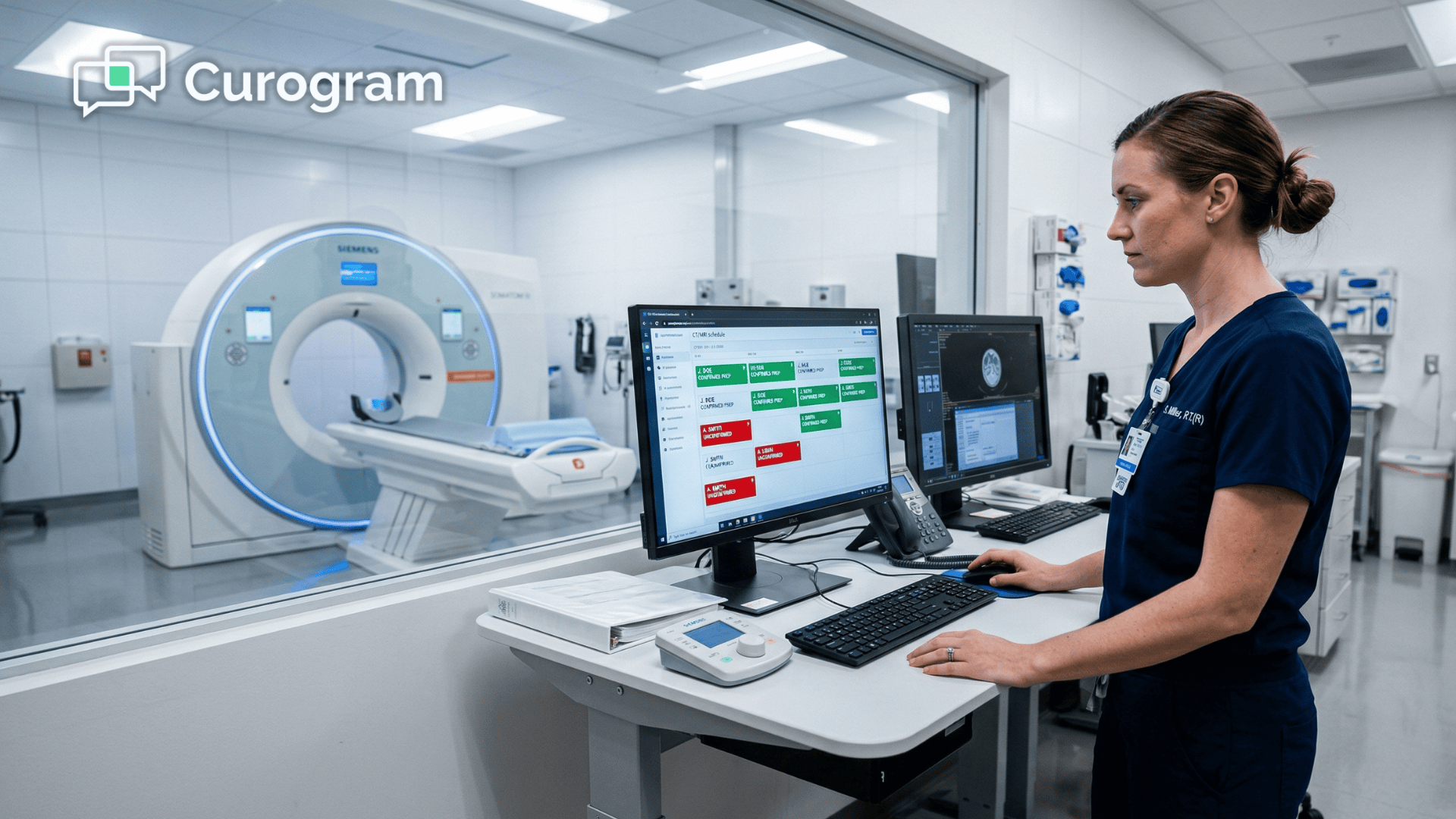
Technologists stop spending the first 10 minutes of every appointment re-screening patients who missed a prep step. They start on time, stay on schedule, and your daily volume holds.
For a practice managing high volumes across multiple modalities, that kind of efficiency compounds quickly — less reactive work, more productive time, and a workflow that doesn't fall apart the moment one patient didn't catch their voicemail.
Prep Communication Isn't Optional. It's the Foundation.
The imaging experience doesn't start when the patient walks through your doors. It starts the moment they're scheduled.
Everything that happens between scheduling and arrival — the anxiety, the confusion, the uncertainty about what to bring and what to avoid — shapes how your patient arrives. Physically. Emotionally. And operationally.
When that window is filled with clear, timely, modality-specific prep communication, patients arrive confident.
They've fasted correctly. They've disclosed their implants. They've dressed appropriately. They feel like your center treated them well before they ever met your staff.
When that window is filled with silence — or a single voicemail they may or may not have caught — you're hoping. And hope is not an operational strategy.
Where Blume Ends and Curogram Begins
RamSoft and Curogram serve the same patient journey at different points — and understanding that distinction matters.
- Blume gives patients a window into their imaging records after the study: viewing images, understanding reports via ChatGPT, managing health history, and requesting follow-up appointments.
- Curogram fills the gap before the study: delivering modality-specific prep instructions, confirming patient understanding, and catching issues — a missed fast, an undisclosed implant, a medication question — days before they become disruptions.
Records and readiness. Both matter. Neither replaces the other.
Patients who download Blume benefit from both layers of support. Patients who don't — the majority of first-time visitors — still receive their prep instructions via text and arrive prepared, because Curogram doesn't require any prior engagement to work.
Right now, if your imaging center is still relying on phone calls and voicemail for prep delivery, you're accepting a system that was never designed for this purpose.
You're accepting unprepared arrivals, idle scanner time, frustrated staff, and patients who leave with a vague sense that something could have been communicated better.
That model breaks at scale. And it's breaking already — you're just absorbing the cost.
Switching to text-based prep communication isn't an upgrade. It's a correction. And it's one that pays for itself faster than most operational changes imaging centers make.
Start Reducing Prep-Related Reschedules — Starting This Month
Your imaging center's schedule is only as reliable as your prep communication system.
Right now, somewhere between scheduling and arrival, patients are losing the instructions they need to show up ready.
They're not doing it on purpose. They're doing it because they received a voicemail once, at an inconvenient moment, with no way to go back and check.
And every time that happens, your center absorbs the cost — in idle scanner time, in rescheduled appointments, in technologist downtime, in referring physician frustration, and in patients who leave feeling like the experience could have been smoother.
Curogram fixes that. Not with a complex system overhaul. With a text message.
A timed, modality-specific sequence of SMS prep instructions — designed around how your patients actually behave, not how scheduling software is built — that reaches patients before the appointment, confirms their understanding, and gives them a channel to ask questions and get answers in real time.
The result is a measurable shift in how your imaging center operates day to day.
Fewer unprepared arrivals. Fewer rescheduled studies. Less reactive work for your staff.
Faster turnaround for referring physicians. And patients who feel so well-supported through the prep process that they leave five-star reviews describing an experience that was "clear, professional, and easy."
That outcome is not complicated. It is within reach.
And the only thing standing between where you are now and a 65% reduction in unprepared arrivals is the decision to stop relying on a voicemail system that was never built for this.
Schedule a demo with Curogram today and see exactly how text-based prep communication fills the gap your current system leaves open. Start your 30-day free trial — no credit card required. Your scanner schedule is too valuable to leave it to chance.
Frequently Asked Questions
Yes. Curogram operates on HIPAA-compliant SMS gateways with full encryption and audit trails built in. Patient consent is collected at the point of scheduling — patients opt into appointment reminders and prep instruction messages as part of their booking. They can opt out at any time with a single reply or phone call. Curogram's platform complies with HIPAA, the Telephone Consumer Protection Act (TCPA), and applicable state-level privacy regulations. Your RamSoft PowerServer or OmegaAI infrastructure integrates securely with Curogram, and no patient data is stored outside of encrypted systems.
SMS works on any mobile phone — smartphones, basic devices, and flip phones alike. No app, no data plan, and no internet connection is required to receive a standard text message. If a patient can only be reached by landline, Curogram supports phone call delivery and email as backup channels within multi-channel workflows. That said, 98%+ of imaging patients today have mobile phones and actively receive texts. Text messaging reaches a broader patient population than patient portals, mobile apps, or email — which means this isn't a system built for the tech-savvy minority. It's built for everyone. For patients with accessibility needs, Curogram also supports language preferences and assistive technology integrations.
They work together — and they're designed to. Blume is your patients' tool for engaging with their imaging records: viewing images, reading AI-powered report explanations, managing appointments, and accessing their health history. Curogram is your operational communication layer: delivering pre-appointment prep, confirming patient readiness, capturing post-study reviews, and managing follow-up imaging recalls. Think of it this way — Blume gives patients a window into their records. Curogram gets patients ready to create them. Patients who download Blume benefit from both layers. Patients who don't download the app — the majority of first-time visitors — still receive their prep instructions via text and arrive prepared. Use Curogram as the universal reach layer and Blume as the deeper engagement tool for patients who choose to opt in.
Yes — and this is one of the most important parts of how Curogram works in practice. Every imaging center has its own protocols, patient population, and workflow preferences. Curogram's prep sequences are fully customizable: you control the timing of each message, the content, the modality-specific instructions, and the language used. If your center requires specific fasting windows, uses a particular contrast agent, or follows a unique metal screening protocol, those details get built directly into your sequences. Your staff doesn't have to work around a rigid template. The system reflects how your center actually operates — not a one-size-fits-all version of how imaging prep is supposed to work.
Most imaging centers are up and running with Curogram within a few days of onboarding — not weeks. The setup process includes connecting Curogram to your existing scheduling system, configuring your modality-specific prep sequences, and confirming your message timing preferences. Your team doesn't need technical expertise to manage it after that. Once the sequences are live, they run automatically: a patient gets scheduled, the prep messages fire at the right intervals, and your staff only steps in when a patient replies with a question. There's no ongoing manual work required to keep the system running, which means the efficiency gains start almost immediately.