
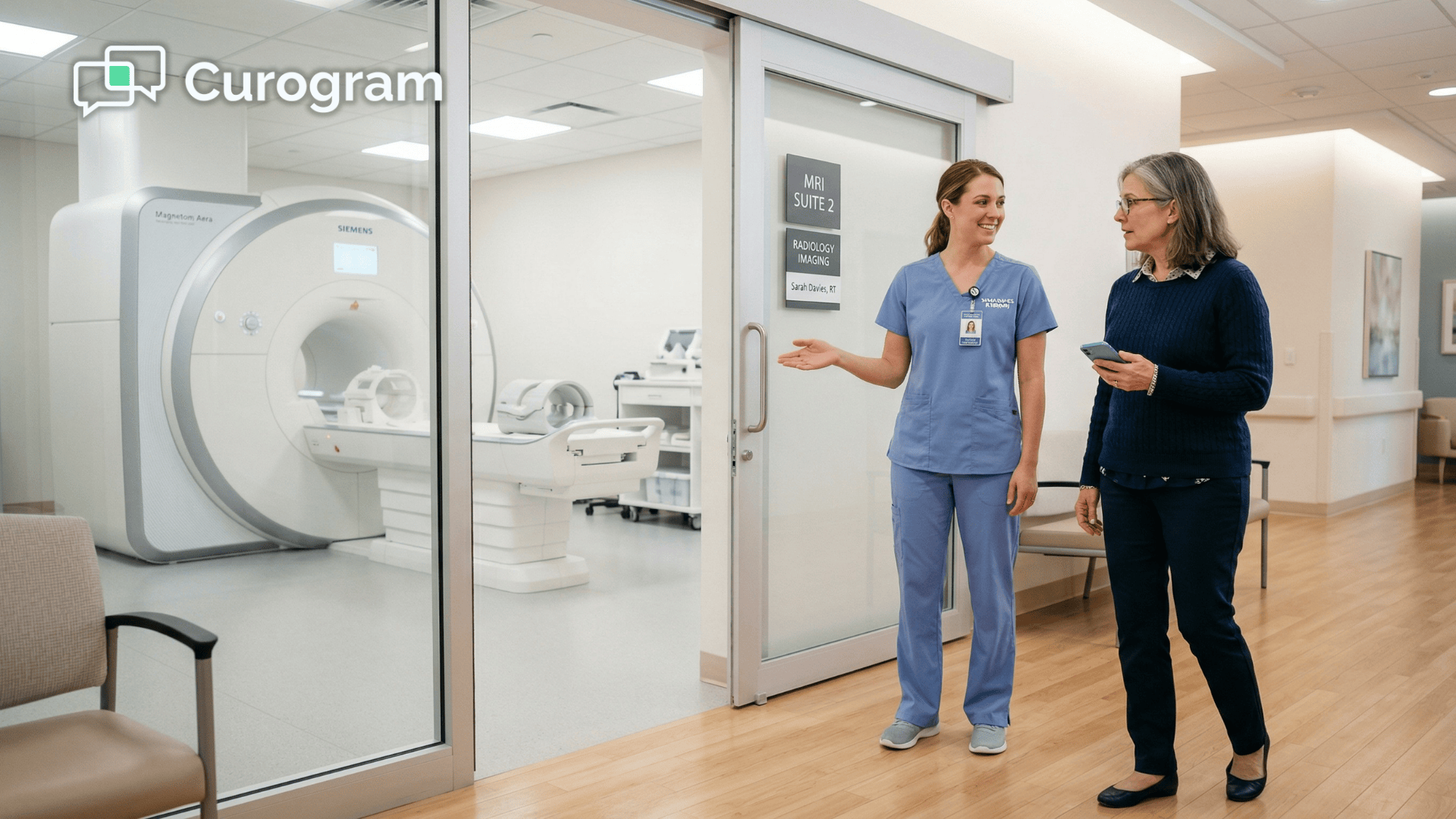
Studies show 70–90% of referred patients skip app enrollment entirely — leaving the majority unreachable through digital channels.
Curogram adds a two-way HIPAA-compliant text layer that works alongside RamSoft's PowerServer and OmegaAI platforms. Every patient gets confirmations, prep instructions, and scheduling updates via text — no app required.
For imaging centers where a single empty MRI slot costs $800–$1,500, reaching more patients before they no-show isn't optional. It's the operational difference between a full scanner and a revenue gap that compounds daily.
It's Monday morning at your imaging center. You have 40 studies on the books for tomorrow. Your front desk team has spent the better part of Friday afternoon calling patients to confirm.
They left voicemails. They sent portal invites. And yet, by Tuesday at 8 AM, six patients haven't confirmed — and two of them won't show up.
That's $1,600 to $3,000 gone before your first scan of the day.
Now multiply that across a week. Then a month. For a mid-size imaging center averaging 80 studies a day at $800 per study, no-show losses can easily reach $1 million annually.
And the worst part? It's not a scheduling problem. It's a communication problem.
The math is hard to argue with. Your clinical infrastructure — the scanners, the RIS, the PACS, the AI integrations — is built to perform. But if patients aren't confirming, aren't arriving prepared, and aren't responding to your outreach, none of that infrastructure matters.
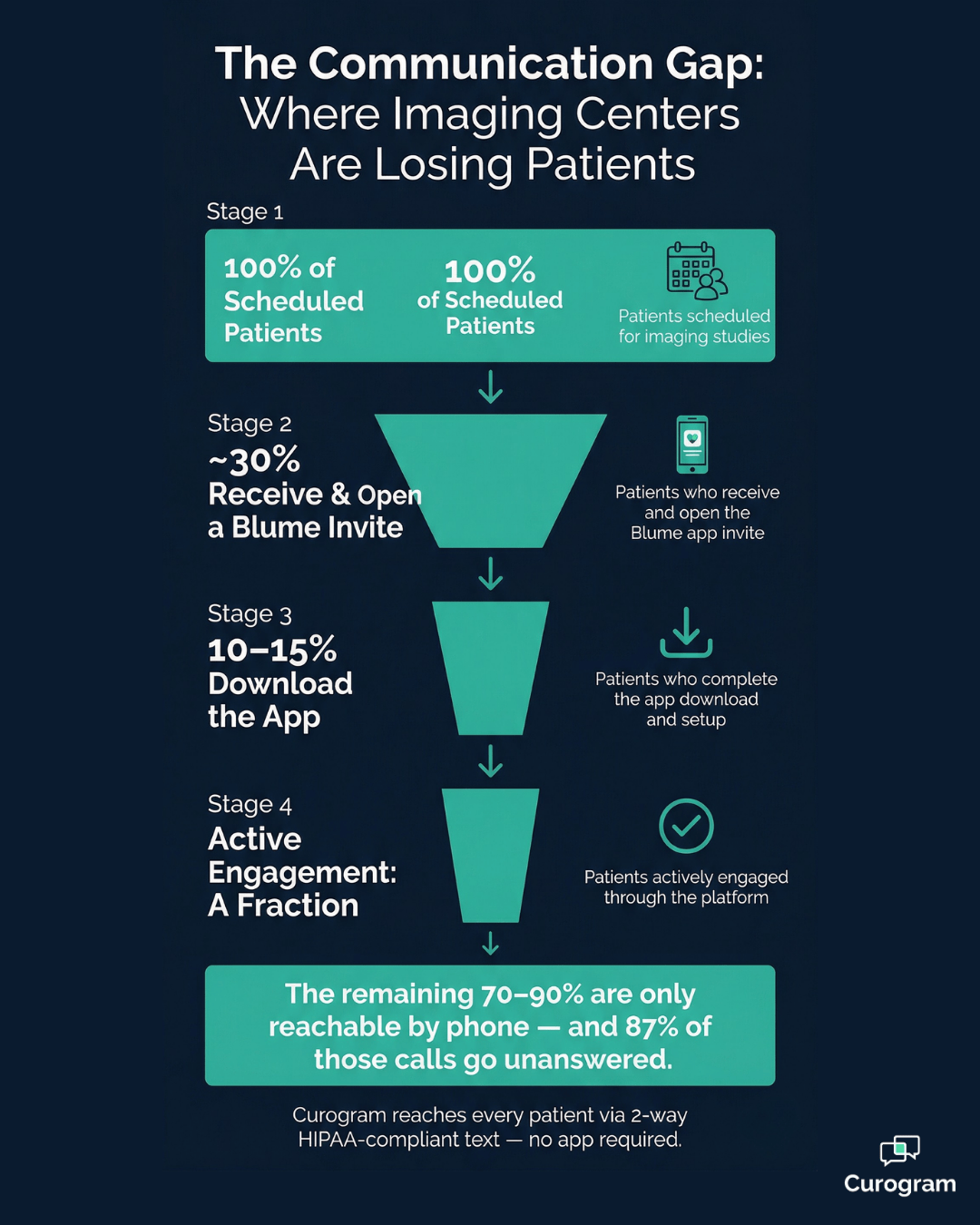
Here's what most imaging centers don't realize: the primary digital engagement tool many RamSoft-powered facilities rely on reaches, at best, 10–30% of their patient population.
That means the majority of your scheduled patients are reachable only by phone. And phone calls in 2025?
They go unanswered 87% of the time when the caller ID shows an unrecognized number.
You're investing in world-class imaging technology. Your patient communication strategy deserves the same level of thought.
This article explains why RamSoft imaging center patient texting — specifically two-way HIPAA communication built to work beyond Blume — is the missing piece in your operational stack. And it shows exactly what it looks like when you fix it.
The App Nobody Actually Downloads
Let's be clear:
Blume is a genuinely impressive product. ChatGPT-powered radiology report explanations, DICOM image sharing without CDs, family health history management, multi-language support — for patients who enroll, it delivers real value.
The problem is the word "enroll."
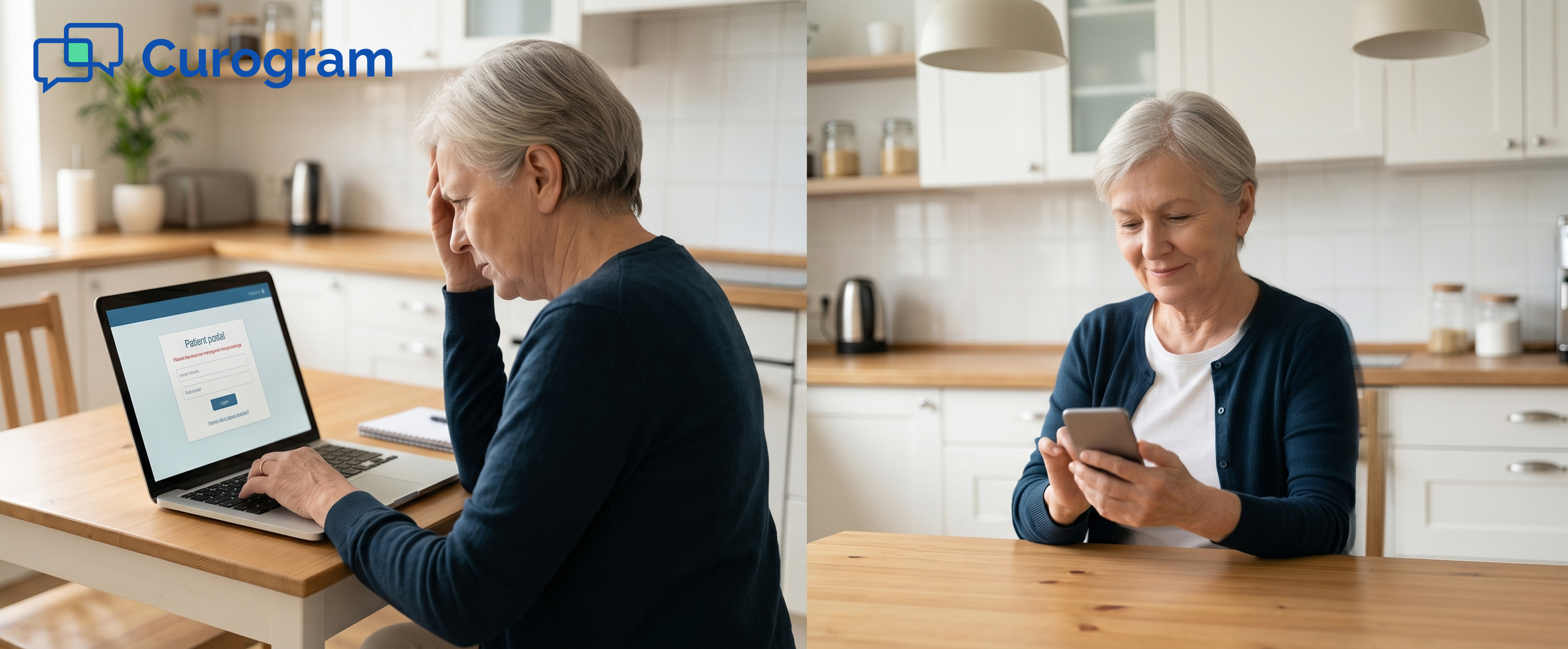
Most imaging patients aren't choosing to visit your facility. Their referring physician chose it for them. They scheduled a single MRI, CT, ultrasound, or X-ray. After that study, they'll likely never return.
Asking this patient to download and configure a radiology app for a one-time visit is a bit like asking someone to download a restaurant's loyalty app before they've ever eaten there.
The effort-to-value equation just doesn't work for most people.
Why Most Patients Skip the App Entirely
Blume is designed for ongoing patient engagement. Imaging patient relationships are episodic.
That mismatch explains why most imaging centers report Blume adoption rates somewhere between 10% and 30%.
That means 70–90% of patients — the vast majority of the people you're trying to reach — are not accessible through the platform designed to reach them.
This isn't a criticism of Blume's design. It's a structural reality of how imaging patients interact with radiology facilities.
The consequence is predictable and costly. When your primary digital communication channel only reaches a fraction of patients, everything defaults to phone calls.
Your front desk team starts fielding 60–100 calls daily:
Confirmations, prep instruction deliveries, insurance questions, rescheduling requests, results inquiries. Each call averages 3–5 minutes.
For a facility with three front desk staff members, that's 3–5 hours of phone time every single day. That's time not spent on insurance verification, waitlist management, or the hundred other tasks that keep a facility running smoothly.
The Fallback Channel That Isn't Working Either
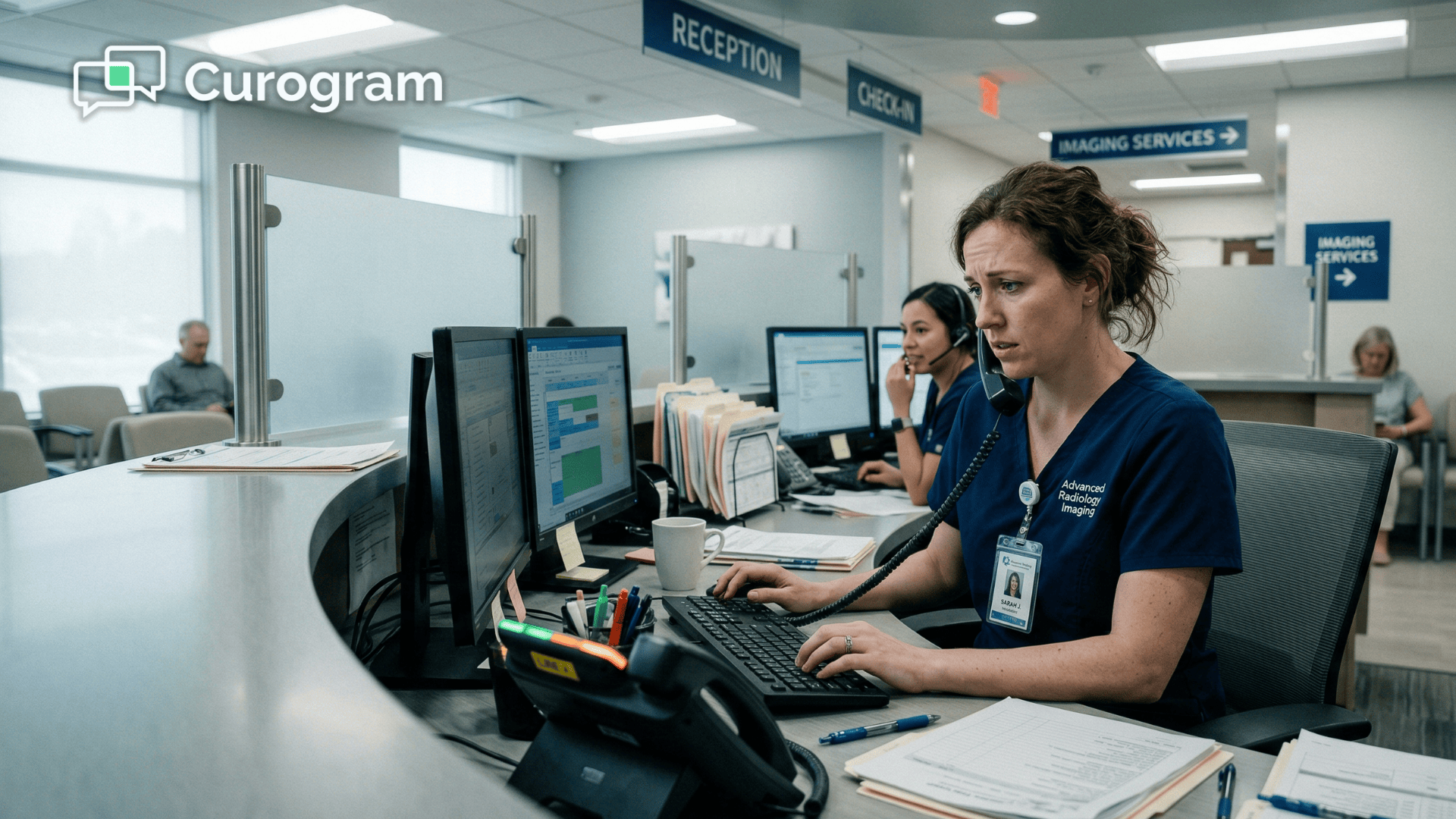
So what happens when the portal doesn't get used? You call.
And 87% of those calls go to voicemail when patients see an unrecognized number. The fallback channel reaches a fraction of the fraction already missed by the app.
Your team works harder, covers less ground, and still ends up with empty scanner slots on Tuesday morning.
It's an exhausting cycle. And it's entirely preventable.
The Gap That AI Partners Don't Fill
RamSoft's partner ecosystem is impressive, and each tool in it does something genuinely useful:
- RADPAIR accelerates radiology report generation
- iCAD and Therapixel strengthen breast cancer detection
- Alpha Nodus handles prior authorization workflows
Every one of these tools addresses what happens after a patient arrives and after their images are read. None of them solve what happens before: getting the right patient to show up, on time, properly prepared, with their questions already answered.
Blume was built to fill that gap — and it does, for the patients who use it. For the 70–90% who don't, the gap stays wide open.
The Communication Layer That Reaches Every Patient
The fix isn't complicated. It's a text message.
Not a portal link. Not an app notification. A plain, simple text sent directly to the patient's phone — the device they check 90+ times a day — that says:
"Your MRI is scheduled for Thursday at 2 PM. Reply YES to confirm or let us know if you need to reschedule."
That's it. The patient replies "yes" in seconds. Or they reply "Can I come at 3 instead?" Either way, the conversation happens — without a single phone call, a voicemail, or a missed connection.
This is exactly what Curogram adds to RamSoft-powered imaging centers.
It's a two-way HIPAA-compliant text messaging platform that reaches every imaging patient with a phone number, whether or not they've ever heard of Blume.

How the Unified Text Inbox Works for Your Team
Curogram gives your team a single dashboard for all patient text conversations.
Confirmations, prep questions, scheduling changes, insurance inquiries, results notifications — every message in one screen, organized by patient and study date. Staff don't need to toggle between platforms or chase down threads across different tools.
For multi-site imaging networks, the dashboard aggregates communication across all locations while keeping site-level views intact.
Every message is HIPAA-encrypted, time-stamped, and fully auditable. This is what PowerServer imaging center 2-way texting looks like when it's built for operational efficiency — not just compliance checkbox.
A Real Scenario: Monday Morning at a Busy Imaging Center
Imagine it's 7:45 AM on a Monday.
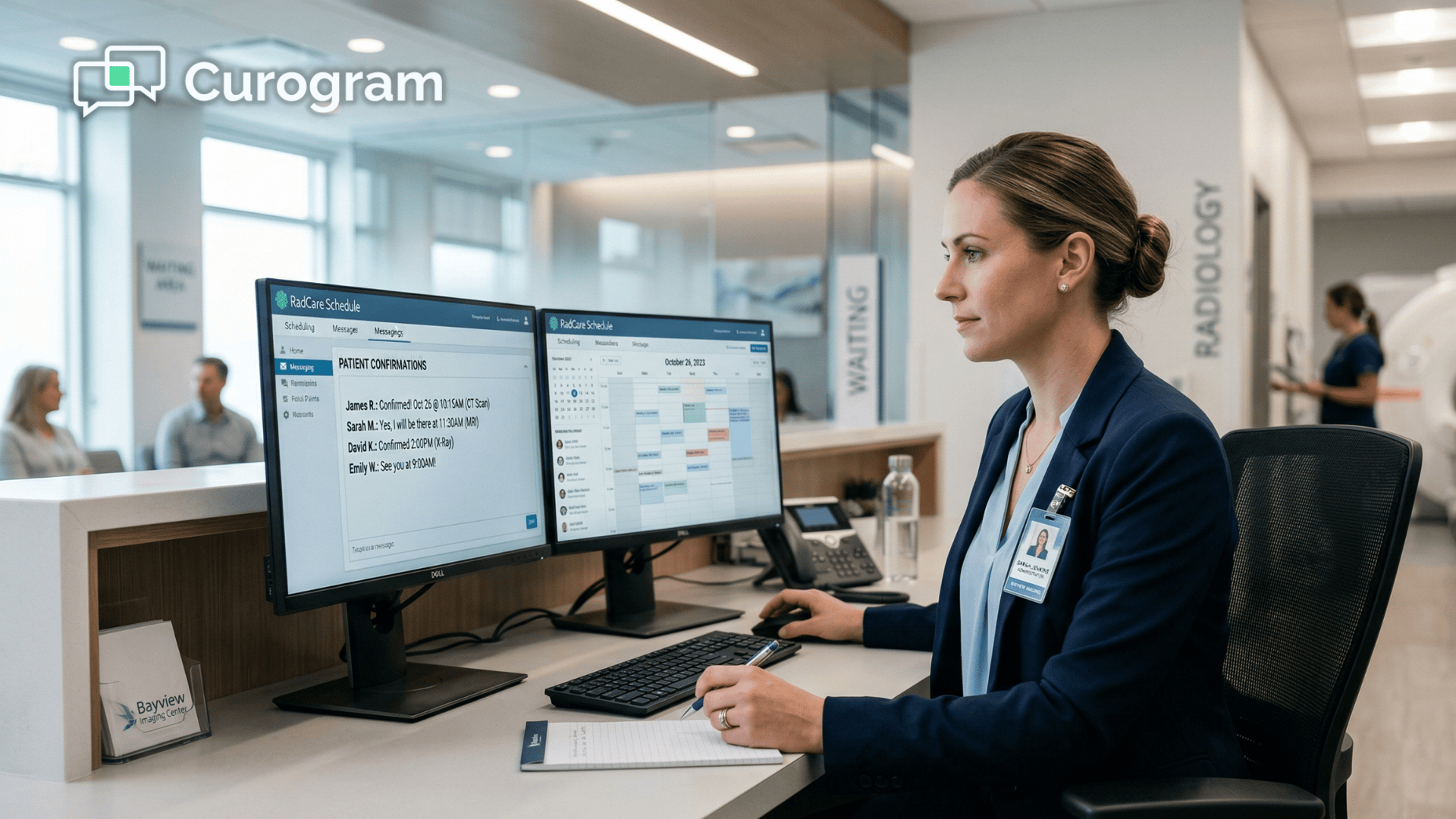
The center administrator opens the Curogram dashboard. Of the 40 studies scheduled for tomorrow, 37 have already confirmed via text.
Two patients rescheduled overnight — their new slots were filled automatically from the waitlist.
One patient asked whether they needed to fast before their abdominal CT. Staff replied in 15 seconds with the correct prep protocol.
The scanner schedule is full. The phone has barely rung. The front desk is preparing for tomorrow instead of calling about tomorrow.
That shift — from reactive to proactive — is what changes the operational experience for your entire team.
Built to Work Alongside RamSoft, Not Against It
Curogram doesn't replace any part of your existing RamSoft stack. Each tool keeps doing exactly what it was built for:
- PowerServer runs your RIS/PACS as normal
- OmegaAI powers your cloud-native imaging workflows
- Blume serves the patients who download and enroll
- Curogram reaches everyone else — via text, from day one
Blume patients keep using the app — great. Non-Blume patients get the same quality of communication via text. Every patient is covered.
No gaps, no disruption to what's already working.
For enterprise imaging networks running OmegaAI across dozens or hundreds of locations, this scalability matters even more.
A centralized communication team can manage text conversations across multiple facilities, standardize prep instruction delivery, and maintain a consistent patient experience — without proportional increases in staffing.
At that scale, even a 2% improvement in no-show rates across 100 locations produces aggregate revenue recovery that reaches into the millions.
The OmegaAI patient engagement text-first model isn't a future state. It's available today, and it scales with your network.

What Happens When Every Patient Is Actually Reachable
Let's put real numbers on the impact, because "better communication" is easy to say and hard to act on without a clear picture of what's at stake.
Atlas Medical Center used Curogram's automated reminder and text confirmation system to reduce their no-show rate from 14.20% to 4.91% in just three months — 3x better than the industry average.
That's not a marginal improvement. That's a near-complete elimination of the problem.
What That Means in Revenue
Apply similar results to a radiology center averaging 80 studies per day at $800 per study.
Here's what the math looks like:
At a 12% no-show rate, that same center loses roughly 10 studies a day — about $8,000 in daily revenue, or $160,000 a month. Drop that rate to 5% through text-based confirmations, and you recover approximately 6 studies a day.
That's $4,800 back per day, or close to $96,000 per month.
That's roughly $96,000 in monthly revenue recovered — not by adding new patients, but by communicating more effectively with the ones already scheduled.
At enterprise scale across 50 locations, the aggregate recovery exceeds $4 million annually.
For your team, this means: fewer empty slots, better scanner utilization, and less frantic morning scrambling to fill last-minute cancellations.
The Shift from Single-Channel to Dual-Channel Communication
Before: Your imaging center relies on Blume as the primary patient engagement tool, with phone calls as the fallback. Together, those two channels consistently miss 70–90% of your patients.
After: You run a dual-channel model. Blume handles app-enrolled patients — image sharing, report access, health management.
Curogram handles operational communication — confirmations, prep delivery, scheduling questions — via text, for every patient.
The result is a communication infrastructure that finally matches the sophistication of your clinical infrastructure.
The Operational Ripple Effect
No-show recovery is the headline number, but it's not the only one.
Curogram's clients typically see a 50% reduction in inbound call volume — and that drop creates a cascade of improvements across the whole operation:
- Prep instruction delivery becomes proactive, not reactive
- Insurance questions get resolved via text before the patient arrives
- Waitlist management becomes easier when cancellations come in early via text
- Staff shift from confirmation calls to higher-value tasks like scheduling optimization
That reallocation of time translates to a productivity improvement of more than 30%.
Staff who were burning 3–5 hours daily on phone confirmations are now spending that time on work that actually requires their judgment.
The radiology patient text HIPAA compliance piece also matters here. Every conversation in Curogram is encrypted, logged, and auditable. You get the communication reach of a text message and the compliance posture of a HIPAA-certified platform. That's not a trade-off — it's both.
Your Imaging Infrastructure Is World-Class. Your Communication Should Be Too.
Here's the simplest way to think about your RamSoft platform:
PowerServer is for your imaging infrastructure. OmegaAI is for your AI-powered workflows. Blume is for your patient records. Curogram is for your patient communication — the text-first channel that reaches every imaging patient, whether or not they've ever downloaded the app.
That's a complete stack. Each tool doing exactly what it was built to do, with no gaps between them.
Most imaging centers that implement communication through text-based see measurable no-show reduction within the first two weeks.
Not because the technology is magic, but because patients actually respond to texts. They confirm. They ask questions before the appointment instead of showing up confused. They reschedule when needed, which frees slots for patients who are ready and waiting.
The imaging centers that delay this conversation are the ones still calling patients on Friday afternoon, leaving voicemails, and walking in on Tuesday to an emptier scanner schedule than they planned.
You've built something genuinely impressive on the clinical side.
The last piece is making sure the patients you've invested so much in reaching actually show up — prepared, on time, and ready to be seen.
Schedule a Demo and find out what your no-show recovery could look like in the first 30 days.
Frequently Asked Questions
No. Curogram complements Blume rather than replacing it. Blume is built for patient record engagement — image viewing, ChatGPT-powered report explanations, health history management, family access. Curogram is built for operational communication — appointment confirmations, prep instructions, scheduling questions, payment collection. Blume serves enrolled patients. Curogram reaches every patient. They're different tools for different functions, and together they create a complete patient experience for your imaging center.
Yes. Curogram is SOC 2 Type II certified and fully HIPAA compliant. All messages are encrypted, and Curogram provides a Business Associate Agreement (BAA) with every imaging facility it works with. Text-based communication through Curogram meets the same compliance standards as any HIPAA-certified portal or app — including Blume. Your team can send confirmations, prep instructions, and scheduling updates via text without compromising patient privacy or your compliance posture.
Curogram works alongside RamSoft's existing infrastructure without requiring deep API integration. Your scheduling data feeds Curogram's communication workflows — study confirmations, prep instruction delivery, and follow-up messaging. RamSoft's open partner ecosystem (RADPAIR, Alpha Nodus, iCAD, and others) reflects a platform architecture that's built for integration. Curogram fits naturally into that ecosystem as the patient communication layer, adding text-based reach without disrupting any existing workflow.
Any RamSoft-powered imaging center dealing with high phone volumes, inconsistent confirmation rates, or persistent no-show problems will see an immediate impact. This includes independent MRI and CT centers, multi-modality outpatient imaging facilities, and enterprise teleradiology networks running OmegaAI across multiple locations. The higher your daily study volume and the more your revenue depends on scanner utilization, the more meaningful the impact of reaching patients beyond app download as a barrier.
Most imaging centers see measurable changes in confirmation rates and no-show frequency within the first two weeks. Because Curogram's text workflows are automated, the shift happens quickly — patients start receiving texts, responding, and confirming without requiring additional staff effort. Atlas Medical Center, for example, reduced no-show rates from 14.20% to 4.91% in just three months. For facilities starting with high no-show rates, the revenue recovery is often visible within the first billing cycle.