10 min read
RamSoft Patient Text Access | No App for One Visit
Aubreigh Lee Daculug
:
April 14, 2026
But they do have questions. About prep. About contrast. About claustrophobia. And those questions need answers before they arrive — or they simply don't show up.
Curogram adds 2-way HIPAA-compliant text messaging to RamSoft-powered imaging centers, giving every patient a direct line to your facility with no download, no login, and no friction.
It's the communication channel imaging patients are already using — and the one your center should be offering.
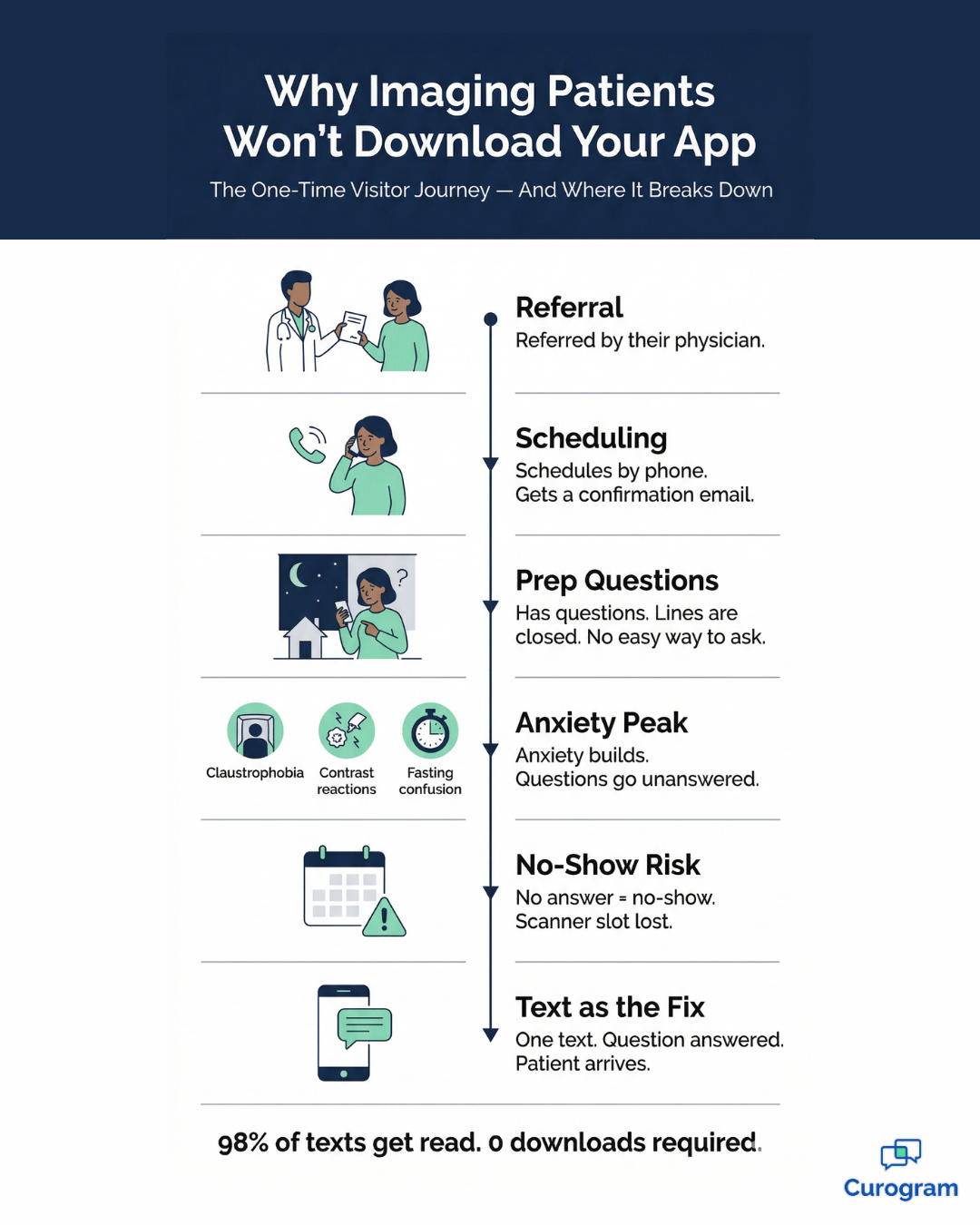
A patient gets a referral for their first knee MRI. They've never visited your imaging center before. They schedule by phone, get a confirmation email, and then — silence.
That night, the questions start. Can I eat before the scan? What do I wear? I get anxious in small spaces. Should I say something?
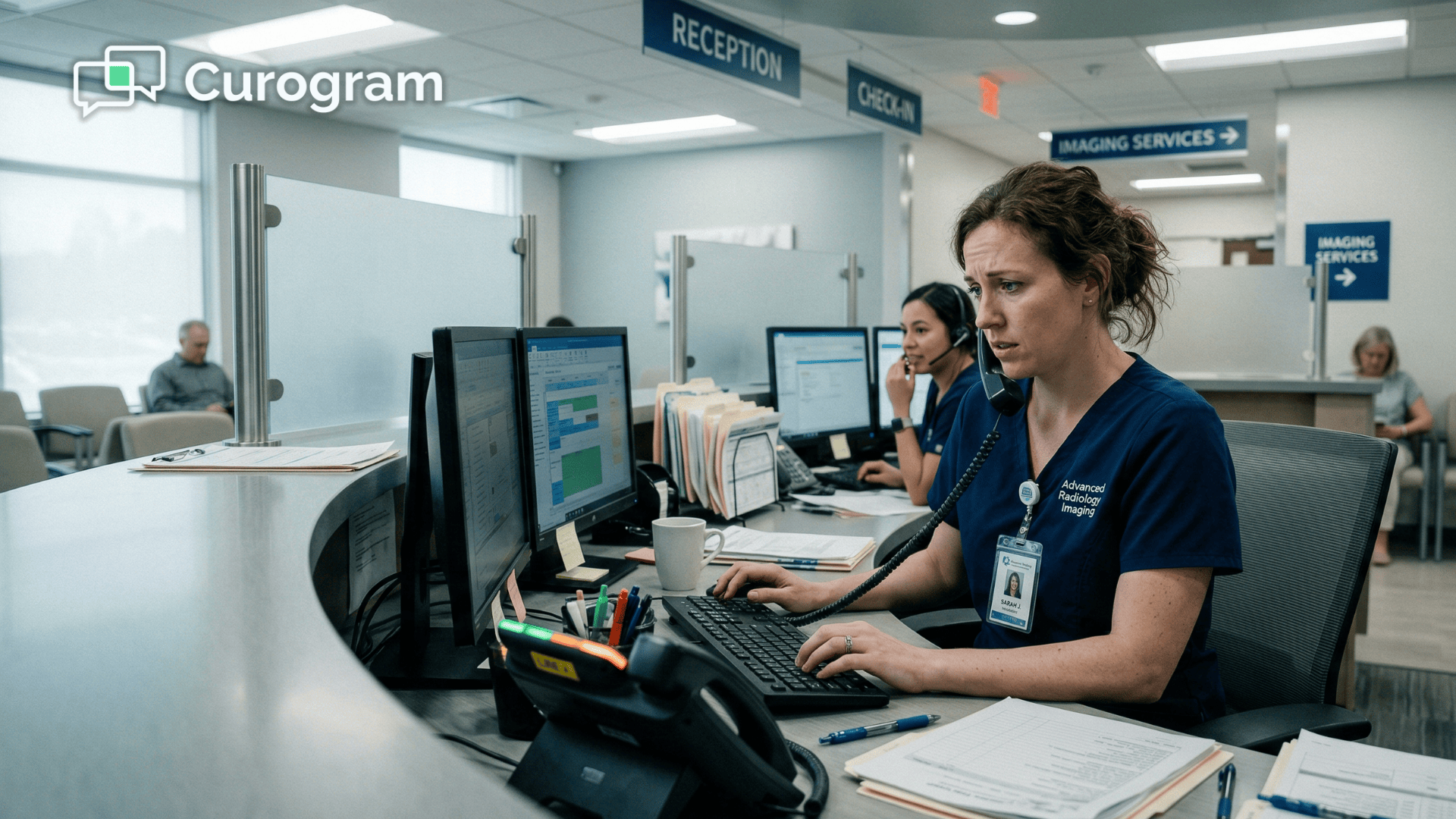
They try calling. The line is busy. They leave a voicemail. Nobody calls back before the appointment. So they show up anxious and underprepared. Or worse — they cancel at the door.
This is not a rare edge case. It's Tuesday morning at most imaging centers across the country.
The radiology world has made real strides in patient technology. RamSoft's Blume patient portal gives patients access to their images, AI-powered report explanations, and health history in one place.
That's genuinely useful — for patients who keep coming back.
But most imaging patients don't keep coming back.
They're referred once. They complete one study. Then they move on. Asking them to download, install, and learn a new app for a single CT scan is like asking someone to set up a loyalty account at a restaurant they're visiting while passing through town.
It sounds reasonable. It isn't.
The truth is, the RamSoft imaging patient text communication experience — specifically the gap between what Blume offers and how first-time radiology patients actually behave — is one of the most overlooked revenue problems in outpatient imaging today. Patients who can't reach your center with a quick question don't just go unanswered.
They no-show. They leave scanner slots empty.
And those empty slots are expensive.
An imaging center running 80 studies a day at $800 per study loses $3,200 every time just four patients don't show up. Multiply that across a month, and you're not looking at an inconvenience. You're looking at a $64,000 gap.
The fix isn't a better app. It's a better channel.
Why Asking Your Patients to Download One More App Is Already Costing You
The One-Time Visitor Problem
Most imaging patients aren't regulars. They're referred by a primary care physician, an orthopedist, or an oncologist. They come in for a specific study — a knee MRI, a chest CT, a screening mammogram — and once it's done, they're gone.
There is no ongoing relationship with your facility. There is no reason, in their mind, to invest in a digital connection with you.
This is what makes the imaging patient text vs app experience so different from, say, a primary care portal.
Your primary care patients log in regularly to check lab results, request refills, and message their doctor. Imaging patients log in never. Or once, reluctantly, after a staff member walked them through it over the phone.
Blume's feature set — image sharing, AI-powered report explanations, multilingual support — is genuinely valuable for patients with complex or ongoing imaging needs. But for the majority completing a single referral, the value proposition doesn't clear the hurdle of downloading a new app.
They're not building a health record relationship with your center. They're completing a transaction. And they won't download a patient app for a transaction.
The Anxiety Gap Nobody Talks About
Imaging studies are stressful.
A first-time MRI patient worries about claustrophobia.
A CT contrast patient worries about allergic reactions.
A patient heading in for breast imaging carries a different kind of weight entirely.
These patients have questions they want answered before they arrive — not in the waiting room, where anxiety is already running high. They want answers at 10 PM the night before, when the worry kicks in and the phone lines are closed.
Here's what those questions actually sound like:
- "I'm claustrophobic. What happens if I can't stay in the machine?"
- "I'm on blood thinners. Do I need to stop before my procedure?"
- "Is the contrast dye safe? I've heard it can cause reactions."
- "I haven't heard back from anyone — is my appointment still confirmed?"
Most of these questions never get asked out loud. And the patient who doesn't ask is often the one who cancels. Radiology patient anxiety text support isn't a luxury feature. It's a retention tool.
And right now, most imaging centers don't have it.
The Digital Divide Is Real
Imaging centers serve an extraordinarily wide range of patients. On one end:
A 25-year-old athlete getting a sports injury MRI who navigates apps without thinking twice. On the other: an 80-year-old Medicare patient getting cardiac imaging who barely texts.
That demographic reality matters. Medicare accounts for a significant share of diagnostic imaging revenue. Elderly patients represent a disproportionate volume of studies.
And many of those patients can barely open a text message, let alone download, install, and configure a patient portal app.
Blume's multilingual support across English, Hindi, Spanish, and French is a genuine advantage for diverse patient populations — but only for patients who can access the app in the first place. A text message meets every patient at the technology level they already have.
No learning curve. No setup. No barriers.
What This Costs You in Referrals
The problem doesn't stop with patients. It ripples outward.
When a patient referred by Dr. Smith's practice can't reach your center — can't get prep instructions, can't confirm their appointment, gives up and cancels — that patient calls Dr. Smith's office to say so.
And Dr. Smith's office starts quietly evaluating which imaging center communicates more professionally.
Referrals are the lifeblood of radiology revenue. A single referring physician can drive dozens of studies per month.
Lose that relationship, and you don't just lose one appointment — you lose a pipeline.
$3,200 |
| Lost in a single day when just 4 patients no-show at $800 per study |
In practice: that's not a billing problem. It's a communication problem — and a text channel fixes it.
The Communication Channel Your Imaging Patients Are Already Using
A Text Line From the Moment They Schedule
Here is what a better first-time MRI patient text communication experience looks like in practice.
The moment a patient schedules their study, they receive a text:
"Your MRI is scheduled for Thursday at 2 PM at [Imaging Center Name]. Questions about your study? Just reply to this text anytime."
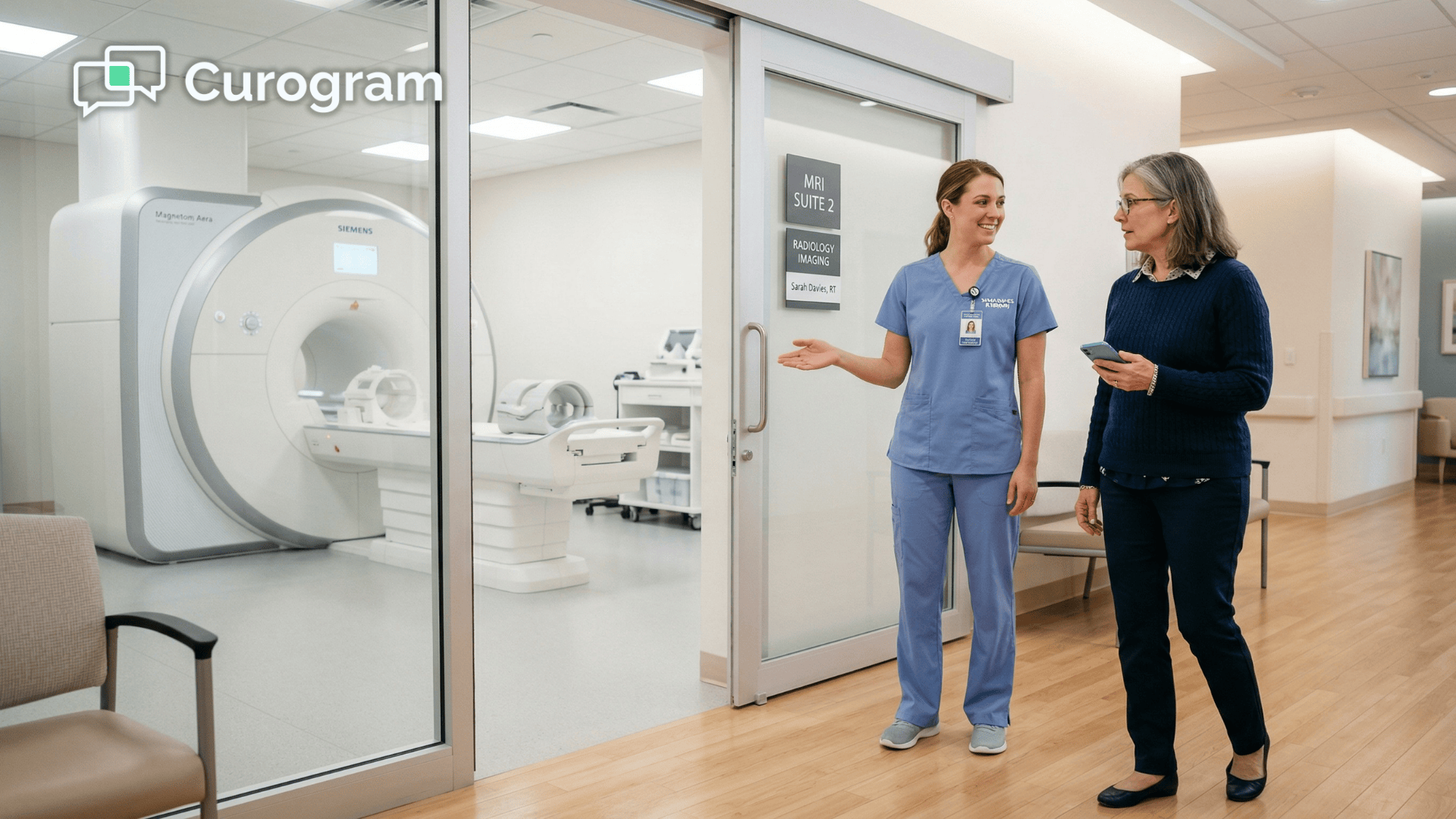
The channel is open. The patient doesn't have to find a phone number, wait on hold, or download anything.
When they have a question — and they will — replying takes five seconds.
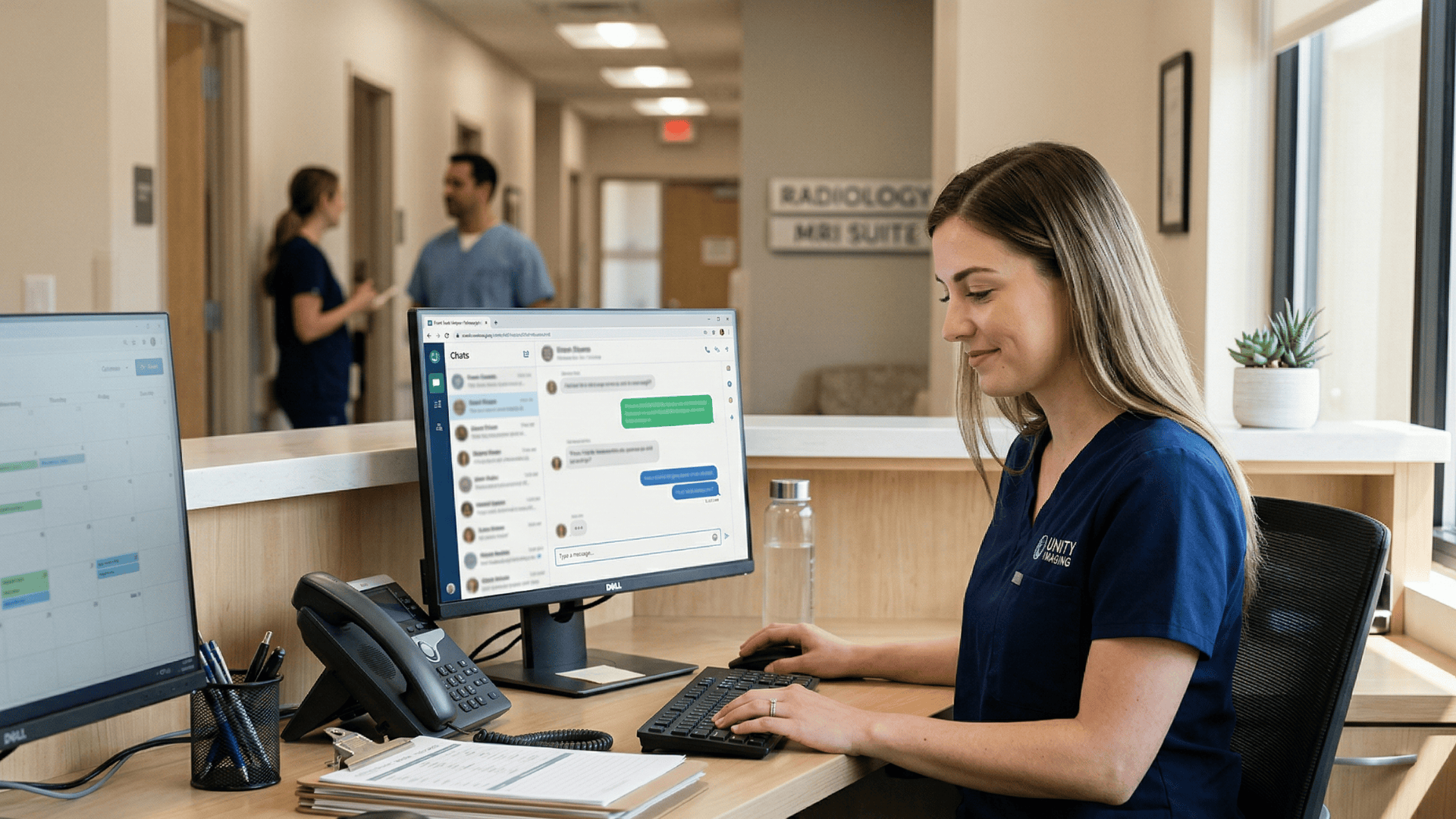
This is exactly what Curogram adds to RamSoft-powered imaging centers: a direct, 2-way HIPAA-compliant text line between your facility and every patient.
Not a portal. Not an app. A text thread that works on every phone, for every patient, without setup.
The practical difference between patient text access at an imaging center with no app requirement and a portal-first model is simple — one requires nothing from the patient, and the other requires effort most patients won't give.

Modality-Specific Prep Instructions via Text
For anxious or first-time patients, prep clarity is everything. Curogram lets your team send modality-specific preparation instructions as a tap-to-view text link.
The patient receives:
"Tap here to review your MRI preparation guide." No portal. No login. One tap.
Through pre-built templates, staff can handle the most common prep scenarios without typing from scratch every time:
- Modality-specific guides for MRI, CT, mammography, and ultrasound
- Contrast protocol instructions and fasting requirements
- What to wear — and what to leave at home
- Study confirmation with date, time, and location details
Instead of five staff members giving five slightly different answers about contrast protocols, every patient gets the same clear, accurate information.
A text link they can re-read the night before is far more useful than instructions rattled off over the phone.
Text and App, Side by Side
Here's something worth stating clearly:
Curogram is not a replacement for Blume. It's a complement to it.
Patients who want to view their images, access AI-powered report explanations, or manage their imaging history can still use Blume.
Patients who want to confirm their appointment, ask a prep question, or flag that they're running late can text. Your center doesn't have to choose one — it offers both.
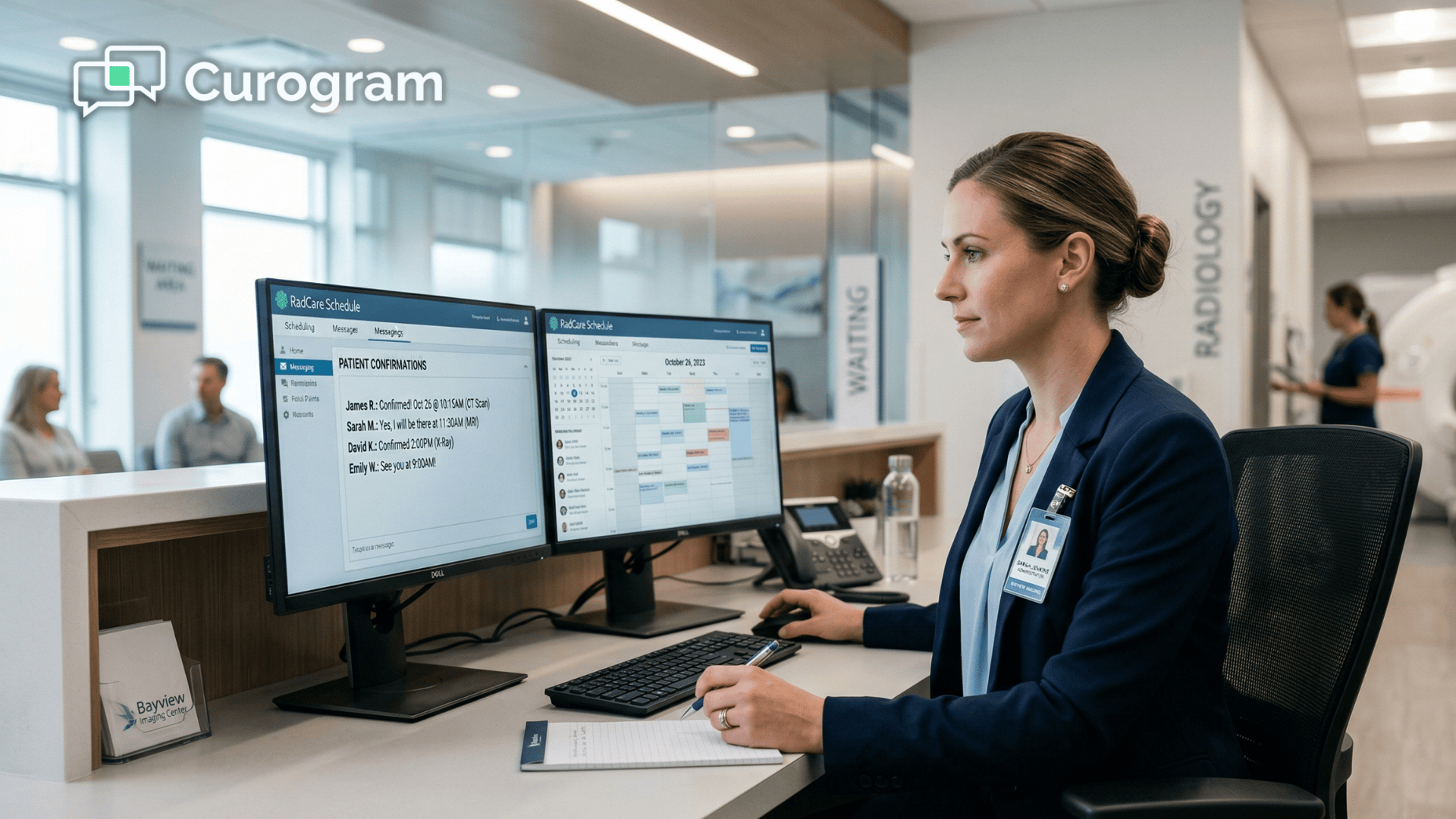
The result changes everything. Instead of reaching the 10–30% of patients who downloaded and configured the app, you reach 100% of patients.
The RamSoft Blume patient access alternative isn't about replacing what Blume does well. It's about filling the gap Blume can't close: the first-time visitor who will not download anything, no matter how good the app is.
98% |
| Share of text messages that get opened and read by patients |
For your team: voicemail sits at 20%. App notifications land between 10–30%. Text is the only channel where the message almost always lands.
The Human Side of a Text Message
There is something worth noting about how a text feels compared to an app push notification or a voicemail.
A text feels personal. Direct. Like a real person is on the other end.
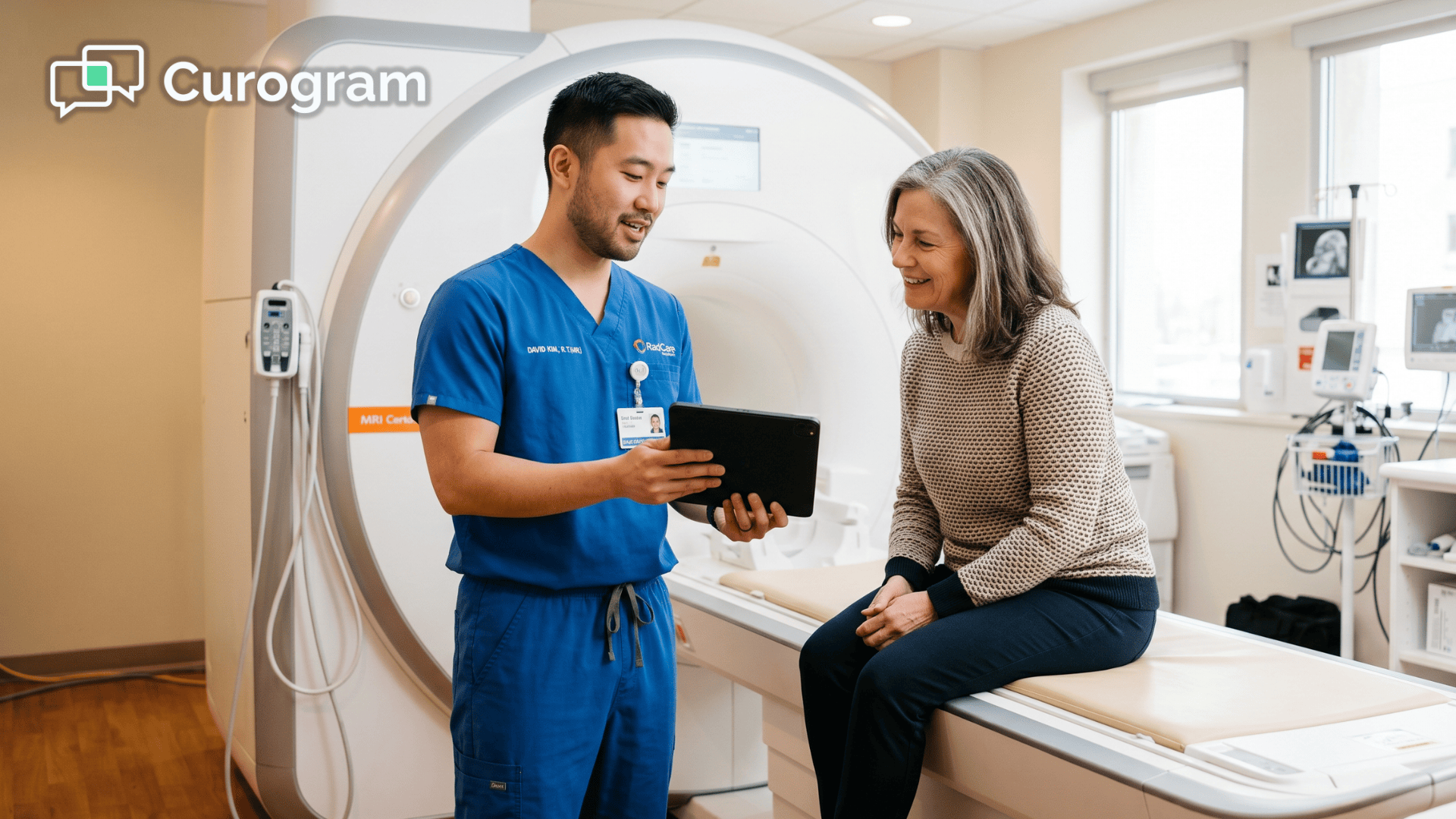
When a patient texts "I'm really nervous about my first MRI" and receives "That's completely normal. Our technologists will walk you through everything. The scan takes about 30 minutes, and you can listen to music the whole time. We're here for you" — that exchange does something no automated portal notification can do. It reassures.
That reassurance reduces cancellations. It builds trust.
And it turns an anxious, uncertain patient into one who shows up, completes the study, and tells someone else about their experience.

What Happens When Every Patient Can Actually Reach You
The Numbers Behind No-Shows
No-show rates are one of the most direct measures of communication failure in outpatient imaging.
When patients can't get answers to their prep questions, they don't show up.
When they're anxious and unsupported, they cancel at the door.
Text-based patient communication achieves a 98% message open rate, compared to roughly 20% for voicemail and 10–30% for app-based notifications.
That gap isn't trivial. Most voicemails go unheard. Most app notifications go unseen. Texts get read.
Atlas Medical Center reduced its no-show rate from 14.20% to 4.91% after implementing text-based confirmation and communication — a 65% reduction in missed appointments, driven largely by giving patients a channel they could actually use.
In plain terms:
For every percentage point you reduce your no-show rate, you're recovering thousands of dollars in revenue each month.
That recovery doesn't require new equipment, new staff, or new referral contracts. It requires a text thread.
From 10–30% to 100%: The Coverage Shift That Changes Everything
Think about what the app coverage gap means in operational terms.
If your center sees 80 patients per day and only 20% download Blume and engage with it meaningfully, approximately 64 patients per day have no convenient way to ask a question, confirm their appointment, or flag a concern.
Those 64 patients are either calling your front desk — adding to phone volume — or they're not reaching out at all.
Adding Curogram's text channel extends your reach to every patient the app was never going to serve:
- Elderly Medicare patients who don't download apps but do read texts
- First-time visitors completing a one-time referral with no reason to onboard to a portal
- Anxious patients who need low-pressure communication before they commit to showing up
- Tech-averse patients across every age group who communicate by text and nothing else
Every one of those patients can now text your center directly. Every question gets answered. Every study gets completed.
A Single Patient Story That Shows the Whole Picture
A 55-year-old woman is referred for her first screening mammogram.
She schedules by phone and receives a text:"Your mammogram is scheduled for Friday at 10 AM. Here are your preparation instructions: [link]. Questions? Just reply to this text."
Thursday evening, she texts:"What should I wear?"
Staff reply at 7:30 AM Friday:"Wear a two-piece outfit — you'll only need to remove your top. We provide a gown. See you at 10!"
She arrives calm. Prepared. On time. The study is completed in 15 minutes.
A week later, she receives a text:"Your results are available through your referring physician. Thank you for choosing [Imaging Center Name]."
She tells her sister — who has been putting off her mammogram for two years — "That place is really easy to deal with. They text you everything." Her sister schedules the following week.
One well-supported patient. One unprompted referral. The text channel didn't just fill a scanner slot — it created a new one.
Your Patients Have Questions — Give Them a Channel That Doesn't Need a Download
Most imaging patients won't download an app for a single study. That's not a criticism of the technology — it's just the reality of how one-time visitors behave.
They have a referral, a schedule, and a phone. They have questions they want answered without friction.
And when they can't get those answers easily, they either call your front desk repeatedly or they stop trying altogether.
Blume does what it was built to do: give patients with ongoing imaging needs a place to manage their health records, view their images, and make sense of their reports. It's a strong tool for the right audience.
But the patient who showed up for one MRI and left? They were never going to use the app. And if they couldn't get their prep question answered — because calling meant waiting on hold and there was no other option — there's a real chance they didn't show up at all.
Curogram closes that gap. It adds 2-way HIPAA-compliant text messaging to RamSoft-powered imaging centers so that every patient — tech-savvy or not, first-time or returning, anxious or confident — has a direct line to your facility from the moment they schedule.
No download. No login. No friction.
The impact is measurable. Text messages carry a 98% open rate. No-show rates drop significantly when patients have a channel they can actually use.
And when a patient feels supported from scheduling to scan, they complete the study, they come back when they need to, and they send someone else through your door.
For your referring physicians, a facility that communicates well is a facility that keeps getting referrals. For your revenue cycle, a completed study is always worth more than an empty scanner.
Text messaging is not a workaround. It is the channel your patients are already using 90 or more times a day. All you have to do is meet them there.
Ready to see how it works for your center? Schedule a demo today and find out how text-based communication fills the scanner slots your app can't reach.
Frequently Asked Questions
Yes — because the imaging center texts them first. Curogram sends an initial confirmation text at the time of scheduling, establishing the text channel before the patient even thinks to reach out. When a question comes up, replying to an existing text thread is far easier than looking up a number, dialing in, and waiting on hold. Most patients engage naturally because the channel was already opened for them. The text doesn't ask them to do anything — it just makes responding effortless.
Anxious patients often avoid phone calls because live conversation adds pressure. Text gives them time to formulate their question, read the answer carefully, and process the information at their own pace. For MRI patients with claustrophobia concerns, or cancer screening patients carrying real health anxiety, a text channel removes the social friction of a phone call. It's a low-pressure way to express a concern, ask something that feels embarrassing to say out loud, or simply confirm that they're going to be okay. Many imaging centers find that patients who text their concerns in advance are significantly less likely to cancel the day of their study.
Curogram's text channel can notify patients that their results are available and direct them to the appropriate next step — their referring physician or Blume for detailed report viewing. Whether direct results communication is appropriate via text depends on your center's policies and compliance preferences. Many facilities use text for notification ("Your results are ready — please contact your referring physician") while relying on Blume or physician communication for detailed report delivery. This approach satisfies 21st Century Cures Act requirements while keeping clinical communication in the right hands.
Yes — when implemented correctly. Curogram is built specifically for healthcare, which means all patient text conversations are transmitted and stored in a HIPAA-compliant environment. Unlike standard SMS apps or consumer messaging tools, Curogram includes the technical and administrative safeguards required under HIPAA, including access controls, audit logs, and encrypted message delivery. Your team communicates through a secure web-based platform, not a personal phone, so there's no risk of patient data sitting in an employee's SMS inbox.
It reduces it — meaningfully. When patients have a direct text line to your facility, they stop calling with routine questions that tie up your phone lines. Prep questions, confirmation requests, and simple scheduling inquiries shift to text, where staff can respond at their own pace using pre-built templates. One staff member can handle multiple text conversations simultaneously in a way that's simply not possible with phone calls. Many imaging centers find that adding a text channel doesn't add work — it redistributes it into a far more manageable format.