

8 min read

From Invisible to In-Demand: The SEO Power of Osmind Review Automation

From Invisible to In-Demand: The SEO Power of Osmind Review Automation
💡 Medical SEO for Osmind practices hinges on two key signals: review velocity and keyword-rich patient feedback. Google's local search now prizes fresh reviews that arrive often, not just old five-star ratings.

When patients write reviews that include terms like ketamine, TMS, or depression relief, Google links your clinic to those specific searches. This tells the search engine your practice has real-world know-how in these areas.

Curogram automates review requests after Osmind visits. This creates a steady flow of fresh, keyword-rich feedback that builds mental health local search authority and pushes your practice into the Google Map Pack for psychiatrists.

Picture this: A patient in crisis types "ketamine clinic near me" into their phone at 2 AM. They need help now. But your practice, the one that could change their life, doesn't show up in the results. Instead, they find a competitor three towns over.

This happens more often than you might think. In 2026, having a great website and skilled staff isn't enough to get found online. Google has changed the rules. The search engine now looks for proof that your clinic is active, trusted, and talked about by real patients.

That proof comes from reviews. Not just any reviews, but fresh ones that show up often and contain the words patients use when they search. Think about phrases like "Spravato treatment" or "TMS for anxiety." When these words appear in your Google reviews, the search engine takes notice.

Medical SEO for Osmind practices is no longer just about keywords on your website. It's about the stream of patient feedback that flows through your Google Business Profile week after week. This is where the real ranking power lives.

The good news? You don't have to beg patients for reviews or hire an SEO expert. With the right tools, this process runs on its own. After each Osmind visit, a simple text goes out. Happy patients click, write a few words, and your search rankings climb.

This guide will show you how psychiatric review velocity, keyword content, and trust signals work together to make your practice visible. You'll learn why the Google Map Pack for psychiatrists matters so much, and how to claim your spot at the top.

The Map Pack Game: Why Proximity Isn't Enough Anymore

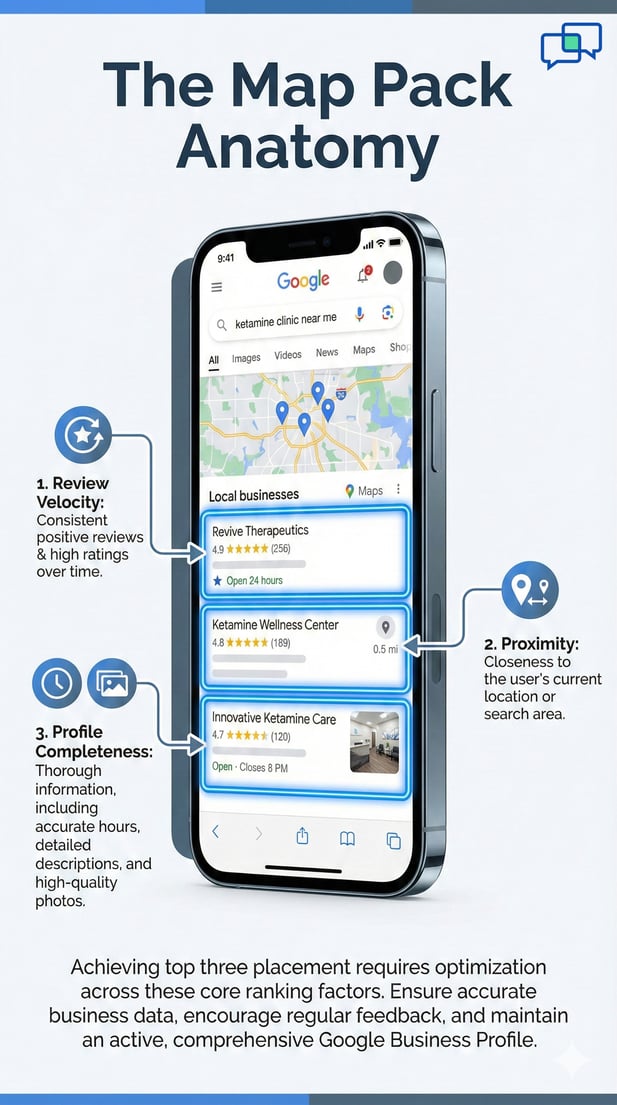
When someone searches for mental health care on their phone, Google shows a map with three clinics listed below it. This is the Map Pack. It takes up the entire screen on mobile devices, which means everything else gets pushed down and often ignored.

Most practice owners think being close to the searcher is what matters most. They're wrong. Google uses three main factors to decide who shows up: proximity, relevance, and prominence.

Of these three, prominence has become the real game-changer for ketamine clinic search rankings and other specialty searches.

The Prominence Pillar

Google doesn't just show the closest clinic. It shows the most prominent one. High review counts tell the search engine that your Osmind-based practice is a trusted local landmark worth showing to patients.

What Review Volume Signals to Google

A clinic with 200 reviews looks more established than one with 20. Google sees high review numbers as proof that many people have chosen your practice. This social proof carries weight in the ranking math.

Think about it from Google's view. The search engine wants to send users to places that will make them happy. A practice with lots of reviews has a track record. A practice with few reviews is a gamble.

Building Volume Without Burning Out Staff

Manual review requests are hit or miss. Staff forget, patients leave, and the moment passes. Automated text requests sent after Osmind visits solve this problem. They go out at the right time, every time, without adding work to your team.

The key is timing. Patients are most likely to leave a review right after a good visit. Automated texts catch them while the positive experience is still fresh in their minds.

The Recency Factor

In 2026, a five-star review from three years ago has almost no ranking power. Google now weighs fresh reviews much more heavily. The search engine wants to know that your practice is active today, not just that it was good in the past.

Review Freshness as a Ranking Signal

Google's system tracks when reviews come in. A practice getting reviews this week looks alive and engaged. A practice with no new reviews for months looks stale, even if its old ratings were great.

This is why psychiatric review velocity matters so much. Velocity means the rate at which new reviews arrive. A steady stream of feedback signals ongoing quality care.

Why Monthly Spikes Don't Work

Some practices try to boost reviews once a quarter with a big push. This creates spikes and gaps that Google can detect. The search engine prefers natural patterns where reviews come in often over time.

Automated requests create this steady rhythm. Every week brings new reviews without any extra effort from your team.

Keywords in Reviews: The Secret Ranking Factor

Most clinics focus on the keywords in their website copy. They forget that Google also reads their reviews. When patients write about their care using natural language, those words become powerful ranking signals that most practices never tap into.

The words patients use in reviews often match what other patients type into search. This makes reviews a goldmine for Spravato local SEO and other specialty searches that matter to your growth.

Unlocking Semantic Search

When patients use phrases like "best Spravato clinic in town" or "life-changing ketamine for PTSD," Google's AI connects these words to your business profile. This creates links between your practice and specific clinical terms that drive high-intent searches.

How AI Reads Patient Language

Google's search system understands meaning, not just exact words. When one patient writes about "depression relief" and another searches for "help with depression," the system knows these connect. Reviews that contain these terms boost your relevance for related searches.

This is why reviews from real patients work better than any marketing copy you could write. They use the same words that other patients search for.

Clinical Terms That Drive Searches

Patients searching for mental health care use specific terms. Words like ketamine, TMS, Spravato, anxiety treatment, and depression help appear in searches every day. When these words show up in your reviews, Google sees your practice as relevant for those queries.

You don't need to coach patients on what to write. Happy patients naturally mention the treatment that helped them. The review system captures this language without any prompting.

Improving Service Relevance

Most clinics list their services on their website, but forget to add them all to their Google Business Profile. Reviews fill this gap. When patients write about treatments you offer, Google learns what you actually do, not just what you claim to do.

Reviews as Crowdsourced SEO

Think of patient reviews as a form of crowdsourced search engine work. Each review that mentions a service acts as a vote. It tells Google that you really provide that treatment and that people value it.

This matters most for newer treatments like ketamine and Spravato. Patients searching for these services want proof that a clinic has real experience with them.

The Long-Tail Advantage

Reviews often capture search terms you never thought to target. Phrases like "depression treatment that finally worked" or "caring TMS staff" might not be on your SEO list. But patients search for them, and reviews that contain them help you rank.

Automated review requests capture this rich language from patients. Over time, your profile becomes packed with the exact words people use when they search.

SEO infographic showing top 3 ranking factors for Google local map results

Satisfying E-E-A-T: Trust as a Technical Requirement

Google uses a set of standards to judge how much to trust a website or business. These go by the letters E-E-A-T, which stand for Experience, Expertise, Authority, and Trust. For medical SEO for Osmind practices, patient reviews are the fastest path to proving all four.

Without strong E-E-A-T signals, your practice may struggle to rank even with good content on your website. Google holds health-related searches to higher standards because bad results could harm people.

Experience (The Second "E")

Google's 2026 rules put heavy weight on first-hand experience. The search engine wants proof that your clinic has treated real patients with real results. A high volume of patient reviews is the best way to show this.

First-Hand Experience in Search Rankings

Each review is a stamp of experience. When dozens of patients describe their care at your clinic, Google sees evidence of real-world work in the mental health field. No amount of website copy can match this.

This matters most for specialty treatments. A patient who writes about their ketamine therapy proves that your clinic has hands-on know-how with this approach.

Why Reviews Beat Other Proof Points

You could list your credentials on your website, but anyone can make claims. Reviews are third-party proof that comes from the people you've helped. Google weighs this type of evidence more heavily.

The more reviews you have, the stronger this signal becomes. One review is an opinion. Hundreds of reviews are a pattern that Google trusts.

Authoritativeness via Velocity

Consistent new reviews signal to search engines that your practice is a leader in its field. This ongoing activity helps build mental health local search authority. It also stops larger hospital networks from pushing you down in the rankings.

Staying Ahead of Hospital Networks

Big health systems have marketing teams that work on SEO full-time. Without a steady review flow, your practice can lose ground to these larger players. Automated reviews level the playing field.

When your review count grows week by week, Google sees your practice as active and growing. This helps you compete with organizations that have bigger budgets.

The Privacy Advantage

In 2026, Google rolled out a feature for anonymous reviews where patients can use screen names. This matters a lot for mental health care. Many patients want to share their experience, but worry about privacy.

When you mention this option in review requests, more patients feel safe to respond. This is key for practices that treat sensitive conditions. More responses mean more reviews, which build stronger authority signals for your profile.


Frequently Asked Questions About SEO & Reviews

Practice owners often have questions about how reviews connect to search rankings. Here are the most common ones we hear, along with clear answers that cut through the noise.

Does responding to reviews help our SEO?
Yes, it does. Google has said that replying to reviews, both good and bad, shows that your business is active and cares about patients. This counts as a positive ranking signal.

Keep responses simple and warm. Thank the patient for sharing their thoughts. If the review is negative, address concerns calmly and invite them to reach out directly. Avoid sharing any medical details in public replies.

Responses also let you naturally add keywords. A reply that mentions your TMS services or ketamine therapy connects those terms to your profile without sounding forced.

Aim to respond to every review within a day or two. Quick replies show that you monitor feedback and value patient input. Google notices this activity pattern.

Set aside time each week to handle responses. Even five minutes can make a difference in how active your profile looks to the search engine.

How many reviews do we need to rank #1?
There is no magic number that works for every market. What matters is having more reviews and a higher review velocity than your top three local rivals. The goal is to outpace your direct competition.

Look at the practices that rank above you. Count their reviews and note how often new ones appear. Your target should be to beat those numbers over time.

In some areas, 50 reviews might put you on top. In others, you may need 200. Local markets vary, so research your specific area.

Numbers alone won't win. Your average star rating matters too. A practice with 100 reviews at 4.8 stars will often beat one with 150 reviews at 4.2 stars. Focus on both volume and quality.

Automated requests sent after positive visits help maintain high ratings. Timing the request right catches patients when they feel good about their care.

Can we use reviews on our Osmind-integrated website?
Yes, you can. Curogram lets you display your best Google reviews on your website using a simple widget. This helps with both conversion rates and on-page SEO metrics like time spent on site.

Visitors who see real patient reviews on your site are more likely to book. Reviews build trust before the first call. They answer the question every new patient asks: "Is this place any good?"

Place review widgets on key pages like your homepage and treatment pages. Let the words of happy patients do the selling for you.

When visitors read reviews, they stay on your site longer. Google tracks this behavior. Pages that keep people engaged rank better than those that send visitors bouncing away.

Review widgets create fresh content that changes as new reviews come in. This gives return visitors something new to read, which also helps with engagement signals.


Professional doctor managing a medical clinic's digital presence on a tablet

Claim Your Position at the Top of Search

Every day that passes without steady reviews is a day your rivals gain ground. Patients are searching right now for the care you provide. The question is whether Google will show them your practice or someone else's.

Curogram's automated review engine works with Osmind to turn every positive visit into a ranking signal. No extra work for your staff. No chasing patients for feedback. Just a steady flow of fresh reviews that push your practice higher in search results.

Your future patients are searching. Make sure they find you.

Schedule a 10-Minute Demo today to see how medical SEO for Osmind practices is revolutionized by Curogram’s automated review engine.

Beyond 5 Stars: Using Feedback for Service Recovery in Osmind Clinics

Beyond 5 Stars: Using Feedback for Service Recovery in Osmind Clinics

💡 Mental health clinics using Osmind can protect their name and care standards through smart feedback systems. Managing patient feedback for Osmind...

Read More
Google Review Automation for Osmind: Build Clinical Authority at Scale

Google Review Automation for Osmind: Build Clinical Authority at Scale

💡 Google review automation for Osmind helps mental health clinics build trust and rank higher in local search. When you link Curogram with your...

Read More
Medical SEO for Cerbo Practices: The Power of Review Automation

Medical SEO for Cerbo Practices: The Power of Review Automation

💡 Cerbo practices can boost their Google rankings by sending review requests right after patient visits. Curogram makes this easy by linking with...

Read More