
1 min read
Reputation Management in Veradigm with Curogram
 Jo Galvez : Jan 5, 2026, 8:00:00 AM
💡 Imaging centers face unique trust issues. A single bad review can damage referral flow and hurt revenue across multi-site networks.Reputation...
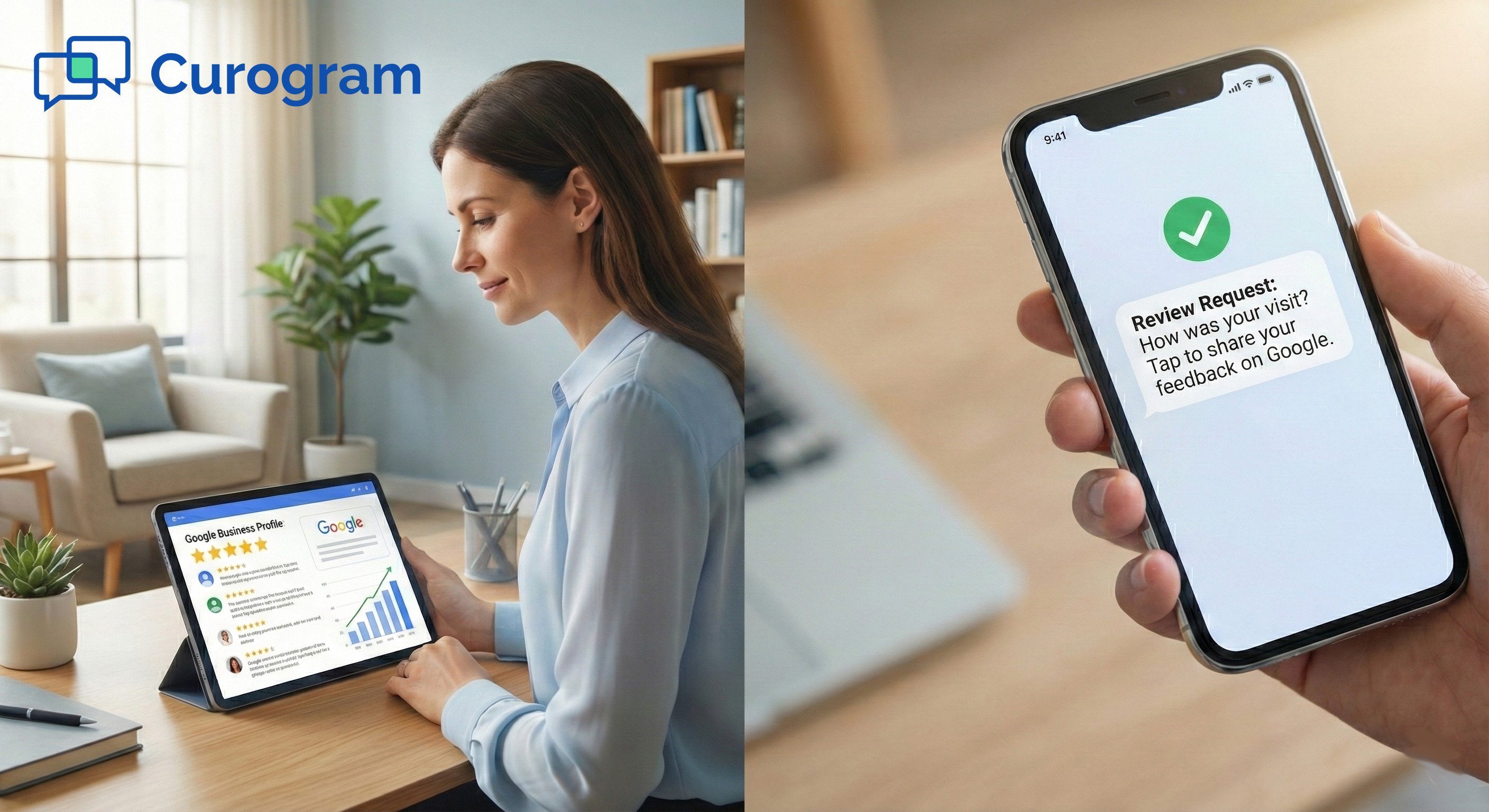
Your ketamine clinic saved a life today. A patient walked in with severe PTSD and left with hope for the first time in years. But here is the problem. No one online knows it happened.
Mental health clinics that offer Spravato, TMS, and ketamine therapy face a unique challenge. They deliver life-changing care every day. Yet their Google profiles look stale. Old reviews. Few stars. Long gaps between feedback. To a patient searching for help, this silence says the clinic is not active or trusted.
This gap between great care and online presence costs clinics new patients every week. And it is not about quality. It is about visibility.
When someone types in best ketamine clinic near me at 2 AM, Google shows them the clinics with the most recent and relevant reviews. Not the best care. The best online proof.
Google review automation for Osmind changes this pattern. By linking your Osmind EMR with Curogram, you create a direct path from successful treatment to public feedback.
Each time a patient checks out, the system sends a simple text asking them to share their story. No staff effort. No awkward asks. Just a smooth process that runs in the background.
The result is a steady stream of fresh, keyword-rich reviews. Google sees your clinic as active. Patients see proof of real outcomes. Your practice rises in local search results, often reaching the top three spots known as the Map Pack.
This guide shows you how to build that system. You will learn why reviews matter for mental health SEO, how to time your requests for best results, and how to stay HIPAA compliant while growing your online presence.
Many ketamine clinics do amazing work but remain hidden online. They heal patients daily, yet struggle to attract new ones through search. This section breaks down the three main reasons this happens and how Google review automation for Osmind solves each one.
Your clinic might be the best in your region. But if your last Google review is six months old, search engines see your practice as dormant. Fresh reviews signal to algorithms that real patients choose you right now.
How Review Age Affects Rankings
Google weighs recent reviews more than old ones. A clinic with ten reviews from last month beats one with fifty reviews from two years ago. The age of feedback matters as much as the volume.
Closing the Gap with Osmind EMR Reputation Management
When you connect Curogram to Osmind, review requests go out after every visit. This keeps your profile current without adding work for your team. Osmind EMR reputation management becomes part of your normal workflow.
The Crisis Bias
Without a system, the patients most likely to leave reviews are the upset ones. A billing issue or long wait time drives them to vent online. Happy patients, on the other hand, simply go home and move on with their lives.
Studies show that angry customers are twice as likely to write reviews. This skews your rating and gives a false picture of your care. One bad review can undo the effect of ten good ones in the minds of new patients.
Automated requests reach every patient, not just the upset few. This creates a true sample of your care quality. Over time, your rating reflects your actual work instead of rare bad days.
The Ethical Barrier
Mental health providers often feel strange asking patients for reviews. The care relationship feels too personal. Asking for a favor after a therapy session seems wrong, even if you delivered great results.
Therapists and psychiatrists train to put patients' needs first. Asking patients for reviews can feel like putting business above care. This hesitation is natural, but it hurts your ability to reach new patients who need you.
When the request comes from a system, not a person, the pressure drops. Patients receive a simple text that invites them to share if they wish. There is no face-to-face ask. No implied pressure. Just a choice. This approach supports building an interventional psychiatry authority while keeping care relationships clean.
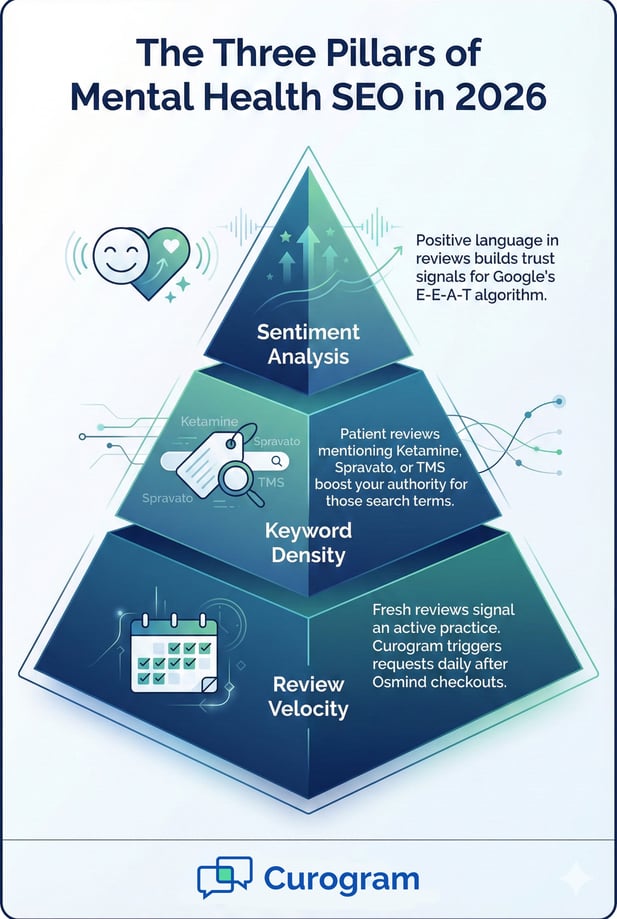
Search algorithms have evolved. Google now looks at three main factors when ranking local mental health practices. Understanding these pillars helps you shape a review strategy that drives real results for your ketamine clinic's Google reviews.
|
Ranking Factor |
Impact on Local Search |
Curogram's Automation Solution |
|
Review Velocity |
Critical |
Triggers requests daily after Osmind check-outs to keep the profile fresh. |
|
Keyword Density |
High |
Encourages patients to mention specific treatments like Spravato or TMS. |
|
Sentiment Analysis |
Medium |
Positive feedback signals Brand Trust to Google's E-E-A-T algorithms. |
Google tracks how often your clinic gets new reviews. A burst of old reviews means less than a steady trickle of recent ones. Search engines want to show users active, thriving practices.
For most mental health practices, two to four new reviews per week keep your profile active. More is better, but even this pace puts you ahead of 80% of local clinics who get reviews only once a month.
The system sends requests after each Osmind checkout. Even if only 20% of patients respond, a clinic seeing thirty patients a week gets six new reviews. That pace compounds fast.
Google reads review text looking for treatment names and terms. When multiple reviews mention ketamine therapy or TMS treatment, your clinic gains authority for those searches. This is core to mental health SEO strategy.
You cannot script what patients write. But you can prompt them with questions like what treatment did you receive? Patients then name the service in their own words, which looks organic to Google.
Spravato is a newer treatment, so there is less online content about it. Clinics that gather reviews naming Spravato gain a big edge in Spravato reputation SEO. Each review adds to your topical weight for that keyword.
Google now scans the tone of reviews, not just the star rating. Reviews with words like caring, life-changing, or finally found relief send strong trust signals.
E-E-A-T stands for experience, expertise, authority, and trust. Positive review sentiment feeds into the trust part of this formula. It tells Google that real people vouch for your care.
Why Timing Affects Sentiment
Patients asked for reviews right after a good session write warmer words. Waiting too long lets the glow fade. Automation catches patients at their best moment.
Getting reviews is one thing. Getting the right reviews at the right time is another. This section covers timing, keywords, and privacy rules that shape a strong Osmind EMR reputation management plan.
Targeting the Neuroplastic Window
Ketamine and other treatments create peak moments of clarity for patients. Asking for a review during this window captures their most positive feelings. Timing is key to building interventional psychiatry authority through patient voices.
The 24 to 48 Hour Sweet Spot
Most patients feel best one to two days after an infusion. Their mood is lifted, but they have had time to reflect. This is when they can speak most clearly about their experience.
Setting Delay Rules in Curogram
You can set the system to wait before sending requests. A 24-hour delay matches the post-infusion glow. The patient gets a text when they are most likely to write something heartfelt.
Keywords That Drive Conversion
Some search terms bring patients who are ready to book. Phrases like best ketamine clinic for PTSD or successful TMS treatment show high intent. Reviews containing these words help you rank for these ready-to-act searches.
Long-Tail Search and User-Generated Content
Long-tail searches are specific phrases with lower volume but higher intent. When a patient writes the words best ketamine clinic in their review, Google links your practice to that exact query. This user-generated content becomes a ranking asset.
Prompting Without Scripting
You cannot tell patients what to write. But the review prompt can ask them what brought them in or how they found the clinic. These questions guide patients toward naming their treatment and condition.
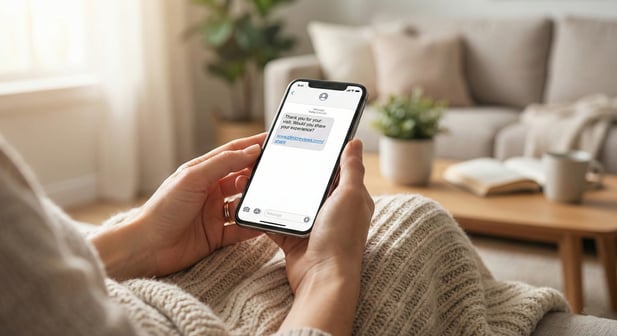
Privacy rules shape how you can ask for reviews. Curogram sends requests through secure, encrypted channels. Patients choose whether to respond. There is no pressure and no exposure of health data.
The request thanks the patient for their visit and provides a link. It does not name their treatment or condition. This keeps the message compliant even if someone else sees the patient's phone.
Patients can ignore the text with no follow-up. The system does not nag. This respects patient autonomy and keeps the process ethical. Consent is baked into the design.

Clinics new to review automation often have concerns. This section answers the most common questions about ethics, negative feedback, and real results for ketamine clinic Google reviews.
Is it ethical to ask psychiatric patients for reviews?
Yes, when done correctly. The key is framing and timing. A review request should feel like an invitation to help others, not a favor for the clinic.
The request message can say something like your story could help someone find the care they need. This shifts the focus from clinic gain to patient impact. Many patients want to pay forward the hope they received.
The system never pressures. One text goes out, and that is it. Patients in crisis are not hounded. The process respects where each person is in their journey.
How do we handle negative reviews?
Negative feedback hurts, but it also offers a chance to improve. Curogram includes a feedback-first step that catches concerns before they go public.
Before reaching Google, patients land on a page asking how their visit went. If they click less than happy, they see a private form. This alerts your team so you can reach out and fix the problem.
Many upset patients just want to be heard. A quick call can turn a would-be bad review into a loyal patient. The system gives you that chance before damage hits your profile.
Does this actually improve our ranking for ketamine or TMS?
Yes. Google scans review text for entities, which are named things like treatments, conditions, and locations. The more your reviews mention ketamine or Spravato, the higher your authority for those terms.
Google reads each review and tags the words it finds. When ketamine appears ten times across your reviews, the algorithm ties your clinic to that treatment. This is how mental health SEO works at the review level.
Each new review adds to your topical weight. After six months of steady reviews, your clinic can dominate local searches for terms like TMS treatment near me or ketamine for depression. The effect builds and lasts.
Building trust takes time. But with the right system, your clinic can become the go-to name for advanced mental health care in your area. Google review automation for Osmind makes this goal reachable.
Most clinics start as one choice among many. Patients see a list of options and pick based on distance or insurance. Reviews change this dynamic by adding proof of results.
The Map Pack shows three clinics at the top of local search. Landing here brings a huge jump in clicks. Clinics with more recent reviews and higher ratings claim these spots.
As your review count grows, Google shows your clinic to searchers farther away. You become a regional name, not just a local one. Patients drive extra miles to see a clinic they trust based on reviews.
Your best marketing asset is the care you already deliver. Google review automation for Osmind captures this value and displays it where new patients look. Every good outcome becomes a reason for someone new to call.
Nothing beats a real person saying, “This clinic helped me.” Reviews provide this proof at scale. Each story adds weight to your online presence and draws more patients in.
The system runs on its own once set up. Your front desk does not need to ask for reviews. Your providers focus on care. The marketing happens in the background, powered by patient voices.
Take the first step toward turning your clinical success into lasting search results. Google review automation for Osmind and Curogram can help your practice rise to the top of local search and stay there.
Schedule a 10-Minute Demo today to see how Google review automation for Osmind can help you turn your clinical success stories into a permanent top-tier ranking on Google.
1 min read
Jo Galvez : Jan 5, 2026, 8:00:00 AM
💡 Imaging centers face unique trust issues. A single bad review can damage referral flow and hurt revenue across multi-site networks.Reputation...

1 min read
Jo Galvez : Feb 4, 2026, 3:00:00 PM
💡 Medical SEO for Osmind practices hinges on two key signals: review velocity and keyword-rich patient feedback. Google's local search now prizes...
1 min read
Sharee Narciso : Dec 10, 2025, 6:00:00 PM
💡 Many practices want to boost Google reviews Office Ally but find that ratings change slowly without a clear plan. Patients share feedback more...