Google Review Automation for Cerbo: Build a 5-Star Reputation at Scale
💡 Google review automation for Cerbo helps integrative medicine practices build a strong online reputation without extra work. Sends text review...
12 min read
Mira Gwehn Revilla
:
February 3, 2026
You run one of the best clinics in town. Your patients rave about their results. Yet when someone searches "functional medicine doctor near me," your practice is nowhere to be found. Sound familiar?
This is the "invisible expert" problem. It affects countless Cerbo practices that offer great care but struggle to show up online. The good news is that the fix is simpler than you think.
Medical SEO for Cerbo practices has changed a lot in recent years. It is no longer just about stuffing keywords into your website. Google now looks at something far more powerful—what your patients say about you and how often they say it.
In 2026, Google cares deeply about two things when ranking local medical practices. First is how many new reviews you get each week.
Second is what words patients use in those reviews. A clinic with ten fresh reviews this month will often beat one with a hundred old reviews from two years ago.
This is where review automation comes in. When you connect Curogram with your Cerbo system through MD-HQ, something magical happens.
Every patient visit can trigger a simple text asking for feedback. Satisfied patients share their stories. Google takes notice. Your rankings climb.
The best part? This system runs on its own. No extra work for your front desk. No awkward asks at checkout. Just a steady flow of real patient voices building your online presence day after day.
In this guide, you will learn exactly how automated reviews feed the Google search engine. You will see why review velocity for medical practices matters more than total review count. Discover how to turn your clinical wins into lasting search rankings:
You might be the most skilled doctor in your area. But if Google does not know that, neither do the people searching for help. Let's look at three traps that keep great Cerbo practices hidden from view:
Many well-known practices fall into this trap. They built a solid rating years ago—maybe 4.8 stars with 150 reviews. Then they stopped asking. The reviews dried up.
Here is the problem: Google sees a practice with no new reviews in months as a stale listing. Think of it like a restaurant with great old reviews but no recent ones. Would you trust it is still good? Google thinks the same way.
A newer clinic that gets three or four reviews per week will often rank higher. Even if they have fewer total reviews. Even if their rating is slightly lower.
This is because Google values fresh signals over old ones. It wants to show searchers places that are active and thriving right now.
For example:
Imagine two thyroid specialists in the same city. One has 200 reviews but the last one came in six months ago. The other has 80 reviews but gets two new ones each week. In most cases, the second practice will show up first in the Google Map Pack for doctors.
Your website says you treat Lyme disease. But do your reviews mention it? If not, you have a keyword gap.
Google looks for proof that you actually do what you say. Your website is one source. But patient reviews are third-party proof—and Google trusts them more.
When ten patients write about their Lyme treatment at your clinic, Google connects the dots. It sees your practice as an expert source for Lyme care.
Without those keyword-rich patient reviews, Google lacks the proof it needs. You might offer the best SIBO treatment in town. But if no one mentions "SIBO" in their review, you will not rank for it.
This is a big deal for integrative and functional medicine practices. You often treat conditions that require specific, niche search terms. Terms like "adrenal fatigue," "mold illness," or "peptide therapy." Each one is a chance to rank—but only if patients mention them.
Large health systems have deep pockets. They spend millions on ads and SEO teams. They can dominate broad search terms like "doctor near me" or "medical clinic."
How does a small practice compete? The answer is local focus.
Large hospitals cannot match the local trust that patients feel toward their neighborhood clinic. They cannot collect the same depth of feedback for niche treatments. This is where independent practices have an edge.
You have to claim that edge. You need reviews that mention your specific location. Your specific services. Your specific approach to care.
When a patient writes "best hormone replacement therapy in Austin," Google sees both the service and the place. That local link is gold.
MD-HQ reputation SEO comes down to this simple truth: you must actively show Google why you are the best local choice. Great care alone will not do it. You need a steady stream of patients sharing their stories in words that match what people search for.
The good news is that you do not need a hospital-sized budget. You need a smart system. In the next section, you will see exactly which signals matter most—and how to automate them with your Cerbo workflow.
Google uses many signals to rank local practices, but three stand out above the rest. These are the pillars that can make or break your visibility in local search.
Review velocity is how often you get new reviews. It is not about collecting hundreds of reviews once and calling it done. It is about keeping a steady pace over time.
Think of it this way. A practice that gets 50 reviews in one month and then zero for the next six months looks suspicious.
Google wonders if something changed. Did the care quality drop? Did the practice close? Even if neither is true, the silence hurts your rankings.
Now, picture a practice that gets 8-12 reviews per month, every month. Google sees this as a healthy, active business. Patients keep coming. They keep having good things to say. This steady signal builds trust in the algorithm.
Curogram helps you hit this mark without extra work. When linked to Cerbo through MD-HQ, it sends review requests as visits wrap up.
Every day, a few patients get a text. Some respond. The reviews flow in at a natural pace. No spikes. No gaps. Just a constant drip that keeps you visible.
Google also looks at where your reviews come from. Are they all from the same provider? The same location? The same week?
Diverse reviews look more natural. They suggest a practice that serves many types of patients across many situations. This makes your listing seem more trustworthy.
For practices with more than one doctor, this matters a lot. If all 50 reviews mention Dr. Smith but none mention Dr. Jones, Google might not rank you well when someone searches for care Dr. Jones provides.
Curogram captures feedback across your whole team. Each provider can have review requests linked to their visits. This spreads the love and builds a fuller picture of your practice.
This is the most overlooked pillar—and maybe the most powerful. The actual words patients use in their reviews shape how Google sees you.
When a patient writes "finally found relief from my chronic fatigue," Google learns you help with chronic fatigue. When another writes "amazing care for my gut health issues," Google now links you to gut health searches.
These are not keywords you can stuff into your website. They come from real patients describing real experiences. That makes them far more valuable in Google's eyes.
The key is to make it easy for patients to share their specific story. Generic reviews like "great doctor, highly recommend" are nice but do not help much. You want patients to mention what they came in for and how you helped.
The table below shows how each pillar affects your ranking and how Curogram helps:
| SEO Signal | Impact on Ranking | How Curogram Automates It |
| Review Velocity | High | Sends requests daily as visits are completed in Cerbo |
| Review Diversity | Medium | Captures feedback across various providers and locations |
| Keyword Content | Critical | Encourages patients to describe their specific health journey |
Together, these three pillars form the base of modern medical SEO. Nail them, and you give Google exactly what it needs to rank you above bigger, less-focused competitors. Miss them, and even the best care will stay hidden from the people who need it most.

Understanding why reviews matter is one thing. Seeing how the system actually works is another. Let's break down exactly how automated reviews from your Cerbo practice send the right signals to Google:
Google's algorithm in 2026 rewards practices that show steady signs of life. A burst of 20 reviews in one week followed by nothing for months looks odd. It can even trigger spam filters. What Google wants to see is a pattern of regular, natural feedback.
This is why daily automation beats manual review campaigns. When your staff remembers to ask for reviews, you might get a few. When they forget—which is often—you get none. The result is an uneven pattern that does not help your rankings.
With Curogram connected to Cerbo, the process runs itself. Here is how it works in practice:
A patient finishes their visit and checks out
Cerbo marks the visit as complete in MD-HQ
Curogram detects this trigger and sends a text within hours
The patient sees a simple message asking about their experience
Satisfied patients click through to leave a Google review
This happens for every visit, every day. If you see 15 patients today, 15 texts go out. Tomorrow, another batch. The reviews come in steadily—maybe two this week, four next week, three the week after. That natural flow tells Google your practice is active and trusted.
Compare this to the old way. You run a "review push" campaign. Your front desk asks everyone for a week. You get 30 reviews. Then the campaign ends, and months pass with nothing new. Google notices the drop. Your rankings slip. You start over.
The automated approach avoids this cycle. No more asking your busy staff to remember one more thing. No more awkward moments at checkout. Just a quiet system working in the background.
Long-tail keywords are specific phrases people type into Google. They are longer than basic searches and often show strong intent.
Someone searching "functional medicine doctor" might just be browsing. Someone searching "best functional medicine doctor for SIBO in Denver" is ready to book.
These specific searches are gold for small practices. Big hospitals rarely rank for them because they cast too wide a net. But a focused integrative clinic can own them—if patient reviews use the right words.
Here is where the magic happens: When patients describe their health journey in reviews, they naturally use long-tail phrases. They do not write "good doctor." They write "finally got my thyroid levels balanced after years of struggle" or "the only place that took my mold exposure seriously."
Google's AI reads every review. It pulls out these phrases and uses them to understand what your practice does best. Each new review adds more data points. Over time, your profile becomes rich with terms that match what real patients search for.
For example, imagine you run a functional medicine practice. In the past month, patients left reviews mentioning:
"Helped with my chronic Lyme symptoms"
"Best integrative approach to hormone balance"
"Finally addressed my gut issues after other doctors dismissed me"
"Comprehensive thyroid panel that changed my life"
Each of these is a search term waiting to happen. When someone types "integrative hormone balance near me," Google sees your reviews and thinks, "This practice matches." You show up. They click. The cycle continues.
This is the power of keyword-rich patient reviews. They do the SEO work for you. No need to hire an agency to stuff your website with awkward phrases. Your patients write the content. Google reads it. Your rankings rise.
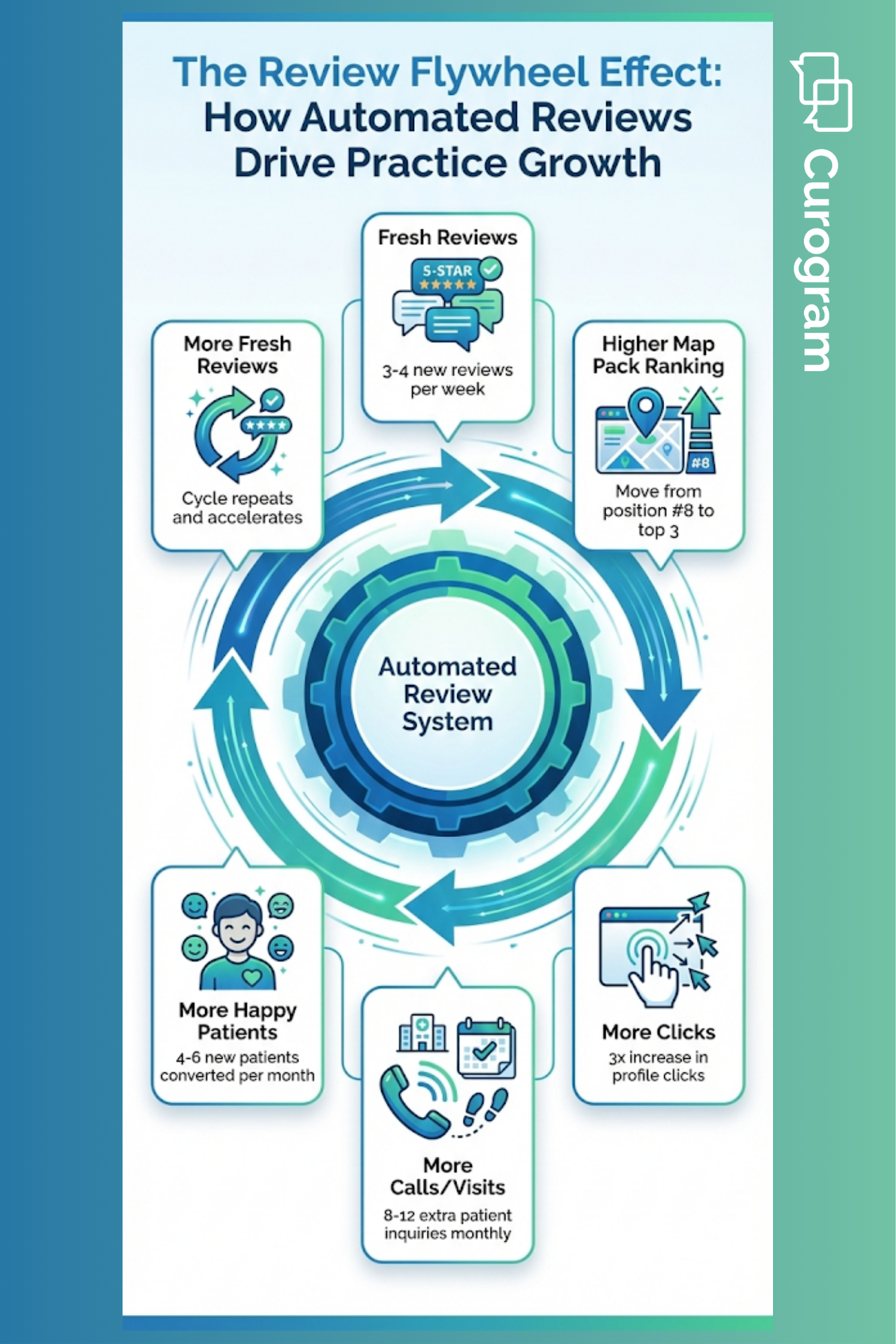
Reviews do not just affect your ranking directly. They also trigger behaviors that boost your ranking even more. This is the flywheel effect.
Here is how it works: A potential patient searches for a functional medicine doctor. They see your practice in the Google Map Pack for doctors. They notice you have 4.9 stars with 85 reviews, including several from this month. They click your profile.
That click is a signal. Google notes that users find your listing worth checking out. Now the patient reads a few reviews. They see one from last week that mentions the exact issue they have. They feel a connection. They hit "Call" or "Get Directions."
Those actions are stronger signals. Google sees that users do not just click your profile—they take action. This tells the algorithm that your listing answers what people need. So Google shows you to more people.
Practices with stale or thin review profiles miss out on this effect. Even if they show up in search, users scroll past them. Low clicks mean lower rankings over time. The flywheel never starts.
Automated reviews keep your profile fresh and full. New reviews attract more clicks. More clicks bring more patients. More patients mean more reviews. The cycle builds on itself.
Let's put numbers to this: Say you get two extra calls per week because your profile looks more active. That is about eight calls per month. If even half turn into visits, you have four new patients. If each patient is worth $500 in first-year revenue, that is $2,000 per month—$24,000 per year—from a system that runs itself.
And it does not stop there. Those new patients leave reviews. The flywheel spins again. Your competitors, stuck with old profiles and no system, fall further behind.
This is why MD-HQ reputation SEO is not a nice-to-have. It is a growth engine. Every day you wait is a day your competitors might catch on. The practices that automate now will own their local search results for years to come.

Every great patient outcome is a chance to grow your practice. But only if you capture it.
Most practices let these moments slip away. The patient leaves happy. The front desk moves on to the next task. No one asks for a review. Weeks pass. The moment is lost.
Automated review requests change this pattern. They reach patients while the positive experience is still fresh. A simple text takes seconds to send and even less time for patients to act on.
The result is a practice that turns clinical wins into lasting visibility. Each review is a small investment in your future rankings. Each ranking boost brings more patients.
Each new patient is another chance to excel—and another chance to share that success with Google.
Curious what this could mean for your bottom line? Use Curogram's Reputation Booster calculator to see how converting just 5-10% of your monthly visits into 5-star Google reviews can transform your online presence.
This is not about gaming the system. It is about making sure your real results get the attention they deserve. You already do the hard work. Automation makes sure the world sees it.
Why Curogram is Your Automated Path to Google Visibility
Curogram is built to solve the review problem for medical practices. It connects directly with your Cerbo system through MD-HQ, turning every completed visit into a chance for Google growth.
Here is what sets Curogram apart. First, it sends review requests by text—the channel patients actually use. No emails that sit unopened. No clunky apps to download. Just a simple SMS that takes seconds to read and act on.
Second, Curogram is smart about timing. Requests go out while the visit is fresh in the patient's mind. This boosts response rates and makes reviews feel natural, not forced.
Third, the system works without adding tasks for your staff. No one has to remember to ask. No one has to track who got a request and who did not. The automation handles it all. Your front desk can focus on patient care, not marketing tasks.
For practices with multiple providers or locations, Curogram keeps things organized. It knows which doctor saw which patient and routes feedback to the right profile. This builds a complete picture of your practice across all your listings.
The results speak for themselves. Practices using automated review systems see a steady climb in Google rankings. They show up more often in the map results that drive local clicks. They attract patients who are ready to book, not just browse.
Curogram also helps protect your online standing. When a patient has a complaint, the system gives you a chance to address it before it becomes a public review. This keeps small issues from becoming big problems.
Medical SEO for Cerbo practices does not have to be complicated. With the right tool, it can run quietly in the background while you focus on what you do best—helping patients feel better.
Google does not care how good your care is. It only sees the signals you send. Reviews are one of the loudest signals you can give.
For Cerbo practices, the path forward is clear. Automate your review requests. Keep them steady. Let patients describe their journey in their own words. Watch your rankings climb.
This is not a quick hack. It is a long-term strategy that builds on itself. Each review adds to your foundation. Each month of steady feedback strengthens your position. Over time, you become the obvious choice for anyone searching in your area.
The practices that start now will have a big lead. They will own the Google Map Pack for doctors in their niche.
They will attract patients who already trust them based on what others have said. They will spend less on ads because organic search does the work.
Those who wait will fall further behind. Old reviews lose power. Active competitors pull ahead. The gap grows wider each month.
You do not need a big budget to compete. You do not need a marketing team. You need a system that captures patient success and shares it with Google—automatically, every day.
Curogram gives you that system. It plugs into your Cerbo workflow and handles the rest. No extra work for your staff. No awkward asks. Just a steady engine driving your practice to the top of local search results.
The choice is simple. Keep being the invisible expert, or let the world see what your patients already know.
Schedule a 10-minute demo today to see how Curogram's Google review automation for Cerbo can transform your clinical success into a top-tier ranking on Google.
Transform your clinical success into a top-tier ranking on Google. Schedule a quick demo today to see how Curogram's Google review automation for Cerbo works.
Yes. Curogram can tell which location the patient visited based on data from Cerbo. It then routes the review request to the correct Google Business Profile.
Google weighs several factors: review count, review freshness (velocity), star rating, profile completeness, and whether review content matches what users search for. Recent, keyword-rich reviews carry the most weight.
Most practices notice changes within 8-12 weeks of consistent review collection. The timeline depends on your market, competition, and how active your profile was before starting.
💡 Google review automation for Cerbo helps integrative medicine practices build a strong online reputation without extra work. Sends text review...
💡 Clinics using GE Centricity face a tough challenge with reputation management in GE Centricity. Getting patients to leave reviews takes time and...
💡 Reputation management in StreamlineMD helps radiology, vascular, and IR practices build a stronger online presence through automated feedback...