Rural Patient Video Visits by Text | No App | Azalea Health + Curogram
💡 Rural patients using Azalea Health clinics can now attend a video visit with their doctor by tapping a single link in a text message. No app...
7 min read
Aubreigh Lee Daculug
:
July 8, 2026
Your patient finished their third ketamine infusion just yesterday. The experience was intense. New emotions surfaced, and you scheduled a telemedicine integration session for today to help them process everything while the therapeutic window was still open.
Then 2 PM arrives, and nothing happens.
They genuinely wanted to be there. They simply could not get in. The Osmind app was buried in a folder they had not opened in weeks. The password was gone.
By the time the reset email finally landed and they located the join button, you had already moved on to the next patient.
Here is the frustrating part.
The distance was not the problem. The schedule was not the problem. The patient's willingness was not the problem. The login was.
This is the quiet failure point in virtual care for interventional psychiatry practices. The clinical work is ready. The provider is ready. The patient fully means to show up.
But a few taps of technology friction stand between them, and those small taps are enough to turn a needed follow-up into a missed one.
It sounds like a small thing. It absolutely is not.
Each missed session is far more than lost revenue. It is a break in a treatment plan that depends heavily on timing. Post-infusion processing, medication changes, and TMS check-ins all lose value when they slip.
HIPAA-compliant text-launched telemedicine for Osmind interventional psychiatry follow-ups solves this by removing the barrier completely. Curogram sends a video visit link by text.
The patient taps it. The call opens in their browser. No app, no password, no portal.
This article breaks down why the login barrier costs practices more than they really realize, why the usual fixes fall short, and how one simple text link can protect the treatment gains you work so hard to build.
Let's start with why this happens, because the reason is not what most practices assume.
When a follow-up video visit gets scheduled, many patients have to reopen an app they have not touched in weeks. They downloaded Osmind during intake, used it for a few early assessments, and then let it drift to a back screen.
Now they have to find it, log in or reset a lost password, and hunt for the join button. Every step is a chance to give up.
Here is the part most practices miss.
In interventional psychiatry, you cannot assume app engagement.
The same executive function struggles that bring patients in for care are the ones that make a buried app feel impossible on a rough day. This is not a motivation problem. It is an access problem.
Think about a real appointment. Your patient had their third infusion yesterday and is still processing heavy emotional material.
At 1:55 they open their phone, dig for the app, and hit the password wall.
The reset email arrives. They log back in at 2:04 and still cannot find the join button, so they text the front desk asking how to get into the call.
By 2:12, you have moved on. The integration session inside the critical 24-hour window is gone.
It sounds like bad luck. It is actually a pattern.

Behavioral health telemedicine no-show rates run 20% to 30%, and technology friction is named again and again as the top reason. Each missed follow-up costs you 30 to 60 minutes of booked clinical time.
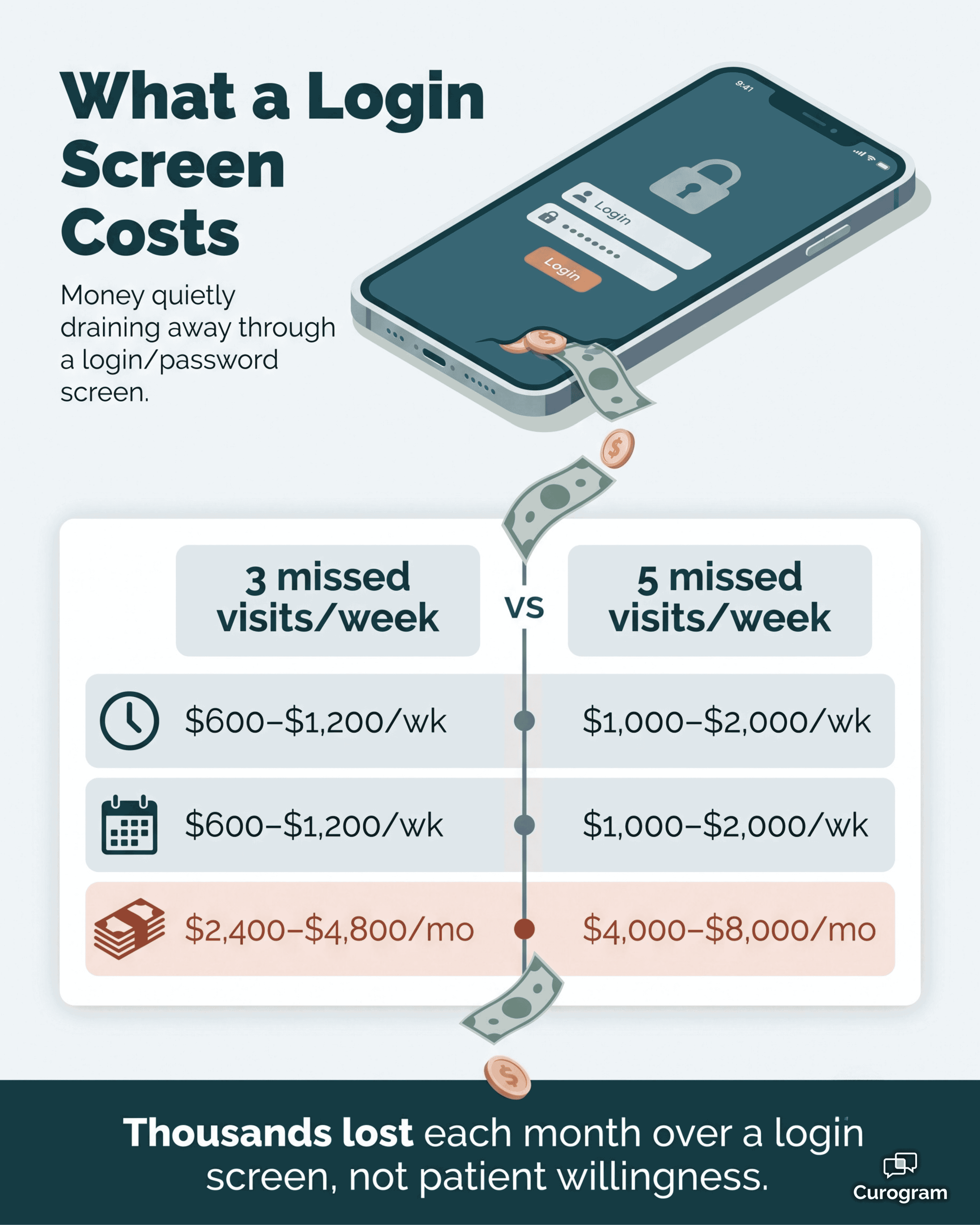
Here is what that looks like for a psychiatrist billing $200 to $400 an hour:
| Missed telemedicine visits | Lost weekly revenue | Lost monthly revenue |
|---|---|---|
| 3 per week | $600 – $1,200 | $2,400 – $4,800 |
| 5 per week | $1,000 – $2,000 | $4,000 – $8,000 |
Read those totals again. This means thousands of dollars a month leaving the practice over a login screen, not over patient willingness.
That is the real cost of the login barrier. You scheduled the session because it matters clinically. The patient wanted to attend. The technology in the middle is what stopped it.
In this specialty, that is not a small design flaw. It is a clinical continuity problem wearing a technology costume.
So what does removing that barrier actually look like? Simpler than you might expect.
Curogram reduces the whole process to one action: tapping a text link. Staff or the provider sends a video visit link through Curogram's SMS platform, and the patient gets it as a plain text message.
Here is the full flow on their side:
Each link is unique and single-use,
Which is part of what makes this the kind of no-app telemedicine interventional psychiatry practices can actually trust:
Simple and secure at the same time. This is the frictionless telemedicine TMS post-treatment check-in your protocol has been missing.

The launcher runs alongside Osmind rather than on top of it. You still document the session in Osmind exactly as you always have.
Curogram handles the access layer, getting the patient onto the screen. Osmind handles the clinical record. The two complement each other instead of competing for the same job.
This specialty has unusually high-value virtual visits. Think post-ketamine integration within 24 to 72 hours, dosage decisions for treatment-resistant patients, post-TMS cognitive checks, and Spravato REMS monitoring calls.
A text link video visit Osmind ketamine follow-up patients can join in seconds turns SMS-launched virtual visit integration therapy from a nice idea into a dependable routine. The same channel carries a HIPAA video call Osmind medication management appointment just as easily.
For your team, that means fewer scramble texts and fewer empty slots at the end of the week.
Atlas Medical Center reached a 4.91% no-show rate on Curogram's SMS platform, down from 14.20%. Telemedicine no-shows are driven mostly by access friction, not travel, so a one-tap link targets the exact variable that causes missed virtual visits.
The mindset shifts with it. You move from hoping patients figure out the app to trusting that every scheduled follow-up has a delivery method as reliable as a text, helping improve patient satisfaction.
The technology becomes invisible. And invisible is exactly what it should be when a patient is trying to process a ketamine experience with their psychiatrist.
Now run that 2 PM scenario one more time. It is 1:55.
A text arrives:
"Your video visit with Dr. Patel starts in 5 minutes. Tap here to join."
The patient taps. The browser opens. Dr. Patel's face appears. By 2:01 the session is underway, the infusion is processed inside the optimal window, and the protocol stays intact. The outcome is protected because the technology finally got out of the way.
You already know these follow-ups matter. You schedule integration sessions, medication check-ins, and post-TMS reviews because the treatment does not end when the patient leaves your office.
It continues in the days that follow, and the timing of that continuation shapes the outcome.
So the question is not whether virtual follow-ups belong in your practice. They clearly do. The real question is whether the way patients reach them is helping your protocol or quietly working against it.
A login screen works against it. A password reset works against it. An app buried in a folder, opened once during intake and then forgotten, works against it. None of these things reflect a patient who does not care.
They reflect a system asking too much at the exact moment a patient has the least capacity to give it.
Text-launched telemedicine flips that. Osmind records the clinical visit. Curogram makes sure the patient is actually on the screen when that visit begins, using a link as simple as any other text they receive all day. One tool documents the session. The other one protects it.
Think about what that protects over a full year. Every recovered follow-up is a treatment gain that stays intact, a revenue slot that stays filled, and a patient who reaches their provider without a fight against their own phone.
Stop losing meaningful follow-up visits to login screens and forgotten passwords. Give your patients the shortest possible path to their provider's face, and give your protocol the reliability it truly deserves.
Schedule a Demo to experience the patient-side video visit flow yourself. Watch how a single text link launches a full HIPAA-compliant video call in under 10 seconds, and imagine what that reliability could do across every follow-up on your schedule next week.
Yes. Curogram's video visits use end-to-end encryption and meet all HIPAA requirements for transmitting protected health information, backed by a signed Business Associate Agreement (BAA). The browser-based approach can even strengthen security. There is no app storing data locally on the patient's device, and each session link is unique and expires after use.
No. Curogram gives patients a lower-friction way to join a video visit, not a replacement for your clinical system. You can use text-launched video for patients who struggle with app access and keep Osmind's native video for patients who are comfortable with the app. Either way, the clinical documentation stays in Osmind.
Yes. Curogram's automated reminders can carry a video visit link that activates at the scheduled time. The patient gets the reminder text with the link already embedded, so when the appointment arrives, they tap the same link they have had all along. That cuts down on touchpoints and makes sure the patient has access before they need it.
No. The video visit runs in the mobile browser the patient already uses every day, so any recent smartphone works. A standard cellular or Wi-Fi connection is enough for a clear call. If the signal drops, the patient can simply tap the same link again to rejoin, with no reinstall and no new setup.
A single tap removes most of the friction, but life still happens. When a patient misses, Curogram keeps the recovery just as simple, because staff can resend the same secure link with one message and reconnect the patient within seconds. That turns a missed appointment into a quick reschedule instead of a lost slot and a broken protocol.
💡 Rural patients using Azalea Health clinics can now attend a video visit with their doctor by tapping a single link in a text message. No app...
💡 NextGen patient video visit functionality powered by Curogram's One-Tap Video Visit lets patients connect with their doctor on video by tapping a...
💡 Tebra patients can join a video visit from a text message — no app, no download, and no portal login needed. Curogram sends patients a text...