



7 min read
Fill Cancellations at Your Meditab IMS Practice | Waitlist Texting
Aubreigh Lee Daculug
:
May 11, 2026
The moment a slot opens, Curogram instantly texts eligible waitlist patients. The first to confirm wins the slot.
This replaces the manual phone scramble that rarely closes the gap in time. Practices using automated cancellation backfill in Meditab fill 60–80% of slots that previously went empty.
The result: protected revenue, less front desk stress, and a schedule that fixes itself in minutes instead of hours.
A cancellation hits your schedule at 11 AM. The 2 PM dermatology visit is gone. Your front desk has three hours to fill it.
That sounds like plenty of time. It rarely is.
Here's what actually happens. A staff member opens your waitlist. They call the first patient — voicemail. They call the second — wrong time of day. They call the third — no answer. Twenty minutes pass. Thirty.
By 1:30, the slot is still empty, the provider has thirty minutes of dead time ahead, and roughly $200 in revenue just walked out the door.
This isn't a staffing problem. It's a speed problem.
Phone calls move one patient at a time. Voicemails create delay. Callbacks come in after the slot is gone.
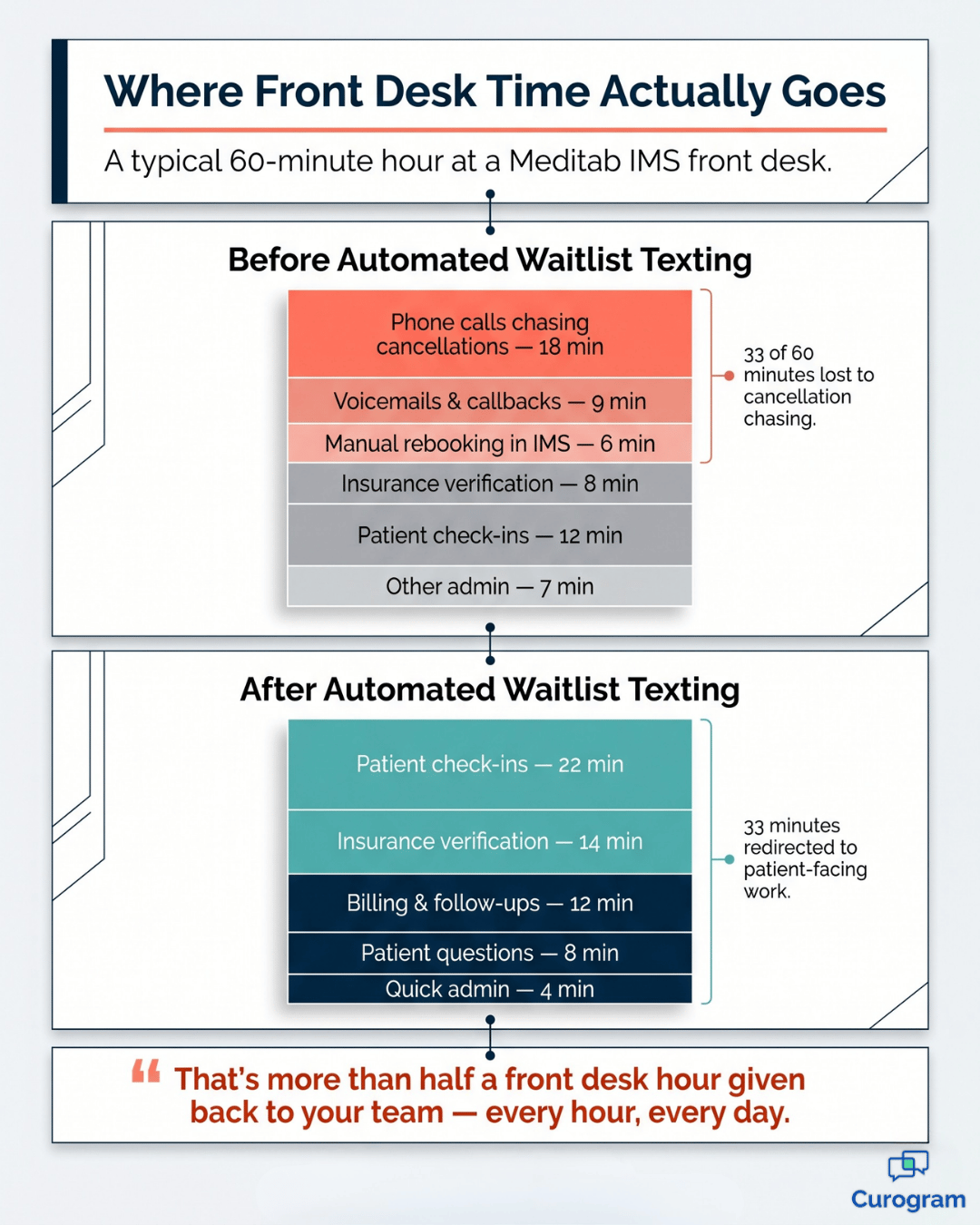
Meanwhile, your front desk is also checking patients in, verifying insurance, and handling the lobby. The math doesn't work — and most teams already know it. That's why they give up after three calls and quietly accept the empty chair.
Now think about the size of this leak. If your practice loses two to three same-day cancellations a day, and only half get filled, you're watching $3,000 to $9,000 a month vanish from a schedule that was already booked. That's revenue you earned, then handed back.
This is exactly the gap that makes the case to fill last-minute cancellations Meditab IMS practice automated waitlist texting solves. Instead of asking your team to outrun the clock with a phone, the system reaches every eligible patient at once — within seconds of the cancellation.
The schedule starts repairing itself before your staff finishes the next check-in. That's the shift this article is about.
The Empty Chair That Didn't Have to Be Empty
Cancellations are part of running a medical practice. Patients get sick. Kids stay home from school. Cars don't start. Emergencies happen. None of that is going away.
The real problem isn't the cancellation. It's the gap between when the cancellation lands in your schedule and when (or if) the slot gets filled. In a Meditab IMS practice that relies on phone-based backfill, that gap is almost always too wide to close.
Why the Manual Scramble Falls Short
Walk through what your front desk actually does when a cancellation comes in. They open the waitlist. They start at the top. They dial. They wait through ringing. They leave a voicemail. They move to the next name. They repeat.
Each attempt eats two to four minutes — and only if the patient picks up. Most won't. Even a fast, focused staff member can only reach three or four patients in the time most last-minute slots stay open.
Every one of those calls competes with check-ins, insurance questions, and the phones already ringing at the front.
It sounds simple. It isn't.
The Real Cost of an Unfilled Slot
A single empty appointment isn't just downtime. It's revenue you already booked.
Across primary care, dermatology, gastroenterology, and multi-specialty practices running IMS, an unfilled last-minute slot averages $150 to $300 in lost revenue.
Multiply that across a normal week and the picture sharpens fast.
| Cancellation Volume | Avg. Revenue Per Slot | Lost Per Day | Lost Per Month |
|---|---|---|---|
| 2 unfilled per day | $200 | $400 | $8,000 |
| 3 unfilled per day | $200 | $600 | $12,000 |
| 5 unfilled per day | $200 | $1,000 | $20,000 |
In practice, a mid-sized IMS practice can quietly write off six figures a year — separate from no-show losses. That's not a scheduling issue. That's a revenue cycle optimization issue hiding in plain sight
The Toll on Your Front Desk
Every manual backfill attempt eats 10 to 15 minutes of staff time. That's time pulled away from patients standing at the desk, time stolen from insurance verification, and time your team resents — because most of those calls go nowhere.
After three dead-end attempts, most staff members give up. Not because they don't care. Because the math told them to. That's the villain here: the empty chair that didn't have to be empty. And the only way to defeat it is to move faster than a phone ever can.

The Automated Backfill System
Once you accept that phones can't move fast enough, the fix becomes obvious. Reach every eligible waitlist patient at the same time.
Let the first one to confirm take the slot. Let your staff stay focused on the patients in front of them.
That's the entire idea behind reduce revenue loss appointment cancellations IMS workflows powered by healthcare revenue cycle management automation.
Instant Waitlist Broadcast
The moment a cancellation is recorded in your IMS, Curogram sends a text to every eligible waitlist patient at once. The text includes the open time, the provider, and a one-tap reply to claim it.
No voicemails. No phone tag. No "I'll call you back."
First confirmation wins. The slot closes automatically. Other patients get a quick text letting them know it's been taken. The whole process — broadcast, response, rebook — usually finishes inside ten minutes.
How It Connects to Meditab IMS
Meditab IMS waitlist management automation works because Curogram pulls directly from your existing IMS schedule.
When a slot opens, the system already knows three things about it:
- The provider whose calendar the slot belongs to
- The appointment type (a 30-minute follow-up vs. a 60-minute new patient visit)
- The waitlist patients who are eligible based on type, provider, and location
Your front desk doesn't trigger the outreach. They don't pick names. They don't dial. The system handles the entire workflow and your team simply confirms the rebooked appointment in IMS once a patient claims it.
That's what front desk scheduling efficiency Meditab IMS looks like in practice — fewer steps, fewer interruptions, more time on patients who are physically in the bui.

Built for Multi-Specialty Workflows
If you're running a multi-specialty practice on IMS, you already know that a generic waitlist creates more problems than it solves.
A GI patient doesn't want a dermatology slot.
A pain management patient won't drive over for a primary care opening.
Curogram routes cancellation alerts to the correct patient pool automatically. Dermatology cancellations reach the dermatology waitlist. GI cancellations reach GI patients.
Each department's Meditab practice schedule optimization texting stays clean — no cross-contamination, no confused replies, no patients accepting slots they were never eligible for.
This is what makes automated cancellation backfill Meditab actually fit how your clinic runs day to day.
Minutes, Not Hours
The shift from manual to automated isn't subtle. It's the difference between a staff scramble and a schedule that fills itself. And it shows up first in the numbers.
The Self-Healing Schedule
Practices using automated waitlist texting consistently fill 60–80% of same-day cancellations that previously went unfilled. Run those numbers against the table from earlier and the picture changes fast.
| Daily Unfilled (Before) | Fill Rate (After) | Daily Recovery | Monthly Recovery |
|---|---|---|---|
| 3 slots × $200 | 70% | $420 | $8,400 |
| 5 slots × $200 | 70% | $700 | $14,000 |
For your team, that means thousands of dollars a month moving from "lost" to "recovered" — without hiring, without adding phone hours, and without changing how your providers practice.
A Real-World Example
A patient cancels their 10 AM pain management visit at 7:30 AM. By 7:45, three waitlist patients have a text on their phone. By 8:00, one has replied yes. By 10 AM, the chair is filled, the provider's day stays on track, and $250 in revenue is protected.
The front desk made zero phone calls. They didn't even know the cancellation happened until the rebooking confirmation appeared in IMS. That's what a self-healing schedule looks like. The cancellation still happened. It just stopped costing you money.
What Your Team Notices First
Front desk staff usually feel the change before the finance team does.
Three things shift quickly in the first few weeks:
- Phones stop ringing as often, which clears the lobby faster
- The end-of-day "we couldn't fill it" conversations get shorter, then disappear
- Cancellations stop feeling like failures and start feeling like background noise
That morale shift matters more than it sounds. When staff aren't burning energy on dead-end calls, they redirect it toward the patients actually in the building — and the patient experience improves alongside the revenue numbers.
Stop Giving Back Revenue You Already Earned
Cancellations are inevitable. Lost revenue from cancellations isn't.
Every unfilled slot at your Meditab IMS practice is money you already booked, scheduled, and prepared for — then quietly handed back because the phone couldn't move fast enough.
The good news is that the gap between cancellation and rebooking is now solvable, not by adding staff or making more calls, but by letting an automated system reach every eligible patient at once.
Meditab IMS runs your clinical schedule beautifully. It's not designed to chase down replacement patients in real time.
That's where Curogram fits — sitting on top of IMS, watching for openings, and turning them into rebookings before your team even hears about the cancellation.
Here's the simple takeaway. If you're losing $200 to $1,000 in revenue every day to unfilled cancellations, recovering even 70% of that pays for the platform many times over within the first month.
Most practices are live within 48 hours, with no long-term contract and no disruption to how your front desk currently works.
Your providers shouldn't have idle time when waitlist patients are ready to come in. Your front desk shouldn't burn 15 minutes per cancellation chasing voicemails. And your practice shouldn't be writing off thousands a month from a problem that already has a fix.
Schedule a demo today. We'll walk you through the full automated cancellation backfill process, show you how the integration sits inside IMS, and run the recovery math on your specific cancellation volume.
Frequently Asked Questions
Yes. Every waitlist notification sent through Curogram is encrypted and HIPAA-compliant. The texts let patients know a time slot is available without disclosing any protected health information. Curogram operates under a Business Associate Agreement and is SOC 2 Type II certified, which is the standard your compliance team will want to see.
Yes, and this is one of the most important parts of the setup. Curogram filters your waitlist by appointment type, provider, location, and patient preferences. You set the rules. Only eligible patients receive a notification for an opening that actually matches their needs. No irrelevant texts. No patient confusion. No staff cleanup afterward.
First confirmation wins. Once a patient confirms, Curogram closes the slot automatically and sends a quick follow-up text to the others letting them know the time has been taken. There's no double-booking, no awkward "sorry, someone already grabbed it" call, and no manual cleanup for your front desk. The system handles the logistics so your team doesn't have to.
Most practices are live within 48 hours. Setup involves connecting Curogram to your existing IMS schedule, configuring your waitlist filters by specialty and provider, and a brief training session for your front desk team. There's no rip-and-replace and no disruption to how IMS already works for your clinical staff.
Yes — it's actually one of the strongest use cases. Curogram routes cancellation alerts to the correct department's waitlist automatically, so dermatology openings reach dermatology patients and GI openings reach GI patients. Each specialty's schedule optimization runs independently inside the same platform.