
 Aubreigh Lee Daculug
Lytec 2026 added online scheduling and better patient search, but it still has no native digital intake with structured write-back. Reseller add-ons usually send back a flat PDF your staff re-types anyway.
Curogram returns answers as structured fields, needs no app or portal password, and rides the same text thread that cut no-shows at Atlas Medical Center from 14.20% to 4.91%.
Count the pages in one new patient packet. Most small offices land somewhere near 19 — demographics, medical history, consents, insurance details, privacy notices, and a financial policy nobody actually reads.
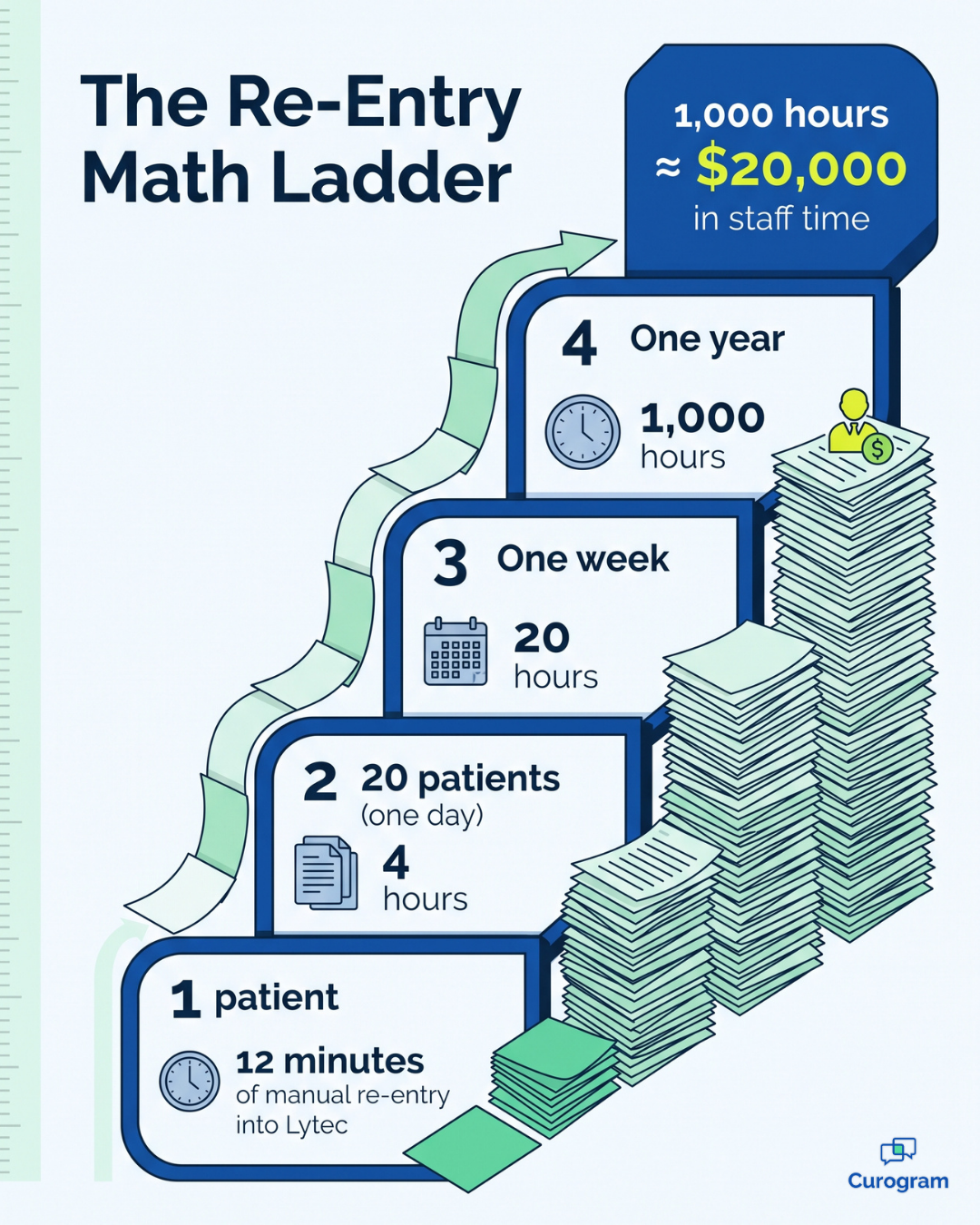
Now count the minutes required to enter all of that into Lytec. Ten on a good day. Fifteen when the handwriting fights back.
Multiply that by twenty patients and you get three to five hours of typing every day, absorbed by a front desk of one to three people simultaneously fielding 80+ phone calls.
The frustrating part is that Lytec itself is not the problem. CGM built a billing and scheduling system that has run dependably for thirty years, and Lytec 2026 pushed it further with online scheduling and a considerably sharper patient search. Intake simply never made the trip.
There is still no native digital intake with structured write-back, so the visit opens with a clipboard.
So practices go looking for a patch. They shop the reseller add-on market, purchase a form tool, and discover that the tool emails a PDF. Staff still key in every field manually. Same work, one additional login, another invoice.
Here is what genuinely changes the math.
Lytec digital intake forms replace paper when the packet leaves your lobby entirely and lands on the patient's phone before they get in the car. Patients tap a link in a text and finish the forms at home.
The answers return as clean fields your team verifies instead of retypes.
No app download. No portal password. No stack.
This article breaks down what the paper packet actually costs you, why the add-on route keeps disappointing practices, and how a single pre-visit text converts 19 pages into a five-minute task the patient completes before check-in.
Bring your own daily patient count. The math gets uncomfortable very quickly.
The 19 Pages Standing Between You and the Visit
Give Lytec its due. Thirty years of dependable billing, clean scheduling, and patient accounts that survive an audit is not a small accomplishment. Lytec 2026 kept the momentum going with online scheduling and a much stronger patient search.
Intake never made that trip. There is still no native digital intake that returns structured data to the chart, so the visit begins exactly the way it did in 2006 — with a clipboard.
Follow a single packet through a Tuesday morning. Someone prints it, or the patient is instructed to arrive 20 minutes early. The clipboard travels out to the lobby, then comes back with half-legible handwriting and a blank line where the group number belongs.
That is when the real work starts. Your front desk enters demographics, insurance IDs, medications, and history between phone calls, then scans the paper anyway just in case.
One flipped digit in a member ID does not remain a harmless typo. It resurfaces weeks later as a denied claim sitting in a patient account.
Here is what an ordinary day actually costs you.
| Step in the paper workflow | Per patient | Per day at 20 patients | Per year at 250 days |
|---|---|---|---|
| Print and hand out the packet | 1 min | 20 min | 83 hours |
| Re-key the fields into Lytec | 10–15 min | 3–5 hours | 750–1,250 hours |
| Scan and file the paper copy | 2 min | 40 min | 167 hours |
| Chase one missing or unreadable field | 3 min | 30 min | 125 hours |
Look closely at the second row, because it carries the most weight. Somewhere between 750 and 1,250 hours a year is roughly half a full-time salary devoted to retyping information the patient already handed you.
At $20 an hour, that is $15,000 to $25,000 of payroll disappearing into a job nobody applied for.
The remaining rows are not free either. Added together, the paper packet quietly consumes more than 1,100 hours a year at a twenty-patient practice. In practice, that is time your team loses to administrative tasks instead of scheduling, benefits verification, or the person waiting at the counter.
You can feel the cost without opening a spreadsheet. It looks like the office manager staying 40 minutes past close to finish the stack, and the new patient spending their first 20 minutes with your practice balancing a clipboard on one knee.
It looks like a physician walking into an exam room where the medication list is still sitting on paper.
Sending the Packet Before Anyone Walks In
The fix is not a better clipboard. It is moving intake out of your lobby and onto the phone the patient already has in their hand.
Curogram does that by riding the same text thread that confirmed the appointment. The reminder goes out, the form link goes with it, and the patient finishes the packet on the couch.
One platform, one vendor, one bill, instead of five add-ons stacked on top of Lytec.
Forms patients actually finish
Curogram's Secure Online Forms cover the whole packet: demographics, medical history, consents, and insurance details, plus photo capture for the front and back of the card. Everything is HIPAA-compliant and sent as a secure link, not raw health information in a text message.
There is no app to download and no account to create. That is Lytec patient intake without portal login, which matters more than it sounds.
The 80-year-old grandmother and the 25-year-old grad student both know how to tap a link. Neither one will call your front desk to reset a password.
The honest version of integration
This is where most tools lose your trust, so here is the plain version. Curogram captures responses as separate, structured fields rather than one flat document, which is what makes Lytec online patient forms with structured write-back different from a PDF in your inbox.
On the Lytec side, that connection runs through CGM's FHIR API. It requires a purchased connector and CGM developer approval. Curogram manages that pathway with CGM directly, so your office never has to work through the developer process alone.
You will see exactly which fields flow where during a demo, along with any limits, because a surprise later is worse than a straight answer now.
One more thing worth knowing:
Curogram works with any EMR. If your practice management system ever changes under CGM's roadmap, your intake process travels with you.
Built for offices without an IT department
Lytec's base is family practice, internal medicine, and small specialty clinics. In most of them, the office manager is the IT department. Staff learn Curogram in under 10 minutes, and there is nothing to install on a server.
With digital new patient forms, a small practice also gets something it did not expect: intake starts to feel warmer, not colder. The visit opens with a conversation about symptoms instead of a clipboard handoff.
What Changes When the Clipboard Stays Empty
Patients do read pre-visit texts, and there is hard proof. Atlas Medical Center cut no-shows from 14.20% to 4.91% in three months using this exact channel. That is 3X better than the industry average.
Curogram clients also average a confirmation rate above 75% on text outreach.
That second number is the entire argument for paperless intake for Lytec practices. If more than three out of four patients respond to a text about their appointment, most of them will complete a form that arrives in the same conversation thread.
Here is the shift in practical terms:
- Forms arrive completed before the patient does
- Your front desk verifies information rather than transcribing it
- 3–5 staff hours a day return to the schedule, the phones, and the people at the counter
- Insurance details arrive typed and legible, so noticeably fewer claims come back denied
For your team, that final bullet carries the longest tail. Reworking a denied claim costs a practice roughly $25 in staff time.
An office fixing even four keying errors a week spends about $5,000 a year cleaning up problems that started at the front desk. Remove the retyping and you remove most of those errors.
There is a quieter benefit as well. When the history and medication list arrive the night before, your clinical staff can review them during morning huddle instead of scrambling at the exam room door.
Now imagine a new patient arriving on a Thursday afternoon. They confirm their name, sit down, and wait maybe four minutes. Nobody instructed them to arrive 30 minutes early. The physician opens the visit with the history already in hand, and billing is not chasing a denial born from a mis-keyed member ID.
When you replace paper intake forms, medical office staff stop acting as data entry clerks. They go back to being the people who run your day.
Retire the Stack, Not the System
Lytec runs your schedule and your billing, and it handles both extremely well. What it was never designed to do is communicate with patients before they arrive. That gap is a communication problem, not a billing one.
Curogram fills it with a single text link sent ahead of the visit. Nineteen pages of paper and 10 to 15 minutes of re-entry per patient become structured data your team reviews in under a minute.
Consider the division of labor. Lytec is built for you — your schedule, your charges, your patient accounts. Curogram is built for them — the five minutes on the couch that replaces twenty minutes on a clipboard. Both matter, and neither system should be expected to do the other's job.
The numbers make the argument without much help. At twenty patients a day, you recover three to five staff hours, along with fewer denied claims caused by rushed data entry and unreadable handwriting. CGM Lytec digital patient intake forms are not a luxury upgrade.
They are payroll you already spend, simply spent better.
So run the calculation yourself before you do anything else. Count today's intake packets, multiply by 12 minutes, and ask what else your front desk could have accomplished with those hours — the callbacks, the benefits checks, the patient at the counter who needed two minutes of genuine attention.
Schedule a Demo and we will walk you through how Curogram's digital intake works alongside your Lytec system in about 15 minutes. Bring your daily patient count and we will run the re-entry math live, using your real numbers instead of a sample practice.
Frequently Asked Questions