7 min read

One Scanner Down: Mass Text Notifications for Exa Imaging Centers

One Scanner Down: Mass Text Notifications for Exa Imaging Centers
💡 Mass text notifications for imaging centers on Exa PACS are filtered SMS broadcasts that reach every patient on one modality, site, or date list in a single action. Curogram runs them beside Exa PACS|RIS, which keeps scheduling, reporting, and billing.
  • Filter a send by modality (MRI, CT, mammography), by location, or by date range
  • Patient replies come back as two-way conversations a scheduler can rebook from
  • Opt-outs are automatic, so a STOP reply ends future sends without staff tracking it
  • The same engine runs screening recalls, including annual mammogram outreach
  • Based on our internal data, SMS recalls brought back 1,240 patients at one multi-location practice
A 7 AM scanner fault becomes one send instead of an afternoon on the phones.

A single MRI out of service for one morning empties more of the schedule than a month of no-shows does. Thirty-odd patients are booked on that magnet. Each one needs reaching before they leave the house.

Front desk staff know how that afternoon goes. Two people work down a printed list, four minutes a call, half the numbers rolling to voicemail. Patients arrive anyway, because nobody got to them in time.

Mass text notifications for imaging centers on Exa PACS solve the reach problem. Exa PACS|RIS still runs the worklist, the orders, the reports, and the billing.

A messaging layer sitting beside it turns "call two hundred people" into one filtered send that goes out in minutes.

Most centers put off buying this until the first bad outage. We'd argue that's backwards. Screening recalls run every month and fill slots that were never going to fill on their own. The tool usually pays for itself long before a scanner goes down.

What a Single Scanner Fault Costs an Imaging Center

A magnet that drops into service mode at the start of a shift doesn't take out a few slots. It takes out every study booked on that scanner for the day.

An MRI running 45-minute slots from 7 to 5 holds roughly 30 patients. CT moves faster and can hold twice that across two rooms.

Those patients can't shift to another room. A shoulder MRI can't be done on the CT down the hall. So the schedule doesn't compress. It empties, and recovery becomes a rebooking project that runs for a week.

Walk-ins won't save it. Imaging volume arrives by referral with prior auth attached. Nobody wanders in off the street for a contrast-enhanced abdomen.

Causes Go Well Beyond Broken Magnets

Downtime has a long list of triggers, and most have nothing to do with equipment:

  • Iodinated contrast on backorder, so every enhanced CT that week needs rescheduling
  • A snow day or hurricane watch closing one site while three others stay open
  • The only mammographer out sick, freezing 3D screening while diagnostic keeps running
  • A planned software cutover nobody mentioned to the front desk

Each trigger hits a different slice of the schedule. A contrast shortage touches enhanced studies only. Weather closes one address. One tech out sick freezes a single modality at a single site.

Generic patient messaging tools miss that. Sending "we're closed today" to your whole database is wrong four ways at once. It also kicks off inbound calls from patients whose appointments were never at risk.

Phone Chains Lose the Race Against Arrival Time

Two staffers working a 200-patient list isn't a communication plan. It's a math problem with a bad answer.

Task

Illustrative math

Patients to reach

200

Minutes per call attempt

4

Staff on the phones

2

Hours to work the list once

6.7

Reached on first attempt

fewer than half


Those figures are illustrative, meant to show the shape of the problem. First names on the list do get reached. The 7:40 arrivals were already in the parking lot when the calls started.

How Filtered Broadcasts Work Beside Exa PACS|RIS

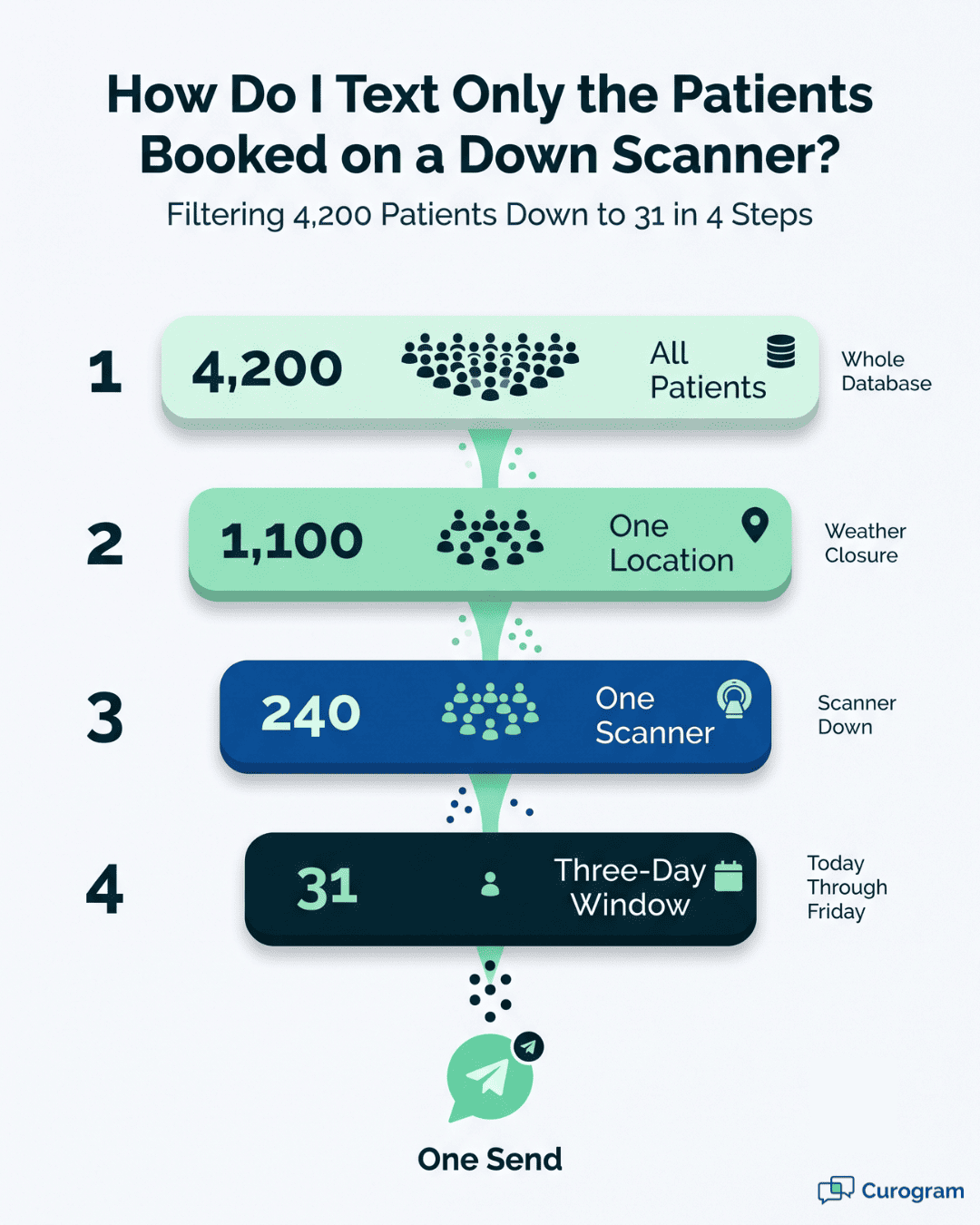
A useful broadcast starts with a narrow list. Staff pick the group by modality, by location, by date range, or some mix of the three. MRI patients at the Westside site booked Tuesday through Thursday, for instance. That group gets the message and nobody else does.

Building the filter takes a minute or two. Once the list looks right, one action sends it.

Tighter filters mean fewer confused callbacks. Precision here saves the front desk a second wave of inbound calls from people who were never affected.

Replies Come Back as Real Conversations

A broadcast patients can't answer just moves the phone chain to the next morning. Two-way texting keeps the thread open. A patient replies "can I do Friday instead?" and that message lands in a staffed inbox as an individual conversation tied to their record.

Staff work the inbox the way they work a callback queue, except they can hold four threads at once and nobody sits on hold. Rescheduling gets typed, confirmed in writing, and the patient keeps the new time in their texts.

What the Downtime Text Should Actually Say

Four things belong in a scanner-down message: which site, which exam, that it's canceled, and what happens next. Leave out the reason unless it's weather. Patients don't need to hear "helium quench."

A workable version, under 320 characters:

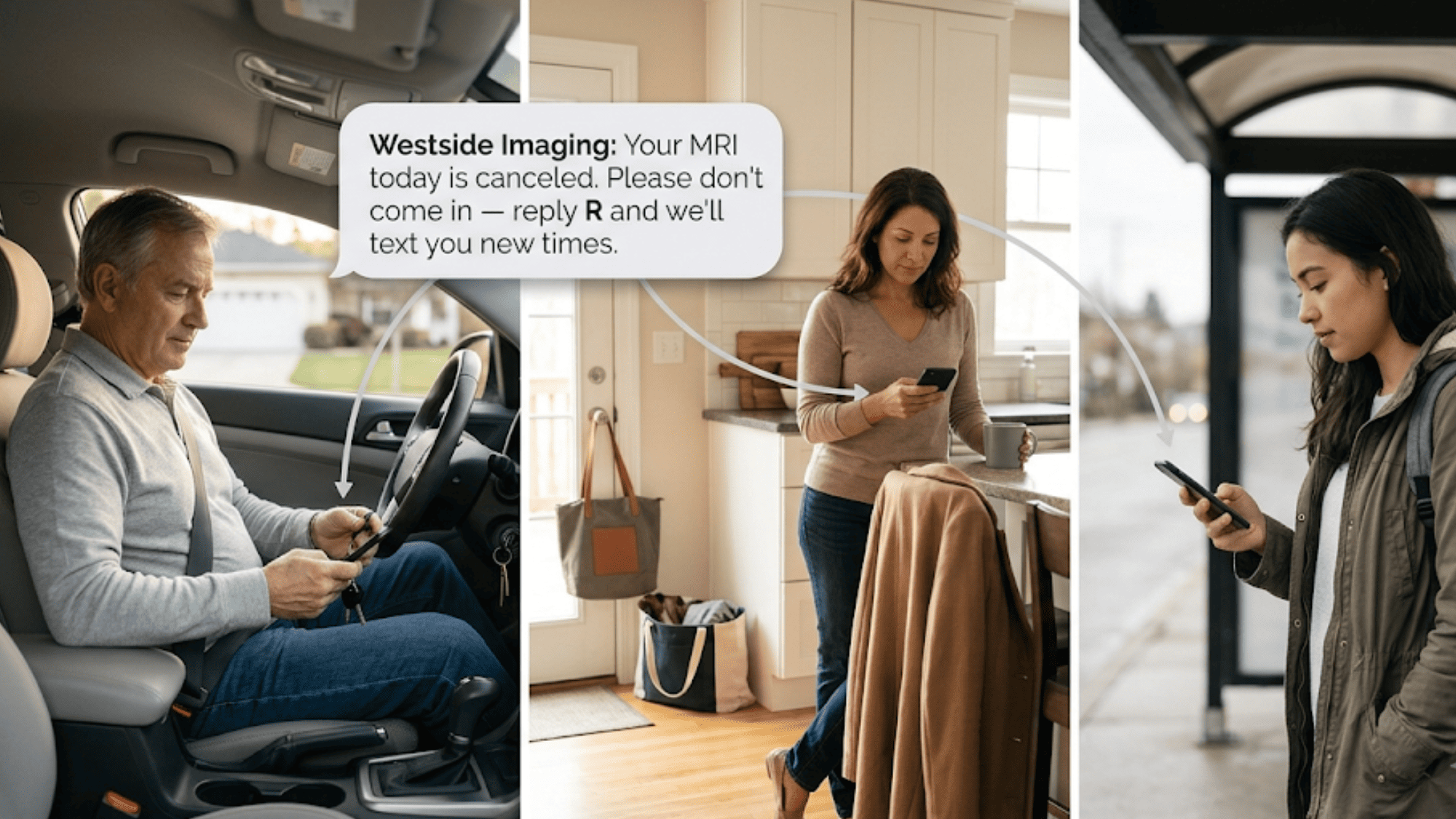
Westside Imaging: your MRI today is canceled — our scanner is down for service. Please don't come in. Reply R and we'll text you the next available times, or call 555-0142. Sorry for the trouble.

Confirmation of receipt matters more than an apology paragraph. The reply option is what turns a cancellation notice into a rebooked slot, and it's the line most centers forget to include.

Opt-Outs Handle Themselves

Patients who text STOP drop out of future sends automatically. Nobody maintains a do-not-text list on a sticky note taped to a monitor. That matters most for recall campaigns, where the same person might be contacted once a year for a decade.

Where Exa's Work Ends and Messaging Begins

Exa PACS|RIS runs the imaging operation. Konica Minolta released a next-generation version in April 2025 built around an open API for partner integrations, and announced a patient-engagement agreement with openDoctor that same month covering self-scheduling.

Messaging platforms like Curogram sit beside that stack rather than inside it. Appointment data flows one way, from the practice management system into the messaging layer.

Mass text notifications for imaging centers on Exa PACS filtered by site, scanner and date

Running a Mammography Recall Campaign, Step by Step

Screening recalls use the same broadcast engine as downtime alerts, just on a longer clock.

The American College of Radiology recommends annual screening mammography beginning at age 40. Every year, part of a center's screening population drifts past due, and nobody calls them.

Step 1: Pull the Lapsed List

Filter for patients whose last screening mammogram was 13 or more months ago. Thirteen rather than twelve gives anyone who already rebooked a month of room, and it keeps you from texting the same person twice.

Step 2: Write One Message

Short and plain. Name the center and the exam, then give a reply option. Something like: "Reply Y and we'll call you with times, or book at [link]." Keep it under 160 characters so it arrives as a single message.

Step 3: Send in Batches

A 900-patient recall sent at once produces 900 replies inside two hours. Send 150 a day across a week instead. The inbox stays workable and schedulers keep pace.

Step 4: Staff the Replies for 48 Hours

Most responses arrive in the first two days. Assign the inbox to one named person per shift during that window, the same way you'd assign the phones.

Step 5: Keep Results Out of the Text

Since September 10, 2024, FDA's amended MQSA rules require mammography reports to carry a breast density assessment and specific notification wording in the patient lay summary.

Recall texts are appointment outreach only. Density language and findings stay in the report and the lay summary where the rule puts them.

Imaging center patients checking phones as a single SMS broadcast cancels their MRI appointments

What Changes When a Center Announces Once

Based on our internal data, SMS recalls at one multi-location practice hit a 35% reconversion rate, with 1,240 patients seen from recall messages alone.

Curogram clients average above a 75% appointment confirmation rate. No-show rates across our client base run 53% below the industry average.

Situation

Phone chain

Filtered broadcast

7 AM fault, 200 patients booked

6+ staff-hours, partial reach

one send, minutes

Single-site weather closure

whole database called, or nobody

one location filtered

900-patient screening recall

rarely attempted

150/day across six days


None of that requires new scanners or new staff. It requires reaching the right subset of patients before they get in the car.


Mass Messaging Built for Day Lists

Mass Messaging sends a filtered SMS broadcast to a patient group in one action, targeted by location, by appointment date, or by a list your team uploads.

Replies route back into the shared inbox as individual two-way conversations, so a scheduler can rebook without picking up a phone.

The same engine runs Patient Recalls for screening populations, which is where the 1,240 recovered patients in our internal data came from. All texting is HIPAA-compliant, covered by a signed BAA, with automatic opt-out handling.

Curogram connects with any EMR or practice management system, Exa PACS|RIS included, as an add-on layer rather than a replacement. Appointment data syncs one way into Curogram. Exa keeps running the imaging workflow it was built for.

Conclusion: Make Joining a Visit as Easy as Opening a Text

Imaging centers usually price out mass texting the week after a bad outage, spreadsheet of lost slots in hand. That's an expensive way to learn the lesson. The stronger case shows up on ordinary weeks, when nothing breaks at all.

Screening recalls are the quiet workhorse. A list of patients who lapsed past 13 months already exists inside your system, and most centers never text it.

Based on our internal data, one multi-location practice saw 1,240 patients return from SMS recalls alone, at a 35% reconversion rate. Those slots pay for the tool several times over before a magnet ever quenches.

Downtime is what makes people finally sign. Both jobs run on the same filtered send, which is the part worth understanding. Build a list by modality, site, or date range, hit send once, and work the replies from a staffed inbox.

Exa PACS|RIS was built to run imaging. It handles the worklist, the reports, the billing, and it does that well. Reaching 200 people before 7:40 AM is a different job, and it belongs to a messaging layer sitting beside your imaging stack, not inside it.

Book a demo with Curogram and watch a modality-filtered broadcast go out in one action.


Frequently Asked Questions

How does mass texting a whole modality list stay HIPAA-compliant?

Compliance comes from the platform and the wording. Curogram operates under a signed BAA with encrypted transmission and access controls. The message itself should carry appointment logistics only, never findings or clinical detail. A cancellation notice naming the site, the exam type, and a callback option stays well inside what's appropriate for SMS.

How do we target only one modality's schedule for a send?

Staff build the filter before sending, narrowing by modality, location, date range, or a combination. MRI patients at one site booked over three specific days is a normal filter. Uploaded lists work too, which helps when the grouping is something odd, like every enhanced CT affected by a contrast backorder.

How do annual mammogram recall campaigns work in practice?

Pull patients whose last screening was 13 or more months ago, write one short message with a reply option, then release it in daily batches of about 150. Replies land in the shared inbox as conversations. Staff the inbox heavily for the first 48 hours, since most responses arrive then.

Why do broadcast replies need a staffed inbox rather than an auto-responder?

Because a canceled MRI patient needs a new time, not an acknowledgment. Auto-replies push the rescheduling work back to the phones the next morning, which was the original problem. A person watching the inbox can rebook four patients in the time one phone call takes.

How does a mass send interact with Exa PACS|RIS scheduling data?

Appointment data flows one direction, from the practice management system into the messaging layer, which is what makes date and location filters possible. Curogram doesn't write status changes back into Exa. Schedulers still update Exa directly when a patient rebooks, keeping the imaging record as the single source of truth.