
How Operations Teams Manage Google Reviews from One Dashboard
💡 Operations staff at GE Centricity multi-location Google Business Profile health systems face a hard truth. Manual review collection across 20 or...
8 min read
Jo Galvez
:
May 18, 2026
Your patients walk in. They get great care. They walk out smiling. But Google does not know that any of that happened.
That gap is the real cost for large health systems. Most Centricity enterprises run 20 or more clinics. Each one has its own Google Business Profile. Each one builds reviews at a different pace.
The result is a split picture of one strong brand. One clinic might show 4,200 reviews and a 4.7 rating. The next shows 340 reviews and a 4.1. Patients see two different practices.
The care is the same. The Google story is not. This is what we call the Invisible Enterprise.
Manual review work cannot scale to 25 office managers. Hiring a reputation lead at every site costs too much. So reviews trickle in, slow and uneven. Local search rankings slip while smaller rivals climb.
The fix is not more effort from the clinic staff. It is automation that runs across every site at once. That is the case for automated Google reviews GE Centricity multi-location practices enterprise reputation systems were built to handle.
Curogram plugs into Centricity's patient database and sends each post-visit patient a text. Each message links to the right clinic's Google profile.
The COO sees real-time review velocity at every site. The CMO sees star ratings climb in markets where rankings used to lag.
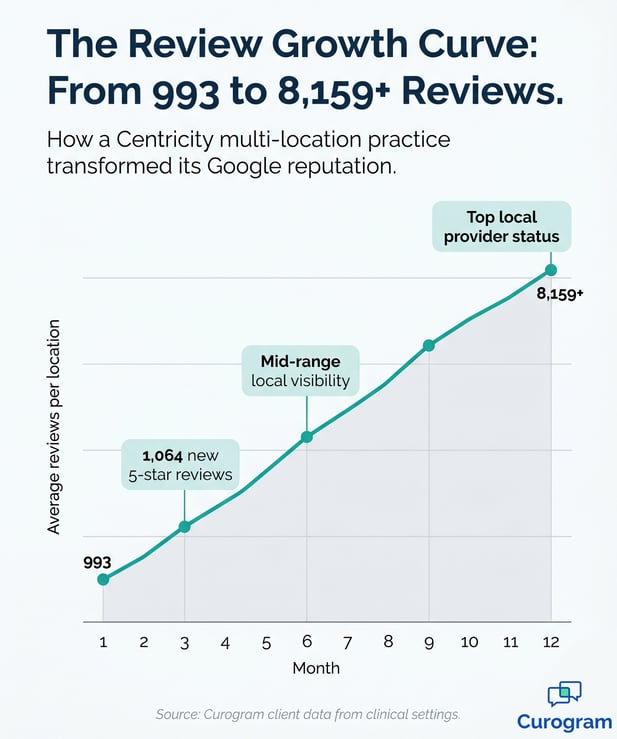
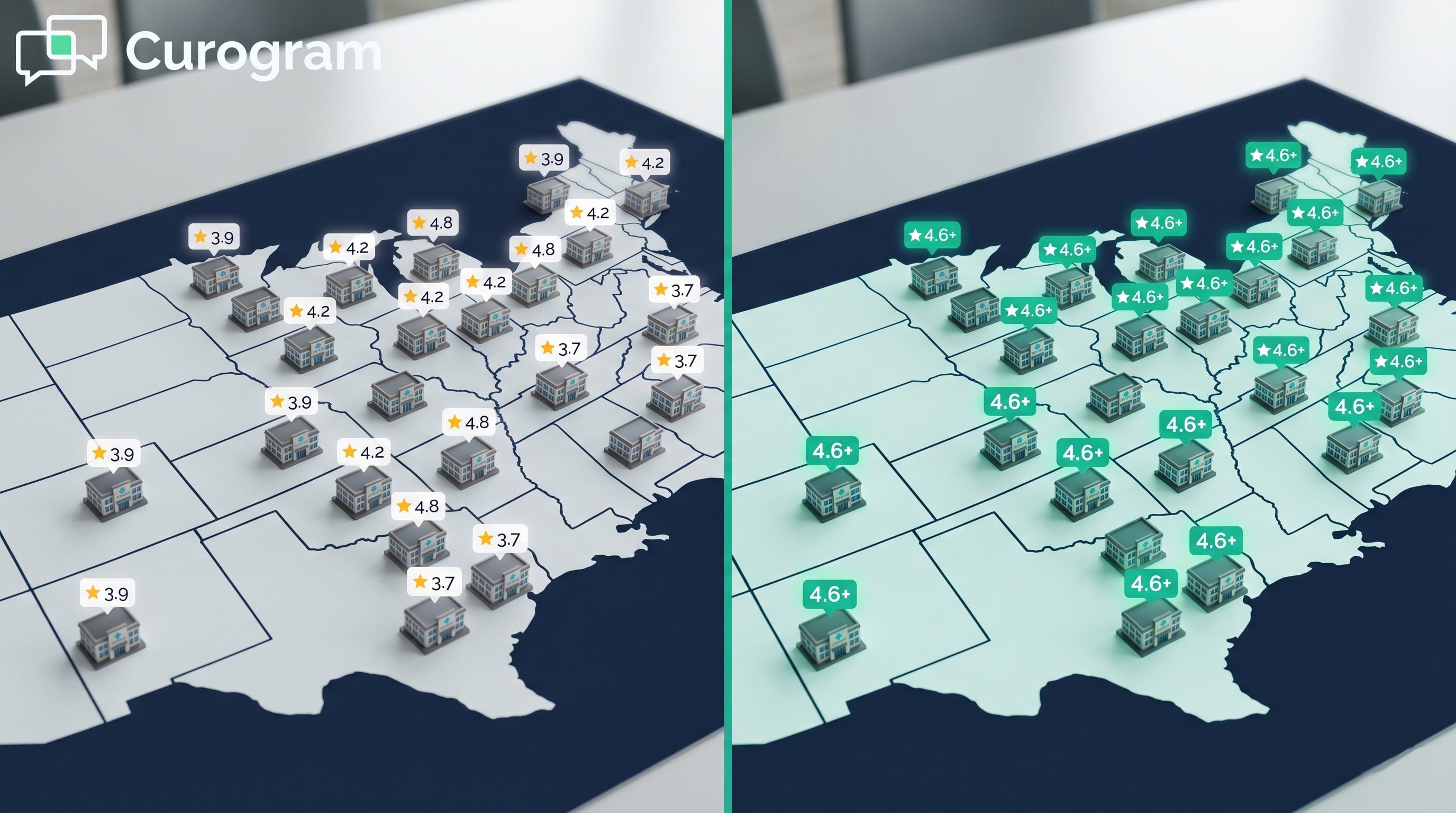
The shift is not small. Based on our internal data, one multi-location Centricity practice gained 1,064 new 5-star reviews in 3 months. Ratings moved from 3.9 to 4.6+ across all sites.
This guide breaks down how it works, why it matters, and what the numbers look like at scale.
Large Centricity health systems share one painful truth. The brand is one. The reputation is twenty-five. This split shows up in patient counts, search rankings, and revenue.
Picture a 25-clinic health system. The COO sees one team, one mission, one care standard. Patients on Google see something else.
Clinic A sits at 4,200 reviews and a 4.7 rating. Clinic B holds 340 reviews and a 4.1. Clinic C lands at 680 reviews and a 4.3. To a new patient, these look like three different practices.
The truth is the opposite. They share staff training, care models, and quality goals.
Most patients pick the clinic with the most stars. They do not check if it shares a parent brand. They click the top result and book.
That means strong clinics in the same system get more new patients while others stay quiet. GE Centricity reputation management multi-location health systems need is exactly this kind of fix.
Review work at scale breaks down fast. One person cannot run 25 review programs at once.
Each clinic manager juggles staff, supplies, scheduling, and patient flow. Asking them to also run a review push gets mixed results. Some managers chase reviews. Most do not have time.
A typical enterprise gathers 500 to 800 reviews per year across 25 sites. That works out to 20 to 32 reviews per clinic per year. At that pace, hitting the volume needed for top search ranking takes decades.
Rivals with multi-clinic review management system tools pass them in two to three years.
Google rewards review volume, star rating, and how fresh the reviews are. The top three local results take about 60% of clicks. Sites with 2,000+ reviews dominate. Sites with 300 lag behind.
For a Centricity enterprise with 200,000+ patients, even a 5% drop in local visibility means thousands of lost new patients per year.
That is $500,000 to $2 million in missed yearly revenue. Healthcare provider local search optimization is not a marketing nice-to-have. It is a revenue lever.
When a patient searches "primary care near me," the top three results win. If your clinic ranks fourth or fifth, you lose the click.
Multiply that across 25 sites and twelve months. The cost adds up fast. Enterprise patient reputation Google Centricity gaps are not just visibility issues. They are growth issues.

This is where the work shifts from manual chaos to a steady system. The goal is simple. Every post-visit patient gets a chance to share their story on Google, no matter which clinic they visited.
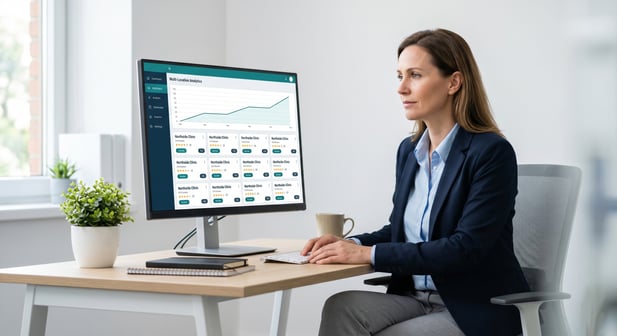
Curogram acts as the central hub for review work across the full enterprise. The COO and CMO see one screen instead of twenty-five.
Curogram pulls visit data straight from Centricity. It knows who came in, where, when, and which provider they saw. Each post-visit patient gets a text within hours of the visit.
The message names the clinic and the provider. It feels personal because it is.
A patient who saw Dr. Smith at Clinic A gets a link to Clinic A's Google Business Profile. A patient at Clinic B gets Clinic B's link. There is no mix-up.
The Google Business Profile automation that Centricity practices needs is built right in. Every review lands on the right page.
The system only works because it speaks Centricity's language. Most review tools sit outside the EHR and miss key data. Curogram does not.
Centricity holds the visit record. Curogram reads it, finds the post-visit window, and sends the request. There is no manual list-building, no CSV uploads, no clinic-by-clinic setup.
Post-visit review automation healthcare enterprises depend on this kind of clean handoff.
Each message uses the patient's name, the clinic name, the provider name, and the visit date. Generic messages get ignored. Personal ones get replies.
That is why response rates stay strong even as volume grows.
The dashboard is where leadership earns hours back each week.
The COO sees which clinics are hitting review targets and which need a nudge. Filters cover location, provider, visit type, or date range. Trends show up in days, not quarters.
This is the part that changes how operations teams run.
Need to push a review campaign for a new clinic? Click. Need to pause one site during a staffing issue? Click.
The system does not need code changes or vendor tickets. Leadership owns the speed of the work.
One reputation manager per clinic costs $60,000 or more per year. Across 25 sites, that is $1.5 million in salaries. Automation does the same work at a fraction of the cost and runs every day without burnout.
This is the part where numbers tell the story. The shift is not slow or small. It happens in weeks and compounds across months.
The first 90 days set the tone. Most clients see results long before that window closes.
One multi-location Centricity practice ran the system for 90 days. Based on our internal data, 90% of patients who replied left 5-star reviews. The total hit 1,064 new 5-star reviews.
Ratings climbed from 3.9 to 4.6+ across all sites. The full review log shows month-over-month growth from 993 to 8,159+ reviews across the enterprise.
Spread across 20+ locations, the new reviews land where they are needed most. Sites that lagged behind catch up. Sites that already led the pack pull further ahead.
The brand presents one strong face on Google.
Three months proves the model. Twelve months reshapes the market position.
The same enterprise grew from an average of 993 reviews per location to 8,159+ reviews per location. That is roughly an 8x jump.
Each clinic moved from mid-range visibility to top-three local results in its market. New patient bookings followed.
Google trusts fresh reviews more than old ones. Sustained campaigns keep new reviews flowing every week. The system never goes stale.
Patients searching today see recent feedback, which builds trust faster than a wall of three-year-old ratings.
Numbers matter, but so does staff time. The dashboard cuts hours of manual work.
Before automation, the COO held monthly review calls with 25 clinic managers. After automation, those calls stopped. The data shows up on the dashboard in real time.
Leaders read it once a week instead of running meetings about it.
The CMO and COO finally share one source of truth. Marketing sees which clinics need a reputation push. Operations sees which sites need staff support. Both teams act on the same data, not on guesses.
|
Metric |
Before Curogram |
After 3 Months |
After 12 Months |
|---|---|---|---|
|
Avg. reviews per location |
993 |
2,260+ |
8,159+ |
|
Average Google rating |
3.9 |
4.6+ |
4.6+ |
|
New 5-star reviews |
Low and slow |
1,064 (enterprise) |
Compounding |
|
Monthly coordination time |
Hours per week |
Minutes |
Minutes |
Based on our internal data from a multi-location Centricity practice.

Reputation work at the clinic level is not the answer for a 25-site health system. The math fails, the staff burns out, and the brand stays split across markets.
The shift is structural. Reviews need to flow from one system that covers every clinic at once.
GE Centricity holds the patient story. It knows who came in, when, and what they came for. But it stops there. The review never happens unless something else triggers it.
That is where Curogram fits in. Curogram captures the moment after a visit and turns it into a Google review.
The EHR records the care. The engagement platform records the reputation. Together, they build a full enterprise picture, one site at a time, all at the same time.
This shift matters because patients shop on Google first. Most new patient leads check your Google Business Profile before they ever see your website. If your rating lags, you lose the click.
If your review count is low, you lose the trust signal. Local search rankings decide who books and who scrolls past.
The fix is not a bigger marketing budget. The fix is automation that runs every day across every site. One dashboard. One source of truth.
Every post-visit patient gets the same chance to share their story.
Your enterprise might serve 200,000 patients across 25 sites.
The question is simple. How many of those patients left a review this month?
If the answer is fewer than you would like, the gap is not a clinic problem. It is a system problem.
The Centricity enterprises that win the next five years will not be the ones with the best ads. They will be the ones with the best Google presence at every site.
Reputation is no longer a clinic-by-clinic effort. It is an enterprise system. Build it once. Run it forever.
Ready to see how it works? Schedule a demo today.
Curogram uses a template system that lets corporate leadership set the brand voice. Each location fills in the clinic name, provider name, and visit details. Patients get a message that feels local, not corporate. The result is brand consistency with local relevance.
Google rewards both volume and freshness, not just star count. A clinic with 50 new reviews per month outranks a clinic with 200 old ones. Volume builds trust signals that lift search rankings over time. It also helps newer locations catch up to older ones in the same brand.
Most clients see visible movement within 2 to 4 weeks of launch. The first campaign often pulls 100 to 200+ reviews across all sites in the first month. Sustained weekly campaigns can add 200 to 400 reviews per month across a 20-site network. Top-tier volume usually lands within 3 to 6 months.
The system works by volume and recency, so old, bad reviews lose weight fast. When a clinic gathers 50+ fresh 5-star reviews per month, one old 1-star review fades into the noise. Bad reviews do not disappear, but they stop shaping the average. New patients see the fresh feedback first.
Curogram connects to the Centricity patient database without changing how your staff works. Visit data flows in the background, and post-visit texts go out on their own. Clinic teams do not need to learn new software or run extra reports. The dashboard sits in one place for leadership to review.
💡 Operations staff at GE Centricity multi-location Google Business Profile health systems face a hard truth. Manual review collection across 20 or...
💡 OA great patient Google review experience in GE Centricity post-visit SMS review requests starts with timing. Most patients leave the clinic...
💡 The impact of Google reviews on MD Systems practice growth shapes how new patients find and choose your practice online. Practices with 50+...