

6 min read

How Operations Teams Manage Google Reviews from One Dashboard

How Operations Teams Manage Google Reviews from One Dashboard
💡 Operations staff at GE Centricity multi-location Google Business Profile health systems face a hard truth. Manual review collection across 20 or more clinics breaks down fast. Each site posts at its own pace, and the brand looks fragmented online.

Enterprise review automation of Centricity health systems use changes that picture. Curogram pulls post-visit patient data from Centricity and sends a brief SMS review request to every patient, tied to their clinic's Google profile. One internal client logged 1,064 new 5-star reviews in 3 months across 25 sites.

This guide shows how to swap monthly coordination calls for a system that runs on its own. You get a unified dashboard, steady review velocity, and stronger local search.

Imagine the Director of Operations of a multi-network enterprise runs a monthly call with 25 clinic managers. The ask is simple.

Please remind staff to invite patients to leave a Google review. The call ends, and nothing much changes on the ground.

Some sites push hard. Others skip it for weeks. A few staff members write their own scripts. Others send patients to Healthgrades instead. The brand voice splits 25 ways, and the data shows it on Google.

Meanwhile, your front desk handles 200 patient touchpoints a day. Asking each one for a review is not realistic. The result is a thin trickle of reviews, far below what your patient base could give.

Operations staff automated review management of GE Centricity multi-location Google Business Profile workflows fix this gap.

The platform sees the visit in Centricity, then sends the request. No huddle. No reminder. No coordination call.

Done right, this turns a fragmented chore into a steady engine. You stop chasing managers. You start watching dashboards.

Below, we break down the villain, the guide, and the shift you can expect across all your clinic locations.

The Villain: A Review Request That Cannot Scale

The core issue is not a lazy team. It is a workflow that asks humans to do machine-scale work. When you spread review collection across 25 sites, four traps appear at once.

Each trap drains review velocity in its own way. Stack them, and you see why most Centricity enterprises sit at 3.9 stars while rivals climb past 4.6.

The Coordination Trap

The Director of Operations sets a monthly call with 25 clinic managers. The agenda is short. Talk about review counts, patient feedback, and weekly reminders to ask for reviews.

The meeting happens. The plan is clear. The follow-through is not. Some managers love the task. Others find it a chore. Review velocity stays slow and clinic-dependent.

Why Monthly Calls Fall Flat

Spoken reminders fade by week two. Even strong managers get pulled into hiring, billing, and patient flow. The review ask now falls to the bottom of the list.

What The Data Shows

Inconsistent effort means inconsistent stars. One site posts 300 reviews. Another posts 28. Google's local pack treats them as different brands, even though the logo is the same.

The Manual Process Trap

Without a system, staff must ask in person or by phone. A busy front desk juggles check-ins, copays, forms, and calls. The review ask gets lost.

Most clinics capture reviews from just 1% to 2% of post-visit patients. With 20,000 monthly visits across 25 sites, that is 200 to 400 reviews a month. Your patient base could give 8 to 10 times that.

The Brand and Compliance Trap

When each site writes its own script, your brand voice splits. One clinic says, "Please review us on Google.” Another point to Healthgrades. A third skips the ask entirely.

The fix is not louder reminders. It is managing Google profiles across clinic locations from one place, with one message framework, set by the corporate team. 


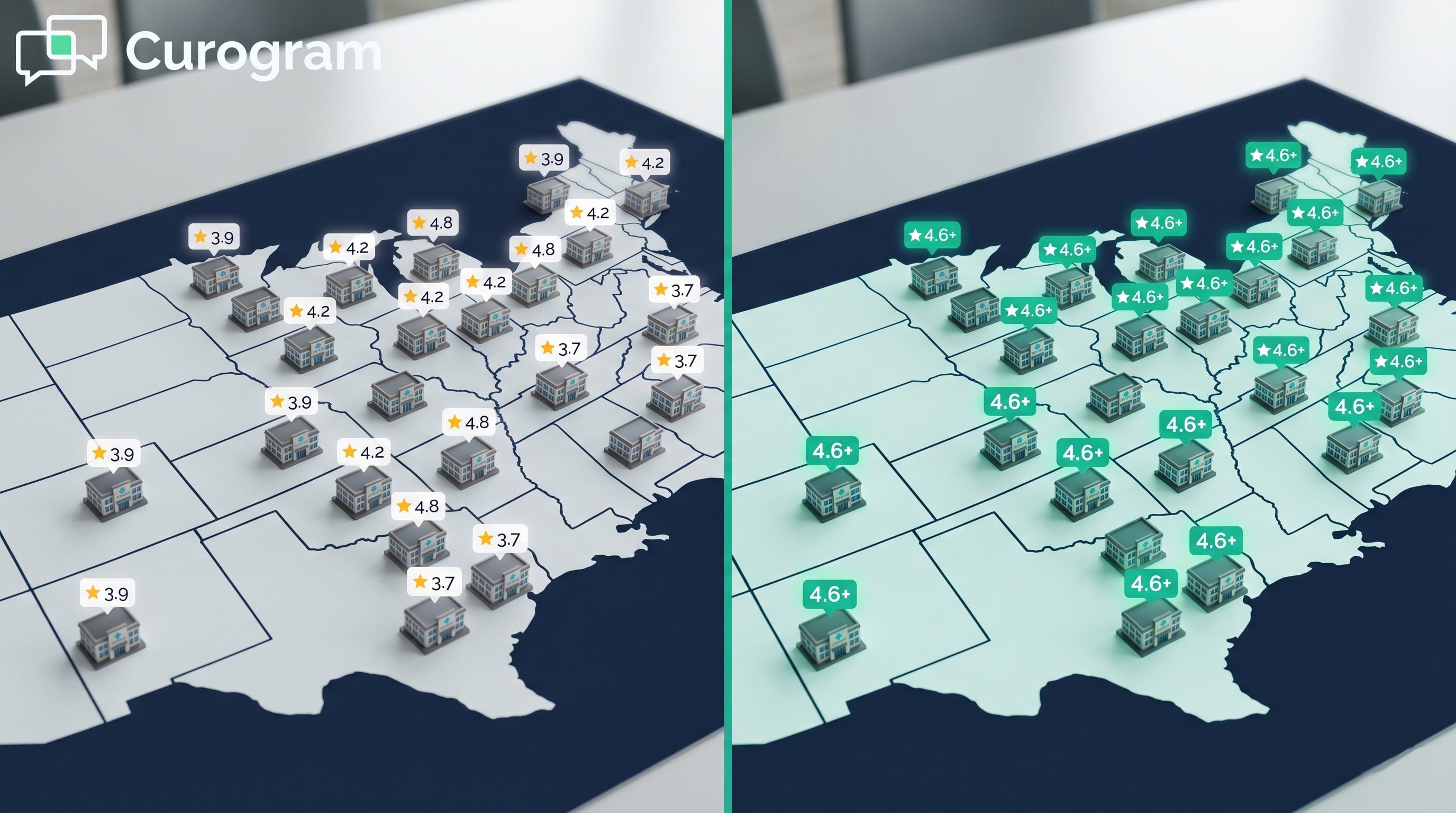
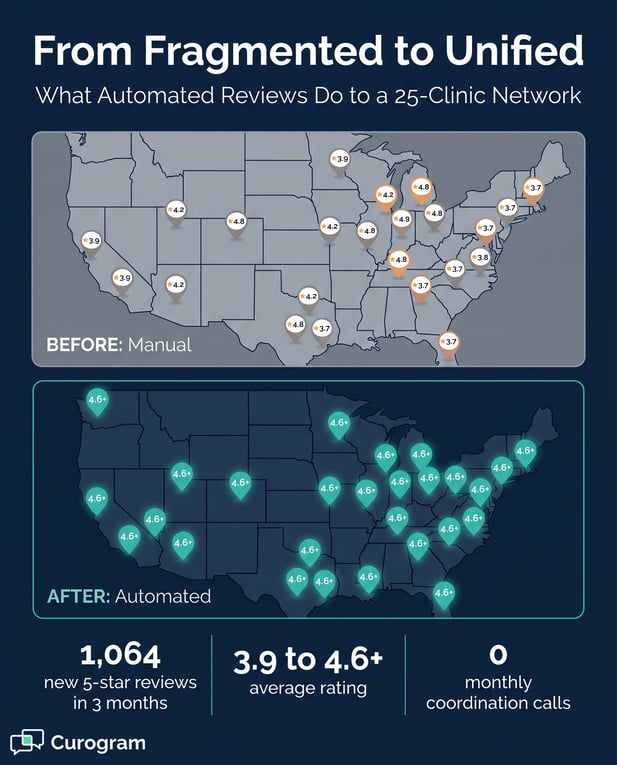
From Fragmented to Unified clinic reviews: 3.9 to 4.6+ average rating, 1064 new reviews

The Guide: An Enterprise Review System

The fix is not more humans. It is a system that turns each visit into a review request, without a single staff prompt. This is the heart of a multi-location review strategy healthcare leaders can scale.

Curogram acts as the engine. Centricity feeds the visit data. The patient gets a brief SMS, tied to their clinic's Google profile.

How the Curogram and Centricity Link Works

Curogram pulls a daily list of post-visit patients from Centricity. It then sends a short SMS to each patient's preferred phone. The message names the clinic and links to that site's Google review form.

The text is simple. “Hi [Name], thanks for visiting [Clinic Name]. Share your feedback on Google: [link].” No staff action is needed.

What Patients See

A clean, on-brand text. One tap opens the Google review form for their clinic, not a different site. The friction drops, and response rates climb.

What The EHR Does

Centricity holds the patient record and the visit time. Curogram reads that data and triggers the request the same day or the next. The two systems run side by side, with no double entry.

The Operations Workflow Google Business Profile Automation Delivers

Each clinic manager logs into a staff dashboard review coordination view. They see review requests sent, new reviews received, response rate, and average star rating. Real time, not weekly digests.

Enterprise leaders see the same data across all 25 sites. They can spot a clinic at 3.8 stars, then act fast. They can also launch a campaign for one site, a region, or the full network with one click.

Centralized Control, Local Personalization

Corporate writes the message frame. Each site fills in its own name, link, and brand voice. You get one standard, 25 personalized versions. Compliance stays clean, and patients feel the local touch.


The Success: From Coordination to Automation

The point of the enterprise reputation management Centricity teams aim for is not just more reviews. It is a workflow that runs on its own, with leadership focused on strategy, not chasing managers.

Here is what shifts when the system goes live.

The Numbers Behind the Shift

Based on our internal data, a 25-location Centricity health system rolled out Curogram and saw a fast change. The system logged 1,064 new 5-star reviews in the first 3 months.

Average review volume per location jumped from 30 to 40 a month, up to 200 to 300 a month. Average Google rating across all 25 sites climbed from 3.9 to 4.6 or higher.

The table below shows the change at a glance:

Metric

Before Curogram

After Curogram

Reviews per location/month

30 to 40

200 to 300

Average Google rating

3.9

4.6 or higher

Monthly coordination calls

1 with 25 managers

0

Patient response capture

1% to 2%

10% to 15%


From Coordination Calls to Automated Campaigns

The Director of Operations dropped the monthly review call. The system runs on its own. Clinic managers check a daily dashboard. Enterprise leaders watch the network view.

Review collection is no longer a human task. It is a workflow. And it captures a much larger share of post-visit patients than any manual ask could.

The Leadership View

The COO and CMO get a single screen. Total reviews this week. Average rating by site. Trend lines. They can spot a site that needs help in seconds.

The Local Impact

Local search rankings shifted. Patient acquisition rose. The team did not need to hire 25 reputation managers, one per site. The system did the work.

Healthcare manager reviews automated patient review data on modern office dashboard

Conclusion: Automate Reviews, Not the Coordination

Multi-location GE Centricity health systems cannot lean on manual review work. The math does not hold up at scale.

Twenty-five sites, 200,000 patients, and one monthly call cannot produce steady review velocity.

The shift is simple. Centricity records the visit. Curogram automates the review request. The EHR knows the patient and the clinic. The engagement platform makes sure the patient leaves a Google review.

You stop running review meetings. You start reviewing dashboards. Each clinic still owns its local feel, but the network speaks with one voice.

Based on our internal research, sites that automate post-visit review requests see large jumps. Review velocity climbs. Star ratings rise. Local rankings move. Patient acquisition follows.

If you sit in operations, IT, or the C-suite at a Centricity enterprise, this is your lane. You are the one who can buy back the time lost to coordination calls.

If you lead marketing, this is the gap between your patient experience and your online story. Patients love your care. Google needs to know it.

Reviews build over time. The first month is fast. The second is faster. By month three, your Google profiles look different across every site.

And once the system is live, it keeps working. No new hires. No new calls. Just more reviews, more visits, and a stronger brand.

Ready to swap your monthly review calls for a working system? Schedule a demo with our team today.   


Frequently Asked Questions

How can operations staff tailor the review message for each clinic location?

Curogram uses a template system. Corporate sets the message frame, and location-specific variables fill in the clinic name, link, and any custom touches. You can also build different message variants for urgent care, primary care, or specialty sites. The result is one brand voice with 25 personalized versions.

Why does an enterprise need automated reviews instead of asking staff to do it?

Front desk teams handle 200 or more patient touchpoints a day. The review ask drops to the bottom of the list. Manual capture sits at 1% to 2% of post-visit patients, while automated SMS pulls 10% to 15%. The volume gap is too large to close with human effort alone.

How does Curogram handle Google Business Profiles across 25 different sites?

Curogram does not manage the profiles themselves. It pulls patient data from Centricity, then sends each patient a request with a personalized link to their clinic's Google profile. Patients leave the review on Google directly. This keeps profile control with you, while Curogram drives the review flow.

Why do some clinics in our network outrank others on Google?

Local search ranks on review volume, star rating, and freshness. Sites with steady review velocity climb. Sites with sporadic reviews fall. When some sites automate, and others do not, the gap shows up in your search results, even though the brand is the same.

How does the system handle a clinic that closes or is acquired?

The operations dashboard lets you pause or activate review campaigns by location at any time. If a clinic closes, you disable its campaign. If you add a new site, you onboard it with its own profile and link in minutes. The system flexes with your network.


Automated Google Reviews for Multi-Location GE Centricity Practices

Automated Google Reviews for Multi-Location GE Centricity Practices

💡 Automated Google reviews for GE Centricity multi-location practices enterprise reputation tools fix a real problem. Centricity holds patient data...

Read More
Why GE Centricity Patients Leave Google Reviews When Asked by Text

Why GE Centricity Patients Leave Google Reviews When Asked by Text

💡 OA great patient Google review experience in GE Centricity post-visit SMS review requests starts with timing. Most patients leave the clinic...
Read More
Turn Every Dolphin Ortho Visit Into a Five-Star Google Review

Turn Every Dolphin Ortho Visit Into a Five-Star Google Review

💡 Dolphin orthodontic Google reviews stay low because Dolphin has no built-in reputation tools. Curogram fills the gap with automated text requests...

Read More