8 min read

Mass Messaging and Patient Recalls for GE Centricity | Curogram

Mass Messaging and Patient Recalls for GE Centricity | Curogram
💡 Patient recall mass texting for GE Centricity enterprise population health outreach turns dormant patient records into booked visits.

Large health systems often hold 200,000 or more inactive records in Centricity. These patients still have charts, providers, and insurance on file. Yet Centricity gives no built-in way to reach them at scale.

Curogram fills that gap. Our platform connects to Centricity and sends HIPAA-compliant text campaigns to thousands of patients in minutes. You can group patients by location, provider, or clinical need.

Based on our internal data, recall campaigns recover 35% of contacted patients. At $150 to $250 per visit, that can mean $2.6M to $4.4M in recovered revenue per cycle. Quality scores like HEDIS and MIPS also improve.

Your next 50,000 appointments are already in your database. You just have not texted them yet.

Enterprise health systems on GE Centricity sit on huge patient lists. Some hold 200,000 records.

Others hold 500,000 or more. Yet a big share of those patients have not visited in over a year.

They did not leave. Life got busy. Reminders stopped. The clinic had no way to reach them at scale.

Now their charts sit idle while marketing dollars chase brand new patients.

This gap hurts more than just revenue. HEDIS and MIPS scores depend on preventive care follow-ups.

When dormant patients stay dormant, quality scores slip. Peers who text their patients pull ahead.

Centricity stores the data well. But it does not send recall texts. It does not group patients by clinical need.

It does not handle two-way replies across 20 clinics at once. That is where the EHR ends and the engagement platform begins.

Curogram is built for that gap. We connect to Centricity and turn dormant lists into booked visits through patient recall with mass texting and GE Centricity enterprise population health outreach campaigns.

The result is a system that brings patients back, lifts quality scores, and respects every HIPAA rule along the way.

This guide walks through the full picture. We will look at the dormant database problem first. Then we will show how the Enterprise Reactivation Engine works.

Finally, we will share what success looks like in real numbers from real clinics.

The Villain: The Dormant Database

Most large practices know their patient list has grown. Few know how much of it has gone quiet. The truth is harsh: a dormant database is not a static asset. It loses value every month it stays untouched.

How Big the Problem Really Is

Centricity systems built over 10 to 20 years often hold 200,000 to 500,000 patient records. Only 40% to 50% of those patients have visited in the last 12 months. The rest are dormant.

That can mean 100,000 to 250,000 patients you cannot easily reach. Many still have insurance on file. Many still trust their old provider. They just need a nudge.

Why Manual Calls Fail at Scale

A front desk team cannot call 50,000 patients. At 3 to 5 minutes per call, that adds up to 2,500 to 8,300 hours. That is more than one full-time staffer doing nothing else for a year.

Now multiply that by 20 clinics. The math breaks. Manual recall is not just hard. It is impossible at enterprise scale.

Why Direct Mail Drains Cash

Direct mail looks like a fix. It is not. Each piece costs $0.50 to $2.00 to print and send.

A 50,000-patient mailing runs $25,000 to $100,000. Response rates sit between 1% and 3%. You spend $20 to $100 per response.

Bulk SMS outreach for health systems use costs $0.02 to $0.05 per text. Response rates can hit 10% to 15%. The cost math is night and day.

The Quality Score Drag

HEDIS and MIPS scores hinge on preventive screening rates. Annual wellness checks, A1C tests, mammograms, and colon screenings all count. Dormant patients pull those scores down.

Even a 20% lift in dormant patient outreach can move HEDIS scores in measurable ways. Without a way to reach them, those points stay out of reach.

Population health recall automation for multi-location practices is not a nice-to-have. It is tied to payer contracts, value-based care bonuses, and public quality reporting.

The Compounding Loss

Time makes the problem worse. A patient absent for 12 months is far easier to recover than one absent for 24 months. Trust fades. Contact info gets stale. New providers pull them away.

Every quarter without outreach costs real money. The CFO sees it in lost visits. The COO sees it in empty slots. The CMO sees it in quality reports that lag behind peers. 


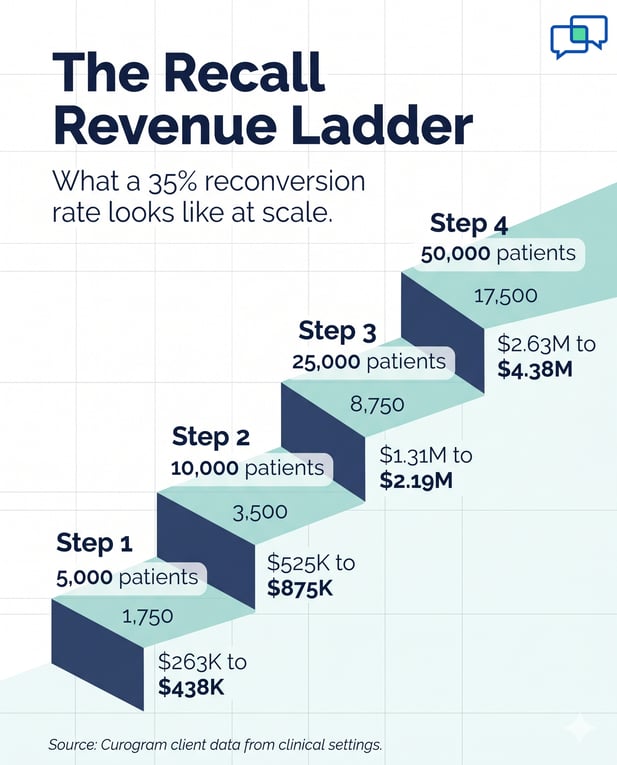
Chart shows revenue scaling with a 35% patient reconversion rate across growing patient volumes

The Guide: The Enterprise Reactivation Engine

Centricity holds the data. Curogram puts that data to work. We act as the Enterprise Reactivation Engine for health systems that need to reach big patient groups fast.

How GE Centricity Patient Recall Texting Integration Works

Curogram connects to Centricity through a secure link. We pull patient data, last visit dates, provider info, and clinical flags. Staff do not need to copy files or run reports by hand.

Once linked, the platform lets your team build text campaigns based on real clinical need. You pick the filter. The system finds the patients. Then it sends the messages in minutes.

GE Centricity patient recall texting integration also means real-time sync. New visits update the system. Booked patients drop off the recall list. Your team always works with fresh data.

Population Health Segmentation at Scale

The real power is in how you slice the list. Curogram lets enterprises group dormant patients by clear, useful filters.

Filter by Clinical Need

You can target patients overdue for annual wellness visits. Or diabetic patients overdue for an A1C check. Or women 40 to 74 overdue for mammograms.

Each campaign goes out with a clear, friendly message. A sample text might read: "Hi Sarah, it is time for your diabetes check-in. Reply YES to book with Dr. Lee."

Filter by Location or Provider

You can run a recall for clinics 1 through 10 only. Or target patients of a single provider. Or send to all 20 sites at once.

Patient database reactivation GE Centricity tools should work this way. The campaign fits the clinic, not the other way around.

HIPAA-Compliant Mass Messaging Enterprise Healthcare Needs

Compliance is built in. Every message is encrypted. Every opt-out is logged. A Business Associate Agreement (BAA) covers all PHI shared through the platform.

HIPAA-compliant mass messaging that enterprise healthcare teams trust must also follow TCPA rules. Curogram handles consent tracking and stop requests on its own. Your staff does not chase paperwork across 20 clinics.

Audit logs are ready when payers, auditors, or legal teams ask. The platform documents who sent what, when, and to whom.

Built for FQHC Networks and Health Systems

Reactivate dormant patients in Centricity EHR data is a strong fit for FQHC networks. Their core mission is population health. They serve groups that often miss preventive care.

A single text campaign can reach thousands of panel patients in minutes. That includes well-child visits, prenatal check-ins, and chronic disease follow-ups.

The same logic works for large primary care groups, multi-specialty systems, and IDNs. If your patient list is big, your recall tool must scale with it.


The Success: The Recovered Enterprise

The proof is in the numbers. When clinics run text-based recalls through Curogram, the dormant list stops being a drag. It becomes a growth lever.

The 35% Reconversion Benchmark

Based on our internal data, multi-location practices saw a 35% appointment reconversion rate from SMS recalls. In one case, 1,240 patients booked visits from a single recall campaign cycle.

At enterprise scale, that math gets serious. A 50,000-patient recall can bring back 17,500 patients. At $150 to $250 per visit, that is $2.6M to $4.4M in recovered revenue.

Sample Revenue Recovery Math

Patients Contacted

35% Reconversion

Revenue at $150/visit

Revenue at $250/visit

10,000

3,500

$525,000

$875,000

25,000

8,750

$1.31M

$2.19M

50,000

17,500

$2.63M

$4.38M

Source: Curogram client data from clinical settings.

From Depreciating Asset to Revenue Engine

Before recall texts, the dormant list aged. Contact info went stale. Trust faded. The list lost value every month.

After recall texts, the same list becomes a revenue source. Cost per reactivated patient is a fraction of new patient acquisition. Marketing dollars stretch further.

Quality Score Lift That Pays Off Twice

Reactivated patients do not just bring revenue. They complete preventive screenings. They show up for chronic care visits. They fill gaps in HEDIS and MIPS reports.

Better quality scores mean better payer contracts. Value-based care bonuses grow. Public quality reports look stronger. The same campaign pays off twice.

Curogram client data shows that clinics that run regular recall cycles see steady HEDIS gains. The lift is not a one-time spike. It compounds quarter over quarter.

Filling the Schedule Without New Marketing Spend

Empty slots fill with returning patients. Providers see familiar charts. Front desk staff spend less time chasing fills.

There is no ad buy. No new patient acquisition cost. Just smart use of the data the practice already owns. The CFO sees the ROI fast.

A $10,000 text campaign can drive $2M or more in recovered revenue. Few growth levers look that clean on paper or in practice.

Ready to see what your dormant database holds? Schedule a consultation with our team. We will map your reactivation potential based on your patient volume and the 35% benchmark.

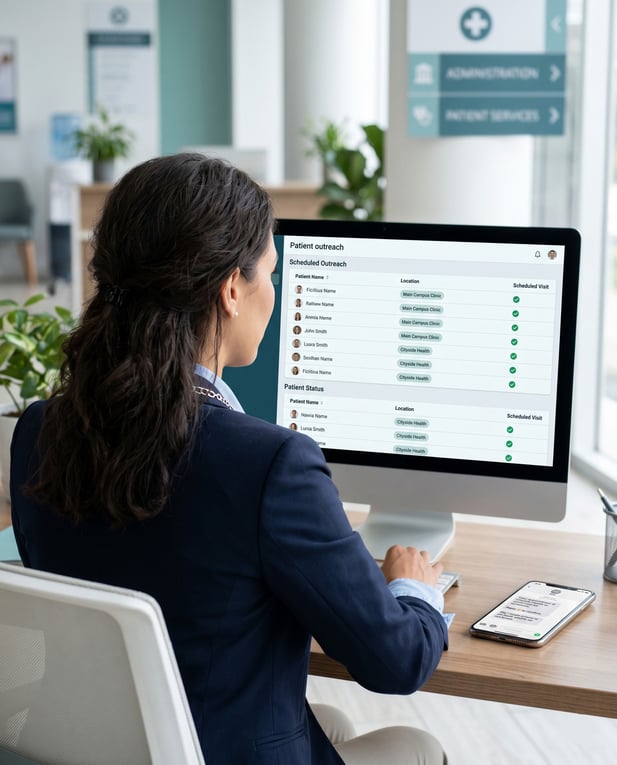
Medical officer on the computer checking list of patients

Conclusion: Your Database Is Your Growth Engine

Every large clinic on Centricity sits on the same hidden asset. The dormant database is not a waste. It is potential. The only thing missing is a way to reach it at scale.

Centricity stores patient records. Curogram reactivates them. The EHR is the archive. The engagement platform is the outreach engine.

Mass messaging and patient recalls via HIPAA-compliant SMS are the fastest, lowest-cost path to filling empty slots. They also drive HEDIS and MIPS gains that other tools cannot touch.

This is not about sending more texts. It is about sending the right text to the right patient at the right time across 20 or more locations.

Dormant patient lists decay every month. A patient absent for 12 months is far easier to recover than one absent for 24 months. Waiting another quarter costs real money and real quality points.

Peer clinics that use mass texting are already pulling ahead. Their schedules are fuller. Their quality scores climb. Their marketing budgets stretch further.

The gap between clinics that text and clinics that do not will only grow. Catching up later costs more than acting now.

How many patients in your Centricity database have not visited in over a year? How many have preventive screening gaps that drag your HEDIS score?

How much revenue sits locked in those records? What would a 35% recovery rate mean for your bottom line and your quality contracts?

If you do not know the answers, that is the first sign your database is working against you, not for you.

Curogram offers a free consultation to map your reactivation potential. Our team will look at your patient volume, dormancy patterns, and quality score gaps.

You will leave the call with a clear view of your revenue recovery range. You will also see how mass texting fits with your current workflow.

No long contracts. No risky pilots. Just a clear plan built around your data.

Schedule a demo today. Your next 50,000 appointments may already be in your database. It is time to text them back.


Frequently Asked Questions

How soon after a visit should the SMS review request be sent?

The sweet spot is within one to two hours of checkout. The visit is still fresh, and the patient is most open to sharing. Waiting until the next day cuts response rates sharply. Curogram triggers texts off Centricity visit data, so timing stays tight at every location.

Why do enterprises see better results from SMS than from direct mail recalls?

SMS reaches patients where they already look. Text open rates hit 98%, while direct mail often gets tossed unread. Cost per message is also far lower, around $0.02 to $0.05 versus $0.50 to $2.00 for mail. The result is a 10x to 30x better cost per response.

How can we run several recall campaigns at once across 20 clinics?

Curogram supports parallel campaign orchestration from one dashboard. You can run an annual wellness recall at all 20 sites, an A1C recall at clinics 5 to 12, and a mammography recall for women 40 to 74. Each campaign targets the right group with the right message. All three run side by side without staff overlap.

Why do dormant patients respond so fast to text recalls?

Texts feel personal and direct, not like junk mail. Patients can reply with a single word to book. Most responses come within 24 to 48 hours of launch. The two-way format also lets staff confirm or reschedule without a callback queue.

How do mass recall campaigns lift HEDIS and MIPS scores?

Recall campaigns target patients with care gaps, such as overdue screenings and missed chronic care visits. When those patients return and complete their care, HEDIS measures improve. MIPS scores also rise as preventive and chronic disease metrics climb. Better scores mean better payer contracts and value-based care bonuses.