10 min read
HIPAA-Compliant Patient Recall Campaigns: Elation Health Texting
Mira Gwehn Revilla
:
May 27, 2026
- Pull patient lists straight from Elation Health using clinical and visit data
- Send thousands of texts at once with full HIPAA and TCPA safeguards
- Manage opt-outs, consent, and two-way replies on autopilot
- Track replies and bookings in real time inside one shared inbox
- Run quarterly campaigns for wellness, screenings, and chronic care follow-ups
Three quarterly planning meetings. Three slide decks with "patient recalls" listed as a priority. Three different staff members assigned to "look into it." And yet, the dormant patient list at most Elation Health practices keeps growing while the recall campaign stays stuck in draft mode.
This is the quiet revenue leak hiding in every mid-market primary care practice. The patients are already in the system. The need is real.
But the work it takes to call them, mail them, or message them one by one feels impossible to fit into a normal week. So the project gets pushed to next quarter, again.
Here is the part that stings. Practices that do run recalls regularly recover a large share of those patients, often at much lower cost than chasing new ones. The longer the list sits untouched, the more contact details go stale and the more patients drift to a competitor that did pick up the phone.
The fix is not more staff or a bigger marketing budget. The fix is changing how recalls get sent in the first place.
HIPAA-compliant patient recall campaigns Elation Health text messaging tools make it possible to skip the calls, skip the postcards, and reach thousands of patients with one well-targeted SMS blast.
This guide walks Practice Managers and Operations Directors through how mass messaging operations Elation users rely on can turn recalls into a 15-minute task. You will see how segmentation works, what the compliance side looks like, and how a staff recall campaign workflow can fit beside your daily reminders, forms, and reviews.
The recall campaign you keep planning does not need another meeting. It needs a different tool. And once you see how fast it runs, you will stop calling it a project and start calling it a workflow.
The Villain: The Recall That Never Happens
Every Practice Manager knows this feeling. You can name the patients you should be calling back. You can almost picture their charts. But the recall campaign keeps slipping further down the list, and the gap between what your team wants to do and what your team can do keeps growing.
The Perpetual Postponement
Patient recalls have been on the agenda since Q1. Someone pulled a rough list. Someone else looked up a direct mail vendor. A junior staffer drafted a script. Then flu season hit, two front desk staff quit, and the project went back into a folder.
The truth is that manual recalls compete with every other task at the front desk. A practice with 8,000 active patients and 4,000 inactive ones cannot spare 200 hours of phone time without slowing down everything else. So the recall stays planned, not run.
The Compliance Paralysis
Even when a team is ready to start, the rules slow them down. Can we text patients we have not heard from in 18 months? Does TCPA still apply if they gave consent three years ago? What counts as PHI in a recall message, and what does not?
These are fair questions, and the answers are not obvious. Without a tool that handles consent and opt-out tracking on its own, a Practice Manager ends up reading legal blogs instead of running campaigns. The project stalls a second time, this time for a good reason.
The Scale Mismatch
Manual outreach works for 50 patients. It strains a team at 500. It breaks down completely at 5,000.
A mid-market Elation practice often has 10,000 or more records in the EHR. Phone calls, postcards, and portal messages were never built for that volume.
They are one-to-one tools. Patient database reactivation at that scale needs a one-to-many tool, and most practices do not have one sitting in their stack.
The Competitive Disadvantage
Inaction here is not neutral. While your list sits idle, three things keep happening. Phone numbers go out of date. Patients move, or switch insurance. And other practices in your area start running their own recall campaigns through automated platforms.
Based on our internal data, a multi-location practice that ran SMS recalls saw 35% of contacted patients book within a month. That same group also recovered 1,240 patients from recall messages alone. The practices that wait do not just miss revenue today. They lose patients to the practices that did not wait.
Below is a quick look at how the volume gap shows up in real life.
|
Outreach Method |
Realistic Daily Volume |
Cost Per Touch |
Compliance Burden |
|
Phone calls |
40 to 60 patients |
High (staff hours) |
Manual logging |
|
Mailed postcards |
200 to 500 patients |
Print + postage |
Limited tracking |
|
Generic email blasts |
1,000+ patients |
Low |
Weak open rates |
|
HIPAA-compliant SMS |
5,000+ patients |
Low |
Handled by the platform |
The story this villain tells is simple. The problem is not that practices do not care about patient retention. The problem is that the tools most teams reach for cannot move at the scale modern outreach demands.
That is why Elation Health recall management ends up stuck in planning mode for so many groups. It is not a willpower issue. It is a workflow issue. And once the workflow changes, the whole picture changes with it.
The Guide: The One-Click Recall Platform
The fastest way to break a stalled recall project is to remove the friction that caused it to stall in the first place. That means replacing manual steps with a system that handles segmenting, sending, and compliance in one place. Curogram fills that exact role for Elation Health practices.
What Curogram Actually Does
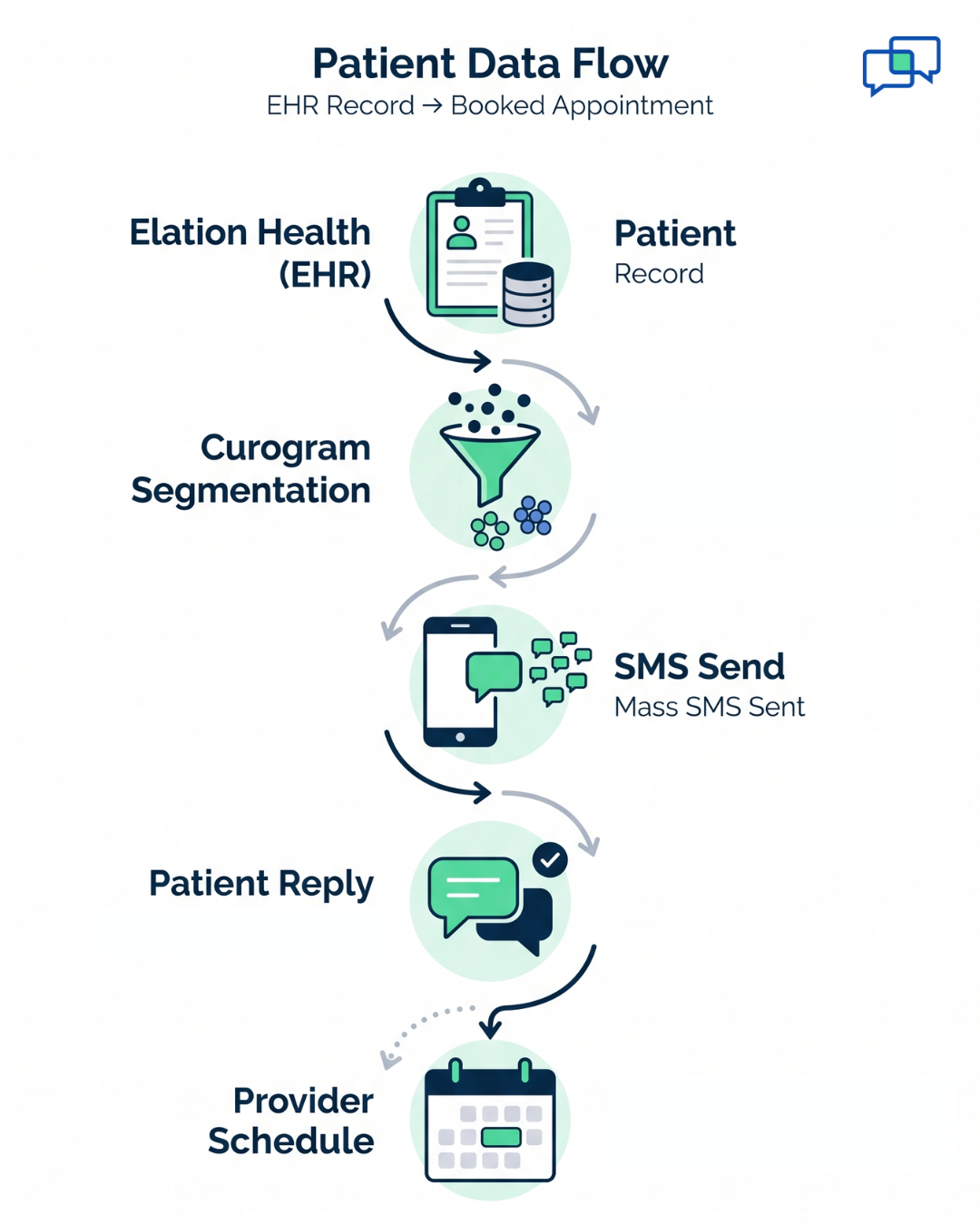
Think of Curogram as a one-click recall platform sitting beside your EHR. Elation Health holds the records. Curogram turns those records into outreach at scale, without forcing staff to copy data, build spreadsheets, or learn a new tool from scratch.
The platform sends mass SMS, runs two-way replies, manages reminders, collects forms, and handles review requests. Recalls are one of the workflows it powers, but the same system runs every day for normal patient communication. That shared use is what keeps the overhead low.
The Feature: Segment, Draft, Send
A full recall campaign runs in three short steps.
- Segment your list. Pull patients by last visit date, provider, appointment type, or custom rules. Need patients who missed their annual wellness in the last 14 months and have a primary provider on staff? That filter takes seconds.
- Draft the message. Use a template or write your own. Keep it short, clear, and tied to a real next step like booking or replying.
- Send the campaign. Launch to a few dozen or a few thousand patients at once. Replies come into a shared inbox where staff can book the appointment right there.
Most teams launch their first send in under 15 minutes. The second campaign is even faster, because the segments and templates are already saved.
The Integration with Elation Health
Curogram pulls patient and scheduling data straight from Elation. That means the segments you build use real clinical and visit details, not stale exports.
When a patient updates their phone number in Elation, the change flows through. When a patient books, the appointment lands on the right provider's calendar.
The platform also handles the compliance work that usually slows recalls down. Opt-outs are processed without staff input. STOP replies are honored and logged. Consent records are kept in line with TCPA rules. Your team does not need to chase those tasks by hand.

The Primary Care and DPC Fit
For primary care and direct primary care groups, recalls are not just marketing. They are clinical care. A reminder to book a colonoscopy, a mammogram, an A1C check, or an annual wellness visit is a clinical nudge that protects patient outcomes and fills slots at the same time.
Here is how a typical staff recall campaign workflow can map to common primary care needs.
|
Recall Type |
Patient Segment |
Sample Send Volume |
|
Annual wellness overdue |
No visit in 12+ months |
1,500 patients |
|
Preventive screening gaps |
Due for colonoscopy or mammogram |
600 patients |
|
Diabetic A1C follow-up |
Last A1C 6+ months ago |
350 patients |
|
General re-engagement |
No visit in 18+ months |
2,200 patients |
Each of these campaigns can run in its own window, with its own message and its own tracking. That is the shift mass messaging operations Elation teams can make once the heavy lifting moves off the front desk.
The point is simple. The work that used to feel impossible at scale becomes routine. Recalls stop being a quarterly idea and start being a quarterly action.
The Success: The Executed Campaign
The moment a stalled recall project turns into a real campaign, the math changes fast. Empty slots fill. Dormant patients return. Staff stop dreading the topic. This section walks through what a successful run actually looks like, both in numbers and in daily workflow.
The Metric That Tells the Story
Based on our internal data, a multi-location practice using Curogram's mass messaging recovered 1,240 patients through recall campaigns. The reconversion rate landed at 35% of contacted patients booking an appointment within a month of the send.
To put that in plain math, imagine an average revenue per visit of $150 to $250 for a primary care practice. A 1,240-patient recovery translates to a rough range of $186,000 to $310,000 in recovered visits. That is real money pulled back from a list that was already sitting in the EHR.
The Shift: From To-Do List to Repeatable Workflow
A successful first campaign is good. A repeatable workflow is better. Once a team sees how fast a single send runs, recalls stop being a one-time idea and become a regular part of the calendar.
A common pattern looks like this:
- January: Annual wellness recalls for patients overdue 12 to 18 months
- April: Preventive screening recalls (colonoscopy, mammogram, DEXA)
- July: Chronic care lapses, including diabetic A1C and hypertension checks
- October: Broad re-engagement for patients absent 18+ months
Each campaign uses its own segment and its own message. None of them require dedicated project management. They live alongside your daily 2-way texting, reminders, and forms.
A Realistic Outcome
Here is a fair picture of what the first 90 days can look like for a mid-market Elation practice. None of these numbers are guaranteed, but they reflect what we see when practices execute consistently.
|
Time After Launch |
What Happens |
|
First 24 to 48 hours |
Most replies land. First batch of appointments books. |
|
Week 1 |
Staff sort replies, follow up with patients who need extra info. |
|
Week 2 to 4 |
Booked appointments start to show up on the schedule. |
|
Day 30 to 60 |
First major reconversion numbers are clear. |
|
Day 60 to 90 |
Second campaign launches based on what worked. |
The practice manager who spent three quarters discussing recalls now executes them on a fixed cadence. The dormant patient list shrinks. The schedule fills with returning patients, often at a much lower acquisition cost than new patient marketing.
Why This Matters for Operations Directors
Operations Directors care about more than one campaign. They care about whether a tool can carry weight across locations and across years. Curogram's recall workflow scales in both directions.
A single-location practice can run one campaign per quarter and see steady improvement. A 12-location group can run staggered campaigns across providers, locations, and patient panels without burning out a regional manager. The same segment logic and the same templates apply across the board.
The deeper win is on staff time. Recalls used to demand dozens of hours of phone work. Now they take 15 minutes of setup and a few hours of inbox triage. That difference is the heart of why this works.

How Curogram Turns Elation Health Patient Data into Action in 15 Minutes
Curogram is a HIPAA-compliant patient communication platform built to sit beside your EHR, not replace it. For Elation Health practices, it adds the outreach engine that the EHR alone does not provide. The integration pulls patient records, visit history, and provider details so segmentation reflects real clinical data.
The mass messaging operations Elation users rely on are designed around a simple idea. Front desk staff and Operations Directors should not need a data analyst to run a recall. They should be able to filter, draft, and send inside one screen. That is what Segment, Draft, Send delivers.
A new campaign starts with a saved or custom segment. From there, staff drop in a tested message or pick a template tied to a clinical goal. The send goes out in seconds, and the two-way inbox catches every reply in real time.
Compliance runs in the background. Opt-out keywords are honored without manual logging. TCPA consent records stay current. PHI safeguards are built in, so staff do not have to guess what belongs in a text and what does not. The platform also keeps a clean audit trail for every campaign.
Where Curogram stands apart from other tools is the breadth of features in one platform. The same system handles 2-way texting, smart appointment reminders, electronic forms, telemedicine, online booking, and review requests. Practices that bolt on three or four tools to get the same coverage often spend more and get less consistency.
The integration with Elation Health is one-way for data, which is the standard pattern for engagement platforms. Patient records, appointments, and provider details flow from Elation into Curogram. That keeps the EHR as the source of truth while giving your team a fast, modern channel to reach patients.
For Practice Managers, the result is a tool that fits into the rhythm of the office. For Operations Directors, it is a platform that scales with new locations and new providers. For patients, it is a familiar channel that meets them where they already spend time, which is on their phone.
Conclusion: Stop Planning Recalls, Start Running Them
Patient recalls do not need another planning cycle. They need a workflow change. With Curogram, that change happens fast and the results show up in weeks, not quarters.
The summary is short. Recalls move from an aspirational project to a 15-minute task once the tool fits the job. Segmentation, sending, and compliance stop being separate problems and become one smooth flow.
The deeper insight is about how your tools relate. Elation Health stores the patient records. Curogram activates them at scale. The EHR is your database. The engagement platform is the engine that turns the database into appointments.
The call to action is just as simple. The recall campaign you have been planning for months can launch in 15 minutes. Bring your target criteria, such as patients who have not visited in 12+ months, and we will build, target, and launch the campaign with you on a live demo.
The next step is to book your Elation integration demo. Come ready with your segments and your goals. Leave with a real campaign plan, a clear view of the workflow, and a path to your first measurable patient database reactivation results.
Stop pulling recall lists into spreadsheets that never get used. Schedule a quick call with one of our experts to see how Curogram turns Elation Health patient data into a one-click campaign.
Frequently Asked Questions
Curogram processes STOP replies automatically, keeps consent records current, and applies frequency limits. Suppression lists block future sends to opted-out numbers. This keeps your recall campaigns aligned with TCPA without forcing staff to track compliance by hand.
SMS open rates run near 98%, and most replies land within 24 to 48 hours of send. Some bookings come in minutes. Two-way replies let patients schedule right inside the same thread, which removes the friction direct mail and email cannot solve.
Curogram supports full segmentation by visit date, provider, appointment type, and custom rules. You can send one message to wellness-overdue patients, another to diabetic A1C follow-ups, and a third to general re-engagement. Targeted messages drive higher response than generic blasts.
Phone calls top out near 40 to 60 patients per staffer per day. SMS sends to thousands at once and reaches patients on the channel they already use. Staff time drops, response rates climb, and the dormant list shrinks faster.
The strongest performers are annual wellness recalls, preventive screening gaps, chronic care follow-ups (A1C, blood pressure), and broad re-engagement for absent patients. Each campaign ties to a clinical goal, which keeps response strong and reinforces care continuity.