13 min read

How to Increase New Patient Volume With CollaborateMD

How to Increase New Patient Volume With CollaborateMD
💡 To increase new patient volume with CollaborateMD, use Curogram to automate Google review requests right after each visit.
  • Automated reviews boost your Google Maps ranking for doctors
  • Higher rankings put you in the top 3 local results (the "Map Pack")
  • More 5-star reviews lower your patient acquisition cost to near zero
  • Practices using this method have seen a 20% rise in self-referrals
  • You replace paid ads with free, organic search traffic
By connecting Curogram to your CollaborateMD workflow, you build a review engine that drives steady new patient growth without ad spend.

Picture this. A patient in your zip code types "best doctor near me" into Google. Three practices show up at the top of the page. Yours is not one of them.

That patient just picked your rival. Not because they are better. But because Google said they were.

This is the harsh truth for most medical practices today. You could be the best doctor in your area, but if your online presence is weak, new patients will never find you. They will find the office down the road that has 400 Google reviews and a 4.9-star rating.

Here is the good news. You can fix this. And you can do it without spending a dime on ads.

The secret is what we call "The Flywheel Effect." It starts with one simple idea: reviews are not just nice to have. They are your cheapest way to bring in new patients.

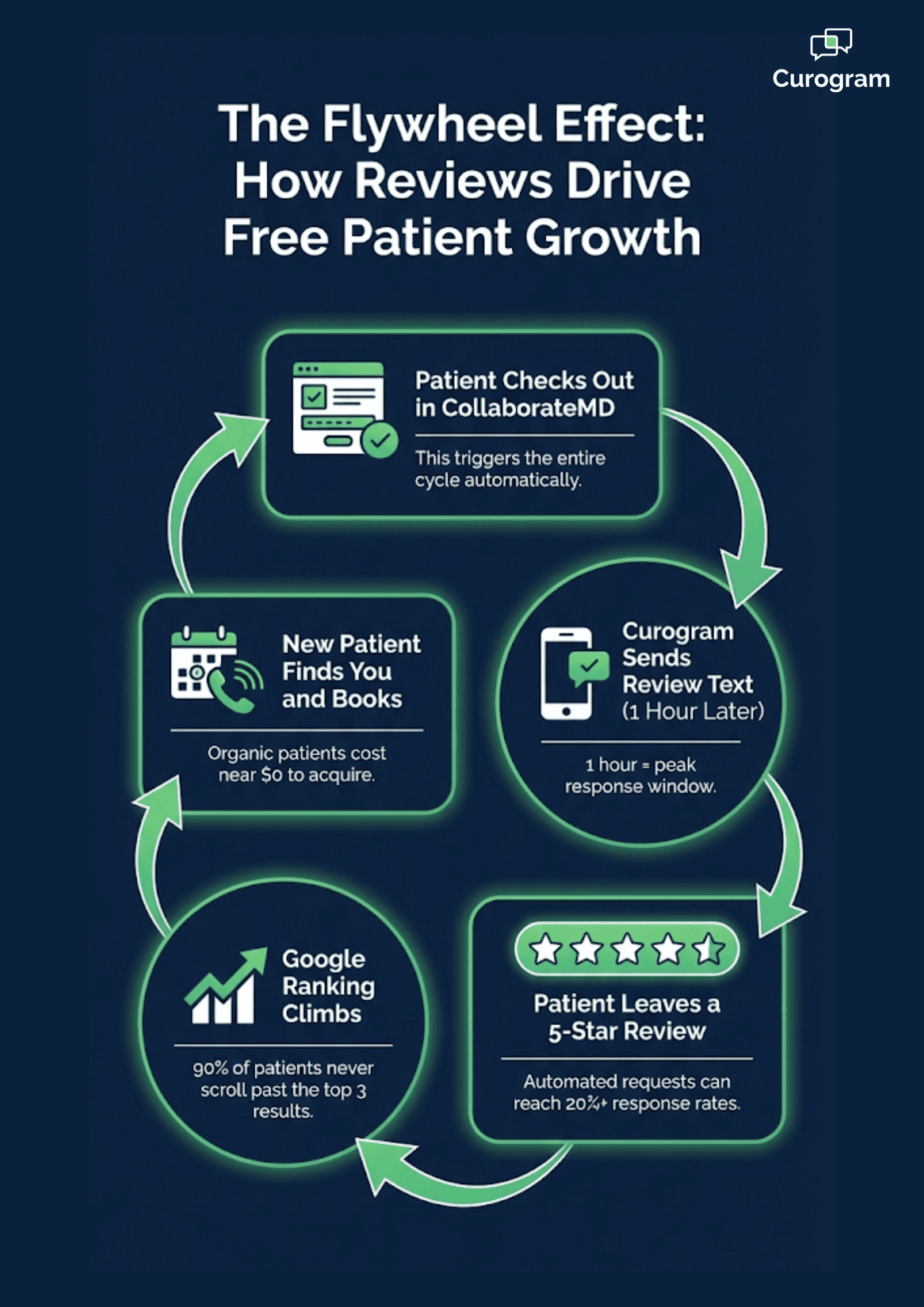
More reviews lead to a higher search ranking. A higher ranking means more people find you on Google. More people finding you means more booked visits. And those new happy patients leave more reviews. The cycle keeps going.

If you want to increase new patient volume with CollaborateMD, the fastest path is to turn every checkout into a Google review. Curogram makes this happen on autopilot.

When a patient checks out in CollaborateMD, Curogram sends them a review request via text. No extra work for your staff. No clunky follow-up emails.

In this guide, you will learn exactly how medical practice local SEO works, why Google reviews are the key driver, and how to set up a system that brings in new patients for free.

Whether you run a solo practice or a multi-site clinic, this approach works because it plugs right into the tools you already use every day.

The Villain: The "Invisible Practice"

Think about how you search for a place to eat. You grab your phone, type in what you want, and pick from the top few results. You rarely scroll past those first three options. Your patients do the exact same thing when they look for a doctor.

About 90% of people never look past the first page of Google results. More than that, most clicks go to the top three listings in what Google calls the "Map Pack."

This is the small box of local results that shows up with a map, star ratings, and contact info. If your practice is not in that box, you are sitting on page two. And page two might as well be page twenty.

This is what we call "The Invisible Practice." You have a great team, solid patient care, and years of experience. But none of that matters if people cannot find you online. You are a hidden gem that stays hidden.

The Ad Spend Trap

Many practice owners try to fix this with Google Ads. They spend $2,000 to $5,000 a month to show up at the top of search results. And sure, it works — while the money flows. The moment you stop paying, you vanish again.

Google Ads rent your spot. They do not build anything lasting. Think of it like paying rent on a store versus owning the building.

Every dollar you put into ads is gone the second your campaign ends. You have no asset left behind. No review count, no trust signal, no lasting place in the rankings.

For example:

Say, you spend $3,000 per month on ads and that brings in 15 new patients. That is a patient acquisition cost of $200 per person. Over a year, you have spent $36,000 just to stay visible. Now, compare that to a practice that earns 50 new Google reviews a month and climbs into the Map Pack on its own. Their patient acquisition cost? Close to zero.


The Trust Gap

Even when a potential patient does find your listing, reviews play a huge role in what happens next. Put yourself in their shoes.

You see two practices side by side. One has 12 reviews, mostly from three years ago. The other has 500 reviews, with new ones coming in every week. Which one do you trust more?

The answer is clear. A low review count sends a signal that the practice is either not busy or not very good. That may not be true at all, but it is what the patient thinks. And in healthcare, trust is everything.

Here is a simple way to think about it:

If your rival has 300 reviews and you have 25, that gap is not just a number. It is a wall between you and every new patient who might have chosen you. They see the big number, they see the fresh dates, and they click on the other listing.


This trust gap also affects your Google Maps ranking for doctors. Google's search engine looks at review count, how recent the reviews are, and the star rating.

A practice with a thin, stale review profile will always rank lower than one with a strong, active profile. So the trust gap does not just cost you one patient at a time. It keeps you lower in the search results, which costs you many patients at once.

The bottom line is this: if your practice is not in the Map Pack with a strong review count, you are losing patients you never even knew about. They searched, they found someone else, and they booked. Your phone never rang. That is the cost of being invisible. And it adds up fast, month after month, year after year.

Medical practice manager reviewing Google review growth and star ratings on a desktop monitor

The Guide: How Curogram Feeds the Google Algorithm

Now that you see the problem, let us talk about the fix. Google uses a set of signals to decide which practices show up first in local search.

If you understand these signals, you can work with them instead of against them. And Curogram helps you do exactly that with your CollaborateMD system.

The Three Signals Google Cares About

Google looks at three main things when it ranks your practice in local results:

  • Quantity -  How many reviews does your practice have? A clinic with 400 reviews will almost always rank above one with 40, all else being equal.

  • Velocity - How often do new reviews come in? Google wants to see a steady stream, not a big burst followed by months of silence. A practice that gets five new reviews every week signals to Google that it is active, busy, and trusted by real patients.

  • Quality - What is the star rating? A high count of 5-star reviews tells Google your patients love what you do. A mix of 2-star and 3-star ratings tells a different story.

Curogram helps you hit all three signals on autopilot. It does this by working right inside your CollaborateMD workflow, so there is nothing extra for your staff to learn or manage.

The CollaborateMD Trigger

Here is how it works in practice. When your front desk changes a patient's status to "Checked Out" in CollaborateMD, that triggers Curogram. Curogram waits about one hour, then sends the patient a text message with a direct link to leave a Google review.

Why one hour? Because the visit is still fresh in the patient's mind. They remember the friendly staff, the short wait time, and the care they received.

If you wait a week to ask, that feeling fades. The response rate drops. Timing matters, and this trigger is built to catch the moment when patients are most likely to say yes.

This is what it means to automate patient reviews. Your staff does not have to remember to ask. They do not have to hand out cards or send emails. The system does it all based on a status change that already happens in your normal workflow.

Think of a practice that sees 30 patients a day:

If even 20% of those patients leave a review after getting that text, that is six new Google reviews per day. That is over 180 new reviews per month. In three months, you could go from 50 reviews to nearly 600. That kind of growth changes everything about where you appear in search results.


How Patient Words Boost Your Ranking

There is a bonus effect that most practices do not know about. When happy patients write reviews, they often use real words that describe their visit. A patient might write something like, "Dr. Smith really helped my back pain" or "Great experience with my knee injury follow-up."

These words act like search terms. When someone else in your area searches "back pain doctor near me," Google sees those exact words in your reviews and connects them to your listing. This is how your review profile helps with specialty searches, not just general ones.

You do not need to coach your patients on what to write. When people have a good visit, they share the details on their own. The key is just making it easy for them to leave that review right when the visit is over. Curogram's text-based system makes that happen.

This is what sets CollaborateMD practice marketing apart when paired with Curogram. Your billing system becomes the trigger for your growth engine. Every checkout fuels your online presence, which fuels your patient pipeline, which keeps your schedule full.

The ROI: Free Marketing vs. Paid Leads

Let us talk numbers. At the end of the day, every practice owner wants to know one thing: is this worth it? The answer becomes clear when you compare the cost of paid ads to the value of organic search traffic powered by reviews.

The Math Behind Free Patient Growth

Start with a simple figure. What is one new patient worth to your practice? For most medical offices, the lifetime value of a single patient falls between $500 and $1,500. This includes repeat visits, referrals, and any follow-on care. Let us use a modest number: $500 per patient.

Now let us say your improved Google ranking brings in just 10 extra new patients per month. That is not a stretch. Moving from page two into the Map Pack can do far more than that. But let us keep it simple.

en new patients a month at $500 each is $5,000 per month. Over a year, that is $60,000 in new revenue. And the cost to get those patients? The cost of your Curogram plan. That is it. No ad spend, no pay-per-click fees, no agency retainer.

Compare that to the paid ads route. A typical Google Ads campaign for a medical practice costs anywhere from $2,000 to $5,000 per month.

Let us say you spend $3,000:

If that campaign brings in 15 new patients, your patient acquisition cost is $200 per person. Some months you might get more, some months less. But that $3,000 is gone whether you get results or not.

Over a year at $3,000 per month, you spend $36,000 on ads. If each of those 15 monthly patients is worth $500, you bring in $90,000 in new revenue but spent $36,000 to get it. Your net gain is $54,000.


Now look at the review-driven approach. You spend a fraction of that on Curogram, bring in those same 10 patients (or more), and keep almost all of the $60,000.

Plus, unlike ads, the effect builds over time. Your review count keeps growing. Your ranking keeps rising. Month six is better than month one.

Here is another way to think about it: With ads, your cost stays flat or goes up. With reviews, your cost stays the same while your returns keep growing. That is the flywheel at work.

Flywheel effect  showing how CollaborateMD checkouts drive Google reviews and new patient volume

Why Review-Driven Patients Convert Better

There is another layer to this that most practices miss. Not all new patients are equal. The way someone finds you shapes how they feel about you before they ever walk in the door.

A patient who clicks on your Google Ad knows it is an ad. They have no strong reason to trust you over anyone else. They may shop around, call two or three offices, and pick based on who answers the phone first.

A patient who finds you through organic search and sees 400 five-star reviews is a different story. They have already made up their mind. They trust you before they call. They are what marketers call "pre-sold."

This means the intake process is smoother. They are more likely to show up for their first visit. They are more likely to accept treatment plans. And they are more likely to pay on time because they chose you based on trust, not a coupon or ad.

For example:

Think about two patients who both call your office on the same day. Patient A found you through a Google Ad that promised a free first visit. Patient B found you because you have 450 reviews and a 4.8-star rating. Which one is more likely to become a long-term, loyal patient? The data points to Patient B every time.


This better conversion rate means your real return from organic patients is even higher than the raw numbers suggest. You are not just getting more patients. You are getting better patients.

What Happens When You Stop Paying for Ads

One of the biggest risks of paid leads is what happens when the budget runs out. Maybe a slow quarter hits. Maybe you need to cut costs. The moment you pause your ad spend, the leads stop. Overnight, your new patient flow drops to whatever your old organic traffic was.

With a strong review profile, that never happens. Your reviews stay on Google. Your ranking holds. Even if you paused Curogram for a month (though we would not suggest it), the hundreds of reviews you have already earned keep working for you.

Atlas Medical Center saw this play out in real terms:

After building a strong review profile through Curogram, they stopped their paid ad campaigns entirely. Their organic local traffic had grown so much that it became their main source of new patients. They did not need ads anymore because their reputation did the heavy lifting.


That is the goal for any practice. Build an asset — your online reputation — that works for you around the clock, for free. Ads are a cost. Reviews are an investment. One drains your budget. The other fills your schedule.

Doing the Math for Your Practice

Here is a quick way to figure out what this could mean for you: Take the number of patients you see per day. Multiply by the days you are open per month. Now multiply by your current review response rate (most practices get about 5% to 10% without automation).

With Curogram, that response rate jumps to 15% to 25%. So if you see 25 patients a day, five days a week, that is about 500 patient visits per month. At a 20% review rate, you get 100 new reviews per month.

Within three to four months, you could have 300 to 400 new reviews on your Google profile. That kind of volume changes your ranking fast. And once you are in the Map Pack, the new patients start coming in without you lifting a finger.

The real question is not "can I afford to try this?" It is "can I afford not to?" Every month without a review system is a month you are losing ground to the practice down the street that already has one.

Curogram has helped clients convert at least 5% to 10% of monthly appointments into 5-star Google reviews. See the exact numbers for your practice using the Curogram ROI Calculator for Reputation Booster. Simply plug in your average monthly appointment volume and estimated conversion rate. 

Own Your Local Market

Every doctor in your zip code is fighting for the same thing: the attention of new patients. The winner is almost always the one with the best online reputation.

Not the biggest office, not the most years in practice, and not the largest ad budget. The one with the most reviews, the highest stars, and the freshest activity on Google.

That is the game now. Medical practice local SEO decides who shows up when someone searches for care. And the single biggest factor in that ranking is your Google review profile.

Think of your online presence as a storefront window. Patients walk by every day — digitally — and glance inside. If your window is bare, with a handful of dated reviews, they keep walking. But if it is packed with hundreds of recent five-star ratings, they stop, they look, and they book.

Your CollaborateMD Workflow Is the Starting Line

The best part about this approach is that it plugs into what you already do. Your team already checks patients out in CollaborateMD. That action is the trigger. Curogram takes it from there, sending a text that turns a finished visit into a Google review.

No new software to learn. No extra steps for your front desk. No awkward "please leave us a review" conversations. The system runs in the background while your staff focuses on patient care.

This is what makes CollaborateMD practice marketing so powerful when paired with Curogram. You are not adding a task. You are turning an existing task into a growth engine.


How Curogram Powers Your Review Engine


Curogram was built with one goal in mind: make patient communication simple, fast, and automatic. It is a HIPAA-compliant texting platform that connects to your CollaborateMD system and handles the tasks your front desk does not have time for.

When it comes to reviews, Curogram does the heavy lifting. Once a patient checks out, the platform sends a friendly text with a direct link to your Google review page. The patient taps the link, leaves a star rating, writes a few words, and you have a fresh review on your profile.

Curogram does more than just automate patient reviews. It also helps you catch problems before they go public.

If a patient rates their visit below a certain threshold, the system can route that feedback to your team instead of Google. This gives you a chance to reach out, fix the issue, and turn a bad moment into a good outcome.

The platform also supports two-way texting, so your staff can message patients about appointments, forms, and follow-ups all from one place. This cuts phone calls by up to 50% and frees your team to focus on the patients who are standing right in front of them.

Setup takes minutes, not days. Staff training is quick because the platform works like the texting apps everyone already knows. There is no steep learning curve and no need for an IT team to roll it out.

For practices that want to increase new patient volume with CollaborateMD, Curogram is the missing piece. It turns your existing workflow into a patient growth system that runs itself. Your schedule stays full, your reviews keep climbing, and your patient acquisition cost stays low.

Conclusion

Your practice does not have a quality problem. It has a visibility problem. The patients are out there, searching for care right now. The question is whether they find you or the office next door.

Everything in this guide points to one truth. The practices that win in local search are the ones that make it easy for happy patients to share their experience. That is it. No secret formula. No big ad budget required.

When you pair CollaborateMD with Curogram, you create a loop that feeds itself. Every checkout leads to a review request. Every review boosts your ranking. Every higher ranking brings in a new patient who will also leave a review. This is the flywheel, and once it starts spinning, it is hard to stop.

The cost of doing nothing is real. Each month without a review system means missed patients, wasted ad dollars, and ground lost to your rivals. Meanwhile, the practice that starts today builds an asset that grows stronger every week.

You do not need to overhaul your operations. You do not need to hire a marketing team. You just need to connect the tools you already use and let the system work.

Stop renting visibility with ads. Start owning it with reviews. Your next new patient is one Google search away — make sure they find you.

Get found by more patients. Schedule a demo with us to see how Curogram turns your CollaborateMD schedule into a marketing machine.


Frequently Asked Questions

How does Curogram send review requests through CollaborateMD?
When a patient status changes to "Checked Out" in CollaborateMD, Curogram waits about one hour, then sends an SMS with a direct Google review link — no manual steps needed from your staff.
Why do Google reviews matter more than paid ads for long-term growth?
Reviews build a lasting asset that keeps working even when you stop spending. Ads stop producing results the moment you pause the budget, but a strong review profile holds your ranking over time.
How quickly can automated reviews improve a Google Maps ranking for doctors?

Most practices see noticeable ranking changes within 60 to 90 days of steady review growth. The speed depends on your starting point and how many patients you see each week.

How does a high review count lower patient acquisition cost?

More reviews push your listing higher in local search, which brings in organic traffic. Since you are not paying per click or per lead, the cost to gain each new patient drops close to zero.

Why is review velocity more important than just having a high total count?

Google favors businesses that get new reviews on a regular basis, not just once. A steady flow signals that your practice is active and trusted, which carries more weight than a large but stale review total.


Medical SEO for Cerbo Practices: The Power of Review Automation

Medical SEO for Cerbo Practices: The Power of Review Automation

💡 Cerbo practices can boost their Google rankings by sending review requests right after patient visits. Curogram makes this easy by linking with...

Read More
Automated Google Reviews for CollaborateMD: Get More 5-Star Ratings

Automated Google Reviews for CollaborateMD: Get More 5-Star Ratings

💡 Automated Google reviews for CollaborateMD practices boost local search rankings and bring in more new patients by sending review requests right...

Read More
Google Review Automation for Opus EHR: Build Trust Fast

Google Review Automation for Opus EHR: Build Trust Fast

💡 Google review automation for Opus EHR helps rehab centers and behavioral health clinics turn patient wins into online trust. Curogram syncs with...

Read More