
CollaborateMD Sends Reminders, Curogram Gets Confirmations
💡CollaborateMD appointment reminders with patient confirmation text turn a one-way notice into a two-way reply that patients actually send....

Your reminder text went out on time. The patient saw it and meant to come in. But something shifted, and now they need a new slot.
Here is the snag. The reminder gives them nowhere to reply. So they picture the hold music and put off the call. The visit quietly slips away.
This is the dead-end text, and it drains real revenue. A one-way reminder tells patients when to show up. It does not let them tell you when they cannot. That gap turns willing patients into silent no-shows.
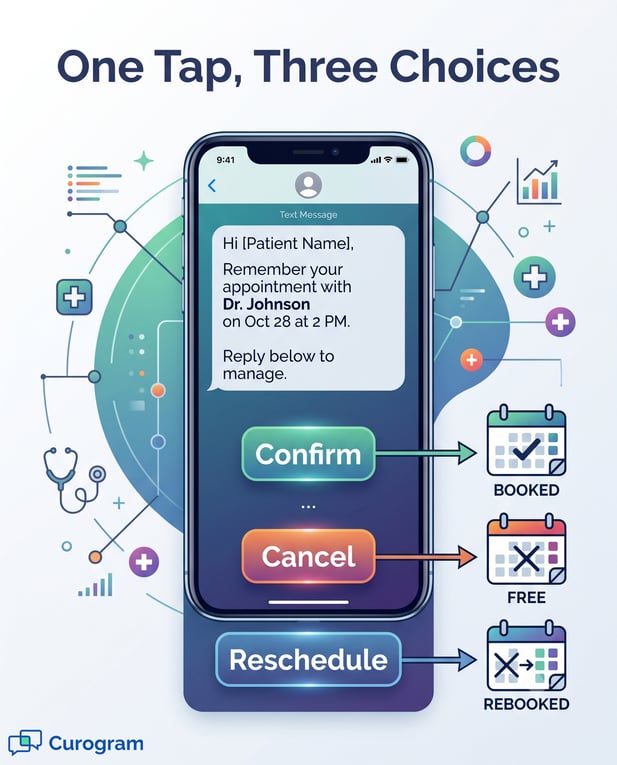
A CollaborateMD appointment reschedule by text reply closes that gap. The patient taps once to confirm, cancel, or move the visit. No phone call. No portal password. The reply reads like texting a friend, so people actually respond.
Curogram makes this two-way reminder patient experience simple. A patient can confirm an appointment by text or cancel the appointment by text reply in seconds. They can also reschedule without calling the office at all. The change flows straight back into your schedule, with no staff re-entry.
The result feels small to the patient but big to your bottom line. One tap replaces a phone tree they used to abandon. That single reply can save a slot you would have lost.
None of these asks your patients to learn a new habit. They already text far more than they call. So the fix works with how they live, not against it. That is why replies come back fast.
Think about your last busy Monday. How many no-shows could a quick reply have saved? That is the gap we are about to close.
In this guide, we walk through why the dead-end text hurts and how the fix works. You will see how a patient-friendly reminder reply frees slots and fills them. Let us start with the villain.
A reminder should start a conversation. Too often it ends one. When a text goes out with no way to reply, the patient hits a wall. That wall is the dead-end text, and it quietly drains your schedule.
A one-way reminder looks helpful, but it hides a trap. Watch what happens the moment a patient needs to reply.
Your patient opens the reminder and nods. Then life gets in the way, and the visit no longer fits. They need a new time, but the text offers no reply. So the thought fades, and the appointment fades with it.
The reminder did its first job well. It reached the patient at just the right time. But it stopped at the door, unable to hear a reply. A well-timed nudge with no way back is only half a tool.
Timing is not the issue here. The reminder arrives right on cue. The issue is the silence that follows it. A text you cannot answer is a door with no handle.
Some patients do try to reply. They type a quick “can we move this?” and hit send. But a one-way system has no one reading the other end. That message drops into a black hole that no staffer ever checks.
Now the patient feels ignored, though no one meant to ignore them. They tried to do the right thing and got silence. Next time, they may not bother to warn you at all. Trust erodes one unanswered text at a time.
When replying feels hard, patients stop trying. The result is an empty chair no one saw coming.
Here is the cruel part. Most no-shows would have gladly moved the visit instead. They just had no easy way to say so. The slot sits empty, and the revenue walks out the door.
Now multiply that by a busy week of visits. A handful of quiet no-shows adds up quickly. Each one is a slot you could have filled with a waiting patient. The loss is not just today's chair, but tomorrow's too.
None of these patients set out to skip care. They wanted to come, then simply could not. With no easy reply, good intent turned into an empty slot. That is a loss you can prevent.
It is tempting to blame the patient. The truth is kinder and more useful. The system gave them no simple path to reply. Fix that path, and the behavior changes fast.
People text all day, every day, with ease. The tool they trust is already in their pocket. Give them a reminder they can answer, and they will. Meet them there, and the no-show problem starts to shrink.

Curogram turns that dead end into a doorway. The reminder becomes a real chat the patient answers in seconds. There is no app to download and no portal to log into. The reply lands where your staff can see it and act.
The core feature is simple by design. Curogram calls it 2-Way Smart Reminders.
The patient gets a friendly text, then picks an option. They can confirm, cancel, or ask for a new time with one tap.
The reply rides on secure two-way texting, so the thread stays private. It feels less like a robot and more like a note from the front desk.
You can read more about the conversation behind the reply in our overview of 2-Way HIPAA-Compliant Texting. Each option maps to a clear next step. Confirm locks the slot in place. Cancel or reschedule opens it for someone else.
The text comes from your practice's real number, not a random shortcode. That builds trust, so patients reply instead of ignoring it.
There is no login and no portal appointment confirmation to hunt for. Pew Research reports that nearly all U.S. adults own a cellphone, so a text meets them where they are.
A familiar number changes how the message feels. It reads like the office, not a spam blast. So patients open it, trust it, and reply. That trust is what turns a reminder into a real reply.
A reply is only useful if it changes something. Curogram makes each tap move the schedule for real.
When a patient picks a new time, it flows back into your calendar. The change syncs into CollaborateMD without staff re-entry. So a CollaborateMD appointment rescheduled by text reply becomes a booked slot on its own. The patient's tap does the work your team used to do by hand.
There is no double entry and no copy-paste. The calendar and CollaborateMD stay in sync on their own. Your team sees the change the moment it happens. Fewer manual steps means fewer slips and errors.
Automation here is quiet, not flashy. The patient sees a simple text and a quick reply. Behind it, the booking updates itself. That is the whole point: less work and fewer errors.
This fits any patient with a phone, which is nearly everyone. It works across primary care, specialty clinics, and lab or imaging visits.
Because it reads like a normal text, patients of all ages respond. The whole two-way reminder patient experience feels effortless on their end.
The same no-portal, text-first approach powers secure online forms, where intake happens through a simple text link. One channel handles reminders, replies, and forms. Patients learn one simple habit: check the text. That habit lifts response rates across the board.
So what changes when patients can finally reply? The numbers move, and so does the mood at the front desk. Empty slots get filled instead of wasted. Here is what the shift looks like in practice.
The win is easy to name. Patients go from stuck to self-served in two taps.
Practices using Curogram average more than 75% confirmation rates. One clinic cut no-shows from 14.20% to 4.91% in just three months. That runs 53% below the industry average, based on our internal data. When patients can reply, they do.
These gains share one root cause. Patients finally had a way to reply. Give people an easy path, and most will take it. The schedule fills because the friction is gone.
Numbers like these are not magic. They come from removing one small barrier. When replying is easy, patients reply. The schedule reflects that choice, day after day.
|
Metric |
Before Curogram |
After 3 Months |
|---|---|---|
|
No-show rate |
14.20% |
4.91% |
Based on our internal data.
The behavior shift is the real prize. Instead of a silent no-show, the patient reschedules without calling the office. They handle it on their own time, day or night. Your phones stay free for the calls that truly need a human.
Self-service is not just faster for them. It is lighter for your staff too. No one plays phone tag to lock a new time. The patient does it in the time it takes to read a text.
The office feels the relief too. Each self-serve reschedule is one less call to the field. That time goes back to patients in the waiting room. Small shifts like this add up fast.
A freed slot is only wasted if it stays empty. Early notice lets you fill it fast.
When a patient cancels early, the slot opens with time to spare. You can offer it to someone waiting for an earlier date. A gap that once meant lost revenue becomes a booked visit. The schedule starts to heal itself.
Early cancellations are a gift in disguise. They hand you time to act. A quick offer to a waitlist patient turns a hole into a visit. What used to be dead air becomes booked care.
Speed is the secret here. The sooner a slot opens, the easier it fills. A same-day cancellation by text beats a no-show every time. Early word keeps the whole day productive.
None of this adds tasks to your team. The replies post to the calendar and CollaborateMD on their own. Staff stop chasing confirmations by phone and start helping patients in the room. The confirmation engine runs quietly in the background.
The front desk stops firefighting and starts helping. Calls drop because patients self-serve by text. Staff spend their energy on people, not data entry. That is a better day for everyone in the office.
Your team notices the calm. The phone rings less for routine changes. Calendars and confirmations stay in step on their own. That steady rhythm is easier to staff and plan around.

A reminder is only half the job. The other half is the reply. When answering takes two taps, patients tell you the truth about their plans. The empty slot gets filled instead of wasted.
That is the gap between a dead-end text and a real conversation. One tells patients when to show up. The other lets them tell you when they cannot. Only the second one protects your schedule.
Think of it as a simple split of duties. CollaborateMD is built for your schedule of record. Curogram is built for your patient's convenience. Put them together, and a reschedule becomes effortless.
Your front desk feels the change first. Fewer hold-time calls and fewer no-shows to clean up. More time for the patients standing right in front of them.
Patients feel it too. A CollaborateMD appointment reschedule by text reply respects their time. It meets them where they already are, in their text thread. No portal, no phone tree, no guilt.
The math is hard to argue with. More confirmations, fewer no-shows, and fuller days. Each reply is a small save that adds up over a month. Those saves are the quiet engine of a healthy schedule.
Start small if you like. Turn on two-way reminders and watch one week of visits. Count the replies you would have missed before. Those replies are slots you just saved.
The best part is how little it asks. No new portal for patients to learn. No phone tree for your staff to run. Just a text that finally listens back.
A schedule is a living thing. Gaps open, and gaps can close again. Give patients an easy way to reply, and they help close them. That is how a schedule stays full and healthy.
Behind every filled slot is a patient who got care. That is the real reward, beyond the numbers. A fuller schedule means more people seen. The reply that saves a slot also serves a person.
So the choice is simple. Keep the dead-end text, or let patients reply. One costs you slots; the other fills them. The better path is one tap away.
You do not have to turn rescheduling into a phone tree your patients abandon. There is a simpler path, and you can watch it work live. See a patient confirm or reschedule by text in real time.
Book a short demo and watch a patient confirm or reschedule by text in real time.
They reply right inside their normal text messages. There is no app to install and no account to create. They tap confirm, cancel, or reschedule, and they are done. It works on any phone that can send a text.
A no-show often starts as a patient who cannot make it and cannot easily say so. Two-way texting gives them a fast way to reschedule instead of vanishing. That early notice frees the slot for someone else. Fewer silent no-shows means a fuller, healthier schedule.
When the patient picks a new time, the change syncs straight into your calendar. It also flows into CollaborateMD on its own. No one at the front desk has to key it in again. The patient's reply becomes the booked appointment.
Calling means dialing, waiting on hold, and hoping someone picks up. Texting takes seconds and fits around a busy day. Most people already live in their text thread, so replying feels natural. That is why a patient-friendly reminder reply gets a response.
Reminders follow TCPA and HIPAA rules, with patient consent captured up front. The texting itself is secure, so private details stay protected. Patients can opt out at any time with a single reply. Compliance runs in the background while the patient just sees a simple text.
💡CollaborateMD appointment reminders with patient confirmation text turn a one-way notice into a two-way reply that patients actually send....

💡Appointment reminders Azalea Health patients can confirm by text turn a one-way alert into a real exchange. The patient simply replies to confirm...
💡 Lytec text reminders patients can reply to reschedule turn a one-way alert into a two-way chat. Patients confirm or move a visit in one tap, with...