


9 min read

CollaborateMD Texting: Fix Missing Claim Data Fast

CollaborateMD Texting: Fix Missing Claim Data Fast
💡CollaborateMD HIPAA-compliant texting for missing claim data turns a multi-day phone chase into a quick text reply. CollaborateMD submits, scrubs, and tracks claims well. But its built-in SMS only covers billing chat.

So when a claim flags for an old card or a wrong birth date, staff return to the phone. Curogram closes that gap.

It sends a secure two-way text from your existing practice number. The patient texts back a photo of the new card or the right detail. That reply writes straight into CollaborateMD through the live HL7/API link.

Whether you bill in-house or run an RCM company, claims submit clean the first time. Patients answer a text in seconds when they would never return a call.

Your billing software just did its job without a single hitch. The claim was scrubbed, formatted, and ready to send to the payer. Then it flagged.

The patient's insurance card expired last month, and now the whole claim sits in pending.

This is the quiet tax on every busy practice and outsourced billing team alike. CollaborateMD files claims fast and keeps them clean before they ever reach the payer.

Yet the moment one claim needs a small fix, the real work leaves the software. A staffer pulls the chart, dials the patient, and lands in a voicemail box again.

That frustrating loop has a name that nearly every front desk knows too well. We call it the phone tag trap, and it quietly drains your day from the start.

A claim that should clear in minutes instead ages in pending for several days. Staff burn hours on hold music and redials while your cash flow simply sits and waits.

There is a faster way to reach the patient and free that stuck claim. CollaborateMD HIPAA-compliant texting for missing claim data swaps the phone chase for a quick text.

You text the patient from your own practice number, not a personal cell. They send back a photo of the new card, and the data flows right into the claim.

This article shows how two-way patient texting for CollaborateMD fills the one gap the platform leaves wide open. You will see how to resolve stalled claims missing patient data without the daily phone grind that wears staff down.

We walk through the simple setup, the writeback into the record, and the real payoff for your busy team. The goal is simple: cleaner claims, fewer calls, and a front desk that works the queue instead of the phones.

The Villain: The Phone Tag Trap

CollaborateMD is built to get claims out the door with speed and accuracy. It scrubs, validates, and tracks every claim with real skill.

But it has no general two-way texting channel for patients. So any claim that needs a correction goes right back to the phone.

How a Flagged Claim Sends Staff Back to the Phone

Most claims sail through the system without any trouble at all. The few that flag tend to share one common cause: a small data gap.

A 97% Clean Rate Still Leaves Gaps

CollaborateMD reaches a 97% clean claim rate through its built-in clearinghouse and payer edits. That figure sits well above the national norm for first-pass claims.

Still, no scrubber on earth can guess a patient's brand-new insurance card. When the data on file is stale, the claim flags and the fix moves to the patient.

These gaps are rarely about coding or software at all. They come from life: a new plan, a new job, or a typo in a birth date.

The software did everything right, yet the claim still cannot move. The only missing piece lives in the patient's pocket, on their phone.

The Voicemail Loop Begins

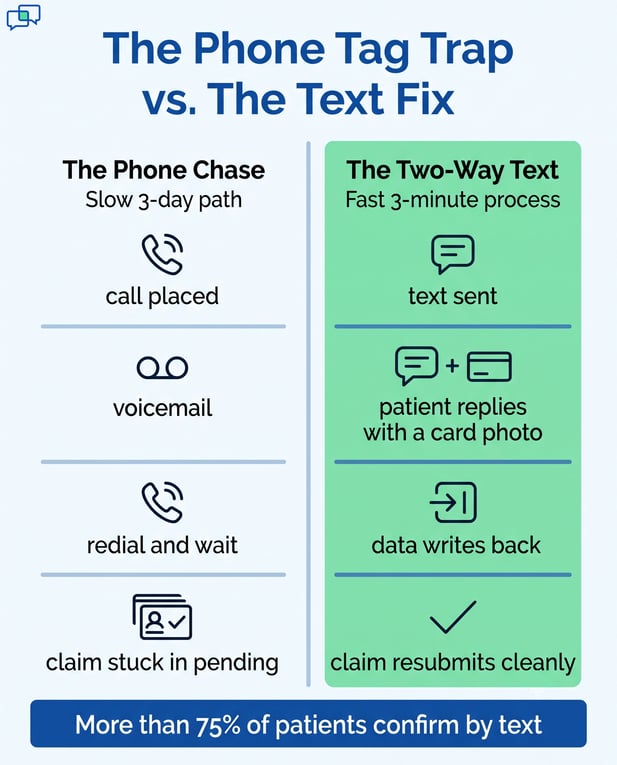
So a staffer pulls the chart and places the call. The line rings a few times, then drops straight to voicemail. They leave a short message, redial later, and a full day passes with no reply. The claim stays parked, pending the entire time, frozen by one missing detail.

The next day, the staffer tries again during a packed front-desk shift. The patient is at work and cannot answer an unknown number.

So the message sits unheard while the worklist keeps growing. This is how a clean billing engine still stalls on a tiny gap.

The Hidden Cost of Chasing Patients by Phone

The phone chase does not just delay one single claim. It drains real hours from your whole team every single day.

Hours Lost to Hold Music

Picture a front desk fielding dozens of patient calls a day. Each one runs about five minutes with holds, transfers, and lookups.

That adds up to hours per person on every single shift. And fewer than one in five voicemails ever gets a call back.

Most of that effort simply goes nowhere at all. The staffer is busy, but the claim is no closer to clean. Phones ring while real billing work waits in the queue. The cost is hidden in plain sight, spread across the whole day.

When Billing Companies Multiply the Problem

Now scale that same chase across a busy billing company. You manage CollaborateMD for many client practices at once.

Four or five staff members each lose hours to the phone every day. That is a full work day gone to redials and dead-end voicemails.

Each client expects clean claims and quick turnaround on every fix. But the phone simply cannot keep that promise at scale.

You need a faster way to end phone tag CollaborateMD billing teams face every day. That faster way is a channel through which patients actually answer.


Infographic: Phone-based vs. text patient confirmation for healthcare claims

The Guide: The Claim-Data Courier

There is a simple fix for the phone tag trap. You need a way to reach patients who actually answer. Curogram acts as the claim-data courier for your billing team. It retrieves the exact detail a claim is waiting on, by text.

How Two-Way Texting Retrieves Missing Data

The idea is plain and easy to picture. Skip the call and send a text, because patients reply to texts in seconds.

Texting From Your Own Practice Number

Curogram runs HIPAA texting from practice phone number lines you already own. There is no strange caller ID for patients to screen and ignore.

They see your practice name and reply with no hesitation. The whole thread stays secure, not on a staffer's personal cell.

That familiar number is what makes the message feel safe. CollaborateMD insurance verification by text becomes a quick back-and-forth.

The patient sends a photo of the new card in one tap. Now you have the exact data the claim was waiting on.

No App, No Portal Login

Patients hate downloading apps for a one-time task. They forget portal passwords almost as soon as they set them.

Curogram skips all of that friction and uses a normal text thread. There is nothing to install and nothing new to learn.

That low effort is the whole secret behind the response rate. A text takes ten seconds, while a portal login takes ten minutes.

So two-way patient texting for CollaborateMD gets answers when calls fail. Patients reply because you made it the easy thing to do.

This matters most for the patients who are hardest to reach. Busy parents, hourly workers, and older patients all text on their own time.

They may never pick up an unknown call during a work shift. But a short, friendly text waits patiently until they are free to reply.

How the Reply Writes Back Into CollaborateMD

Getting the photo is only half of the win. The corrected data still has to reach the claim itself.

Data Lands in the Record, No Re-Keying

This is where the live HL7/API link does the heavy lifting. The patient's reply does not sit in some separate inbox.

Curogram can write patient data back to CollaborateMD, straight into the record. No one re-types the card number by hand or risks a typo.

That writeback is the part that makes the whole fix stick. A saved message in a chat app does not update the claim. True write-back puts the right data exactly where billing needs it. The claim is now ready to resubmit clean.

Why the Integration Already Exists

You do not have to build a single thing here. The CollaborateMD connection is production-ready and live today. It answers the real question every billing lead asks first. Will this actually populate our fields? Yes, it will.

There is no long IT project and no custom code to wait on. Your team keeps the same screens and the same workflow.

So you resolve stalled claims and missing patient data without double entry. The courier does the legwork while your staff works the queue.


The Success: Minutes, Not Days

The shift from phone to text changes the whole math. Replies arrive in minutes, not days, across your worklist. Your claims queue clears at a brand-new pace. And your front desk finally gets its hours back.

Aspect

The Phone Chase

The Two-Way Text

Time to resolve

2 to 3 days

2 to 3 minutes

Patient response

Fewer than 1 in 5 voicemails returned

Most texts answered in seconds

Staff effort

Hours of redials and holds

One text, then back to the queue

Data entry

Re-typed by hand

Writes back to CollaborateMD

Claim status

Sits in pending for days

Resubmits the same morning


How the Claims Worklist Clears Faster

Texting does not just feel a little faster. It changes how the whole queue moves through the day.

Replies Arrive While Staff Work the Queue

Send a batch of texts first thing in the morning. Patients reply as they check their phones over coffee. Your team keeps working on the worklist the whole time. Each reply that lands unlocks one more stalled claim.

No one sits on hold waiting for a single answer. The work flows in parallel instead of one slow call at a time. That parallel pace is what melts a long worklist down. Claims move because the patient and the staff both keep going.

A handful of texts can clear what once took a full afternoon. Each photo of a fresh card unlocks a claim with no phone time at all.

Your staff simply watches the replies land and updates the records. The queue shrinks while the team stays calm and focused.

Same-Morning Resubmission

A claim that used to wait three days now moves fast. The patient texts the new card photo by mid-morning. You correct the record and resubmit it before lunch. That is the heart of minutes, not days.

The claim is clear while it is still fresh and top of mind. Cash flow speeds up because nothing ages in pending. Fewer claims slip past timely filing windows. The whole revenue cycle simply moves more quickly.

How Texting Frees Your Front Desk

The biggest gain is not just raw speed. It is what your staff can finally do with the time they save.

From Answering Machines to Claim Work

Texting pulls your staff off the phones for good. They stop chasing voicemails that no one returns. Instead, they work on the claims that bring in real revenue. Front-desk hours shift from answering machines to real billing work.

The same team can now handle a larger load with less stress. Mornings feel calmer because the phone stops ruling the day.

Staff focus on the worklist, not on hold music. That is a better job and a faster revenue cycle at once.

A Personal Touch That Scales

Some leaders worry that automation will feel cold to patients. The opposite is true with a well-timed text. A text meets patients right where they already are. They answer in seconds and feel cared for, not chased.

And this personal touch scales across every practice you serve. Curogram client data from clinical settings shows more than 75% of patients confirm by text.

That is a response rate no phone line can ever match. You get the warmth of a personal note with the reach of software.

The result is a front desk that feels less like a call center. Staff spend their day solving claims, not leaving the same voicemail twice. Patients feel seen because every message comes from a name they trust. That blend of care and speed is what completes the revenue cycle.

Patient at home using smartphone, smiling

ConclusionComplete Your Revenue Cycle

Here is the simple truth at the center of it all. CollaborateMD files the claim with speed and accuracy. Curogram retrieves the patient data that makes the claim clean. One handles the billing engine, and the other handles the patient reply.

Think of the two tools as partners, not rivals. CollaborateMD is built for your billing work and your worklist.

Curogram is built for their replies – the texts only the patient can send. Together, they close the loop that the phone left wide open.

The platform scrubs and submits with a strong 97% clean claim rate. But it cannot text a patient for a new card on its own.

That one small gap is exactly where so many claims stall. And a stalled claim is money sitting still pending.

Curogram fills that gap as the claim-data courier. A secure text goes out from your own practice number. The patient replies in seconds with the missing detail. The claim that sat for three days now clears the same morning.

The change shows up across your whole team, not just one claim. Staff trade hours of redials for a few quick taps on a keyboard.

Patients trade a missed call for a text they actually want to answer. Everyone wins, and the worklist finally stops growing.

And the model fits any size, from a solo clinic to a large RCM company. Each practice keeps its own number, its own brand, and its own voice.

The secure channel scales without adding new screens or new logins. You get one clean way to reach every patient who is holding up a claim.

The payoff reaches well past billing, too. The same two-way channel powers your appointment reminders, so fewer patients miss their visits. It also drives text-to-pay, which speeds up how fast you collect. One text line earns wins across the whole revenue cycle.

Want to go deeper on the workflow? See how CollaborateMD billing teams end the voicemail treadmill, and learn why patients text back their insurance card in seconds.

Stop letting one unreturned voicemail freeze a clean claim for three full days. The fix is already built, tested, and ready to run for your team today.

You do not need new software or a long, costly IT project to start. You just need a faster, friendlier way to reach your own patients.

Complete your revenue cycle and schedule a demo today.


Frequently Asked Questions

How does two-way texting with patients stay HIPAA compliant?

Curogram operates under a signed BAA, which keeps your texting inside legal bounds. Messages are secured in transit and at rest, and patient consent is captured before any text goes out. Patients reply from their own phones while their protected data stays in a compliant channel.

Why will my staff not have to re-key what the patient texts into CollaborateMD?

The patient's reply is written back through the existing HL7/API link. So the corrected insurance or demographic data lands in the record on its own. Your team skips the manual typing that invites errors. That writeback is the difference between a saved message and true data entry.

How does this differ from CollaborateMD's built-in billing SMS?

The built-in SMS is made for billing chat and payment notes. Curogram handles the wider two-way conversations that the platform leaves out. That means insurance fixes, scheduling, and care coordination by text. The two tools complement each other rather than overlap.

Why does texting reach patients when phone calls do not?

People screen unknown calls but read almost every text they get. A message from your own practice number feels familiar and safe. Patients can reply on their own time, even between meetings. That is why a text often gets an answer while a voicemail sits ignored.

How quickly can a billing company roll this out across many practices?

The CollaborateMD integration is production-ready, so there is nothing to build. Each practice texts from its own number, which keeps every brand distinct. Staff need little training because the texting flow stays simple. Teams can begin texting patients soon after setup, with no long IT project.


Two-Way Texting for Opus EHR Staff: Cut Calls in Behavioral Health

Two-Way Texting for Opus EHR Staff: Cut Calls in Behavioral Health

💡 Opus EHR two-way texting for front desk staff efficiency behavioral health helps practices replace the daily phone tag cycle with quick SMS...

Read More
Cut CollaborateMD Phone Tag for Billing Teams

Cut CollaborateMD Phone Tag for Billing Teams

💡CollaborateMD two-way texting to reduce front desk phone calls gives billing teams a way off the voicemail treadmill. That treadmill is the wall...

Read More
How Patients Text Their Doctor's Office Without an App or a Portal

How Patients Text Their Doctor's Office Without an App or a Portal

💡 Practice Fusion patient texting powered by Curogram lets patients text their doctor's office for scheduling, billing questions, prescription...

Read More