
1 min read
Patient Insurance Updates by Text, No Portal
 Jo Galvez : Jul 1, 2026, 4:00:01 PM
💡CollaborateMD patient texting to update an insurance card without a portal is simple. Patients send a card photo or fix a wrong date of birth in...

Picture a billing specialist at 9 a.m. The rejection worklist is long. One claim needs a patient's updated insurance ID. So the specialist dials, waits, and lands in voicemail again.
Left a message, the note reads. Then on to the next claim, same script, same dead end. This is the voicemail treadmill. It runs all day and goes nowhere.
Staff stay busy, yet the claims sit still. Calls get placed, but the accounts receivable barely budges. Nothing in the queue actually moves. The day ends, and tomorrow it starts over.
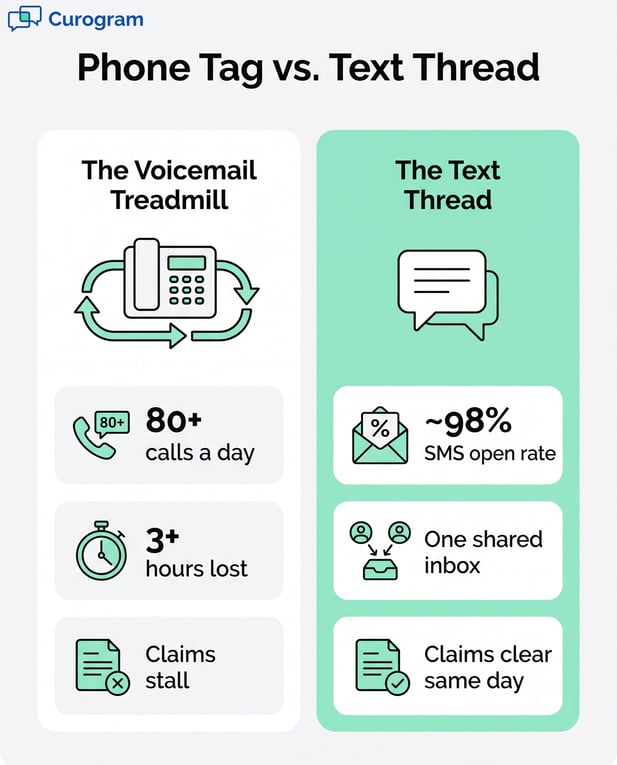
The math is brutal. Many billing desks push past 80 calls a day. At roughly five minutes each, that is more than three hours per person. Most of those calls reach no one, since patients stopped answering unknown numbers years ago.
For a billing company, multiply that across the whole follow-up team. Four or five staffers can burn 15 hours a day on the phone. Scaled across a team, the waste only multiplies. That is 15 hours that close zero claims.
CollaborateMD is built for the claim itself. It scrubs, codes, and submits with real skill. But its only built-in line back to the patient is the phone. So a claim that needs a quick fact puts your team right back on the treadmill.
There is a faster lane. CollaborateMD two-way texting to reduce front desk phone calls swaps the call list for a text thread. Your staff text from the practice number, so it still feels local and trusted. Patients read texts, reply on their own time, and the answer flows back into the claim.
This guide shows how that shift works. We will name the villain, meet the guide, and map the win. By the end, you will see how a medical billing company can turn patient texting into claims that close.
The voicemail treadmill is the daily grind of calls that never connect. Your team dials, waits, and leaves messages that go unheard.
Claims that need one quick fact from the patient stall for days. Here is why the phone has become the slowest tool in the building.
CollaborateMD handles claims with care. It scrubs errors, checks codes, and submits clean files. Yet its only built-in path to the patient is a call. So a single missing field can freeze an otherwise perfect claim.
A flagged claim often needs something small. A new address, a policy number, a birth date. CollaborateMD cannot text the patient for it, so the work falls to the phone. And the phone is where these small requests go to wait.
The data itself is easy to fix. The hard part is reaching the one person who holds it. A call demands the patient stop and pick up right then. Most people simply will not, so the field stays blank.
The pattern never changes. The specialist dials, sits on hold, then hits voicemail. They jot left a message and slide to the next claim. Tomorrow brings the same loop, with the same claim still open.
Each lap feels like progress because it takes effort. But effort is not the same as a resolved claim. The note pile grows while the worklist stays frozen. That is the treadmill in one image: moving, never arriving.
Each call looks cheap on its own. Stack them up, though, and the cost grows fast. This is where reducing the phone tag your billing team plays in CollaborateMD starts to matter. The bill shows up as wasted hours, not a line item.
Push past 80 calls a day at five minutes each. That is over three hours per person, gone. None of it moves a claim toward payment. For a five-person team, that is 15 hours a day lost to dial tones.
Now stretch that across a full work week. The lost time adds up to nearly two full shifts. Those are hours you pay for but never collect on. And no patient data arrives to show for them.
The team feels productive because the phones never stop. But the accounts receivable tells a colder story. Effort piles up on a channel patients ignore. So the worklist holds steady while everyone runs in place.
Managers see the call logs and assume the work is moving. The aging report says otherwise, week after week. The gap between activity and results keeps widening. Breaking the loop means changing the channel, not the pace.
Curogram does not replace CollaborateMD. It rides alongside it as a claim-data courier. The call list becomes a text thread that patients actually read. And every reply lands right where your staff need it.
Texts get opened, while voicemails get ignored. That single gap is the whole point. Two-way texting gives your claims follow-up staff a channel for patients to answer the same day. The patient replies on their own time, not yours.
One inbox holds every patient thread. Several staff can work it at once, with no crossed wires. A billing company's whole follow-up team sees the same view. So no one juggles a separate phone line per client.
Each thread shows who replied and what is still open. A teammate can pick up a conversation mid-stream. Nothing falls through the cracks between shifts. The inbox becomes the single source of truth for follow-up.
A multi-practice text dashboard lets a billing company run threads across all clients at once. Each practice keeps its own number and identity. Staff switch between books without logging in and out. One screen covers the entire roster.
Patients still see a familiar local number on their phone. Behind the scenes, your team works from a single hub. Adding a new client practice takes minutes, not weeks. Scale stops being a reason to add more phones.
A text is only useful if it reaches the claim. So Curogram sends each reply straight into CollaborateMD. The record updates, and the specialist resubmits fast. No detour through a spreadsheet or a sticky note.
When a patient sends a new policy number, it flows back through the integration. The field updates inside CollaborateMD on its own. No copy, no paste, no typos. The specialist just resubmits the corrected claim.
Re-keying is where errors and delays sneak in. Cutting it out removes a whole class of mistakes. The data the patient sends is the data the claim gets. That keeps clean claims clean on the second pass.
One setup covers a whole book of practices. New staff learn the tool in under ten minutes. So adoption never turns into its own project. This is an RCM claim follow-up by text, built for scale.
A single conversion can lift every client at once. There is no slow rollout, practice by practice. Your team gains one workflow instead of many. That is how a small staff covers a large roster.

When patients reply, claims start to move. The worklist clears instead of carrying over. Your team shifts from chasing dial tones to closing claims. Here is what that change looks like day to day.
|
The voicemail treadmill |
The text thread |
|
|---|---|---|
|
Patient response |
Most voicemails go unreturned |
SMS open rates near 98% (industry) |
|
Staff effort |
80+ calls a day, 3+ hours lost |
Replies handled in one shared inbox |
|
Claim status |
Stalls and carries over |
Moves and clears the same day |
Name the shift plainly: from caller to closer. Staff stop leaving messages and start resolving claims.
Across Curogram client settings, patients confirm by text more than 75% of the time. That same responsiveness is what finally moves a stalled claim.
A texted question gets a same-day answer most of the time. So staff fix the claim and move on. They are not redialing the same patient for a week. The work finally ends with a closed claim.
Each resolved thread is one fewer call tomorrow. The backlog of left messages stops rebuilding itself. Staff feel the difference by mid-afternoon. Their effort now points straight at revenue.
Replies arrive while staff handles other tasks. The thread waits for them, unlike a missed call. By day's end, more rejections are resolved. The worklist shrinks instead of rolling forward.
A shrinking list changes the whole mood of the desk. Progress is visible, not just busy noise. The team starts each morning a step ahead. Momentum, once rare, becomes the norm.
Texting cuts CollaborateMD's front desk call volume sharply. That frees up hours your team already pays for. So you add output without adding people. The gain comes from the channel, not the budget.
Faster patient replies mean faster fixes. Faster fixes mean quicker resubmissions. Industry guidance from HFMA puts a healthy days-in-A/R target near 40 days or fewer. Closing claims sooner helps you stay on the right side of that line.
Every day a claim waits is a day of added risk. Aged claims grow harder and harder to collect. Texting trims that wait at the patient's step. Cash arrives sooner, and the aging report calms down.
No new hires. No new phone lines. Just the same staff, freed from the phone. They reposition from answering machines to claim coordinators.
The capacity was always there, trapped in dial tones. Texting unlocks it without a budget request. One conversion, and the whole team gains room. That is growth you do not have to staff for.

The fix here is not a bigger phone bank. It is a better channel. Two-way texting moves claims forward by reaching the patient where they respond. The phone, by contrast, parks your team on a line no one picks up.
Think of the split this way. CollaborateMD is built for your claims workflow. Curogram is built for its responsiveness. Put the two together, and the worklist finally moves.
So change what you measure. Stop counting calls placed, which reward motion without progress. Start counting claims resolved, which reward real revenue. That single shift reframes the whole front desk.
Your staff stops being answering machines. They become claim coordinators who close work. The days-in-A/R clock tightens. And you gain throughput without gaining headcount.
Patients feel the difference, too. A text respects their time and their day. They answer because it is easy, not because they must. Goodwill grows even as your costs fall.
There is a human payoff inside your own walls. Phone tag wears teams down fast. Closing claims instead feels like real work. Morale climbs when effort finally lands.
The change is quiet but quick to feel. Within days, the call backlog stops growing. Within weeks, the aging report starts to ease. None of it asks for a single new hire.
It also fits how billing companies actually work. One conversion lifts every client practice at once. Staff learn the inbox in minutes, not days. Scale stops fighting against your headcount.
Texting pays off well beyond a single claim, as well. The same channel powers patient recall through mass messaging, which brings lapsed patients back. It keeps the schedule full through appointment reminders, too. One tool, many wins across the revenue cycle.
Ready to see it in action? Schedule a demo today.

1 min read
Jo Galvez : Jul 1, 2026, 4:00:01 PM
💡CollaborateMD patient texting to update an insurance card without a portal is simple. Patients send a card photo or fix a wrong date of birth in...

1 min read
Jo Galvez : Jun 30, 2026, 2:00:01 PM
💡CollaborateMD HIPAA-compliant texting for missing claim data turns a multi-day phone chase into a quick text reply. CollaborateMD submits, scrubs,...
1 min read
Jo Galvez : Mar 17, 2026, 1:00:00 PM
💡 Practice Fusion front desk texting powered by Curogram's One-Inbox Workflow puts all patient communication into a single screen.Scheduling...