9 min read
Two-Way Texting for Opus EHR Staff: Cut Calls in Behavioral Health
Jo Galvez
:
May 22, 2026
Front desk teams at addiction treatment and mental health programs often spend three or more hours each day on confirmation calls. Curogram works alongside Opus EHR to give staff a secure text channel for confirmations, intake forms, and group session updates.
The result is staff communication workflow Opus EHR texting that reduces phone call volume by up to 50%, based on internal Curogram client data. That gives admissions coordinators, office managers, and intake staff hours back each day. They can focus on care coordination, new admissions, and census growth instead of leaving voicemails.
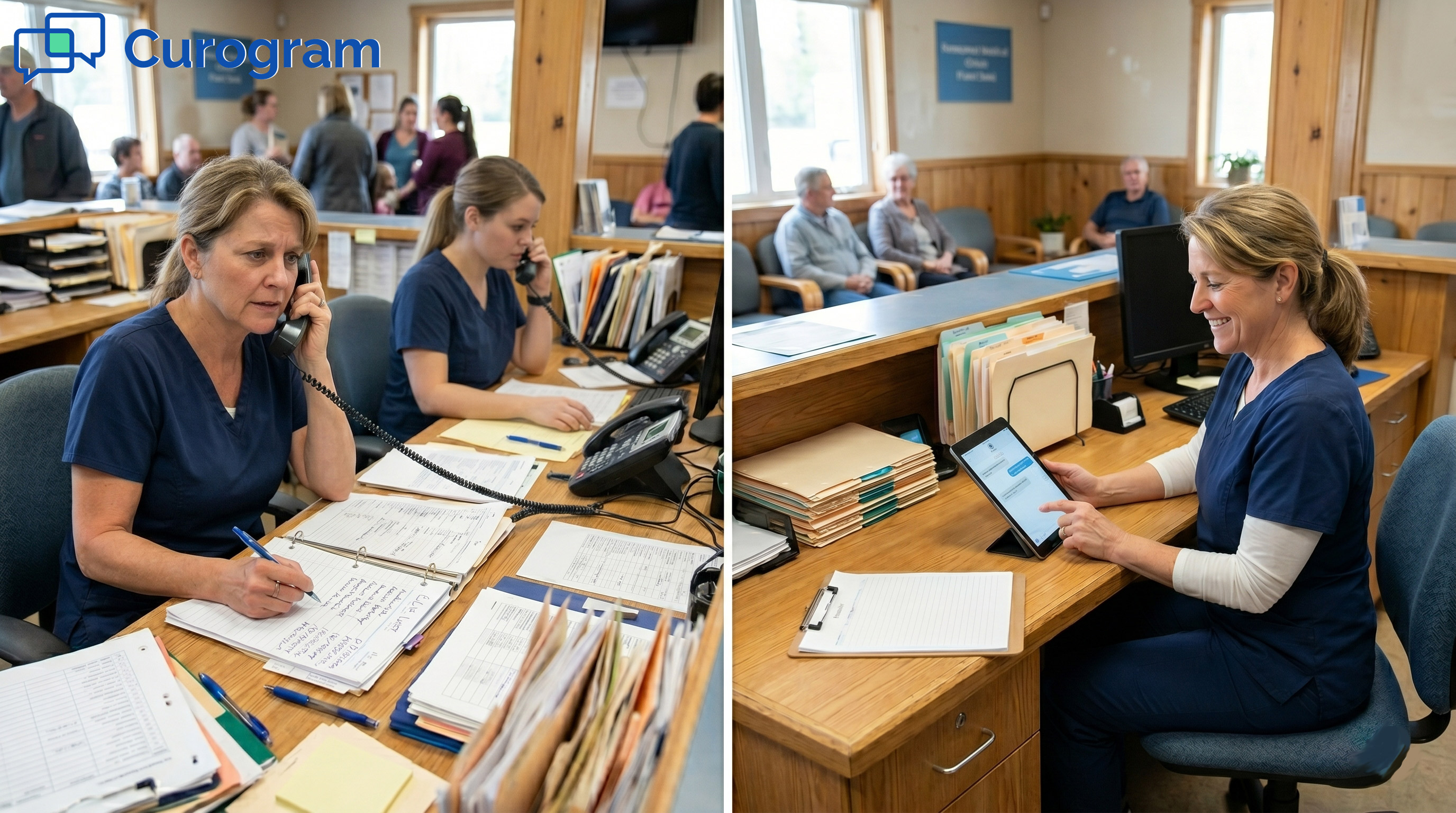
It's 8:47 AM at a 40-patient IOP program. The admissions coordinator opens her Opus EHR schedule and starts dialing.
First patient: voicemail. Second: disconnected number. Third: a quick "yes," then a copay question that takes 6 minutes.
By 11:30 AM, she's still working through tomorrow's group confirmations. Three new referrals sit untouched in the queue.
The discharge planner needs help with two step-downs. The phone has eaten her morning, and the real work hasn't started.
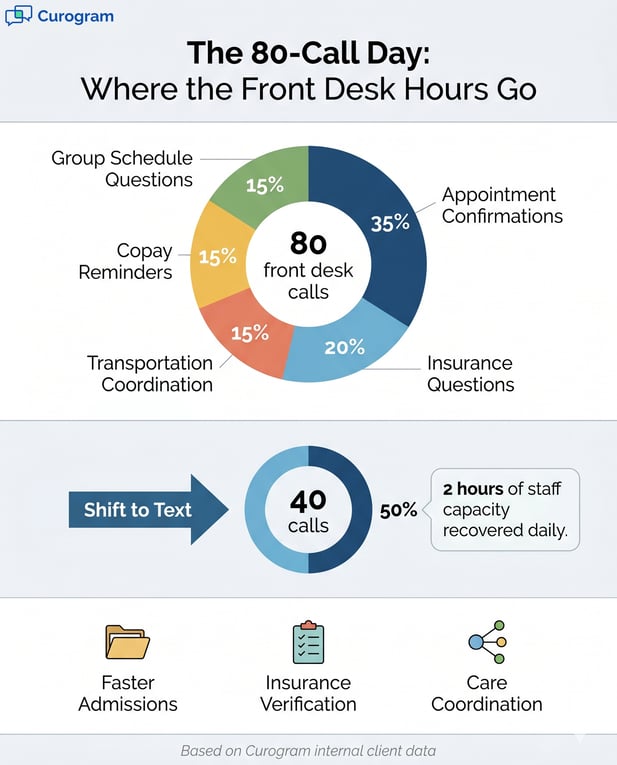
This is the daily reality at most behavioral health practices. Front desk teams handle 80+ calls a day, with most of that time spent on routine tasks. Appointment confirmations. Insurance checks. Transportation questions. Group schedule updates.
Opus EHR was built for the clinical side of behavioral health. Intake notes, e-prescribing, billing, and scheduling all live there.
But its native Messenger has known delivery issues. Reminders show up at 3 AM. Messages vanish. So staff picks up the phone to fix what the texting layer can't.
That's where Opus EHR two-way texting for front desk staff efficiency behavioral health changes the math.
Curogram adds a reliable SMS channel that sits next to Opus, not on top of it. Patients reply by text in 30 seconds instead of dodging voicemails for three days.
The shift is real and measurable. Curogram practices report cutting phone call volume by up to 50%, based on our internal data. For a front desk handling 80 calls daily, that's 40 calls gone. Two hours of staff time returned.
This article walks through how that shift happens. We'll cover the bottleneck, the workflow fix, and the daily wins that follow. Your staff didn't sign up to be a switchboard.
The Villain: The Phone Tag Trap
Front desk teams at SUD and mental health practices face a volume problem that most general clinics never see. Group schedules, level-of-care moves, and crisis admissions all add layers.
The phone becomes the default tool because the native texting layer can't be trusted. That's the trap, and it costs hours each day.
The Math Behind 80 Calls a Day
At 3 minutes per call and 80 calls daily, that's 4 hours of staff time lost to the phone.
Most of those calls are routine: "Are you coming tomorrow?" or "What time does group start?" These are 30-second text exchanges trapped inside 3-minute calls.
The real cost shows up across the morning. By the time confirmations are done, new admissions haven't been touched. Insurance checks are late. Discharge planning slips to the afternoon.
Voicemail Loops Eat the Morning
Patients in recovery often have unstable phone access. Numbers change. Voicemail boxes fill up. A coordinator may dial the same patient 3 times before giving up. Each attempt is a small drain that adds up to a missed admission.
Reduce phone calls Opus EHR behavioral health practice teams have flagged this for years. The fix isn't more staff. It's a channel where patients actually answer.
Transfers, Holds, and Lost Context
Every transferred call is a context switch. The billing question that comes mid-confirmation pulls the coordinator off her list. She loses her place. She picks up 10 minutes later, now behind on PHP confirmations too.
Phone calls don't leave a clean record either. A text thread shows exactly what was said and when. A call log just shows a number and a duration.
Why Opus EHR's Native Messenger Falls Short
Opus EHR handles the clinical backbone well. Documentation, e-prescribing, scheduling, and billing all run inside it.
But the native Messenger has known reliability gaps. Reminders sometimes arrive at 3 AM. Some messages never land at all.
When messages fail, staff fall back on the phone. That's how the bottleneck forms, even at practices that thought they had texting covered.
Failed Deliveries Push Work Back to Staff
A reminder that never reaches the patient becomes a confirmation call the next morning. Multiply that by 40 patients, and the front desk has inherited a full day of cleanup work. The texting layer was meant to prevent that.
Administrative efficiency in behavioral health two-way messaging only works when the messages actually arrive. Reliability isn't a nice-to-have here. It's the whole point.
Compliance Adds Another Layer
SUD programs need 42 CFR Part 2-compliant messaging on top of HIPAA. Personal texting apps don't meet that bar. Staff who use their own phones to fill the gap create a real compliance risk.
So the practice ends up with two bad options. Use the phone for everything and lose hours. Or use texting that fails and creates risk. Neither protects the staff or the patient.
The good news: there's a third option, and it integrates with Opus.

The Guide: The Workflow Liberator
Curogram doesn't replace Opus EHR. It sits beside it as the communication layer that Opus was never built to perfect.
Staff keep clinical work in Opus and use Curogram for every patient text. The setup takes days, not months, and training runs under 10 minutes.
A Communication Layer, Not a Replacement
Think of it this way: Opus runs the chart, and Curogram runs the conversation.
Patient data flows between the two systems, so staff don't double-enter anything. That removes the top objection most office managers raise when they hear "new tool."
Front desk SMS automation addiction treatment teams adopt fast because the learning curve is almost flat. If you can text on your personal phone, you can use Curogram.
Shared Inboxes for Team Coordination
A single patient thread is visible to every staff member with access. The admissions coordinator can hand off a copay question to billing without re-typing context. The discharge planner can see what was promised yesterday.
This matters in behavioral health, where 4 or 5 staff members may touch a single case in a week. Shared inboxes turn handoffs into 5-second reads instead of 5-minute catch-up calls.
Audit Trails That Phones Can't Match
Every message is logged, time-stamped, and searchable. If a patient says they were never told about a schedule change, the thread proves otherwise. That record helps with compliance reviews and clinical disputes alike.
Phone calls leave no such trail. A voicemail isn't a paper trail. A text is.
Built for Behavioral Health Communication Patterns
General patient engagement tools weren't made for IOP groups or MAT schedules. They don't handle level-of-care moves or alumni check-ins. Curogram was built around these workflows from day one.
Call volume reduction in SUD treatment practice gains show up because the platform speaks the language of the work. Templates exist for group reminders, transportation, intake links, and discharge follow-up.
IOP, PHP, and Residential Schedules
A coordinator can text 20 IOP patients about a group time change in under 2 minutes. Patients reply with a simple "got it" or "need to reschedule." The whole batch is done before the morning coffee gets cold.
Opus EHR office manager texting workflow patterns rely on this kind of speed. Without it, schedule changes turn into half-day phone marathons.
Crisis and Admissions Response
When a referral comes in from a hospital, response time matters. A text with the intake form link goes out in 30 seconds. The patient can complete it from the same phone they were texted on.
Compare that to the old way: a phone call, a voicemail, a callback that may never come. By then, the patient has called another program.
The platform also stays compliant the whole way through. HIPAA, SOC 2, and 42 CFR Part 2 are baked in, not bolted on. Your compliance officer will sleep better.
The Success: The 50% Call Reduction
The phrase sounds clinical, but the result is simple. Hours come back. Staff stop dialing and start doing the work they were hired to do. Here's what a real day looks like once the phone tag trap is gone.
A Morning Built Around Patients, Not Voicemails
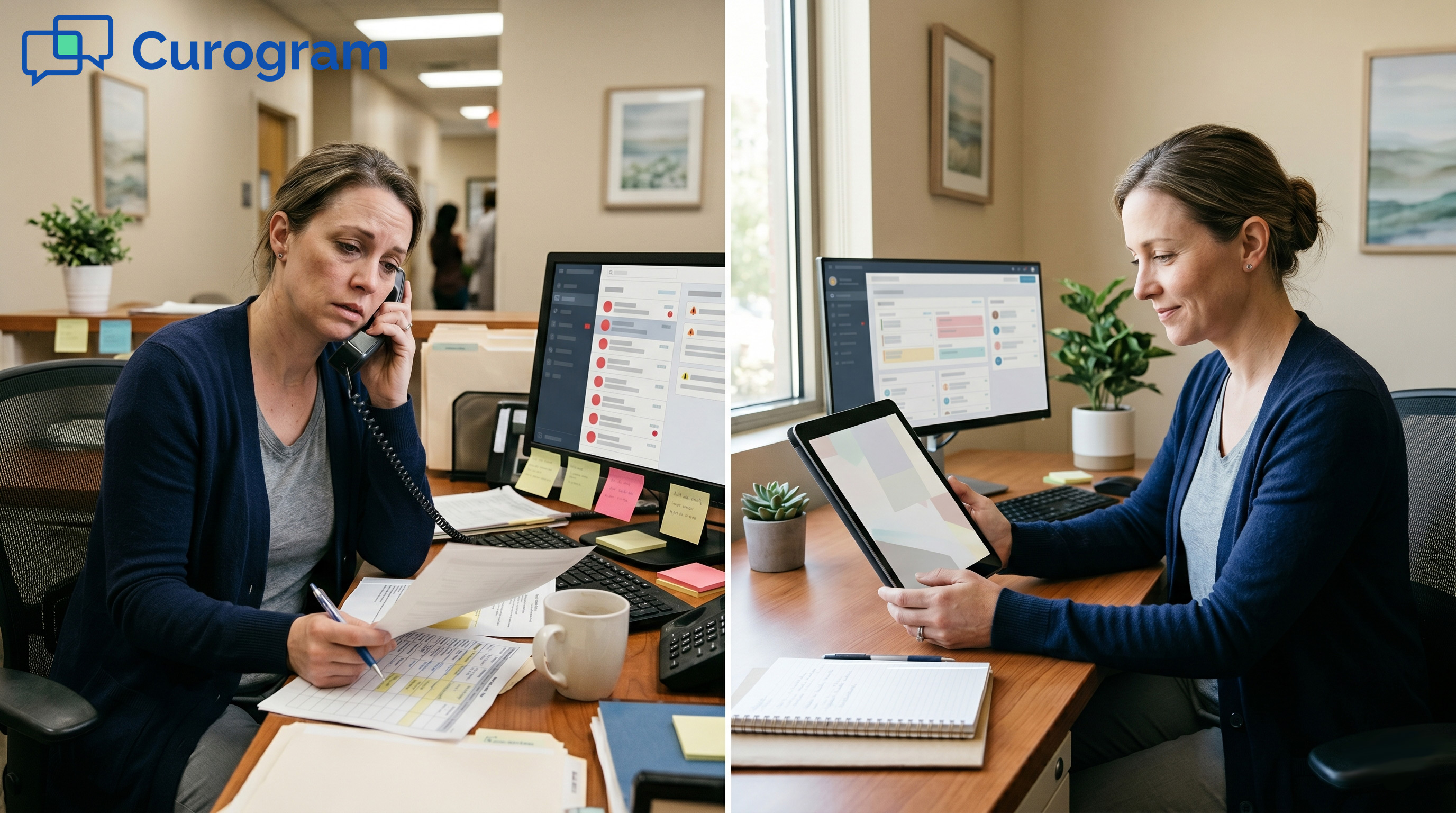
Picture the office manager at a 30-bed residential program with an attached IOP. By 10 AM, all IOP confirmations are done by text.
Three new referrals have intake form links in their inbox. The billing team has sent copay reminders to 15 patients, and 7 have already paid via text-to-pay.
The front desk phone still rings, but now it's a clinical call from a referring hospital. Not a patient asking what time group starts. That's the 50% call cut in real terms.
The 80-to-40 Call Shift
Based on our internal data, Curogram practices report cutting call volume by up to 50%. For a front desk handling 80 calls daily, that means 40 fewer calls. At 3 minutes per call, that's 2 hours of staff time recovered each day.
Those hours don't just vanish into thin air. They go straight to admissions intake, insurance checks, and care coordination.
Confirmation Rates That Stick
Covina Arthritic Clinic confirmed over 1,100 appointments per month through automated workflows, based on our internal data.
That kind of volume isn't possible by phone. It's only possible when patients can reply with a single tap.
For behavioral health, the same math applies. Group sessions get confirmed. No-shows drop. Census stays steady.
Where the Reclaimed Hours Go
The point of staff capacity recovery isn't to give people less work. It's to shift them toward higher-value work. Admissions, care coordination, and discharge planning all need human attention that the phone was eating.
Faster Admissions Processing
Three new referrals that used to sit until 2 PM now get a response by 9:30 AM. Intake forms go out by text. The patient can fill them in from bed if they need to.
Faster intake means more patients enter treatment before they change their minds. That's a clinical win and a revenue win at once.
Proactive Discharge Planning
Discharge planners can now coordinate step-downs the day before, not the morning of. Patients moving from residential to IOP get clear text instructions about timing and location. Family members can be looped in via a shared thread.
The result is fewer dropped transitions. Patients stay engaged through the most fragile point in their recovery.
The Human Side of the Shift
There's a quieter benefit nobody puts on a slide deck. Staff burnout drops. The intake coordinator who used to quit after 6 months because she spent more time calling than helping now stays. She's doing the work she signed up for.
Faster communication doesn't mean less personal care. It means staff have the capacity to give more of it.
Conclusion: Free Your Staff from the Phone Tag Trap
The phone tag trap isn't a small problem. It's the daily reason your front desk is stretched thin. Confirmation calls that should take seconds eat hours instead. The work that grows your program waits in a queue.
Opus EHR handles the clinical side well. Intake notes, e-prescribing, billing, and scheduling all live there. But the native Messenger leaves gaps that staff fill with phone calls, which is how the bottleneck forms.
Curogram closes that gap. It's the reliable text line your team needs next to the chart system you already trust.
Patients reply by text because that's where they already live. No app to download. No portal to log into.
The numbers tell a clear story. Based on our internal data, Curogram practices report cutting phone call volume by up to 50%. For an 80-call-a-day front desk, that's 2 hours back every single day.
Those hours don't get lost. They flow into admissions, insurance verification, and care coordination. The work that actually grows your census starts moving again.
Every text is HIPAA-compliant, SOC 2 certified, and 42 CFR Part 2-ready for SUD programs. Audit trails are built in.
Your compliance officer gets a system that meets the standards your accreditation demands.
The harder-to-measure win is retention. Front desk staff burn out when their day is a wall of voicemails. Give them a tool that works, and they stay longer. That alone changes the math on hiring costs.
This isn't about texting for the sake of texting. It's about matching your communication layer to the intensity of the work.
Behavioral health patients are managing addiction, mental health crises, and unstable housing. A 30-second text reply is what fits their reality.
Your staff entered this field to support recovery. Not to listen to voicemail greetings. The tool you give them should reflect that.
You don't need to commit to anything to see how this works. A demo shows the Opus EHR office manager texting workflow side by side with your current setup. You'll see the call volume drop in real numbers, not promises.
Book a demo today and walk through it with someone who knows behavioral health. Bring your office manager. Bring your admissions coordinator. Let them ask the questions that matter to their day.
Frequently Asked Questions
Curogram replaces routine confirmation calls with quick SMS threads patients actually answer. Staff send a confirmation text from the Curogram platform, and patients reply in under a minute.
Based on our internal data, practices report cutting phone call volume by up to 50%. That frees admissions coordinators and office managers from the daily phone tag cycle.
The native Messenger has known reliability issues, including reminders that arrive between 1 AM and 4 AM and messages that fail to deliver. For behavioral health patients in active recovery, unreliable timing pushes them away from care.
Staff then fall back on phone calls to fix what the texting layer missed. That's how the bottleneck forms even at practices that thought texting was covered.
Staff training averages under 10 minutes because the platform feels like normal texting. Clinical work stays in Opus, and Curogram handles the patient communication layer next to it. There's no complex migration, no IT lift, and no workflow disruption. If your team can text on a phone, they can use Curogram on day one.
42 CFR Part 2 sets stricter federal privacy rules for substance use disorder treatment records than HIPAA alone. General patient engagement tools rarely meet that bar, which puts SUD programs at risk.
Curogram is built with 42 CFR Part 2-compliant secure messaging from the ground up. That protects both the patient and the program during compliance reviews.
A single patient thread is visible to every staff member with access, so handoffs take seconds instead of minutes. The admissions coordinator can pass a copay question to billing without re-typing context.
Discharge planners can see what was promised yesterday before a step-down call. That cuts the catch-up time that eats up team meetings.