



CollaborateMD Telehealth: Launch a Visit by Text
💡A CollaborateMD telehealth video visit by text link lets a practice add virtual care with no extra platform.The video call opens with one tap....
8 min read
Jo Galvez
:
July 11, 2026
Your team runs a lean stack for a reason. CollaborateMD handles your billing and your records. It works well, and you do not want more tools to babysit. Then a patient asks for a video visit.
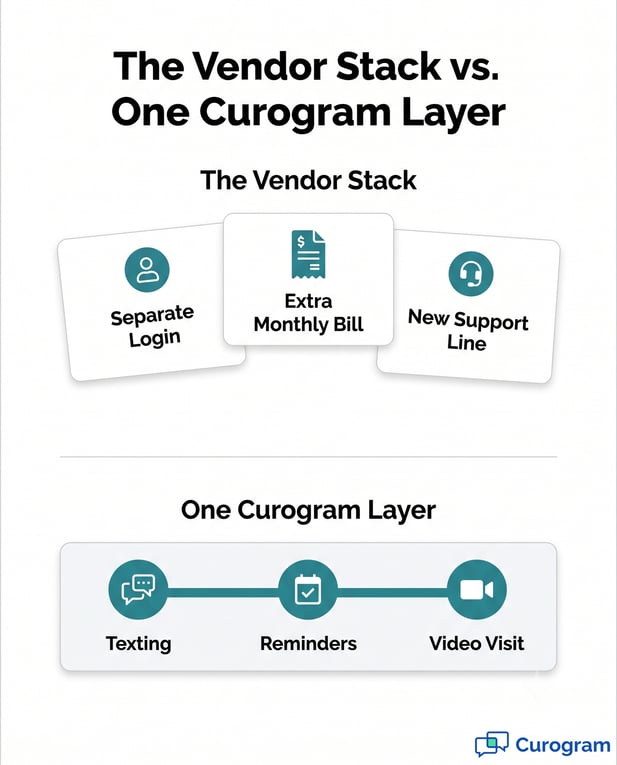
Here is the catch. CollaborateMD has no built-in telehealth. So the usual fix is to bolt on a separate video tool. That tool arrives with its own login, its own bill, and its own support line.
Many staff have seen this movie before. A past telehealth app felt glitchy, or it just got shut down. Now someone has to set up another vendor. Someone else has to train the whole team on it.
You set out to offer one visit. You ended up with a new software chore. That is the quiet cost of the vendor stack, and it grows over time. Each month, the bill and the busywork return.
It does not have to work this way. The problem is not video care itself. The problem is the extra platform wrapped around it. Remove that wrapper, and the friction falls away.
There is a simpler way to add telehealth to CollaborateMD without a separate platform. You fold video into a layer you already run. That layer sends your texts and reminders today. It can host the visit too.
Curogram calls this the one-tap clinic. Video visits start from the same thread as your messages. There is no new app to install, and nothing extra to maintain. Staff pick it up fast, often in under 10 minutes.
This guide walks through the real cost of the vendor stack. Then it shows how one platform for video visits keeps your practice lean. You will see how a clinic or a billing company can offer virtual care with far less admin.
CollaborateMD has no telehealth of its own. So virtual care usually means adding a separate platform. That choice feels small at first. The weight shows up later, and it lands on your staff.
A new video vendor is never just a video vendor. It comes with parts your team must manage. Each part is one more thing to track and keep alive.
Every new tool needs its own login. Staff juggle one more username and one more password. When the video drops mid-visit, you call a new support line.
That means a new queue and a new set of hold times. None of it touches the care you meant to give. A no-new-login telehealth setup keeps that friction off your team.
Passwords also expire and get lost. Then a shared account locks, and the front desk stalls. Small snags like these add up across a busy week.
A separate platform also adds a bill. That bill lands every month, right on top of CollaborateMD. For a lean practice, each added vendor is real money.
It is also more admin for whoever tracks the invoices. You wanted a video visit, not a fresh line item. The costs pile up in ways that are easy to miss.
Renewals and price hikes bring more review. Someone has to weigh the tool each year. That is time better spent on patients than on paperwork.
The true cost is not just the monthly fee. It is the drag of running more tools than you need. A leaner stack is easier to trust and easier to teach.
Small teams feel every extra login. Someone has to set up accounts and reset passwords. Someone has to learn the tool and coach the rest.
If you want to reduce your software stack while adding telehealth, more vendors work against you. The goal is fewer moving parts, not more. Each tool you drop is time your front desk gets back.
Turnover makes this sharper. A new hire must learn each system from scratch. Fewer tools mean a faster, calmer onboarding.
For a billing company, the math gets worse. You would stand up that vendor for each client practice. That is many logins, many bills, and many setups.
What should be a simple value-add turns into a stack of tools to manage. Every client adds more support tickets to your plate. The lift grows with each new practice you serve.
Scaling then feels risky, not routine. Each new client stretches your team thinner. That is the opposite of a clean value-add.

Curogram folds the video vendor into a layer you already run. That layer is the same one linked to CollaborateMD for texting and reminders. So there is no new platform to stand up. Virtual care rides on tools your team already knows.
The core idea is simple. Video visits start from the same Curogram thread as your texts. There is no separate app to open or administer.
Your staff already text patients from Curogram. To start a visit, they send a link from that same thread. The patient taps it, and the video opens.
No one hunts for a second tool or a second tab. This is one platform for video visits in your practice, start to finish. The flow feels like the texting your team does all day.
Patients feel the ease too. They tap a link they already trust. No app store, no account, no fuss.
Because the layer already connects to CollaborateMD, nothing new gets installed. There is no fresh login to provision and nothing extra to maintain.
Your 2-way HIPAA-compliant texting and appointment reminders already run here. So integrated virtual visits fit right in. The reminder that confirms a visit can also launch it. One layer carries the whole handoff.
This is the same channel patients already answered. Video simply rides that trusted path. You build on habits your patients have, not new ones you must teach.
The same design helps the revenue cycle teams. You can offer telehealth across every client from one place. There is no vendor to spin up per practice.
A billing company runs many practices at once. With Curogram, one layer stretches across all of them. You add virtual visits as a value-add, not a new tool per client.
That means integrated virtual visits for a billing practice without the vendor sprawl. You skip the per-client logins and per-client bills. The offering scales with far less overhead.
You also present one clear story to clients. Video care comes from a layer they already know. That makes the pitch simple and the rollout fast.
Staff learn this fast because it lives where they already work. There is no separate platform to master first. They send a link, and the visit opens.
Most teams get comfortable in under 10 minutes. That short ramp is a big deal at scale. New hires reach the same speed with almost no lag.
Short training also means fewer errors. Staff do not fumble an app they rarely touch. Confidence grows from day one.
The payoff is a stack that stays lean. You collapse the separate vendor, login, and bill into the layer you already use. Fewer tools mean less admin. And telehealth that staff actually adopt.
Name the shift for what it is. You move from a vendor stack to one layer. The table below shows the swap at a glance.
|
What You Manage |
Separate Vendor Stack |
One Curogram Layer |
|---|---|---|
|
Logins |
A new login for staff |
No new login to provision |
|
Monthly bill |
An added bill each month |
No separate telehealth bill |
|
Support |
A new support line to call |
One place your team already knows |
|
Staff training |
A new tool to master |
Learned in under 10 minutes |
|
Billing company fit |
One vendor per client practice |
One layer across every client |
One layer means fewer accounts, fewer bills, and fewer support lines. Your front desk tracks less and fixes less. That time flows back into patient care.
A simple telehealth setup for CollaborateMD keeps the stack tight. You add a service without adding a system. The result is calm, not clutter.
Fewer tools also mean fewer gaps. Nothing slips between two systems that never talk. The handoff stays clean from text to visit.
Tools get used when they fit the daily flow. Video that lives in the texting thread meets that bar. Staff does not dodge a second app they dislike.
Adoption climbs because the path is short and clear. That is telehealth with no extra vendor for CollaborateMD, working the way your team already works.
High use is the real measure of value. A tool that sits idle helps no one. This one earns its place by getting used.
The outcome is virtual care with none of the software bloat. You offer visits without expanding the stack. And you keep your support life simple.
When one layer runs your video, there is one place for help. You do not chase a new vendor when something breaks. Your team already knows who to ask.
That saves time on the days you can least spare it. Fewer vendors mean fewer finger-pointing calls. Problems get solved in one queue, not three.
One point of contact also builds trust. Staff learn the fix once and reuse it. Downtime shrinks, and stress drops with it.
Your practice offers virtual visits, and the stack stays the same size. CollaborateMD still handles billing and records. Curogram still handles the patient-facing layer.
Together, the two keep the stack lean by design. You gain telehealth without a new system to babysit. That balance is the whole point.
Lean stacks are easier to trust and defend. Fewer tools mean fewer risks and fewer bills. Your practice stays nimble as it grows.

Adding video care should not cost you a whole new platform. Yet that is the trade most CollaborateMD practices make. They bolt on a vendor, then manage the login, the bill, and the support line for years.
There is a cleaner path. You fold video into the layer you already run for texting and reminders. That is how you add telehealth to CollaborateMD without a separate platform. The visit launches from the same thread your staff use every day.
Think of the split this way. CollaborateMD is built for your billing and your records. Curogram is built for their one-tap visit. Together, the stack stays lean, and each tool does its own job well.
The wins are easy to see. You skip the extra vendor and the extra login. You skip the second monthly bill and the second support line. And your team learns the whole flow in under 10 minutes.
For a billing company, the value grows. One layer covers every client practice at once. You offer virtual visits as a value-add, with no per-client tool to stand up. That keeps your own operation lean while you help clients grow.
Adoption is the part many teams miss. A tool only pays off when staff actually use it. Because this video lives in the texting thread, your team leans in. There is no second app to avoid or forget.
The same layer already earns its keep every day. Curogram clients confirm more than 75% of appointments by text, based on our internal data. Video visits ride that same trusted, high-response path. So you build on a channel patients already answer.
This also fits how patients now expect care to work. Many arrive by text and want a fast, simple visit. Federal telehealth guidance backs this shift toward flexible virtual care.
The choice, then, is really about focus. You can spend energy managing another vendor. Or you can spend it on patients and growth. One layer frees your team to choose the second path.
So stop standing up a whole platform to offer a single video visit. Keep the stack you trust, and let one layer carry the rest. Your staff will thank you, and your patients will notice the ease.
Ready to see it live? Complete your revenue cycle and schedule a demo. Watch a video visit launch straight from your existing Curogram layer.
CollaborateMD focuses on billing and records, and it has no built-in video visits. So practices usually bolt on a separate vendor to offer virtual care. Curogram removes that need by running video inside the layer you already use. You get the visit without the extra platform.
Staff work from the same Curogram thread they use for texting patients. They send a video link from that thread, and the patient taps to join. There is no separate app to open or manage. Most teams learn the flow in under 10 minutes.
A billing company can extend the same Curogram layer across every client practice. That means no vendor to stand up for each client, and no per-client login to track. Virtual visits become a value-add with far less overhead. The offering scales as you add practices.
Each separate tool adds its own login, bill, and support line to your day. One layer collapses those parts into a single place your team already knows. So there is less to set up, less to teach, and less to fix. Your front desk gets that time back for patients.
You add a service, not a whole new system, when video lives in your current layer. CollaborateMD still handles billing and records, and Curogram handles the patient-facing side. Nothing new gets installed, and nothing extra needs upkeep. The stack stays the same size while your care options grow.
💡A CollaborateMD telehealth video visit by text link lets a practice add virtual care with no extra platform.The video call opens with one tap....

1 min read
💡 AdvancedMD uses Zoom for its built-in telehealth platform. Zoom works fine for users who already have it installed. But for many patients, it...
💡 eClinicalWorks telemedicine with zero-download, browser-based video visits lets enterprise networks launch virtual appointments directly from the...