9 min read

Frictionless Appointment Confirmation: Cerbo Cash-Based DPC Patients

Frictionless Appointment Confirmation: Cerbo Cash-Based DPC Patients
💡 Frictionless appointment confirmation for Cerbo cash-based DPC patients works through Curogram's two-way SMS system. Patients confirm visits with one text reply — no portal, no phone call. Key elements include:
  • 98% SMS open rate vs. single digits for email and portal
  • One-tap reply: C to confirm, R to reschedule
  • Personalized texts with prep instructions per visit type
  • Real-time sync with Cerbo through the Open API
  • Atlas Medical Center cut no-shows from 14.20% to 4.91% in three months
Most missed visits are not refusals — they are forgotten reminders. A text in the right channel turns booked slots into kept ones.

A $450 functional medicine slot does not vanish because the patient changed their mind. It vanishes because the reminder sat unread in a busy inbox. The patient meant to come. The portal notification never got checked. By 9 AM, the chair sits empty and the revenue is gone.

This is the quiet drain hitting cash-based and DPC practices using Cerbo EHR today. Your patients are engaged and invested. They paid full price out of pocket for personal care.

They want to show up. But the confirmation step relies on channels they rarely open — email and patient portals — not the one they check all day.

Frictionless appointment confirmation for Cerbo cash-based DPC patients closes that gap. Patients confirm with a single text reply.

No login. No phone tag. No friction between their intent and your front desk's certainty about the schedule. The whole exchange takes one second.

In this guide, we unpack why The Forgotten Appointment keeps stealing slots from concierge medicine clinics. We look at the cost in real dollars and the patient story behind it.

You will see how a two-way SMS workflow sits alongside Cerbo's scheduling. And how it locks in attendance without adding staff work or extra phone calls.

We also share data from practices that already made the switch. Based on our internal research, Atlas Medical Center cut no-shows from 14.20% to 4.91% in just three months. Their patients did not suddenly become more committed. The reminder simply landed in a channel they actually read.

By the end, you will see what an easy text confirmation for concierge medicine patients should feel like. You will also know why the practice that sends it earns patient trust before the visit begins.

The Villain: The Forgotten Appointment

Cerbo patients are not disengaged. They research practitioners for weeks before booking. They travel hours for specialized care. They pay premium out-of-pocket rates because they believe in the integrative model.

But intention is not the same as a kept commitment. Cerbo's native reminder system does not close the loop. The email reminder lands between newsletters and sale alerts. The portal notification needs a login they cannot remember.

No one asks them to confirm in the channel they check 80 times a day — their text messages. The gap between "I plan to come" and "I am confirmed" stays wide open. That is where the slot quietly disappears.

Walking Through the Patient's Day

Imagine a functional medicine patient who booked a 90-minute initial visit three weeks ago. The week of the appointment arrives, but life has been loud. They vaguely recall it is "sometime this week."

An email reminder sits in their inbox from two days ago — unread. A portal notification waits behind a password they have not used in months. They mean to call the office, but the day gets busy. The call never happens.

At 9 AM Thursday, the chair is empty. The patient is embarrassed. The practitioner is frustrated. A $450 time slot has just vanished — and not because the patient did not want to come.

The cause is Cerbo patient scheduling friction functional medicine practices know too well. The confirmation process needs too many steps in channels patients do not watch.

The Real Cost of a Missed Slot

The financial loss is the most visible part. A single no-show in a functional medicine practice costs $300 to $500 in direct revenue. There is no insurance reimbursement to soften the loss. The slot cannot be resold in the moment.

But the deeper cost is care continuity. Functional and integrative treatment protocols depend on regular visits. Lab reviews, supplement adjustments, and progress checks all matter. Each missed visit pushes the patient's health outcomes backward.

For DPC members paying $300 to $600 per month, a missed appointment is wasted membership value. They paid for access and did not use it. The perceived worth of the membership starts to erode quietly.

What's Lost in a Single No-Show

Cash-Pay Functional Medicine

DPC Membership

Direct revenue per slot

$300–$500

Already paid

Reschedule effort

10–15 staff minutes

10–15 staff minutes

Care plan delay

2–6 weeks

2–6 weeks

Trust impact

Patient embarrassed

Membership value questioned


The Patient's Side of the Story

Here is the hardest part to see from the front desk. The patient chose this practice because it felt different — the longer visits, the personal attention, the provider who remembers their supplement protocol by name.

Then the communication arrives the same way every other clinic does it. Cold portal notifications. Generic email reminders. A phone tree if they want to verify a detail.

The premium care experience ends at the clinical visit. It does not extend to the moments between visits. That mismatch is the real villain. The care is high-touch — the communication around it is not.

Frictionless appointment confirmation for Cerbo cash-based DPC patients fixes that mismatch. Not by adding more tools, but by meeting patients in the channel they already use.

Until that happens, "The Forgotten Appointment" will keep stealing slots. Not from disengaged patients — from the ones who care most.

The Guide: The One-Tap Commitment

The fix is not louder reminders. It is reminders that arrive in the right channel and ask for one thing only. Curogram positions itself as The One-Tap Commitment — the confirmation experience that finally matches the care experience.

Here is what the patient sees: A personal text shows up two days before the visit. It includes the date, time, provider, and any prep notes. At the end is a simple line: reply C to confirm, R to reschedule.

One tap. One second. Done. The patient feels acknowledged. The practice gets certainty. The appointment is locked in before the day even starts.

Personalized Prompts That Feel Human

The text is not a generic reminder. Curogram's system pulls real details — the patient's first name, the provider name, the appointment type, and any prep notes tied to that visit type.

For an integrative medicine initial consult, the message can remind the patient to fast for lab work. For a follow-up, it can ask them to bring an updated supplement list. For a functional medicine recheck, it can include the lab tracker link.

The reminder stops being a notification and becomes a care touchpoint. It improves clinical prep and secures the confirmation at the same time.

That is one of the strongest moves practices can make to reduce patient no-shows Cerbo integrative medicine communication efforts have struggled with for years.

Here is a sample text a DPC patient might receive:

"Hi Sarah, this is Dr. Chen's office. Your wellness visit is Thursday 6/12 at 10 AM. Please bring your updated supplement list. Reply C to confirm or R to reschedule. Reply STOP to opt out."

That single message does more than four emails ever will.

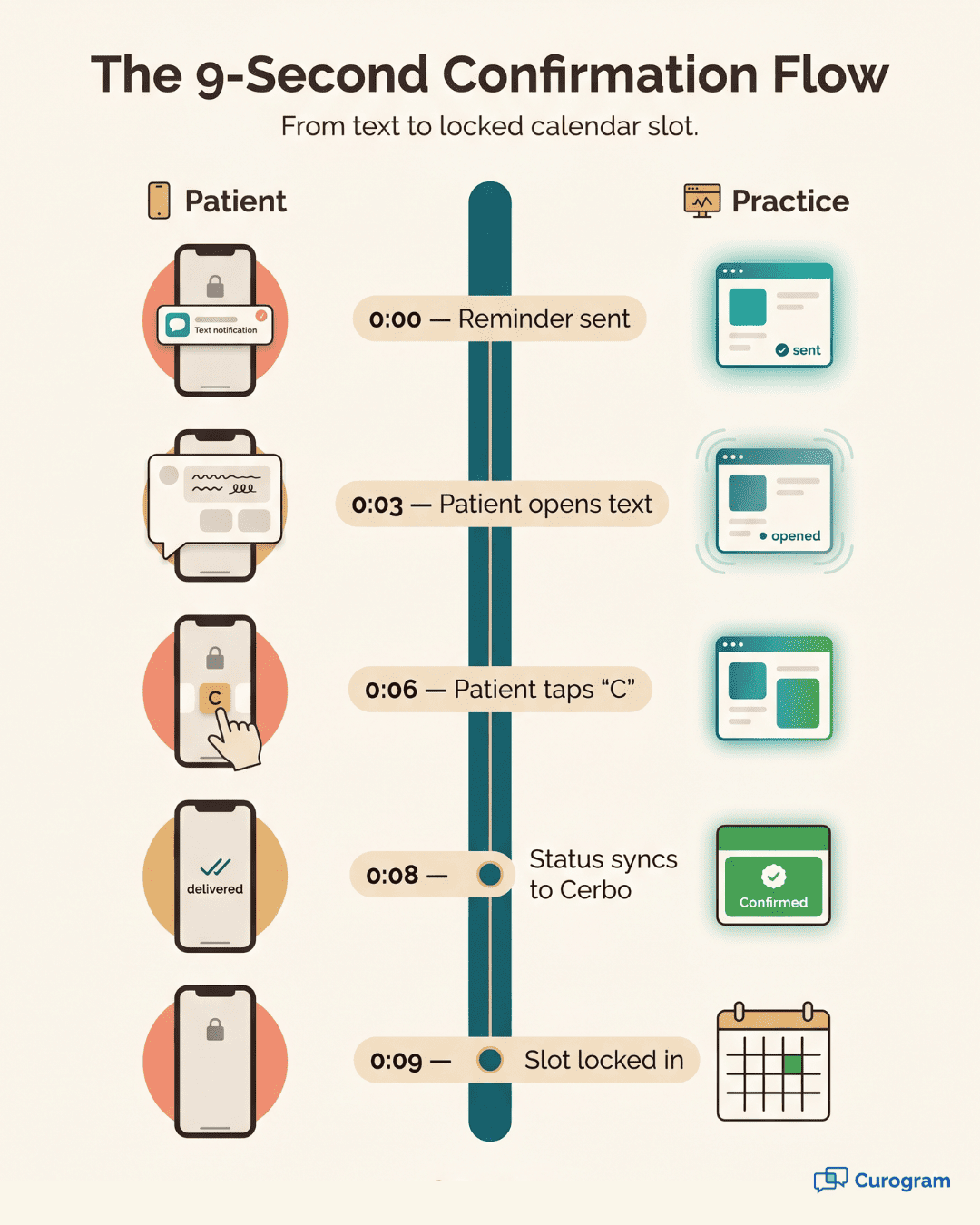
Vertical timeline infographic showing the 9-second flow from text reminder to confirmed Cerbo appointment

How the Cerbo Integration Works Behind the Scenes

The patient never sees the tech. They just know their practice texts them. Behind the curtain, Curogram syncs with Cerbo's scheduling system through Cerbo's Open API.

Appointment details flow into Curogram in real time. When the patient replies C, the confirmation status updates inside Cerbo automatically. When they reply R, the message is routed to your front desk for a quick reschedule.

The patient appointment confirmation experience Cerbo EHR clinics deliver gets simpler, even as it gets more personal.

Step

What the Patient Does

What Happens in Cerbo

Reminder sent

Reads text on phone

Status: Reminder Sent

Replies "C"

Taps two keys

Status: Confirmed

Replies "R"

Taps two keys

Routed to front desk

No reply

Sees follow-up text 12 hrs out

Flagged for staff call


Built for the Premium Patient You Actually Serve

Cash-paying patients chose your practice for a reason. They wanted care that respects their time and treats them like an adult. Portal logins and phone trees signal the opposite of that.

A text reply signals something different. It says: we respect your time, we know you carry your phone, and we trust you to handle your own schedule. That is the kind of one-tap appointment confirm DPC membership practice patients quietly notice and quietly value.

For a DPC member who pays $4,000 a year for access, the confirmation step is a small but loaded moment. It is the practice saying: your time matters as much as ours. Every interaction should reinforce why they keep paying.

Curogram makes that mindset visible — one text at a time.

The Success: The Kept Appointment

What changes when the confirmation finally lives in the right channel? Numbers move first, then the patient experience follows.

The Metric: Real Numbers from Real Practices

Based on our internal research, practices using Curogram's confirmation system see no-show rates drop sharply within weeks. Atlas Medical Center cut no-shows from 14.20% to 4.91% in three months. That is a 65% reduction with no change to the patient base.

SMS reminders pull a 98% open rate. Email reminders sit at single-digit engagement for many cash-pay practices. Portal notifications fare worse. The channel matters more than the message.

The math gets serious quickly. Say a functional medicine practice books 40 visits a week. At a 14% no-show rate, that is about 5.6 missed slots a week. At a 4.9% rate, the practice misses fewer than 2 slots per week.

Practice Size

Visits/Week

No-Shows at 14%

No-Shows at 4.9%

Weekly Revenue Saved

Solo practitioner

25

3.5

1.2

$920 – $1,150

Small group (2 providers)

50

7.0

2.5

$1,800 – $2,250

Multi-provider DPC

100

14.0

4.9

$3,640 – $4,550


The numbers above use $400 as the average cash-pay visit value. Multiply that by 50 working weeks. The annual recovery for a small group sits between $90,000 and $112,500. That is real money that used to walk out the door silently every Thursday morning.

The Shift: From "Forgotten" to "Kept"

The transformation is more than a stat change. It is a shift in how the practice and the patient relate to the appointment itself.

Before the shift, the reminder was a one-way notification. It was a thing the office sent that the patient hopefully noticed. Confirmation was assumed unless the patient called to cancel. Silence was treated as a yes — until 9 AM proved otherwise.

After the shift, the reminder becomes a two-way moment. The patient is asked. The patient answers. The schedule reflects a real, captured commitment, not a hopeful guess.

"The Forgotten Appointment" becomes "The Kept Appointment." And the kept appointment carries weight far beyond the slot itself. The patient who confirms feels connected to the practice before they even walk in.

Confirmation becomes the first touchpoint of the visit. It sets the tone. It primes the patient to show up prepared and on time. When they arrive, the visit starts smoother because the connection started 48 hours earlier.

For the front desk, the shift is just as meaningful. Confirmation calls drop from 30 per day to a handful.

Staff time gets redirected toward higher-value work — onboarding new patients, processing intake forms, and answering real clinical questions.


DPC member reviewing a frictionless appointment confirmation text from her integrative medicine practice

What Makes Curogram's One-Tap Confirmation Different from Cerbo's Built-In Reminders


Cerbo is a clinical powerhouse. Its scheduling, charting, and protocol management are built for the way integrative and functional medicine actually practice. But its native reminder system was never designed to be interactive. It sends. It does not listen.

Curogram closes that gap with a layer built specifically for two-way communication. The reminder text goes out through Curogram. The patient's reply comes back through Curogram. The confirmation status syncs into Cerbo through the Open API in real time.

Three things set this apart from any reminder system Cerbo can offer on its own.

First, replies are captured as data. A patient typing "C" is not just a message — it is a structured confirmation that updates the scheduling record. Cerbo's native email reminders cannot do this. The patient has no way to confirm in-channel.

Second, the messages are personalized at scale. The reminder can include the patient's first name, the provider's name, the visit type, and the prep notes that match that visit type. A single template handles every appointment type your practice books, with the right details swapped in automatically.

Third, the workflow stays two-way for everything that follows. If the patient needs to reschedule, the reply routes to your front desk.

If they have a quick question, they can ask. The same SMS channel that handles confirmations also handles intake forms, follow-up nudges, and review requests.

Curogram is not a replacement for Cerbo. It is the communication layer that makes Cerbo's scheduling stick. Cerbo holds the clinical truth. Curogram makes sure the patient shows up to meet it — every time, in the channel they already use daily.

Conclusion: Make Confirming as Easy as the Care Is Personal

Your patients did not pay $400 a visit to forget about their appointments. They paid to be cared for. They paid to be remembered. They paid to be treated like adults whose time matters.

The confirmation experience should match that. A text reply takes one second. A portal login takes five minutes the patient does not have. An unread email earns nothing back.

Curogram's one-tap text confirmations give Cerbo patients the scheduling experience that finally matches the care they are paying for. Passive reminders become active commitments. Booked slots become kept slots. Revenue stops leaking quietly every week.

Here is the quiet truth most practices miss. Cerbo is built for your clinical calendar — the visit types, the prep requirements, the 90-minute slots that fit functional medicine work. That is its job and it does it well.

Curogram is built for their commitment. The single text reply that turns a booking into an attendance. The personal reminder that makes them feel like the only patient on your schedule that day. Cerbo holds the schedule. Curogram makes sure the patient meets it.

Your patients intend to keep their appointments. The question is whether your confirmation process meets them where they are. Email and portal notifications no longer count. Text is where they live.

If you run a Cerbo-based practice and watch slots slip through silently, the fix is not more reminders. It is reminders that ask one thing in one tap.

Show your patients that confirming an appointment should be as effortless as the care you provide. Schedule a demo and watch how a single text reply replaces every portal login.


Frequently Asked Questions

How does Curogram's one-tap confirmation actually sync back into Cerbo?

Curogram connects through Cerbo's Open API. Appointment details flow into Curogram in real time. When the patient replies, the confirmation status updates inside Cerbo automatically — no double entry or manual reconciliation by your front desk staff.

Why do text confirmations outperform Cerbo's built-in email reminders so dramatically?

Patients check texts dozens of times a day and email far less often. Based on our internal data, SMS pulls a 98% open rate while email reminders sit in single digits. The channel is doing the heavy lifting, not the wording.

How can I personalize confirmation texts for different visit types like initial consults vs. follow-ups?

Curogram lets you build templates by visit type. An initial consult text can include fasting and intake form reminders. A follow-up can reference the supplement list. Each template auto-fills the patient name and provider name.

Why are DPC members more sensitive to clunky confirmation processes than insurance-based patients?

DPC members pay directly for the experience itself, not just the clinical care. A portal login feels like the practice does not value their time. A text reply feels like respect — exactly what their monthly membership promised them.

How does the system handle patients who do not reply to the first confirmation text?

Curogram sends a configurable follow-up sequence. A second text often goes out 12 hours before the visit, then a final text two hours out. Patients who still have not replied get flagged for a targeted staff call.