12 min read

Cerbo EMR ROI for Telehealth: Scale Your Practice Beyond Borders

Cerbo EMR ROI for Telehealth: Scale Your Practice Beyond Borders
💡 Cerbo EMR ROI for telehealth comes from expanded reach and recovered revenue that would otherwise be lost to no-shows or travel barriers. 
  • Capture last-minute cancellations by converting them to virtual visits
  • Reduce no-show rates by up to 75% with frictionless video technology
  • Expand your patient base beyond the typical 20-mile radius
  • Lower overhead costs by shifting follow-ups to virtual care
  • Increase patient lifetime value through easier long-term engagement
When you combine Curogram's one-click video visits with Cerbo EMR, your practice can serve more patients without adding exam rooms or staff. This creates a high-margin service line that scales your clinical expertise with minimal added cost.

Your practice has a ceiling. You may not see it, but it's there. It's the limit of how far patients will drive to see you and how many exam rooms you can fill each day.

For most integrative and functional medicine clinics, that ceiling sits at about 20 miles. Beyond that, patients start to cancel. Traffic, illness, or a busy day turns into a lost slot and lost revenue.

This is where telehealth changes the game. When you pair Cerbo EMR with a strong telehealth platform, you break through that ceiling. Your expertise is no longer tied to your zip code. You can treat patients across your state or beyond from your desk.

The result? You capture revenue that would have walked out the door. You turn last-minute cancellations into completed visits. You build a patient base that grows without needing more square footage.

Curogram's no-app video visits make this simple. Patients click a link sent via text message. No downloads. No tech support calls. Just a smooth, on-time visit that keeps your schedule full.

This article explores the Cerbo EMR ROI for telehealth in practical terms. We'll look at why in-person-only models limit your growth. We'll show you how to turn virtual care into a revenue engine.

If you run an integrative practice and want to scale, this is your guide. Virtual care isn't just about patient access. It's about building a business that grows without breaking.

Let's dig into the strategies that help practices like yours achieve specialty practice revenue growth through smart telehealth use.

The "Geographic Ceiling" Villain: Why In-Person Only Models Limit Revenue

Every boutique practice has a hidden limit. It's not your skills or your reputation. It's geography. When your revenue depends on patients showing up in person, your growth stops at the edge of your local map.

The Limited Radius

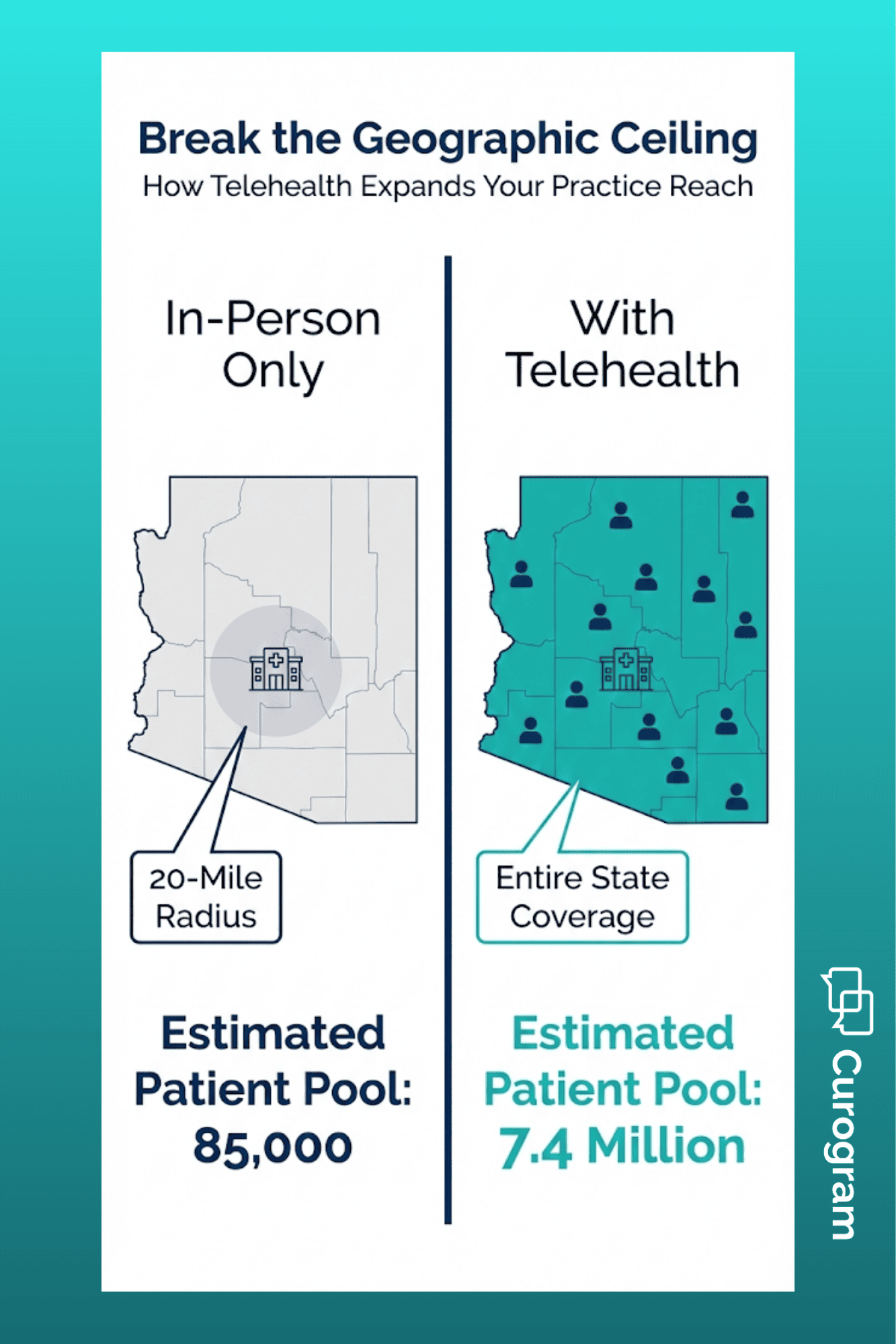
Most integrative and functional medicine practices draw patients from within a 20-mile radius. Beyond that, the drive becomes a barrier.

Patients who live 45 minutes away may book an appointment, but life gets in the way. A long commute makes it easy to cancel when something comes up.

Think about what this means for your patient pool. If you're in a smaller city or suburban area, your reach might include just 50,000 to 100,000 people. That's your ceiling. No matter how great your care is, you can only grow as fast as local demand allows.

This is a real problem for functional medicine business scaling. Your niche expertise may be in high demand across the state, but if patients can't get to you, they'll look elsewhere.

The "Travel Friction" No-Show

No-shows are expensive. In integrative care, a single missed visit can cost between $300 and $500 in lost revenue. For practices that rely on high-value follow-ups, even a few empty slots each week add up fast.

Travel friction is one of the biggest reasons patients cancel at the last minute. A patient with chronic fatigue syndrome may feel fine when they book an appointment two weeks out.

On the day of the visit, they feel wiped out. A 45-minute drive feels impossible. So they call and cancel.

This pattern repeats often. Patients with complex health issues are the most likely to experience flare-ups that make travel hard.

These are the same patients who need your care the most. And they're the ones you lose to last-minute cancellations. When you rely on in-person visits alone, you have no safety net. That empty slot stays empty.

The High Overhead Trap

Physical exam rooms are expensive. Rent, utilities, and upkeep all cut into your margins. The more rooms you have, the higher your fixed costs.

Here's the trap: to see more patients, you need more rooms. But more rooms mean more rent. Your revenue goes up, but so do your costs. The ratio stays stuck.

This is why so many practices hit a growth wall. They can't afford to expand their space. And without more space, they can't grow their patient volume.

The in-person model also limits how many providers you can bring on. Each new provider needs a room. If you're out of space, you're out of options.

Breaking the Ceiling with Virtual Care

Telehealth removes these limits. When you can see patients from anywhere in your licensed states, your radius goes from 20 miles to 200 or more. A functional medicine specialist in Phoenix can treat patients in Tucson, Flagstaff, or Yuma without anyone leaving home.

This opens up real opportunities for specialty practice revenue growth. You can market your services to a much wider audience. Patients who search for "best SIBO specialist in the state" can find you and actually become your patients, not just website visitors.

Virtual care also protects you from travel-related no-shows. When patients can join from their couch, they're far more likely to keep their appointments. This reduces no-show rates and keeps your revenue steady.

Finally, telehealth lowers your overhead. You can see more patients without adding exam rooms. Each virtual visit uses no physical space. Your rent-to-revenue ratio improves with every video call.

The geographic ceiling is real. But it's not permanent. With the right tools, you can break through it and build a practice that grows on your terms.

Turning Telehealth into a Revenue Engine

Telehealth is more than a backup plan for bad weather days. When used right, it becomes a core revenue driver for your practice. The key is to shift your mindset from "virtual as a last resort" to "virtual as a growth strategy."

Capturing the "Last Minute" Cancellation

It's 9 AM. Your front desk gets a call. A patient scheduled for 10:30 needs to cancel. In a traditional practice, that's a lost slot. The revenue is gone.

With Curogram, your staff can flip that situation in seconds. Instead of canceling, they offer a virtual visit. The patient clicks a link, joins from their phone, and the appointment happens. You keep the revenue.

This approach works because most cancellations aren't about the visit itself. Patients still want to see you. They just can't make the drive. When you remove the travel barrier, you save the appointment.

Over time, this adds up. If you recover even three or four lost slots per week, you're looking at $1,000 to $2,000 in protected revenue every week. That's more than $50,000 per year in visits that would have vanished.

Optimized High-Margin Follow-ups

Not every visit requires a physical exam. Lab reviews, supplement check-ins, and progress updates are perfect for virtual care. These visits are often short but carry high value. They also represent some of the most profitable appointments in integrative medicine.

By shifting these follow-ups to video, you can see more patients in less time. A 15-minute lab review takes the same amount of clinical effort whether you do it in person or online. But when done virtually, you cut out room turnover time, patient check-in delays, and travel buffer.

This means higher daily patient throughput without adding hours to your day. You can stack virtual visits back-to-back more easily than in-person ones. The result is better use of your time and stronger margins on each visit.

This is a key part of telehealth profitability. The visits that generate the most profit per minute are often the ones that don't need a stethoscope.

Lowering Patient Acquisition Cost (PAC)

Every new patient costs money to acquire. Marketing, referrals, and outreach all add up. When your reach is limited to a small local area, you compete for the same patients as every other practice nearby.

Telehealth changes this math. When you can treat patients across your state, you can market your niche expertise to a much larger audience. Instead of "best functional medicine doctor in Springfield," you become "best functional medicine doctor in Illinois."

This shift lowers your cost per lead. You're not fighting for local attention. You're attracting patients who search for your specific skills, no matter where they live.

For example, if you specialize in SIBO treatment, you can target that keyword statewide. Patients who find you online can become real patients, not just phone inquiries that go nowhere because they live too far away.

The result is better marketing ROI. You spend less to attract each new patient because your pool of potential patients is so much larger.

Building a Scalable Model

When you combine these three strategies, you create a business model that scales. You recover lost revenue, increase throughput on high-margin visits, and lower the cost of growth.

This is the core of virtual care ROI for doctors who run boutique or integrative practices. You're not just adding a feature. You're building a revenue engine that works even when your exam rooms are full.

The practices that thrive in the next decade will be the ones that master this balance. Telehealth isn't replacing in-person care. It's amplifying what you already do well.

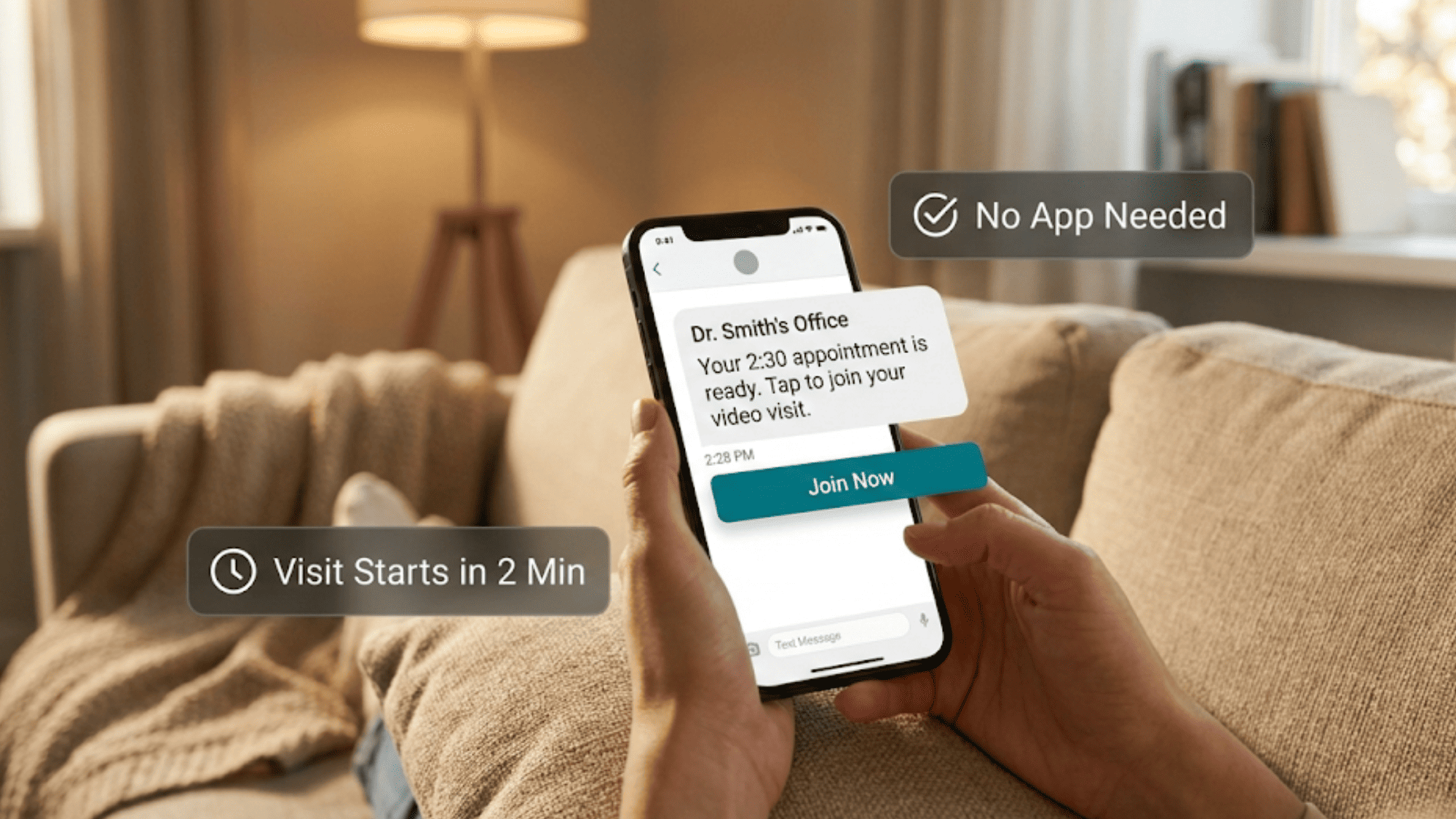
Patient receiving one-click telehealth video visit link via text message on phone

The Profitability of "Frictionless" Tech

Technology can either save you time or steal it. The wrong telehealth platform turns every video visit into a mini tech support session. The right one makes virtual care feel as easy as sending a text.

This is where the real profits hide. Not just in what telehealth lets you do, but in what it lets you stop doing.

Zero Technical Overhead

Think about how many telehealth visits get derailed by tech issues. The patient can't find the app. The link doesn't work. The video won't load. Your staff spends 10 to 15 minutes on the phone walking someone through a download process.

That time adds up fast. If your medical assistant spends an average of 12 minutes troubleshooting each virtual visit, and you do 10 virtual visits a day, that's two full hours lost. Every day. To tech support.

Curogram eliminates this problem with one-click SMS video links. There's no app to download. No login to remember. The patient gets a text, taps the link, and joins the visit. It works on any smartphone or computer.

This design choice has a direct impact on your bottom line. Visits start on time. Staff spend their energy on patient care, not IT help. And patients don't associate your practice with frustration.

When you reduce no-show rates by making the experience easy, you also reduce the hidden costs of rescheduling, follow-up calls, and empty slots.

Staff Recovery ROI

Here's a number most practices don't track: how much time staff spend on non-clinical tasks related to virtual care. That includes login help, reminder calls about how to join, and troubleshooting during the visit.

When you use a frictionless platform, you recover that time. A single medical assistant can support a much larger panel of patients because they're not stuck on the phone fixing tech problems.

Let's put some numbers to this:

Say, your MA earns $20 per hour. If they save 90 minutes per day on tech support, that's $30 per day in recovered labor. Over a year, that's more than $7,500 in productivity you get back.

But the real value is in what they can do instead. With that time, your MA can prepare charts, manage pre-visit forms, or follow up with patients who missed appointments. These tasks drive revenue directly. Tech support does not.

This is a core part of Cerbo EMR ROI for telehealth. When your tools work together smoothly, your team works smarter. When they don't, everyone pays the price.

Increasing "Lifetime Value" (LTV)

Patient retention is one of the most overlooked drivers of practice revenue. It costs five to seven times more to acquire a new patient than to keep an existing one. Every time a patient drops off mid-treatment, you lose months or years of potential visits.

Integrative care often involves long-term protocols. A 12-month gut healing plan. A hormone balance program. A thyroid support regimen. These plans only work if patients stick with them. And patients only stick if the process is easy.

Virtual care removes one of the biggest barriers to long-term commitment: the burden of showing up. When patients can do their monthly check-ins from home, they're far more likely to complete the full plan.

This increases lifetime value in two ways. First, you see more visits per patient. Second, you get better outcomes, which leads to referrals and positive reviews.

Consider a patient on a six-month SIBO protocol. Each month, they have a 15-minute virtual check-in to review symptoms, adjust supplements, and answer questions.

If those visits required a 40-minute drive each way, many patients would skip a few. With virtual care, they rarely miss.

The result is stronger adherence, better results, and longer patient relationships. That's how you build a practice that grows year over year.

Real Numbers: A Sample ROI Calculation

Let's walk through a simple example to show how these factors combine.

Assume your practice does 200 visits per month:

Of those, 30% are follow-ups that could be done virtually. That's 60 visits.

Before telehealth, you had a 15% no-show rate on in-person visits. With virtual care, that drops to 5%. On those 60 visits, you go from 9 no-shows to 3 no-shows. That's 6 recovered visits per month.

If each visit brings in $250 in revenue, that's $1,500 per month in recovered income. Over a year, that's $18,000 just from reducing no-shows on follow-ups.

Now, add the staff time savings. If your MA saves 60 minutes per day on tech support, that's 20 hours per month. At $20 per hour, that's $400 per month. Over a year, another $4,800.

Now, factor in patient retention. If just two patients per month stay in care longer because virtual visits are easier, and each patient is worth $1,000 per year, that's $24,000 in added lifetime value.

Total annual ROI from frictionless telehealth: $18,000 + $4,800 + $24,000 = $46,800


That's before you count the new patients you can attract from outside your local area.

Side-by-side comparison of patient pool size with and without virtual care

The Hidden Costs of Bad Tech

Not all telehealth platforms deliver these results. Some create more problems than they solve.

Clunky systems frustrate patients. They leave bad reviews. They tell friends that your practice is hard to work with. These ripple effects can cost you far more than the visits themselves.

The wrong tech also burns out staff. When your front desk spends all day on tech support, morale drops. Turnover goes up. And hiring replacements costs thousands. This is why platform choice matters so much.

The cheapest option is rarely the best value. What you want is a system that works without drama, integrates with your EMR, and lets your team focus on care. When you get that right, telehealth becomes a profit center, not a headache.

You can also use our calculator to see how much revenue you're losing to no-shows—and how much you could recover with the right system.


Scale Your Clinical Expertise Beyond the Office

Your training took years. Your skills are rare. But if your practice only serves patients who can drive to your door, you're leaving impact and income on the table.

Virtual care lets you scale your expertise without scaling your overhead. You can see patients in rural areas who have no local access to integrative medicine.

You can treat busy professionals who can't take half a day off for a doctor visit. You can serve chronic illness patients who struggle to leave home.

Each of these groups represents untapped demand. And with telehealth, you can meet them where they are.

This is what functional medicine business scaling looks like in practice. It's not about opening more locations. It's about using technology to extend your reach while keeping your costs flat.

The best part? Your patients get better care. When access is easy, they show up more often. They follow their protocols. They get results. And they tell others.

Word of mouth is still the most powerful marketing in healthcare. When you make care convenient, you earn more referrals. And those referrals can come from anywhere in your licensed states, not just your neighborhood.

If you've been thinking about telehealth as a "nice to have," it's time to rethink. For practices built on specialized expertise, virtual care is the lever that unlocks real growth.


Why Curogram Makes Telehealth Work for Cerbo Practices


Curogram is built for practices that need telehealth to work without friction. Unlike platforms that require patients to download apps or create accounts, Curogram uses a simple SMS link. The patient taps, the video opens, and the visit begins.

This design matters for Cerbo practices. When your EMR already holds your patient data, you need a telehealth tool that fits into that workflow.

Curogram integrates directly with Cerbo, so appointment details, patient contacts, and visit notes stay connected. There's no double entry.

The result is a streamlined process that your staff can learn in minutes. Training takes about 10 minutes, not days. That means faster adoption and fewer headaches during the rollout.

For integrative and functional medicine clinics, Curogram also supports the high-touch communication style your patients expect.

You can send reminders, confirmations, and follow-up messages via text. You can offer virtual visits as easily as in-person ones. And you can keep your patient relationships strong, no matter how far away they live.

Practices using Curogram with Cerbo report stronger show rates on virtual visits and easier conversion of last-minute cancellations. These results directly improve revenue and reduce the stress of empty slots.

If you're evaluating telehealth platforms, look for three things: ease of use, EMR integration, and HIPAA compliance. Curogram delivers all three.

Your patients deserve care that fits their lives. Curogram makes that possible without adding complexity to yours. It's the kind of tool that pays for itself by protecting the revenue you've already earned and opening doors to the revenue you haven't reached yet.

Conclusion

Telehealth is no longer optional for practices that want to grow. It's the bridge between your expertise and the patients who need it, no matter where they live.

For Cerbo practices, the Cerbo EMR ROI for telehealth comes down to three things. First, you protect revenue by reducing no-shows and capturing last-minute cancellations.

Second, you expand your reach beyond your local radius. Third, you lower overhead by shifting high-margin visits to virtual care.

These gains are real and measurable. Practices that embrace virtual care see stronger patient retention, better protocol adherence, and higher lifetime value per patient.

The key is choosing tools that work without friction. Curogram's one-click video visits remove the tech barriers that frustrate patients and drain staff time. When the system works smoothly, everyone benefits.

If you've been treating telehealth as a side feature, it's time to rethink. Virtual care isn't a backup plan. It's a growth engine.

The practices that thrive in the coming years will be the ones that scale their expertise without scaling their costs. Telehealth makes that possible. And when paired with Cerbo's workflow tools, it becomes a seamless part of how you deliver care.

You built your practice on specialized knowledge. Now it's time to share that knowledge with more people in more places.

Take the step that turns potential into profit. Schedule a quick demo today to see how many lost slots your practice can recover with Curogram's telehealth platform.


Frequently Asked Questions

Is telehealth reimbursable for integrative care?
Yes, many private payers and Medicare now reimburse virtual visits at the same rate as in-person care. This shift accelerated in recent years and has held steady. For cash-pay practices, telehealth is often viewed as a premium service that patients are happy to pay for.
Does this help with supplement sales?
Absolutely. One of the hidden benefits of virtual care is the screen-share feature. During a video visit, you can pull up a patient's lab results side by side with their supplement protocol. You can walk them through exactly what to take, when, and why.
How do we track the financial impact?

Start by tracking your no-show rate before and after adding Curogram telehealth. Pull reports by appointment type to see how virtual visits compare to in-person ones. Next, look at patient zip codes. If you're seeing more patients from outside your usual radius, that's a sign your reach is expanding. This is a direct measure of geographic growth.

How can integrative practices use telehealth to attract out-of-state or distant patients?

By marketing specialized expertise online and offering virtual consultations, you reach patients beyond your local area. Patients searching for niche treatments can find you, book online, and receive care without driving hours to your office.

How does telehealth integration with Cerbo EMR improve daily workflow efficiency?

Curogram syncs directly with Cerbo, so patient data and appointments stay connected. Staff don't need to enter information twice. This saves time, reduces errors, and lets your team focus on care instead of admin tasks.


Telehealth for Cerbo: Scaling High-Touch Integrative Care Digitally

Telehealth for Cerbo: Scaling High-Touch Integrative Care Digitally

💡 Telehealth for Cerbo through Curogram helps integrative and functional medicine practices grow their reach with ease. Send secure video visit...
Read More
Streamlining the Elation Health Telehealth Workflow for Clinical Staff

Streamlining the Elation Health Telehealth Workflow for Clinical Staff

💡 Independent clinics can boost Elation Health telehealth workflow efficiency by using an app-free, SMS-based video solution.When you integrate...

Read More
Telehealth in DrChrono with Curogram

Telehealth in DrChrono with Curogram

💡 Telehealth in DrChrono gives small clinics a secure way to reach patients where they are. With telehealth integrated into workflows, you can: ...

Read More