

9 min read
Automated Google Reviews for Cerbo Integrative Medicine Practices
Jo Galvez
:
August 5, 2026
A visit marked complete on the Cerbo schedule triggers a text, and the patient taps twice to post. One multi-location practice using Curogram collected 1,064 new 5-star reviews in three months. Of the patients who replied, 90% left five stars, based on our internal data.
Volume and freshness both matter. In BrightLocal’s 2026 survey, 47% of people said they will not use a business with fewer than 20 reviews. Another 74% weigh only reviews from the last three months. Automated review requests keep both of those numbers on your side without adding a task at the front desk.
Most integrative practices sit below the review count patients now treat as a floor. BrightLocal’s 2026 survey puts that floor at 20: 47% of consumers will not use a business with fewer, and only 9% will consider one with five or fewer. Plenty of excellent Cerbo clinics have 11.
That gap has nothing to do with clinical quality. Cerbo handles the clinical side well, with Chart Parts, structured lab results from Genova and Rupa, supplement protocols, and membership billing.
Review generation was never in its scope, and no charting system is going to fix local SEO for integrative medicine on its own.
The arithmetic runs against you every month anyway. A patient finishes a 75-minute intake, walks out with a protocol that finally explains a decade of fatigue, means to write something kind, and forgets by Thursday. The one patient who disputed a $250 late-cancel fee does not forget. She writes four paragraphs.
Our claim here is narrow and testable. The reviews your care has already earned aren’t missing because patients are unwilling to write them.
They’re missing because nobody asked while the patient still had the feeling, and asking by hand doesn’t survive a full schedule.
Automation solves it because the ask stops depending on anyone remembering. Post-visit review request texting fires off the completed appointment in Cerbo’s schedule, which is the one event in your day that already happens reliably.
Front desk staff keep doing check-out. The request goes out on its own, worded so it carries no clinical detail, and the patient answers it from the parking lot.
The Villain: The Invisible Practice
Every practice keeps two records of its work. One is the chart. The other is whatever Google shows a stranger who searched “functional medicine near me.” Only one of the two gets maintained.
Cerbo covers the chart, not the profile
Cerbo, built by MD HQ, does what a clinical system for this specialty should do. Charting templates live inside it. So do lab results from Genova, Vibrant, and Rupa, supplement dispensing with stock counts, member and non-member fee schedules, portal messaging, and reminders by text and email.
Reputation tooling doesn’t. That isn’t a defect. Software sold to more than 5,000 clinicians for chart work has no reason to ship a Google Business Profile tool.
The consequence still lands on you. Google review automation sits outside Cerbo EHR, so someone in the clinic has to own it. In a five-person practice, that someone is usually nobody. Ranking wasn’t covered in residency, and it isn’t covered by your EHR either.
The asymmetry compounds every month
Two kinds of patients write reviews without being asked: the delighted and the annoyed. Everyone in the wide middle means to and doesn’t.
BrightLocal found that 60% of people wrote about a good experience in the past year, against 29% who wrote about a bad one. Good reviews go to the businesses that ask. Of the people asked for a review last year, 83% wrote one.
Skip the ask and your profile fills with outliers. The billing dispute over a superbill that a patient thought was an insurance claim.
The person who arrived at the wrong location. Each one sits on the page next to a patient whose Hashimoto’s finally got worked up properly.
What thin review counts cost a cash-pay practice
Cash-pay changes the stakes. A first visit at $300 to $500 with no insurance network feeding you referrals means the Google Business Profile is the shopfront.
Based on our internal research, 90% of new-patient leads see that profile before they ever reach your website.
|
What patients require |
Share of consumers |
|---|---|
|
Won’t use a business with fewer than 20 reviews |
47% |
|
Willing to use a business with 5 or fewer reviews |
9% |
|
Will only choose 4.5 stars or higher |
31% |
|
Will only choose 4 stars or higher |
68% |
|
Care only about reviews from the last 3 months |
74% |
Source: BrightLocal Local Consumer Review Survey, 2026.
Read the 4.5-star line twice. That share was 17% a year earlier. Expectations moved faster than most practices adjusted.
Old reviews stop counting
Volume alone won’t hold a profile up. Buyers now discount anything stale. Only the last three months count for 74% of them, and 32% look for reviews from the past two weeks, up from 20% a year ago.
Sixty solid reviews, all posted in 2023, read like a practice that closed. A steady trickle of four or five a week reads like a practice with a full schedule.
Recency has gotten sharper for a second reason. People now check an average of six review sites. Google’s share as a discovery source fell from 83% to 71% in a year, while use of AI tools for local recommendations climbed from 6% to 45%.
AI summaries lean on what’s recent and consistent, so a dormant profile gets quoted less often by the tools patients increasingly ask first.

The Guide: The Quiet Advocate
Closing this gap doesn’t call for a marketing hire. It calls for one trigger and one link.
The trigger is the visit status, not a person
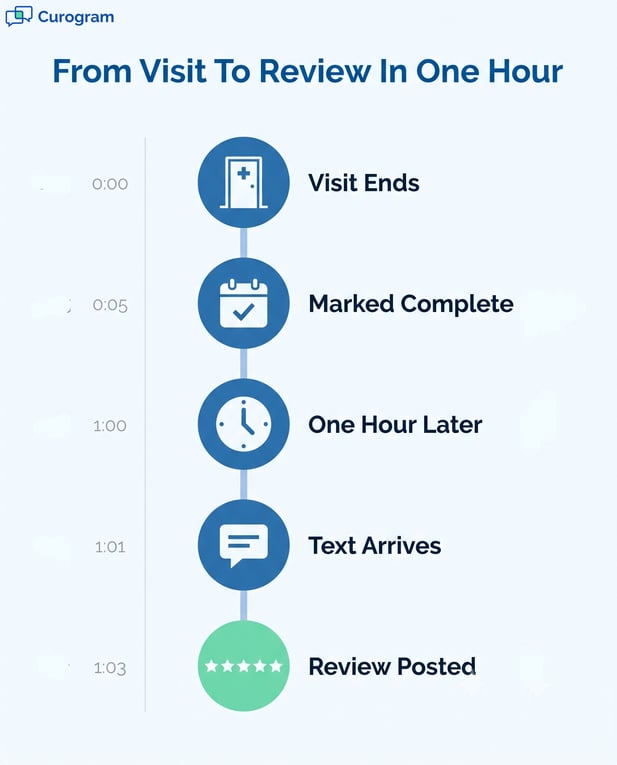
Curogram reads appointment data from Cerbo, and a visit marked complete is the event that fires the request. Data flows one direction, from the EHR into Curogram, so nothing writes back into the chart. No CSV exports, no weekly list pull, no reminder note taped to the check-out monitor.
Timing is a setting you control. Most practices send between 60 and 120 minutes after check-out, late enough that the patient has left, early enough that the visit still feels present.
Same-day sending matters more than it sounds. A patient who replies today leaves a review dated today, which is the exact window buyers check.
Practices already running HIPAA-compliant texting for Cerbo patients can turn requests on inside the same number and the same inbox.
What the text actually says
Keep it short and free of clinical detail. A working version runs under 160 characters:
|
Hi Dana, thanks for coming in today. If we did right by you, would you leave us a quick review? [link] Reply STOP to opt out. |
No provider name tied to a specialty, no service, no diagnosis, no appointment type. Written this way, a review request carries no PHI.
That is the point of post-visit review request texting built for clinics, rather than a generic marketing tool bolted on.
Two taps follow: open the link, land on the Google review form with the patient already signed in on their phone. Each extra step between the text and that form drops a share of patients partway through.
Where unhappy feedback goes, and where it can’t be sent
Every patient gets the same message and the same link. A patient who taps a low rating first gets a private reply path to the practice, which is where most complaints belong and where most can be fixed.
What the link never does is disappear based on sentiment. Filtering patients by rating before showing them Google is review gating, and it violates Google’s policies.
It also runs into the FTC’s rule on consumer reviews, effective October 21, 2024, which carries civil penalties of up to $51,744 per violation. Any vendor promising to keep bad reviews off your profile is selling you a compliance problem with a marketing label.
The honest version works better anyway. Complaints reaching you privately within an hour are complaints you can still resolve.
Why research-driven patients read harder
Patients seeking root-cause care research the way they research a supplement protocol. They’re paying cash, they’ve been dismissed before, and they read until the story holds together.
The factor people weigh most is whether a review is backed by others saying similar things, at 56%. That’s a volume problem dressed as a trust problem. Reputation management for a functional medicine practice is mostly this: give those readers enough recent voices to spot a pattern in.
Practices that get more patient reviews in DPC and concierge settings tend to be the ones that stopped treating the ask as a favor and started treating it as part of check-out.
The Success: The Found Practice
Numbers first, then the mechanics behind them.
What 90 days produced
One multi-location practice turned on Curogram’s automated requests and collected 1,064 new 5-star reviews in three months. Of the patients who replied, 90% left five stars, based on our internal data.
Break that down and it stops looking dramatic. Roughly 355 reviews a month. About 12 a day across the group. Nobody was hired to do it, and no staff member sent a single request by hand.
Left running, the total keeps stacking. That same group’s review count moved from 993 to more than 8,159 across the full engagement, based on our internal data. Each of those entries came off a visit the practice was already completing.
The 90% figure deserves a note, because it isn’t a filtering trick. When you ask every patient instead of only the ones who seem pleased, the average patient turns out to be pleased. Practices are usually surprised by this.
Running the same math on your own schedule
Take a two-provider Cerbo practice completing about 170 visits a month. The following is illustrative, not a promise:
|
Month |
Completed visits |
New reviews at a 20% response rate |
Running total |
|---|---|---|---|
|
1 |
170 |
34 |
34 |
|
2 |
170 |
34 |
68 |
|
3 |
170 |
34 |
102 |
Illustrative figures for planning only.
Three things fall out of that table. You clear the 20-review threshold inside week three, not next year. Your newest review is never older than a day or two, so the 74% who only count the last quarter always have something to count.
And by month three you have enough entries for the consistency signal to form, because one glowing review persuades nobody.
Response rates vary by panel. DPC and concierge members, who already text their clinic, tend to run higher than a med spa’s walk-in traffic.
What moves after the profile fills
Star average rises before volume does, since new reviews outweigh a two-year-old complaint. Then the search side moves, because a profile collecting fresh five-star reviews weekly is the profile Google has reason to rank locally.
Inquiries change character too. After reading good reviews, 54% of people go to the business website next, and they arrive half sold. Front desk calls shift from explaining what functional medicine is toward booking a slot.
The input to all of it is completed visits, which is why the other automations compound here. Automated appointment reminders raise the completed-visit count.
Patients brought back through mass texting campaigns become completed visits too. Every recovered appointment is another request that would never have fired.
The part that still needs a person
Sending automates cleanly. Answering does not, and practices lose ground here more often than anywhere else in the workflow.
A reply is expected by 89% of reviewers. Within a week for 81% of them, and the same day for 19%. Copy-paste replies backfire: 50% of people say a canned response makes them less likely to pick the business.
Budget 20 minutes twice a week for a staff member to answer new reviews in their own words, keeping replies free of any clinical detail.
Thanking a patient by first name, without confirming they were seen for anything in particular, stays inside HIPAA and reads as a human wrote it. Rotate who writes them if one person’s phrasing starts repeating.
Curogram Highlight: Automated Review Requests
Automated Review Requests is the piece that turns a completed Cerbo appointment into a review on your Google Business Profile.
Curogram reads appointment status from Cerbo, waits the delay you set, and texts the patient a request with a direct link. Staff send nothing.
Everything runs on the number your practice already texts from, so patients see one sender rather than a marketing tool they don’t recognize.
Feedback from patients who rate you poorly routes to a practice inbox instead of sitting unanswered, and your team sees new reviews and sentiment on one dashboard.
Compliance is built in. Curogram is HIPAA compliant and SOC 2 Type II certified, works under a signed BAA, and keeps request messages free of PHI.
Every patient with a completed visit gets one, with no filtering by rating, which keeps the workflow inside Google’s policies and the FTC rule.
Curogram complements Cerbo and never replaces it. Your charts, protocols, lab results, and billing stay exactly where they are.
Curogram adds the layer Cerbo was never built to cover: the public record of your work, refreshed each time you finish a visit.
Practices already using Curogram for texting, reminders, forms, or text-to-pay can switch requests on inside the same account. For Cerbo practice marketing, reviews cost nothing per new patient once setup is done. Paid search terms in this specialty do not.
Conclusion
Your Google profile is a lagging indicator of a decision nobody in the clinic made on purpose. Reviews stopped coming because asking got skipped on the busy days, and every day is a busy day.
Two facts sit next to each other. Nearly everyone reads reviews before picking a local clinic, and 83% of people who get asked for one write it. The gap between those numbers is the whole opening, and a trigger closes it.
For a cash-pay practice, this is the cheapest marketing you own. No ad spend, no agency retainer, no content calendar. Just the visits you already finish, turned into the proof a stranger wants before booking a $400 first visit with a clinic she found on her phone.
Practices pulling ahead in local search have the same clinical training you do and a profile that reflects it.
Book Your Cerbo Integration Demo to see how requests fire off completed Cerbo appointments, and what a practice earning 1,000 reviews in 90 days actually has switched on.
Frequently Asked Questions
Requests go to every patient with a completed visit, with no rating-based filtering, which avoids review gating. Messages carry no clinical detail or PHI, and the workflow operates under a signed BAA.
Most upset patients want a response, not an audience. A private reply path reaching your team within the hour lets you resolve a billing or scheduling problem before frustration hardens into a public post.
Sending takes none, since requests fire off appointment status in Cerbo. Plan roughly 40 minutes a week for a team member to write personal replies to new reviews, which consumers notice and reward.
Consumers discount stale feedback heavily: 74% weigh only the last three months. A practice with 200 reviews last updated in 2023 reads as inactive, while steady weekly arrivals signal a full schedule.
Between 60 and 120 minutes after check-out works best for most practices. The patient has left the building, the visit still feels present, and the review lands dated the same day.