
Automated Google Review Requests for Azalea Health
 Jo Galvez : Jun 25, 2026, 9:00:00 AM
In a small town, your Google rating is your front door. See how Curogram automates review requests for Azalea Health practices.

It is the end of a long visit. Your front desk staffer knows the practice needs more reviews. The right move is to ask the patient, out loud, right now. But the lobby is full, the phone is ringing, and the words just do not come.
This scene plays out at busy practices every single day. Asking face-to-face feels pushy, so most staff skip it. When the ask leans on memory, it happens at random. A strong month follows a slow one, with no clear reason why.
Reviews are not a vanity score. They are how new patients judge you online. A thin or stale review page sends them to the next name on the list. So a missed ask is often a missed patient.
There is a name for this pattern. We call it The Awkward Ask. It is well meant but never steady. And it quietly holds your online rating below the real quality of your care.
The fix is not a pep talk or a sticky note. It is a system that asks for you. With the right setup, you can stop asking patients for reviews manually for good. The request goes out the same way, after every visit.
That is where Curogram meets Azalea Health. Azalea Health runs your schedule and your charts. Curogram watches for each finished visit and sends a friendly text. The patient taps once and leaves a review on their own time.
This guide breaks down the whole shift. You will see why the manual ask keeps failing your team. You will see how a simple post-visit review automation takes its place. And you will see what changes when reviews grow without the front-desk ask.
Every review strategy needs a trigger. Without one, getting reviews falls on staff asking patients in person. Most people find that task hard. So it gets done less and less, until it barely happens at all.
The problem is not your team. The problem is the design. You are asking busy people to do an awkward thing, again and again, with no backup.
In short, the manual front-desk review workflow leans on memory. And memory fails first when the lobby is full. On a packed day, the ask is the first task to drop.
No one trained for this part of the job. They trained to care for patients, not to pitch them. So a public ask can feel like a sales move they never signed up for.
That discomfort is normal and human. It is also a weak base for growth. A goal that depends on someone feeling brave will never hold steady.
Think about what real consistency would take. The same staffer, in the same mood, with the same energy, after every visit. That bar is impossible to keep. So the gap between intent and action only grows.
Picture a two-person front desk at noon. Phones ring, the waiting room fills, and a line forms at checkout. In that rush, no one stops to ask for a review.
Growth then turns random. It is strong in a month when someone remembers. It is flat in a month when they do not. That swing has nothing to do with your care.
Now stretch that over a year. The good months and the quiet months blur into a flat line. Your review count creeps when it should climb. New patients see a page that looks asleep.
There is also a cost you cannot see. Every skipped ask is a happy patient who stays silent. Those lost reviews never show up in a report. They simply fail to exist.
Here is the hidden cost. When asking is spotty, the only steady reviewers are the highly motivated. Often, that means the upset few.
So your public rating can fall below the care you give. That is not fair to your team. Most admins do not want to nag patients or push staff.
The math is simple and unfair. Happy patients stay quiet, while a few unhappy ones post. The score you show the world drifts from the truth. What you really want is for reviews to happen on their own, fairly, for everyone.
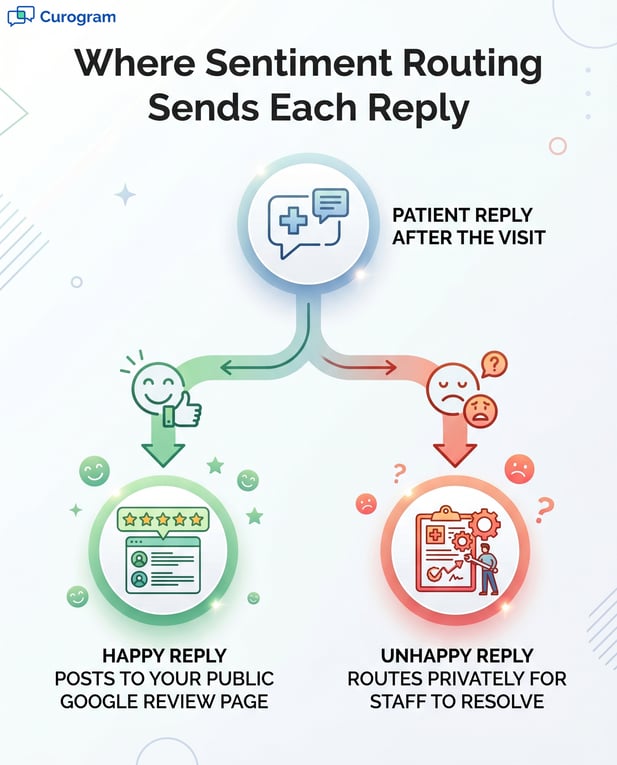
There is a better way to run this. Take the ask off the front desk and let a system handle it. Curogram acts as that system. It asks every patient the same way, with no one standing at the desk.
The idea is simple. Curogram removes the ask from staff and runs it on its own. This is the heart of Azalea Health automated review requests to replace the front desk ask.
It fires off real visits, so the timing is always right. With Curogram, you automate Google review requests for your clinic from one place.
The result is consistent review requests on Azalea Health, visit after visit. You can even pair it with automated appointment reminders and confirmations so the review fires right after the completed visit.
No new habit has to stick. No one has to remember a script. The engine does the asking, every single time, without a nudge.
That steadiness is the whole point. A system that runs on its own beats a person who has to feel brave. It turns a hit-or-miss task into a sure thing.
Staff still matter in this model. They just stop being the trigger. Their energy goes to the patient, not to a script. The engine carries the part that felt awkward.
After each visit, Curogram texts the patient a one-tap link. The patient leaves a review in seconds, on their phone, on their own time. The message is short, warm, and easy to act on.
Sentiment routing adds a smart safety net. If a reply is unhappy, it goes to the staff in private. So the public's ask always stays positive. You catch problems early before they ever post.
Because the request fires off a real visit, the timing takes care of itself. There is no list to work on and no reminder to set. The trigger is the visit you already logged.
For a two-person desk, this hands-off approach is the only one that survives a busy Monday. It also lives beside your texting and reminders, not in a separate tool.
One platform means one less thing to manage. The ask just happens, in the background, while the staff helps the next patient.
Setup is light and lives where you already work. Your team sees the same Curogram inbox they use for texts. There is nothing new to open and little to learn. The review flow rides along with the tools they trust.

So, what does this change mean in real life? The setup is small, but the effect is large. Reviews stop being a chore someone forgets. They become a steady result of the care you already give.
When the ask is automatic, every happy patient gets a fair shot to speak up. The pool of reviewers grows wide, not narrow. Your rating starts to match your real quality.
Day to day, this looks like nothing at all. No one logs in to send requests. No one keeps a list of who to ask. The work simply disappears into the visit you already booked.
This matters because patients shop with reviews. Studies have found that the majority of patients read reviews before they choose a provider. A fuller, fairer review page helps you make that shortlist.
Fairness is the quiet win here. A wide pool of voices balances out the loud few. Your page starts to read like your waiting room, not just its worst day.
The table below shows the shift in plain terms. On the left is the old manual ask. On the right is the engine that runs on its own.
|
The Manual Ask |
The Reputation Engine |
|---|---|
|
Staff ask each patient in person |
Curogram texts a one-tap link |
|
Happens only when someone remembers |
Fires after every finished visit |
|
Random, skipped on busy days |
Steady and the same each time |
|
Adds stress to the front desk |
Runs with no staff effort |
|
Rating skews to the upset few |
Rating reflects your real care |
The numbers back this up. In one multi-location practice, automated post-visit surveys drove 1,064 new 5-star reviews in three months. In that same practice, 90% of patients left 5-star reviews. This reflects Curogram client data from clinical settings.
The shift is clear. You move from The Awkward Ask to an automatic post-visit request. It is steady, fair, and the same for every patient. The growth comes from reach, not from pressure.
This kind of growth also compounds. More fresh reviews can lift your spot in local search. A higher spot brings more eyes, which brings more reviews. The engine starts to feed itself over time.
Best of all, none of this adds work. You get reviews without staff effort, and no one has an awkward chat at the desk. The front desk gets to breathe.
Your team spends that saved attention on care, not on chasing feedback. Reviews grow quietly in the background. The desk remains present for the patient in the room. That is the quiet payoff of letting the engine run.
Owners feel the shift, too. The nagging worry about reviews fades into the background. You stop managing a task and start watching the result. That peace of mind is hard to put a price on.

Let us bring it together. Your staff is not the problem. The manual ask is. It is awkward, easy to skip, and unfair to the care you give.
The fix is a clean split of labor. Azalea Health runs the visit, the schedule, and the chart. Curogram turns each finished visit into a review request on its own. One side asks nothing of your team.
Think of it this way. Azalea Health is built for your schedule. Curogram is built for their feedback. And that feedback gets collected without anyone having to ask out loud.
The result is a quieter, steadier kind of growth. No big campaign, no awkward scripts, no pressure on staff.
Just a fair request after each visit, working on its own. Over months, that adds up to a stronger page.
Picture the change in your week. No more reminders to ask, no more guilt when it slips. The review count climbs on its own, week after week. Your front desk simply does its job.
Want the full picture first? Start with our guide to automated Google review requests for Azalea Health. Then see the patient side in one-tap review requests for Azalea Health patients. Together, they show the whole loop, from visit to review.
This is not a big lift to start. The visit data already lives in Azalea Health. Curogram simply listens for the finished visit and acts. From there, the asking runs without you.
Your reputation is too important to leave to a busy Monday. It should grow on a system, not on luck. The right setup makes that growth the default, not the exception.
The takeaway is short. A steady, fair ask beats a brave one every time. And it grows your reputation without taxing your team.
You do not need to push your front desk any harder. Let the ask run itself, every visit, for every happy patient.
Book your Azalea Health integration demo and watch the post-visit request fire with no staff involvement. It takes about 15 minutes to see it work live.
 Jo Galvez : Jun 25, 2026, 9:00:00 AM
In a small town, your Google rating is your front door. See how Curogram automates review requests for Azalea Health practices.
See how Curogram integrates with Office Ally to automate review requests, filter negative feedback, and boost reputation for small practices.
 Jo Galvez : Jun 30, 2026, 8:00:14 AM
Happy patients will not navigate a login to review you. See how Curogram texts Azalea Health patients a one-tap review link.